gbrooks9
(George Brooks, TE (E.volutionary T.heist OR P.rovidentialist))
1
In 2025, Marcus Ross published a paper offering his theistic assessment of the GAE Hypothesis:
I was disappointed in his approach, but perhaps it was helpful to him to find ways to
distinguish his personal “take” on theories involving Universal Common Ancestors.
The abstract is below, and pretty much is all that is needed to see the ironies in his
analysis:
”Joshua Swamidass’ recent genealogical Adam and Eve (GAE) hypothesis posits that all humans alive by AD 1 could share genealogical ancestry with the biblical Adam, who lived as recently as 6,000 years ago. We evaluate the scientific underpinnings of this hypothesis, including
(1) ancestry studies providing timeframes to universal ancestors,
(2) the choice of AD 1 as a point of universal connection to Adam, and
(3) the deployment of unfalsifiable claims in both the recent GAE’s core and auxiliary propositions.
We find that the recent GAE hypothesis itself has not been specifically modeled or simulated, but rather it anachronistically employs studies of genealogical ancestors among the modern-day population. Necessary adjustments to the parameters of these studies would likely extend any potential date to GAE, as do challenges regarding the applicability of AD 1 and the extreme isolation of native Tasmanians. Both individually and collectively, these issues raise substantial challenges to the recent GAE timeline.”
Ross has done an impressive job explaining many of the scientific limitations for
evaluating just how long it would take to contribute Adam&Eve’s genealogy to
distant populations, including the very isolated one on Tasmania. But he isn’t
critical of the possibilities - - only of the probabilities. In other words, he doesn’t
say it isn’t possible. In fact, it is my impression that he believes the unguided
process, within an ancient context, would take well more than 100,000
years.
But my objection to his objections comes down to just one phrase: a Universal
Common Ancestor is an aspect of a theistic view of Genesis, and being
consistent with a theistic interpretation does not require a string of miracles,
it only requires a well planned series of PROVIDENTIAL marriages and matinigs
when the time and place allows for it.
How do you dismiss a scenario embracing the THEOLOGY of Adam and
Eve by not allowing for God’s providential hand to bring about the point of
having Adam & Eve.
DISCLAIMER: I personally do not endorse the necessity of Original SIn
to make Christianity sensible to the human situation. For more than 1,000
years, millions of Good and Devoted Christians - - in most of the Orthodox
communities - - have been satisfied that God required the burden of sin to
shape the lives and souls of mortals into his desired vessels. But for the
millions of Augustinians alive today, if you are “in for a penny, you are in
for a pound!” My Pilgrim ancestors believed in the Providential events
shaping the future of their devout community. I share this belief!
A recent Adam is still quite problematic. Tasmania is a problem. But you are correct, Christians generally do believe in providential events.
This does not mean that other genealogical proposals face the same scientific challenges. The existence of genetic ghosts among our ancestors is, after all, uncontroversial. Since Adam and Eve may be located among them without fear of scientific falsification, similar propositions that place the GAE deeper in time can be made (and indeed, already have been made).70 Such propositions, if anchored within a timeframe that proves durable against critique, may be serviceable for those who seek to maintain a historical Adam within the context of an evolutionary history of our species. That said, such models will need to contend with various theological issues that arise from their specific claims and interpretations about Genesis, most notably, the thorny questions raised by separating humankind into those who are descended from Adam and those who are not, no matter what point in history is chosen. Debates on these issues are ongoing and will doubtless be points of contention for any future GAE proposal.
$40 seems a little steep especially considering I am not sure I would find anything new in there… anyone have any info on the book?
Zoom meeting from ASA where Loke was present to discuss his work.
Edit: after going through some…man…some of these guys ask terrible questions…a few were good but a quick listen does not make me a fan of ASA based on just this…
Note that Toke identifies as a substance dualist so he adopts a position generally similar to the Catholic one and my now that the soul is supernaturally created by God.
I appreciated Seth’s Hart’s comment about geology and history overlapping in explaining an earthquake and applying that to what we are doing with A&E and science. Nothing is being force fit. It is integrating the understanding provided by overlapping frameworks to create a model that shows how both fields (taken to be accurate) can attempt to give us an even fuller picture of things.
I hesitate to bump a GAE thread just before it’s dead, but I’ll poke my head in long enough to say Marcus Ross is an enigma to me. He’s a YEC who works with Liberty University, but he has a PhD in paleontology and has no problem discussing things that happened far in the past.
Ross, Rohde, Kelleher, Ken Keathley. Oof. I corresponded with all of them as a journalist. There’s a lot of background I could supply, but suffice it to say that Ross’s scientific critique of Swamidass’s specific GAE proposal is on point, even if almost all is borrowed from me uncredited. Swamidass constantly vacillates between scientific evidence and the unfalsifiable de novo creation of Adam & Eve alongside a population of “biological humans.” It’s nonsense, but if one wants to hold onto that nonsense, it has to be much deeper in time than 6,000 years ago.
Edit: Ross mentions William Lane Craig’s proposal of ~650,000 years ago, even though WLC uses genealogy rather than biology as an explanation for how A&E passed down “sin” to their progeny. It’s a category error. He’s equating the origin of humanity with the “fall” of humanity.
My assessment of Adam & Eve (Us Humans) is We are separate from all other animals. The ingredient in Us that’s separate is We have the ability to Pray, if We choose to. The Praying Mantis isn’t Praying, have you seen a Chimpanzee Praying? I see many of Us Praying, including Children.
I’ll take that as an admission that you have no idea whatsoever what a chimp or dolphin praying would look like, and haven’t bothered to look for behaviour in them that might be consistent with them praying, and consequently your claim is worthless.
The key here is the immaterial aspect of our existence. The Christian church has largely believed in the existence of immaterial souls for the past 2,000 years. It has taken on different forms going from a more platonic view to one of hylomorphism. But a distance and immortal aspect of humanity has been considered proper Christian doctrine or belief virtually since it started. A more physical Hebrew understanding present in the BC days was Hellenized. Not corrupted. In light of New information, it evolved into something closer to reality and much more defensible.
The idea is something like this. Two cats make a kitten and everything in the nature of a kitten is ultimately material and stems from its parent’s reproductive act. But this is not the same for humans. Two humans obviously reporoduce like other animals, but a baby does not come from just the parents. God creates immortal souls for each human. That soul is rational and survives death and is properly considered the form or animating principle of what it means to be human. Catholics believe all life has a soul that goes beyond what efficient and material causes acting on meaningless and mindless particles and force fields alone are capable of providing.
There is nothing ad hoc or nonsensical about God choosing to endow a pair or group of humans with souls at some point in time. Under normative Protestant Christianity which mostly does subscribe to the notion of immaterial souls-- at least partially since they believe Jesus (<-- God incarnate) mentioned them. For Catholics, the same applies and under the magisterial authority of the Church and in line with the earliest and the most common ancient Christian tradition on the subject, souls are also accepted. So the notion that God endowed humans with souls at some point happened no matter how you slice it. The question is were the first humans created from the dust in the ground instantly or did God choose to ensoul a pair of animal hominids at some point in time.
A GAE is a wonderful bridge between what we learn from the efficient and material causes in biological science and what we learn from scripture, Church tradition, philosophy, theology. Please note that the former is utterly incapable of completely defining a human or even the intellect adequately. The sheer disdain some have for this is unwarranted. In my mind it stems from post enlightenment thinking and a mind enslaved to physicalism.
If we accept that humans are a mix of material and immaterial substances–which is an extremely viable (and the correct) position-- the GAE is a model that truly honors both our biological descent and what scripture teaches. Ignoring this bridge in favor of physicalism is to ignore that which allows us to contemplate it in the first place. Calling it ad hoc is just completely ignorant.
Of course, if we are willing to jettison whatever parts of scripture we don’t like or think are hard to fit with whatever the current and ever fickle spirit of the age thinks, then none of this matters and we can all invent our own religions.
And if other animals like dolphins can pray and understand universal concepts like triangularity then this does not undercut our model or understanding of human beings (metaphysical – not biological). It simply shows there is more life with a rational soul than we initially thought. Metaphysical “humans” would simply need to be a broader category. Such red herrings don’t really amount to much but they are interesting to consider.
Aside from all the typos (some I fixed). You can take the last word in the other thread. I’m done with that discussion but I’ll read whatever you write.
Yep I agree. And that would be an “if” because as far as I know there are no evidences that animals pray, if I’m not mistaken.
Actually I wanted to read your opinion on a specific point we haven’t addressed yet (it wouldn’t be an historical argument, it would be another kind of argument), because I think that it would be interesting.
There is a point that cannot be stressed enough: all the major Christian denominations have always taught the existence of immaterial souls and their survival to physical death.
Now let’s suppose for a second that a scientific demonstration as strong as evolution managed to demonstrate that consciousness has entirely material origins: the consequences would be absolutely devastating.
And I’m making the comparison with evolution because evolution is not a speculative idea; it is a large-scale explanatory framework supported by convergent evidence from multiple disciplines.
So, in this essay, the phrase “the material origin of consciousness proved as strongly as evolution” means at least four things.
First, it would mean that consciousness is shown to arise wholly from material processes under law-like conditions.
Second, it would mean that every major feature of subjective life (selfhood, memory, moral awareness, mystical states, grief apparitions, conversion experiences, and the sense of transcendence) can totally be explained through neurobiological and evolutionary mechanisms.
Third, it would mean that no explanatory remainder requires positing an immaterial soul.
Fourth, it would mean that attempts to preserve a non-material soul would become scientifically analogous to postulating a special creation of species in the face of evolutionary biology: still logically possible for some believers, but no longer the rational account.
That scenario would not merely show that the brain is involved in consciousness; Christians already grant that. It would show that nothing over and above the material organization of the organism is needed to generate consciousness at all.
Roman Catholicism would face one of the deepest crises: If consciousness were shown to be wholly material, the Catholic doctrine that the spiritual soul is immediately created by God and survives bodily death would be directly refuted. Catholic theology could still attempt to say that the soul is not an empirically detectable explanatory posit but a metaphysical principle of personhood. Yet the more complete the material explanation became, the more that move would look like retreat from explanatory realism into semantic preservation. The Catholic doctrine of the intermediate state, purgatory, and particular judgment in the soul would all be placed under extreme pressure. The church could still defend resurrection by divine miracle, but its traditional anthropology would be badly damaged and every claim of infallible Magisterial teaching would be destroyed.
Orthodoxy would also face major pressure, though the damage would appear less in scholastic metaphysics and more in liturgical and devotional coherence. Prayer for the departed presupposes that the departed remain personally existent in a meaningful sense. If consciousness ceased entirely with the dissolution of the brain, then the rationale for intercession for the dead, the language of repose of the soul, and many assumptions surrounding the communion of saints would be refuted as well. Orthodoxy could preserve resurrection as a future divine act, but its present account of the departed would become impossible to sustain.
Anglican and Methodist traditions would likely prove more adaptable because they are already doctrinally broader and often less committed to a tightly defined metaphysics of the soul. They could respond by shifting emphasis from “an immortal soul” to “the whole person held in the faithfulness of God” and from immediate postmortem consciousness to eschatological resurrection. In these traditions, the discovery would still be serious, but it would likely accelerate trends toward symbolic, relational, and less ontologically dualistic theology rather than producing a single confessional rupture.
Confessional Lutheranism and especially Westminster-style Reformed theology would face a more direct contradiction. These traditions have official doctrinal language that treats soul as more than a biblical metaphor. If consciousness were materially sufficient, then the claim that human beings possess immortal souls would no longer look like a modest theological supplement; it would look like a denial of the best-established account of human consciousness. Theological conservatives in these traditions would likely resist longest, but the doctrinal strain would be impossibile to ignore.
And for Baptists and Pentecostals the immediate impact would fall less on formal metaphysics and more on religious experience. Testimonies of divine presence, visions, near-death experiences, charismatic states, sensed encounters with the dead (and this would actually apply to all encounters with the dead in every possible setting), and dramatic conversions would be reclassified by the surrounding culture as neurobiologically generated states. That would not logically disprove Christianity, but it would destroy a large amount of its popular evidential force. Traditions that rely heavily on experiential immediacy would feel the discovery as a major cultural and apologetic defeat, even where confessional language remained somewhat flexible.
The most important consequences of thus hypothetical discovery would concern the evidential status of religious experience. If consciousness were materially explained as strongly as evolution explains species development, then mystical ecstasy, contemplative union, visions of saints, Marian apparitions, conversion experiences, sensed divine presence, and experiences of contact with the dead would cease to function as prima facie evidence of a transcendent source. They would be treated by default as brain-based events, whether adaptive, pathological, grief-related, socially reinforced, or cognitively constructed.
This would matter enormously because many Christians, even when they claim to base faith on Scripture or revelation, actually rely in practice on the credibility of spiritual experience. A world in which such experiences had been decisively naturalized would not refute God by strict logic, but it would empty an enormous range of Christian experience of its ordinary evidential force.
And, as I argued a few days ago, even the original apostolic testimony would be enormously affected. Not erased, but reinterpreted. The resurrection appearances of Jesus would become easier to classify as bereavement visions, intense altered states, communal expectation effects, scripturally shaped meaning-making, or other forms of cognitively powerful but non-veridical experience. In that sense, the “original testimony” would not disappear, but the epistemic framework in which it is judged would be completely transformed and lose basically all of its evidentiary value. Testimony once taken as revelatory would now be filtered through a well-confirmed model of materially produced visionary consciousness (as every single encounter with the dead through human history in every possible country, tradition and setting would prove to be an illusion internally generated by the brain). This wouldn’t mean that Christians wouldn’t be able to choose to believe that in that specific case the apostles saw something real: but it would definitely mean that the choice to believe that it was real in that specific case would become completely arbitrary and not rationally founded at all. And I’m saying this as someone who would most likely still choose to believe even in the face of such a discovery.
That is a crucial distinction: the discovery would not show that the apostles lied. It would show that their experiences would no longer need a supernatural explanation.
Within this hypothetical one could still affirm the final resurrection, but it would no longer be naturally continuous with an immortal soul. It would have to be treated as a radically divine act of re-creation or reconstitution of the person.
Christian ethics, liturgy, symbolism, and communal identity could also survive. Christianity could remain a way of life, a moral vision, a sacramental or narrative tradition, or a theological interpretation of history, but churches that wished to keep all of their traditional claims intact would face mounting internal incoherence.
Tl;dr: If the material origin of consciousness were demonstrated with evidential force comparable to evolution, the consequences for Christianity would be profound and devastating.
It would be most damaging to traditions that teach a spiritual, immaterial, immortal soul that survives death in a conscious state: Roman Catholicism, Eastern Orthodoxy, Reformed theology, much Lutheranism, and much traditional evangelical Protestantism, and, while the discovery would not, by itself, disprove the existence of God, and it wouldn’t make the resurrection of Christ logically impossible, it would radically refute the traditional Christian doctrine of the soul, deeply undermine the evidential role of religious and postmortem experiences, and prove a major reinterpretation of the evidentiary nature of the apostolic witness.
Which is why it would be a discovery much more devastating, hundreds of thousands many times more devastating (and i’m not being hyperbolic at all) to Christianity and to every form of non materialist thinking than evolution ever was. Hell, it would be like comparing an ICBM with a firecracker.
Ye, it’s not trendy, new, or some pure return to pristine Biblical Hebrew to deny souls. It is to pull out the carpet from underneath Christianity itself which is not compatible with pure materialism anymore than young-earth creationism is compatible with biological evolution or radiometric dating. Hand-wave dismissals of a GAE stem from a worldview duped by physicalism.
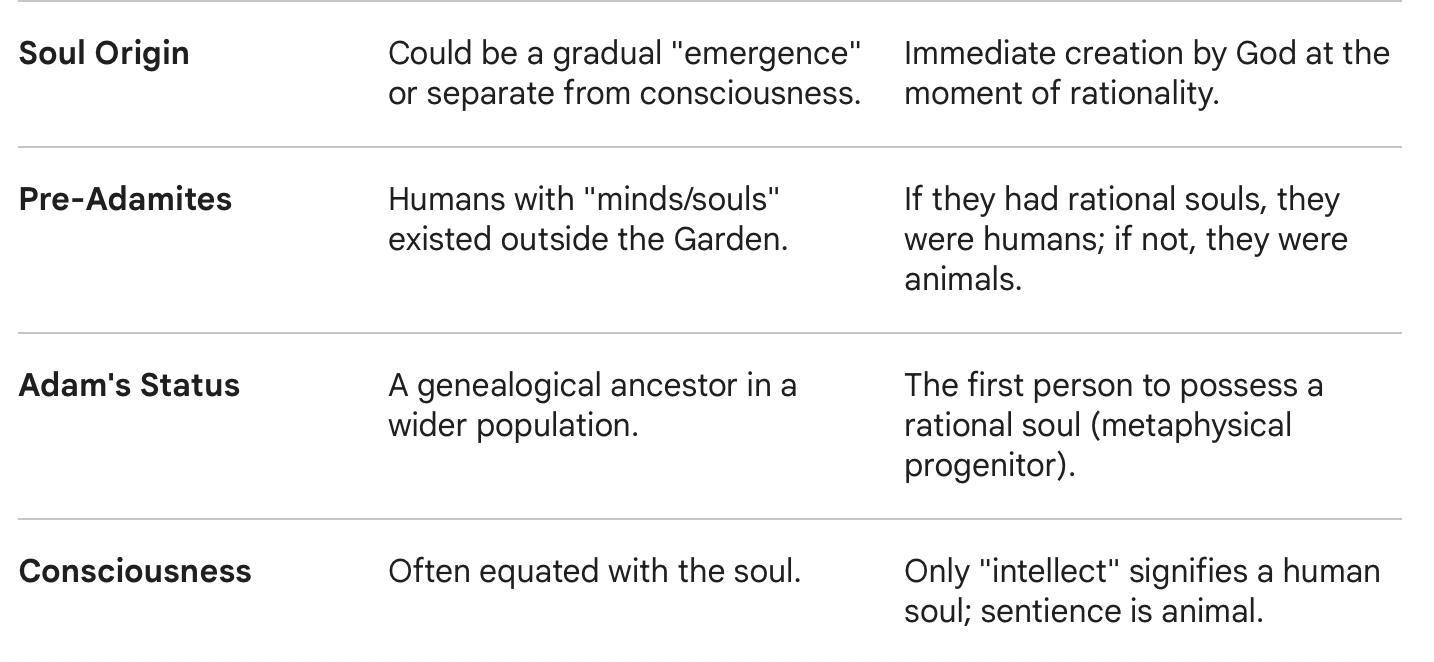
I have never read Swamidass but per comments elsewhere this is where his model fails from my understanding. He thinks there were full metaphysical humans before Adam and Eve and this creates a mess out of original sin (which is a privation stemming to all from being ancestors of A&E). His GAE model isn’t the most robust form because his metaphysics is just sub-optimal. I think this table summarizes the differences:
Swamidass (left) vs Thomistic Hylomorphism (right)
I can verify the right half is correct but not sure if the left is exactly what Swamidass would argue. But if someone really wants to critique the GAE, they should do so with a Catholic model (steel man it). Since the soul is the form of the body, this is a chief characteristic of what it means to be human. If you get this wrong your model will suffer as a result. This is also the best way of explaining original sin which some of us maintain despite it being trendy for revisionist Christians to prematurely dispense with long-standing views of the Church at the first signs of difficulty.
For a Thomist, anything that has complex language and understands abstract concepts like triangularity is a human–regardless of how biologists would classify it (maybe something like: “is this part of the Homo sapiens breeding process”). Thus far, most of us don’t think any other animals actually fit that bill with us at the moment though there are certainly a few that are worth looking into.
That raises an interesting philosophical question some like to talk about. If you make a copy of a person, moving all their bits and pieces to the exact same arrangement elsewhere, are they the same person? What if you found equivalent parts (and made two such copies), are they the same person? The Thomist answer is obviously no.