This came up in bible study this week, as to why God waited until 4 AD for Jesus to be born, and the covenant with Abraham to be fulfilled to include the “many nations,” As is is similar to this question, but different, will make a separate post for that question, so direct any comments there.
1 Like
That is my thought. When you read God’s response to Job, it seems to be the answer to that question.
I just reread it and while it was written for the understanding of the universe of the day, it is still humbling, and perhaps more so in light of what we know of the universe today: Job 38 - Then the LORD spoke to Job out of the storm. He said:
2 Likes
Yeah, apparently unnecessary from the viewpoint of us humans. That does not tell that they were unnecessary from the viewpoint of God or potential alien lifeforms.
What if there are also other worlds with life? When Earth was still a fairly boring place, God may have enjoyed of life elsewhere.
Just speculating…
1 Like
Or to keep the angels humble.
(not that that seems to have worked)
1 Like
But not in terms of beauty and awe. The universe seems designed to stretch beyond our reach.
Amen. The YEC deity is (too) small.
4 Likes
Believe what you like mate, it’s a free country. Including believing that whatever you believe is true, because you believe it based on existential revulsion, fear, and no reasoning is necessary. You have knowledge free knowledge, reason free reason. Brilliant.
Science by definition is wrong. Approximate. Fuzzy. The closer one looks, the fuzzier it gets. Unanswering. And unanswerable. You can rely on it completely. The further one looks, in scale, it gets utterly unknowable. But nonetheless smooth. As at every meaningless scale.
K.I.S.S. works for me.
It doesn’t matter how I feel about it, apart from acceptant. At peace with meaningless death. A tough one admittedly!
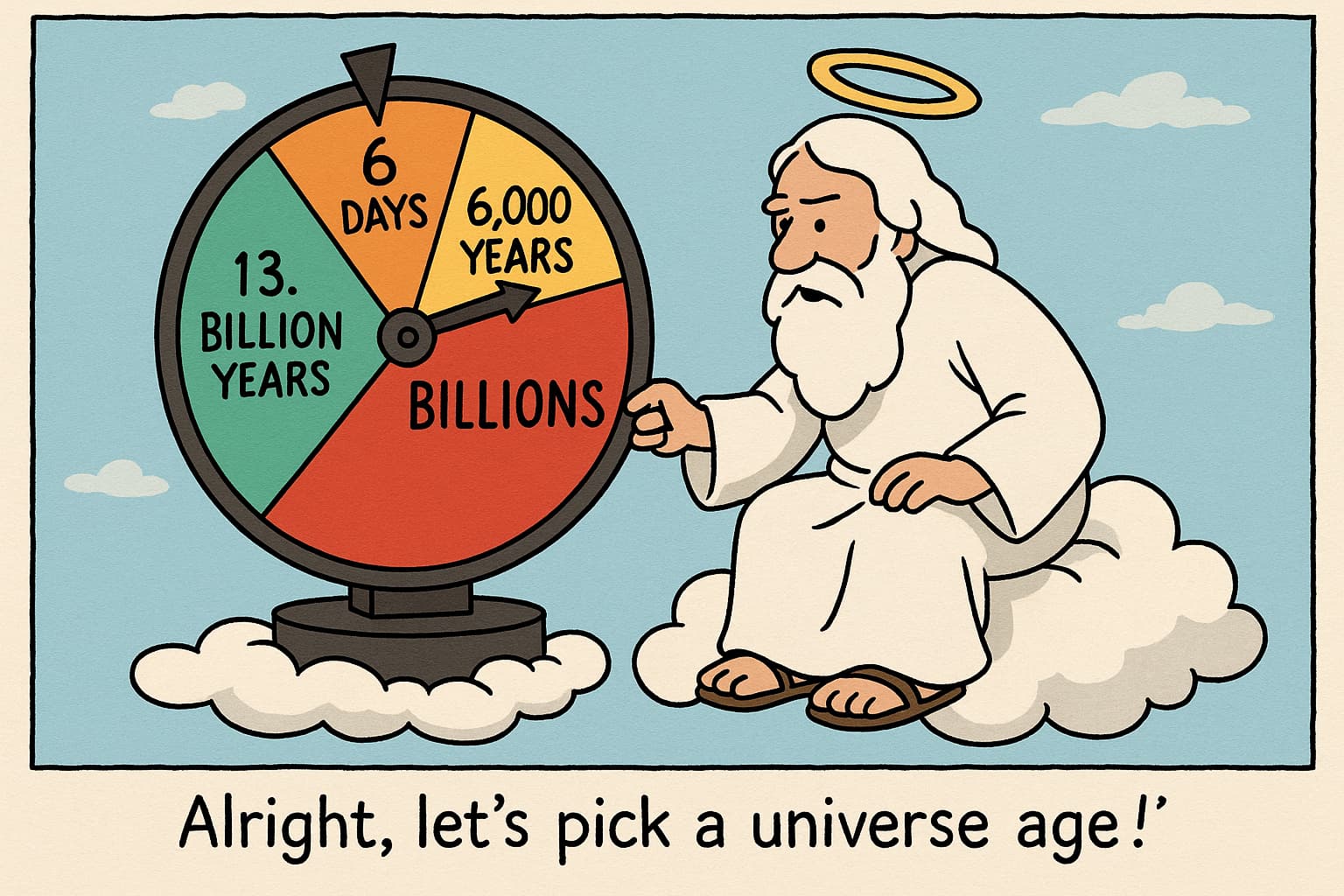
Why would God create the universe to be billions of years old?
Because he is a liar who hates science and want all of mankind to live in the filth and ignorance of the dark ages forever because that is when the church had all the power and was free to torture and murder whoever they wanted.
I feel like something is missing here.
2 Likes
Good question Ben. I am trying to understand the response below, but am having trouble making sense of it.
Now I have my Bible in front of me, reading Genesis 1. “And God saw that it was good.” One day, the second day, the third, fourth, fifth and sixth days. Evening came and then the morning. Then verse 31 after the creation of Adam and Eve, “God saw all that he had made, and it was very good indeed. Evening came and then morning: the sixth day.” Still good, and even better, “very good indeed.”
How can “very good indeed,” after the creation of Adam and Eve, describe a time after billions of years of animal disease, death, and suffering as recorded in the geological record? It can’t.
And God lives, exists, outside of time and is not constrained or bound by time, and yet he has placed us in a universe in time and with time. This is truly beyond our understanding, but here is a feeble attempt. The entirety of eternity spreads out before God in a single moment. It is not as if it unfolds before him a day or a year at a time. His delight is not dependent on lengths of years or millions of millennia. He is the God of eternity, and there is no other god like him.
So I ask Matthew Pevarnik his own question:
Thank you, Ben Lee, for your insightful question.
Must we keep repeating the same things over and over.
Suffering! It revolts us. We think it should not occur. W think God should have excluded it or banned it from creation but…
Suffering has a purpose. It is part of the healing process. To remove suffering you have to remove all injuries and death itself. How are you going to do that?
No accidents, not even a paper cut or an ingrowing nail, tooth decay, headache, stress, over exertion, tiredness, or lack of sleep, Sunburn Bright lights, (sun included) fear, reckless or exciting behaviour, eating too much, (acid stomach etc), stubbed toe, slipped tool (hammer, knife etc) , back ache, feet ache, squeeze, need I go on?
Richard
Edit,
not to mention, bereavement, Love, compassion, empathy, frustration, disapointment, laughing hard.
2 Likes
We recently studied Romans 5 at church, and focused a bit on :
3 Not only so, but we[c] also glory in our sufferings, because we know that suffering produces perseverance;4 perseverance, character; and character, hope.5 And hope does not put us to shame, because God’s love has been poured out into our hearts through the Holy Spirit, who has been given to us.
It was pointed out that suffering here is not punishment for sin, as that is covered by grace, but a part of the conditions of life. those sufferings may be part of the consequences of our or others sin, but are not punishment. Jesus said God cares for the sparrows, but that doesn’t mean life is often short for the little birdies.
1 Like
We are the crown of God’s creation. We, collectively and individually, are the focus of God’s love and grace and divine redemption. He loves us in a unique way that is above his love and concern for the galaxies and planets and comets. He has put us in a unique position as the stewards of his creation–the creation was made for us to enjoy and explore and study and to demonstrate God’s eternal power and divine nature. The earth itself is perhaps unique in all the universe as a place to sustain life and enable observation.
We have a special place in God’s heart that none of the rest of God’s creation has. He did not die for the stars, the trees or the lions. He died for me and you. And one day he will dwell with us.
“And I heard a loud voice from the throne saying, “Behold, the dwelling place of God is with humanity. He will dwell with them, and they will be his peoples, and God himself will be with them as their God.” Revelation 21:3.
Of course, we will dwell with God, but that is not what the passage says. It says that “God will dwell with us.” O the wonder of it all, that God loves me, and desires to dwell with me.
Heaven and earth will pass away, and all that is in them. But we are eternal. Only the redeemed and the damned and the angels will remain of God’s original creation. The universe that now is will be no more, but we will remain in God’s home with him eternally. And there will be a new heavens and a new earth.
“For he (God) chose us in him, before the foundation of the world, to be holy and blameless in love before him.: Ephesians 1:4. We also learn that God chose us before there were even stars and planets and galaxies. Before he even created us, he chose us.
So if we humans (and angels) are the entirety of God’s creation that remains in eternity, perhaps we can be forgiven for thinking of ourselves as the “center of the Universe.” Perhaps we actually are. We are certainly at the center of God’s abounding love and unending grace.

First, don’t mix the stories – Adam and Eve don’t appear in the first Creation account.
Second, you’re imposing a modern enlightenment subjective concept of “good” onto the text. If you want us to believe that the death of prey to feed predator is not-good, show that definition of good from the text.
Third, if you’re going to claim that animal pain is not-good, are you maintaining that – since you included them – Adam and Eve were invulnerable, that they couldn’t have broken an arm or had a leg crushed?
2 Likes
To conflate the two is to endorse pride.
That said, “crown” twists the picture: we are the “statue” in the cosmic temple; that does not make us its focus, it makes us a window.
Stewards aren’t the “crown” of what they care for.
St. John disagrees: he wrote that all things are created for God’s pleasure . . . and that includes us.
We are easily prone to exalt ourselves. That we can enjoy nature does not mean it was made just for us; the Psalmist disagrees with that in every mention of animals and hills and all creatures praising God. We may be the ‘priests’ in God’s temple, but the priest is not ruler over the choir.
“Do not think of yourselves more highly than you ought to, but consider others more important than yourselves”. I daresay that applies not just to fellow humans – we are stewards, not kings.
6 Likes
Funny, but the age of the universe is bound up with the laws of physics – a young universe would have to have different laws, else God is being deceptive.
4 Likes
Though a common idea, this is a misunderstanding of the mission of Jesus and the redemption of the cross.
Jesus died for creation as a whole - he rescued Creation itself “For God so loved THE WORLD…” Though the fullness of that has not been realized yet, the means has been established and fulfilled. He died specifically for humans because we were the problem - we were meant to be his emissaries and regents in creation - to represent himself as his “Images” or one could even say “idols” as the original language indicates. Instead we sold his creation to dark powers and corruption by serving ourselves and other things, and bestowing the power and authority he gave us on them instead. Jesus death for us was to undo that, and to liberate creation as a whole. Again, the fulness will not be realized until the new creation, but the means have been achieved.
As for the suffering of creatures for millions of years - some (and I emphasize Some) of what we might consider wrongful natural suffering is simply the mechanics of a workable universe. Volcanoes aren’t evil - in fact they are a byproduct of an aspect of our world that actually keeps us alive (plate tectonics and a mantle that produces a magnetic field that shields us from solar radiation). I believe true evil in nature only happens when suffering originates from the broken interactions of humans with the environment - in other words it originates with humans themselves. I approach this humbly - can I judge such a thing when I myself cannot create something so grand as the universe?
I can say scripture indicates it was not always meant to be this way - that is what the garden narrative is about. God making the universe his temple, and continuing the project with humans going forward. We of course derailed this. We also know, according to the gospels there is a point where all suffering will be undone.
If you disagree with this, thats OK, ideas like this will be highly variable among the individual.
Is it easier to say there is no God because of suffering? Perhaps. I choose, however, to acknowledge some things are above my understanding (as God answers Job), and I choose to believe in a God who did not hesitate to enter into suffering himself.
But that is a personal choice I have made. Others have their own well thought out reasons for not doing so.
4 Likes
The famous geological phrase, “no vestige of a beginning, no prospect of an end,” was
coined by James Hutton, the “father of modern geology,” to describe the Earth’s immense age and the continuous, cyclical nature of its processes. This idea is the foundation of uniformitarianism, which suggests that geological changes are the result of slow, continuous processes that have been operating throughout time.
-
Origin of the phrase: Hutton included this line in his 1788 publication, Theory of the Earth, to summarize his findings from observing rock formations, such as the juxta positioning of vertical and horizontal layers at Siccar Point.
-
Hutton’s theory: He proposed that the Earth’s features were the result of a continuous cycle of erosion and uplift, an endless loop of rock formation and destruction, rather than a single, cataclysmic event.
-
Impact on science: Hutton’s concept of a very old, constantly changing Earth challenged the prevailing views of his time and laid the groundwork for modern geology, influencing later scientists like Charles Lyell and Charles Darwin.
2 Likes
The modern usage is a bit different. Today, uniformitarianism means nature obeys the same laws through both space and time. In geology, this would mean the same processes are operating the same today as they were in the past, including catastrophic processes that are not slow and continuous.
6 Likes