T_aquaticus
(The Friendly Neighborhood Atheist)
151
Appear to be? Why? Why would having feathers preclude a species from having tidal lungs like that found in mammals? Why would having fur preclude a species from having flow through lungs like that found in birds? Why would having a notochord force a species to have a backwards facing retina?
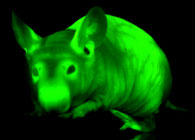
Heck, even humans are able to combine features. For example, this mouse has an exact copy of a jellyfish gene that makes a fluorescent protein and it is a product of human genetic engineering:
Nature does have parameters. We don’t see squirrels giving birth to dogs, or other random combinations of features in offspring. We see vertical inheritance. Any changes that occur in a lineage are only passed on to the offspring of that lineage which keeps those changes within that branch of the tree of life. That is what produces the tree of life we see. If species were created separately then there is no reason to not mix and match different adaptations that would not appear on this restricted tree of life.
Is physics any less creation than Nature or Cosmos?
Why should random conform to anything? (if it is truly random)
Evolution, without God, must rely on pure chance. (chaos?) The order of the Universe denies a chaotic beginning, unless order is the necessity of progress? (So chaos has to dissipate into order)
Richard
T_aquaticus
(The Friendly Neighborhood Atheist)
154
Science can only say that a process is indistinguishable from truly random (statistically random), but it refrains from ever saying that something is ontologically random.
There are many, many processes in nature that are statistically random. This is at the heart of thermodynamics and processes like gas pressure and Brownian motion. Nature wouldn’t work like it does if these processes deviated from random.
In evolution, there are random and non-random processes. Offspring aren’t born with a random sequence of bases in their genome. However, there are a relative handful of random mutations (with respect to fitness) that occurs between each generation. Natural selection is also not random. Evolution works because of the non-random frequencies of alleles caused by selective pressure.
So if you want to discuss chaos, randomness, order, and nature you will have to be a bit more specific on what you want to talk about. We would also need to ask what type of randomness we are talking about, be it statistical or ontological randomness.
This is my huge problem with “Darwinism,” which is really metaphysical naturalism plus natural selection & synthesis. It is not that I think evolution is false or not demonstrated or anything like that (I don’t deny evolution occurring). Rather it is the claim that everything we observe can be accounted for by reductive materialism/naturalism explained by Darwinian accounts alone. This is actually an incredible claim, and one I don’t think anyone is justified in holding (however this is more for epistemic reasons).
There is certainly a lot we do not understand and even the existence of plausible Darwinian explanations for all phenomena does not constitute a “proof” or even necessarily evidence for it. Rather the above is a metaphysical assumption or constraint on how things operate. Most researchers do tend to understand the nuances between what is speculation and what has been experimentally demonstrated, but this nuance often gets obfuscated when communicated to the public (where there are also political factors).
There is a huge difference between claiming evolution occurs and is established and going on to claim that evolution can explain “anything and everything” about life and the natural world. Naturalists cannot even agree on what should be included in naturalism itself, which is a problem if, as they claim, “naturalism is enough.” This of course does not mean naturalism is false, but it does mean a more precise definition is required to support their claims.
1 Like
T_aquaticus
(The Friendly Neighborhood Atheist)
156
Wouldn’t this apply to all of science?
I mentioned geology earlier. In this case, I think it is generally assumed that all geologic formations can be explained through known and understood geologic processes, or at least natural processes. In other cases, we assume medical conditions are caused by natural processes. When we look at distant solar systems we assume a combination of Einstein’s and Newton’s equations can explain their motion. When we look at distant stars we assume our theories of nuclear fusion explain the light they give off.
We know (at least some of ‘we’ know ) that God intervenes in providence and we have seen the wonderful results, but in no case can we point to a particular detail in an event and say how God intervened or even necessarily that this was where he intervened, except only by the outcome.
It seems to me that is what you and @RichardG are suggesting we should be able to find. Not gonna happen.
I’m sure we agree on 99%, but would quibble with your defining “Darwinism” like that. According to Wikipedia, “ In the United States, creationists often use the term “Darwinism” as a pejorative term in reference to beliefs such as scientific materialism, but in the United Kingdom the term has no negative connotations,”
My impression that here, the pejorative is the norm, and often used by AIG and DI to try to paint with a broad brush and infer philosophical naturalism to those of us who are actually holding to methodological naturalism. Also, Darwinism also implies that which conforms to Darwin’s writings, and of course, much has happened to modify and add to that over the past 150 years or so.
While I agree with you that naturalism is not all there is, it is still the only way science can operate as we live in the natural world.
Yeah, I think so, but to various degrees to the extent to which we know (or can know) such explanations are subject them to falsification. Just as Newtonian mechanics gave way to Einsteinium relativity, perhaps there are other such theories we have yet to come up with or other things we have yet to discover. Regardless, it is unclear the extent to which naturalistic “explanations” are truly natural, in the sense they are predicated on mathematical or logical dedications that seem to consistently escape natural explanations. The usefulness of mathematics and the fact that we have a conscious experience are difficult to understand in a purely naturalistic framework, at least given our current understanding. A blind, unguided, uncaring, mechanistic world makes more sense on the Newtonian and Laplacian than one given quantum mechanics .
Exactly, I think it would also be an extraordinary claim to say we know exactly when & where God intervened in the natural world, except as Christians for the resurrection & incarnation, etc. One could believe God set the universe in motion and was incarnated in Jesus and still believe naturalistic explanations for everything else.
Must have been the fact that I’ve been reading books by British authors recently haha. Is there a term for “metaphysical naturalism + reductive NeoDarwinism” that doesn’t carry negative or pejorative connotations?
I have reason to believe that some naturalistic and ‘normal’ but physically detrimental mutations in renal DNA were under providential oversight in their timing as well, however. Can I point to when? Absolutely not, and only approximately to their location.
T_aquaticus
(The Friendly Neighborhood Atheist)
162
In keeping with the topic of the thread, if we find observations that defy our theories do we then chalk it up to “God did it”? In the case of observations that defied Newton’s equations (e.g. the precession in Mercury’s orbit) science didn’t do that. Instead, a new natural explanation was found.
When we find something that is difficult to understand my immediate reaction is to try harder at understanding it.
I wonder how far we can go in being able to write multiple things off as mere coincidences, and in combination with other similar events as being merely 50-σ statistical flukes or freaks, ‘satisfying’ our understanding, so to speak.
T_aquaticus
(The Friendly Neighborhood Atheist)
164
The mere act of time moving forward guarantees that 50 sigma statistical flukes will happen. The act of shuffling a deck of cards will produce an order of cards with a 1 in 52! (1 in ~8E67) probability of existing, and yet this statistical fluke is guaranteed to happen by the very act of shuffling the deck.
T_aquaticus
(The Friendly Neighborhood Atheist)
168
Thanks for the link. I actually think this is a great article for this topic, and it might offer some ways of clearing up some misunderstandings.
This appears to be the most cogent part of the article:
I kind of get where Gleiser (the physicist being interviewed) is coming from, but I think he is using definitions and concepts that just aren’t accurate for all atheists.
He seems to be under the impression that all atheists believe that God absolutely does not exist and they are comfortable making that proclamation. That just isn’t the case for all atheists. I am an atheist and I will gladly admit that God could exist and that I could be wrong, but I still don’t believe. I am still an atheist because I am without (a-) a belief in deities (-theism).
Agnosticism is an answer to a different question. Agnosticism is about what we know. Atheism is about what we believe. Knowledge and belief are two different things, even if they have some overlap.
So how does this relate to the scientific method? Well, just take a step back and consider it a bit more. When someone says, “I don’t believe so”, when asked a question would you consider that a proclamation that they are 100% sure that they are right? When I use that phrase I am usually hedging. That is, I am saying that I could be wrong, but don’t believe I am. That fits in just fine with the scientific method.
There are still multiple 50-σ sets and large numbers of people across millennia. I sincerely hope something similar happens to you to change your mind without necessitating crises to do it!
Honour physicians for their services,
for the Lord created them;
2 for their gift of healing comes from the Most High,
and they are rewarded by the king.
3 The skill of physicians makes them distinguished,
and in the presence of the great they are admired.
4 The Lord created medicines out of the earth,
and the sensible will not despise them.
5 Was not water made sweet with a tree
in order that its power might be known?
6 And he gave skill to human beings
that he might be glorified in his marvelous works.
7 By them the physician heals and takes away pain;
8 the pharmacist makes a mixture from them.
God’s works will never be finished;
and from him health spreads over all the earth.
9 My child, when you are ill, do not delay,
but pray to the Lord, and he will heal you.
10 Give up your faults and direct your hands rightly,
and cleanse your heart from all sin.
11 Offer a sweet-smelling sacrifice, and a memorial portion of choice flour,
and pour oil on your offering, as much as you can afford.
12 Then give the physician his place, for the Lord created him;
do not let him leave you, for you need him.
13 There may come a time when recovery lies in the hands of physicians,
14 for they too pray to the Lord
that he will grant them success in diagnosis
and in healing, for the sake of preserving life.
15 He who sins against his Maker
will be defiant towards the physician.
 ) that God intervenes in providence and we have seen the wonderful results, but in no case can we point to a particular detail in an event and say how God intervened or even necessarily that this was where he intervened, except only by the outcome.