I’m not sure if this counts as “normal means”, but in some bomb craters in London at the end of WWII there were brand new plant species that apparently resulted from the impact of heat, pressure, and chemicals on seeds present when the bombs fell. While it’s possible to deduce what their ancestors were, they are clearly different species.
“That is an exaggeration. Sub-species maybe. Cross-breeding is not evolution.”
It’s an understatement; the example of Brassicoraphanus is a new genus produced experimentally. Cross-breeding is evolution - it creates new combinations of genes that will be tested against the environment, just like any other sets of genes. Polyploidy, whether through crossbreeding or anomalous cell division, is a convenient example of producing new species quickly because the resulting organisms are often clearly reproductively isolated from the parent form(s). Corn (maize) and wheat are important examples of new species produced in this way. Whiptail lizards are a well-studied example in animals.
What constitutes a “species” in bacteria is rather challenging, so it’s not easy to say if a new species has been made. Producing new species through the gradual accumulation of differences between populations is a somewhat slow process, and it’s challenging to say at what point things are species. For example, the Rhagoletis fruit flies are in the process of becoming separate species, but it’s not clear if they have gotten there. The courtship of the flies is on the fruit where they lay their eggs. Different species of flies use different types of fruit. But some of the flies on hawthorn here in the eastern US discovered that humans had brought a new kind of fruit to the region - apples. Besides smelling different, apples are bigger and last longer before they rot, so there are different contexts for larval development. Now there are flies that specifically go to apples to find mates and lay eggs (much to the annoyance of apple growers). The apple flies also seem to have gotten some different DNA by a hybridization event with another species of fly. (This is not the same group as the standard genetics fruit flies, aka vinegar flies.)
Some flowers have a single gene controlling color. Red flowers appeal to hummingbirds; white flowers attract moths. As a result, the two color forms are not mixing - a degree of species separation. If you take a look at older and newer bird guides (as an easy to obtain example), you will see changes in the lists of species. Studies are constantly finding that one population does or doesn’t blend with another to various degrees and deciding whether or not we should consider them different species or not. For example, eastern North American Baltimore orioles and western Bullock’s orioles look noticeably different. However, hybridization between the two was found, and the hybrid offspring were fertile. So the two were combined into “northern oriole” as a single species. But further study found that the hybrids were less successful - potential mates preferred non-hybrids. They were recognized again as separate species. Now DNA analyses show that the two are in fact not even each other’s closest relative. The degree of wasted reproductive effort in the relatively small area of overlap is not serious enough to strongly promote the development of stronger barriers to interbreeding, and they are not so different form each other that the mere accumulation of genetic differences is enough to make them incompatible. Western and eastern painted buntings are a bit different in size but otherwise quite similar. But they don’t mix at all. Are they different species? Western flycatchers include Pacific-slope and Cordillieran populations that sound different, but there are populations in between. At the moment, they are considered two species, but that judgment may change. There’s no clear line of “this is a species and change never exceeds that”.
Well, if we see new species and genera, why not higher levels? This is a function of how families, classes, phyla, etc. are defined. If we just defined them based on having big differences, then we can claim that new things are turning up from time to time. For example, the classes and higher divisions of arthropods are identified based on how many body regions and appendages there are. Insects have six legs, two antennae, and three body regions, for example; chelicerates such as spiders and scorpions have eight legs, no antennae, one or two body regions, and chelicerae and pedipalps for head appendages. An experimental mutation makes a fruit fly grow legs instead of antennae. That does not fit the basic definition of “insect”. Do we call it a new class of arthropods? No, we just call it a mutant fruit fly. We don’t just use “this is really different”; groups are defined based on relationships into larger and more inclusive categories. A family or order is a group that is established enough to be considered different at a higher level. But how do you know whether the mutant fruit fly is going to be just a lab freak or prove to be successful in some way of living that establishes a significant group of animals? The only way to know that is hindsight. Today’s individual mutation might be the founder of a new family from a viewpoint a few million years into the future, but we don’t have that viewpoint yet.
3 Likes
Which of these is Piltdown Man?
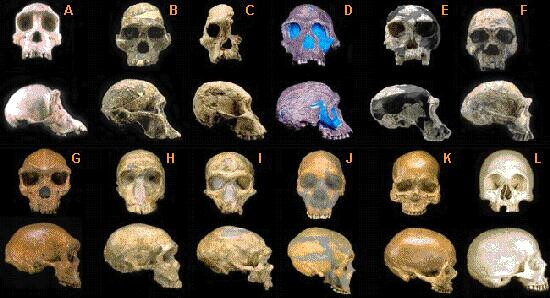
Took a different turn? What do you even mean by that?
Monotremes have a mixture of features from reptiles and placental mammals. They are perfectly transitional. They lay freaking eggs like a reptile, for crying out loud.
When you were taught biology, were you taught anything about how life falls into a tree-like structure of shared and derived features?
No, it didn’t. For example, it didn’t have a beak. There are tons of non-avian features in Archaeopteryx.
Well, there you go. You have pronounced that a theory is preposterous. I guess scientists world wide will have to give up on the theory now because you think it’s silly.
2 Likes
So you reject all of science?
Christian biologists will also say that evolution occurred through the natural processes we can observe today. You are disagreeing with Christian biologists on this one.
Do you also reject atheist meteorologists because they don’t insert God into how weather is produced?
2 Likes
I am very tempted not to answer you at all because of your general attitude of desrision, insult, and mocking. Kindly keep to forum guidelines.
Monotremes are warm blooded and primarily mammalian. A duck like beak does not qualify as reptilian. Laying eggs is not the point. We all use eggs. Not having a placenta is the point, however,as you clearly did not go to school when I did, what right have you to declare my words false or ridicule them?
No
Was not considered important. It had full feathering and could fly.
No, I pronounced some of the theorising as propostersous. All or nothing does not apply.
You have seen enough of my posts to know this is not true. Still not all or nothing!
I do not have to agree with all. I certainly do not disagree with it all.
Which is why I said that many Christians who practice science do not mix the two.
Not all, but yes. Science is part of God’s creation so He will be a part of any theory of creation. Not a bystander.
Non-sequator. If you re going to draw parrallel you need to understand the principles of both things. Clearly you do not.
Weather is produced by varying areas of air pressure. God does not need to be involved. It is just the workings of His creation. Evolution is progressive. Weather is cyclic.
Now kindly keep this civil or I will get the moderators involved.
Richard
Why? It seems a perfectly legitimate analogy. Science does not address God’s providential interventions into physical reality because we have no evidence (except maybe the big bang, if you can grant that – it’s a matter of faith). Your objections to evolutionary speciation and common descent appear to only be arguments from your personal incredulity. What we do have is evidence of his M.O. in individuals’ lives, but that is another question.
I explained why.
That is not the point.
The point is that if we are ging to propose a God driven evolution/creation, we have to make it so and not just try and shoehorn God into the current (aethiest) theory.
I will still argue against elements of the Macro Evolutionary theory that, in my eyes do not add up. But, and I m fed up with having to emphasise this, this does not mean I reject the whole theory!
Richard
Just like the weather. Does God have anything to do with the weather? What ‘current (atheistic) theory’ about the weather would you like to change ‘to make it so’?
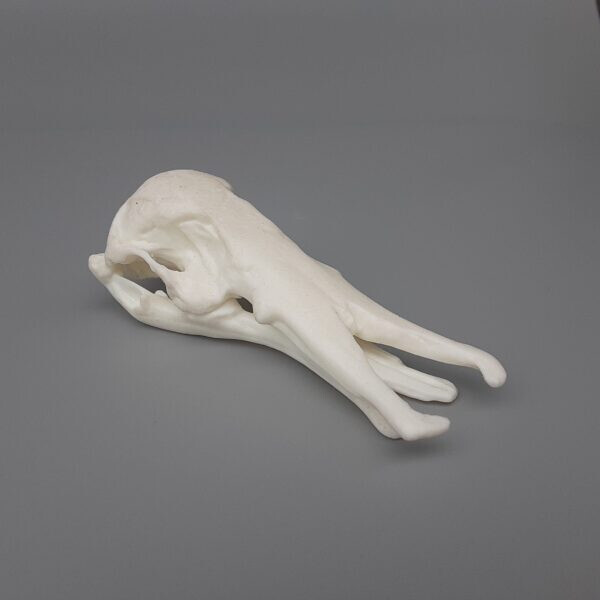
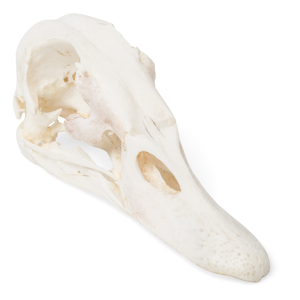
It qualifies as mammalian, and it only roughly resembles a duck beak from the outside. Nearly everything about the platypus skull is different from the duck, even down to what covers it. For example, the duck beak is covered keratin (i.e. horn) while the platypus bill is covered in skin. The position of the nostrils is entirely different. The skeletal structure is also completely different.
Platypus:
Duck:
Placental mammals don’t lay eggs. Reptiles do. Monotremes have a mixture of reptile and placental mammal features which makes them transitional.
If you weren’t taught about the most basic feature of biology then your teachers did a poor job.
You said that Archaeopteryx had all the bird features. When it was pointed out that it didn’t, now it doesn’t matter. Then why say it to begin with?
Archaeopteryx had a mixture of bird features not found in other basal dinosaurs and dinosaur features not found in any living bird. It is transitional.
Evolution is also the working of the creation in the very same way weather is. There is as much need to insert God into weather as there is into evolution.
1 Like
And you don’t find it incredulous?
What else can I argue from? The idea is to point out incredulity that others might see it.
Here try this Development of the hinged jaw
It is taking a two dimensional image and transposing it into three dimensional ohysiology, with no respect to basic anatomy.
I really cannot see how anyone could actually beleive it.
Richard
I find it amazing and impressive. I’ve said somewhere here lately that exaptation is cool. That doesn’t extrapolate into denialism.
The moray eel jaw(s) are truly amazing:
Scientific evidence.
1 Like
I don’t have access to it. Nor do I have the skills or resources to do it myself
(The Interent is not reliable)
Richard
There are tons of searchable peer reviewed articles available through PubMed (https://pubmed.ncbi.nlm.nih.gov/) and Google Scholar (scholar.google.com). Genetic data is also widely available through NCBI, UCSC, and Ensembl, all of which are sources that scientists depend on.
The evidence is there for everyone to see.
For example:
1 Like
Ahhh - but … (and here is where people like @RichardG will have something of a point) … this is a classic case of the expert vastly overestimating the basic knowledge of the public-at-large (even a literate public-at-large). For example, I do consider myself literate, and even competent over basic scientific methodology, and yet as a non-geneticist (and non biologist even) I would be helpless if just turned loose among all those papers and wonderfully accessible genetics sources you refer to. And I suspect that RichardG is in the same boat with me on that.
You see - we depend on people like you to curate that evidence for us - to explain what in there is significant and why. And you do a great job of that! Don’t get me wrong - it’s one of the reasons you are such a valuable contributer around here. All I’m saying, though, is that Richard and many others have had the misfortune (maybe part that, and part bad judgment too) to fall in with selected groups of ideology-driven curators - some of whom themselves probably didn’t really know what they were talking about, and some of whom have just become deceptive about it in the name of their religion and ideology. But (at our level) it is still more a choice of who we listen to than it is us setting aside a significant non-professional portion of our personal lives to dive in and try to climb learning curves and research for ourselves.
I for one, would much rather get the quick elevator ride (with somebody like you here), and even if I haven’t intellectually fought and clawed my way from the foundation up to where you are, I at least am content to know that you have, and I have just enough scientific and personal sense to regcognize honesty and honest answers when I see them (for the most part).
But this is all just to say, (and I hope you don’t take this in any offensive way), - there are a lot of Christians here that thank God for the honesty and expertise of atheists such as yourself! I’ve learned a lot from you. But not so much that I’m about to begin a deep dive down into the current genetics literature for myself.
2 Likes
From what I can tell, @RichardG doesn’t trust what I curate nor why I find it significant. That would appear to be the same for the scientific community as a whole. If that is the case, then the only cure is to go to the evidence cited in the peer reviewed articles and show why the evidence presented does not support the conclusions.
There’s a lot I don’t understand about quantum physics. In fact, a lot of it sounds downright unbelievable (e.g. quantum chromodynamics). However, I know that my human brain is pretty limited, so what it finds believable or not believable is not an infallible judge of how reality actually operates. People who have studied quantum chromodynamics are pretty sharp physicists, so at first blush if they say the evidence is good then I tend to believe them. If I am going to call the entire field hooey, then I had better have the evidence ready to prove my point. That means learning the theories, and learning the evidence.
If all I want to be is the science version of “man yells at clouds” then I guess I could be completely ignorant of quantum mechanics and deem it all hooey, but I can’t make myself do it.
Thank you for the compliments, and do ask any questions that crop up.
3 Likes
Just FYI we went over all this last year. See this thread
2 Likes
…the advent of understanding neutral drift and the neutral theory of evolution.
Without it, I was stuck in incredulity too, just like @RichardG still is.
And it failed miserably.
Richard