These people would flattered, but this claim that they are the most intelligent is dubious to point of being laughable. This is not an observation but frankly just buying into the propaganda of the people you have been listening to.
Statistical studies that atheists have a higher IQ is also easily explained by the simple fact that more intelligent people ask more question, and thus the deviation from the norm (which is currently 80% theist) is sufficient to explain this statistical difference.
With the advent of AI, the importance of intelligence is also dubious. By many measures now the most intelligent are AI not humans. I don’t think they can answer this question, and that tells us that intelligence is not the correct means of answering the question.
This is not a sign of intelligence, quite the contrary. This is foolish.
Incorrect. He said it was childish, and a person trained in science would never accept a literal understanding of the Bible creation story. The Bible creation story with a talking snake and magical fruit does indeed read like a story for children. But is it foolish for a book to speak to children? If this was a story addressed to everyone then shouldn’t it speak to children? But the Bible quite clearly does not ONLY speak to children.
Wrong!!! Even in their areas of expertise you have EVERY right to tell them they are wrong. You can and should check out their every claim for yourself. Science is NOT about authority. It is about measurable EVIDENCE! And that is just science, based on objective observation (where what you want doesn’t matter), while life requires subjective participation (where what you want is central). It is demonstrable that all of these people have been wrong even in their areas of expertise.
First of all. They are not lacking in faith. Science requires faith – faith in the fundamental premise that there are no supernatural beings out there fixing the evidence to deceive us. It is a reasonable premise, but there is no way to prove such a thing.
Your faith should not require the agreement of others. A need to go along with the crowd is a sign of lower intelligence.
Very very very foolish claim to make – indicating a fundamental lack in understanding science. Someone making such a claim is not an intelligent scientist or intelligent atheist.
“It is time to face reality, California Institute of Technology theoretical physicist Sean Carroll says: There is just no such thing as God, or ghosts, or human souls that reside outside of the body. Everything in existence belongs to the natural world and is accessible to science, he argues. “
And the fact that a comedian-pretending-to-be-a-serious-scientist like this one was allowed to make this claim without being immediately submerged by thunderous laughter and subsequently stripped of every credibility says a lot about the world we are living in.
Only one of those people (Hawking) made an actual contribution to our understanding of the universe. The rest were popular communicators.
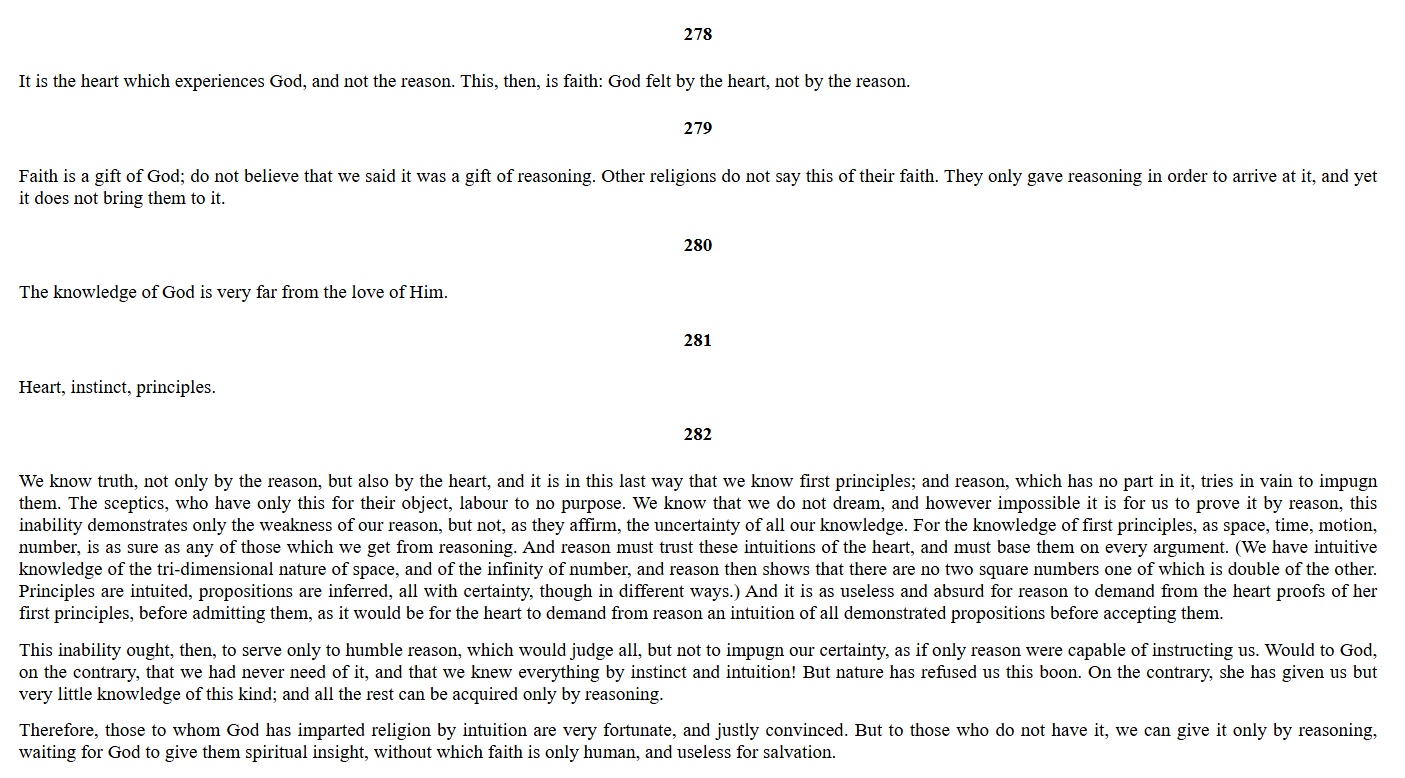
Belief or unbelief aren’t a product of intelligence or reason. You should read Pascal’s Pensees (Thoughts) sometime. He was one of the great geniuses of history, making contributions to mathematics (Pascal’s Theorem in geometry), science (basically inventing hydrology and the syringe), and engineering (inventing one of the first “mechanical calculators”). Here’s what he had to say:
I’d say Francis Collins, the founder of BioLogos, is the most famous actual scientist in this country.
True.
That’s part of it. But the flipside is that most social media atheists are former Christians who grew up in fundamentalist homes, and they make the easy arguments against Biblical literalism. As you’ve learned, that isn’t the only sort of Christianity, and most of those arguments fall flat against a more nuanced understanding of the Bible and Christianity as a whole.
I forgot to include the link to the Project Gutenberg version of Pensees. It has a lengthy introduction by T.S. Eliot, one of the greatest English-language poets of the 20th century, that’s worth reading on its own.
I also left off the most well-known Pascal quote immediately before what I screenshotted:
“The heart has its reasons, which reason does not know. We feel it in a thousand things. I say that the heart naturally loves the Universal Being, and also itself naturally, according as it gives itself to them; and it hardens itself against one or the other at its will. You have rejected the one, and kept the other. Is it by reason that you love yourself?”
Well…great question. These “recent greatest minds” are just recent and better known. There have been others over time –Newton, Galileo, Pascal–who had a belief in God or some sort of deity. The fact that some or many notables today are skeptical could be the fashion of our times as much as anything. It is not a statement that truly intelligent people know enough to not believe in such foolishness as a Supreme Being.
It seems to me that we all don’t believe in some gods, but hold on to the one we give a capital G.
The question seems to overlook this point. There are people from other disciplines who will tell you that gods are a cultural construct, explaining the experience of transcendence in awe of the observable universe. Many gods began in stories that were made up about the star constellations and woven into moral teaching, gaining literary substance as time went on. Others were associated with weather phonomenon or cycles and were appealed to asking for a bountiful harvest.
We understand why we reject these gods but question why some scientists expand their rejection to include the god with the capital G. That seems strange to me.
IMO, there’s an important distinction being missed here. Many ancient gods were indeed tied to particular natural phenomena—weather, harvests, constellations, and so on. As science advanced, those explanations were replaced by natural ones. But the God of classical monotheism was never proposed as a god of thunder or crops competing with natural causes.
In Jewish and Christian thought, God is understood as the creator and sustainer of the entire order of nature, not as one causal agent within it. Science explains how the processes within the universe work. It doesn’t address why a universe with intelligible laws exists in the first place. So rejecting mythological gods tied to natural phenomena doesn’t automatically imply rejecting God in the classical sense. That’s a different question entirely.
The real question, then, is this: what discovery in science would actually count as evidence against the God you are dismissing?
The actual real question in my opinion is not “what discovery in science would actually count as evidence against the God you are dismissing?” But “what discovery in science would be widely perceived as a real evidence against the God you are dismissing?”
As for the rest I agree completely, but as I said to Vinnie in the last few days there are potential discoveries that could be made in the future (even though I don’t think it will actually happen) that wouldn’t actually disprove God but would definitely be perceived in that way.
And in the age of post-truth perception and narration are more important than truth.
If the question is what might be widely perceived as evidence against God, then yes, I agree that some future discovery could be narrated that way even if it would not actually disprove God. But that only sharpens the distinction I was making. Perception is not evidence, and narration is not truth. In an age of post-truth, that distinction is not less important, but more important.
Jesus Christ is hardly a mere “cultural construct”. He was a historical person, and the events that took place 2,000 years ago are historical events (even if, for a long time before the Third Quest, they were often described as later fictional constructions).
The real question is whether the events of 2,000 years ago can be explained purely in naturalistic terms. More precisely, the question is whether naturalistic explanations truly offer the best account of what happened, without relying on multiple ad hoc hypotheses and without forcing a naturalistic explanation even when doing so becomes increasingly strained.
Absolutely. The problem is that when they are widely perceived as such the distinction between perception and evidence, and narration and truth, kind of blurs. And that’s a real problem
To give an example, I think we can agree that a hypothetical discovery showing consciousness to be entirely material in origin (I do not think this will ever happen, because I do not believe consciousness has a purely material origin, but that is beside the point) would not disprove God, nor would it disprove the Christian belief in the final resurrection (as it could be true even if souls don’t exist).
But it would:
Show that all experiences of dead relatives and spirits are nothing more than illusions produced by the brain.
Raise a profound epistemological problem for spirituality as a whole. If billions of people can be so deeply deceived by their own brains, why could the apostles not have been deceived as well? Their claim is admittedly different from the claim of merely seeing or interacting with a spirit, but the problem would remain. The leap of faith required to trust their testimony would become enormous. It would still be possible to believe that Christ truly rose from the dead, absolutely, but any talk of “reasonableness” or of being “convicted in a court of law of having resurrected” (as Roymond likes to say, and I think he puts it well) would have to be abandoned. It would become a complete, absolute, and pure leap of faith.
Destroy every spiritual institution that has dogmatically taught for millennia that souls exist and are judged after death.
In other words, I agree that no scientific discovery could dismantle belief in ipsum esse subsistens, and even some core Christian beliefs would remain largely untouched. But the discovery that consciousness is entirely material would still change many things dramatically. As I have explained above, God would be pushed into absolute hiddenness (and even the discovery of the multiverse, while not disproving the ipsum esse subsistens, would push God more into hiddenness and would dismantle the fine tuning, even though it would not be nearly as devastating as the discovery of material origins of consciousness would be) , and believers who retained their faith would have to renounce any claim to “reasonableness”, as well as any suggestion that the leap of faith required is anything less than a vast leap into the void, sustained only by the faint hope that a loving hand will, in the end times, rescue them from the abyss of annihilation and nonsense.
Not necessarily. It might be a fatal hit to some interpretations, not all.
We believe that our material existence has been created by God through the process of evolution. If consciousness developed through the same process, that would not change the big picture of God creating through the process of evolution.
Even if our consciousness would have developed through evolution, that would not limit the possibility that God may speak to us or that the Holy Spirit may guide us.
I don’t disagree with you, the hypothetical (and imho impossible) discovery that consciousness has no supernatural origins would be devastating for other reasons.
It is a fact that billions of people have had ( and continue to have ) experiences of encounters with the dead, going back, I would argue, to the very beginning of human civilization (in my opinion even the burial of the dead originated from these experiences). If consciousness were proven to be entirely material in origin, that would mean it does not survive death, and it would also mean that all of those experiences (every single one, without exception) are illusions, coincidences, or fabrications generated by the brain.
And that would call everything into question. If billions of psychologically normal human beings can, without the influence of any substance or mental illness, be so profoundly deceived by their own brains that they believe they are seeing or experiencing things that are not real, then the entire epistemology of spirituality would suffer a massive blow. In that scenario, even the Kierkegaardian leap of faith (and I disagree with Kierkegaard on that matter) would seem like a baby step compared with what would be required to go on believing.
It might be devastating to some interpretations and even to some old doctrines.
Whatever we think about the origin of consciousness, if we assume that the evolution towards the modern human took aeons, there was a long time period when the understanding of our ancestors was quite limited. I do not know if God interacted with our ancestors but if He did, the revelations needed to be very simple - like trying to discuss with the modern animals. More complicated ‘discussions’ needed to wait until we had proper understanding for such communication. At least some part of the developed understanding seems to have emerged through material evolution, as the brain sizes gradually grew and the ability to communicate through talking developed. Whether this development lead to the gradual emergence of consciousness, or whether it was just the needed forming of a sufficient ‘basement’ for the insertion of the consciousness is a matter of opinion, interpretation or ‘guestimate’.
Massimiliano, you’ve raised an interesting question about the implications of a hypothetical discovery about consciousness. But that’s really a different question from the one I asked Rob. At this point Rob actually has two questions on the table: yours and mine. I’ll be interested to see how he answers them.
 .
.