His entire ‘point’ is that some things he won’t name have a property he won’t define that means they can’t evolve in a way that isn’t how evolution actually works.
2 Likes
It is somewhat interesting too, that the only boney attachment of the upper limb girdle is the little articulation of the clavicle to the sternum. All else is floating around held together by muscle
4 Likes
A third of the people I know over 60 have at least one replacement of hip or knee – two folks I know have had both hips replaced and one knee (I’m trying to avoid joining them)!
Right now I’m a bit loopy on pain killers thanks to Knox living up to the “Knocks people down” version of his name; he slammed into my left knee today while I was carrying a large tub of wood chips, twisting my knee, and the ankle, and the foot, turning the moderate plantar fasciitis pain to white-hot agony sufficient that I nearly blacked out – all symptoms of less-than-stellar design in hip, knee, ankle, and foot.
1 Like
If you have to ask then I have been wasting my time.
Vlearly you see nothing amazing about the wway a hip jint works. Or the fact that the shape os a femur is npt just a cylinder. Each end is not only different but necessary for the type of joint. I’s just how it is so it must have evolved. You do not hae to consider if there are any steps needed (possible) in this evolution. The result is enough. You can obseve that it works, who care how it was constructed. (and I do not mean from DNA)
Irreducible? No, you can show mw hundreds of smaller and simpler bones. (And in doing so fail to see the point)
Richard
None of that is true.
It is not enough to look at the result. It is not enough to observe that it works. It is not just assumed that the hip joint evolved. People do care how it was constructed.
There is research on how the hip joint evolved, that does look at the steps needed, in great detail, to see what evolutionary routes are possible, and which route was taken. That research isn’t even difficult to find. A quick Google search produced several sources, including
- Evolution of the human hip. Part 1: the osseous framework
- Evolution of the human hip. Part 2: muscling the double extension
You couldn’t be bothered to check whether such research existed before ignorantly proclaiming that it didn’t. You have no excuse for such contemptible behaviour. You should be ashamed of yourself, and you should be apologising to scientists in general and @T_aquaticus in particular.
Stop prattling on about subjects on which you are completely clueless, and go and learn something instead.
3 Likes
You haven’t given any arguments.
Except that every femur has a ball on the end.
How did that shape evolve?
You need the ball to fit the sicket. So go from a hinge (the one you showed before) ro a socket. Show mw a part way step by step evolution of that shape.
(What you referenced was standard adaption. Nothing special or remarkable. )
Sorry, i did look. Not impressed.
Richard
The hip joint is amazing, and the femur is not just a cylinder.
What point are you trying to make?
What makes you think I don’t care about those things? I’m the one who keeps pointing you to the primary literature where many of these answers are found. There’s this paper, but it’s behind a paywall:
This one is free:
There’s also the fossil intermediates I have shown you multiple times now.
4 Likes
I didn’t show a hinge before.
One possible route is via a condyloid joint.
Start by blocking off the ends of the hinge, which won’t affect the single-plane movement. Then gradually widen the centre of the hinge, again without affecting the existing movement, until you get some sideways flexibility. Then shrink the long axis of the hinge until it matches the diameter, gradually increasing the sideways and rotational flexibility until you get a spherical ball-and socket joint. The two parts would need to change in parallel, and the musculature would need to change in parallel with the bones, but since the bones and muscle grow together in each organism there’s no real danger of there ever being a non-fitting joint, and any mutations that led to a non-working joint rather than a differently-working joint would be weeded out by natural selection
Of course this may not be what actually happened, and if it was it was unlikely to have been a smooth or direct transition, or to have happened in every lineage. But it is a possible step-by-step transition.
So what’s the problem?
(Any response to the effect that you shouldn’t need to explain it will be treated with fully merited contempt).
2 Likes
I already conceded that the hand and digits matches fins of a fish. but you have to stick a limb in the middles not to mention the associated joints.
So it was Auaticus same difference.
ff Meaning i read it all
WHether your process is plausible or not, there is some very specific alterations, in sequence to end up with a ball.
And it is specualtion, as you admit.
The point being
There is no obsevation involved., because there i not enough examples. That is true of probably 90% of ToE.Which is why ToE is unique in terms of science.
The net result is belief. I am sorry if belif is not a scientific term but what else can it be termed when there is not enough confirming observable data?
ToE is the best scientific answer, I have never denied it, but that does not mean it is the only one.
Richard
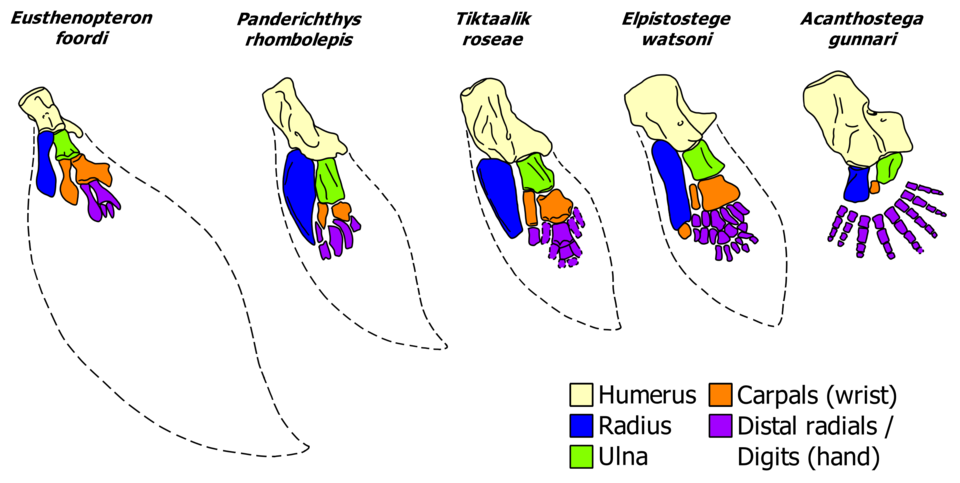
You asked for “a part way step by step evolution of that shape”, and that’s what I gave you.
So having been provided with exactly what you asked for, you’re not in the slightest bit interested in discussing or responding to it. Instead you retreat to false platitudes.
What a waste of time.
No, you just jump in the middle and asume you have the whole story,
And your graphics do not make much sense anyway. I have no idea what the latin names refer to in terms of toype of creture although it looks vaguely lie a flipper, and there are no visible flexible joints, just a collection of bones.
I guess you think it proves your point. but those blobs do not look like any bone i have ever seen. They could be flat for all the definition.
The response is:
It sounds plausible, but there is (or appears to be) no way to confirm it.
Not really. It has been interestng, but i do not have to go along with it… I appreciate the attempt. All information is noted. You make valid points, within the limitations of the discussion This was never going to be a game clincher for either of us.
Richard
Then look them up. Learn something for once.
So it’s not a problem for evolution.
1 Like
Like I said, you just ignore the observations. Does Google not work in the UK?
It is by no means conclusive
You can epeat yourself as often as you like, it does not make you correct.
But here is my repetition
And you did not tell me whqt kind of creatures they were.
Are they in direct lineage to modern mamals?
Richard
What am I jumping in the middle of? What story am I assuming? You make no sense.
If you want to know what those species are, Google it. Or does Google not work in the UK? You accuse me of not wanting to know specifics, and you can’t even look up stuff on Google?
2 Likes
That is not how this works.

That is now your problem, not mine. Perhaps Google could help you?
Richard
Wow, the utter failure to understand science here is astounding!
The steps are what evolution is about and are “how it was constructed”. The sequence can be shown despite your imagining that it can’t.
The astounding thing is that this is not merely not even university-level science, it isn’t even high school science.
And computer simulations show how progression from “smaller and simpler” arrives at what we have today – and that things are functional at every tiny incremental step along the way. That is where your imagination goes astray: things were functional all the way along even while they were changing, even while functions were changing!
Oh – and the computer simulations aren’t just made up, they follow the laws of physics.
That’s true of a lot of geology as well, so ToE isn’t unique.
It’s also true of a lot of cosmology, so again ToE isn’t unique.
Why would God provide gobs of evidence for a process which can be shown to suffice to explain what we see but have a different process hiding behind it?
This is why you sound like a YECist: you present a Creator Who appears dishonest.
They would to anyone who’s taken an advanced high school or university biology course.
Then plainly whatever texts you had for biology courses were intellectually deficient since those are standard bone diagrams that match what were in the eighth-grade biology text I taught from doing student teaching.
If it’s plausible, then why the vociferous objections? Do you think that the Creator gave us a Creation meant to be confusing? I should think He did in Creation as Jesus did in teaching: made things open to the world.
Or for theology. Or for philosophy.
3 Likes