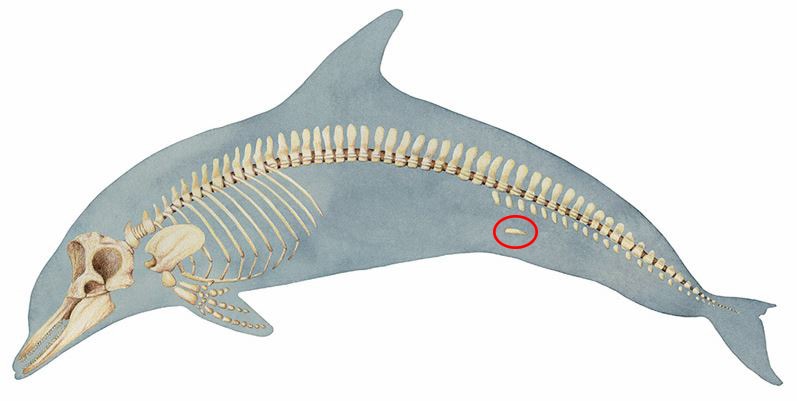
Note the highlighted bone that’s unconnected to the rest of the skeleton. It’s a roughly cylindrical bone with no developed ends. It’s not partially made, but it is somewhat unadapted, being a vestigial remnant of ancestral legs that is available for adaptation to new functionality. Yet dolphins don’t find this bone “unusable” or “an impassible burden”.
It’s more like one meaning and one vague notion that conveniently changes whenever challenged.
If @RichardG would provide his definition of ‘irreducible’ to compare with the definition everyone else is using[1], it might reduce the amount of talking past each other.
Though since AFAICT that definition is just ‘can’t evolve’, providing that definition would instantly result in all his arguments suffering the same fate as the Oozlum bird.
“Irreducible means the system has multiple parts where the removal of any one part causes the system to lose function.” ↩︎
I know what ‘vestigial’ means. (I don’t know that you know).
It doesn’t matter. Whether that bone is unconnected because connections to the rest of the skeleton have yet to be established,[1] or because connections to the rest of the skeleton have been lost, it’s still a bone that’s unconnected, and is not “an impassible burden”.
You were wrong, as usual, and you’re trying to avoid admitting it, as usual.
P.S. The hyoid bone is unconnected to the rest of the skeleton in many mammals, including humans. That’s not “an impassible burden” either, and can’t be as easily dismissed as being ‘vestigial’.
This isn’t how new bones evolve, but explaining that shouldn’t be necessary. ↩︎
As usual you claim knowledge without stating it, and criticise me for doing the same.
Your example is not the same as what i was talking about.
A vestigial structure is left over, not growing. The burden would only occur if the nw structure was growing up to the moment it is viable. A vestigial one is decreasing not increasing.
So you have not addressed the actulal problem, instead you have sidetracked.
The whole point was that if something cannot work before it is fully functional
The growing it woul be an impossble burdem. Instead you have found something that is both vestigial and not a problem. Brilliant.
Richard
T_aquaticus
(The Friendly Neighborhood Atheist)
130
I would strongly suggest you internalize those criticisms. Many of the discussions we have had on this topic involve you claiming that such and such a system requires all of these different attributes. In each case, I have shown you simpler systems that exist in biology. For example, you went on and on about all of these changes that had to happen in order for animals to be warm blooded. You apparently didn’t know about the very simple changes that occurred in tuna that allow them to be warm blooded.
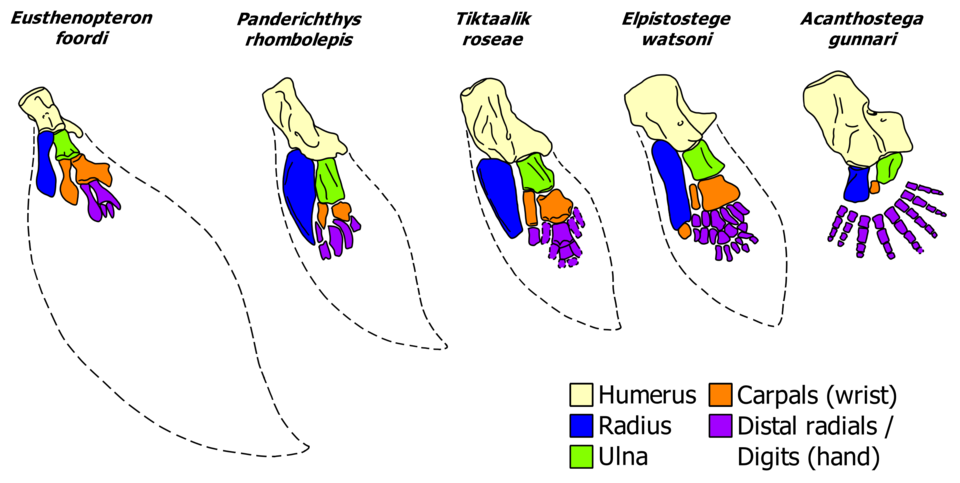
You are now talking about bones that have to be completely unconnected from the rest of the skeleton before they can evolve function. Even a passing knowledge of vertebrate anatomy across species would show you this is false. The mammalian middle ear is an example. The evolution of tetrapod limbs is yet another.
You seem to have a lot of uninformed opinions about biology, and a lack of humility when it comes to telling those who are informed that they need to learn more.
You seem to think that existence of complex structures invalidates ToE because they must become functional to serve a complex purpose “out of nowhere”, and before that the structure would have been an impossible burden. It seems to me that you are missing the key idea that complex structures can develop from simpler ones, often with changes in purpose. Several specific examples have been given, such as the development of the middle ear from the jaw.
If you would like to do a deep dive into a specific structure that you don’t think can be explained by ToE, there are people here that are willing to discuss it.
However, I think you need to demonstrate some good faith that you are willing to try to understand the details. You should not be surprised when talking to scientists, that they want to have some rigour in the discussion.
If you have already made up your mind that ToE doesn’t fit with your philosophical framework, or you are just incredulous, that is fine, but I don’t see the purpose of “hand-wavy” arguments against science.
I haven’t even suggested any of the (how many) individual organs in a human (or other creature), epidermis, blood system, nervous systems, plasma, and so on and so on. Would you care to hazard a guess at how many elements (from cell to organ etc) there are in the whole of creation? How long have we got? And not one is complex, or irreducible! (according to you)
No. I have an exstensive knowledge of anatomy, that you do not.
And I really am getting tired of your belittling insults.
Not to mention your distinct lack of theoretical science. You need an example. That is not what theoretical science is.
And you still refuse to define the basic evolutionary process. (You and all the other scoffers) Without that common ground the rest of this is pointless.
What, in your understanding, constitutes a "small step? If Evolution happens in small steps, what is a small step? A change in beak size? Or a new pair of legs!
Richard
T_aquaticus
(The Friendly Neighborhood Atheist)
134
I am comparing tuna to your claim that endothermia requires too many changes for evolution to produce all at once.
Then what are you talking about?
Are you so unaware of vertebrate anatomy that you think the human leg evolved independently of all other vertebrates and somehow had to evolve with no functioning ancestral systems? Perhaps you haven’t read up on the pelvic girdle in T. roseae?
Its’s just so simple for you. Who cares about the little details!
It i the details that you gloss over.
Now compare the mechanics of a mammalian hip, to a reptillian hip, to an amphibian hip to a fish with not hip at all, where is the “simple” hip? WHere is the simple leg bone, where is the leg with no hinge? (The fish do not a limb as such, the fins are closer to digits)
So simple. So easy. Small steps. What small steps!
Richard
T_aquaticus
(The Friendly Neighborhood Atheist)
136
Ummm, no.
Apparently, you don’t care about the details.
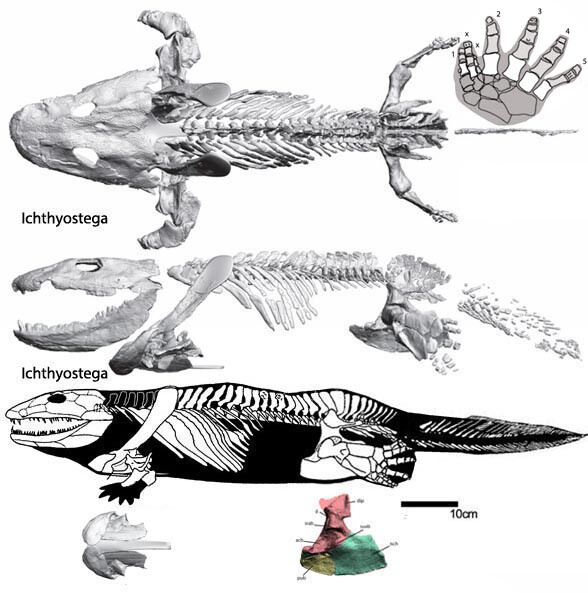
Then apparently you haven’t studied the hind limbs of Ichthyostega or Acanthostega.
Probably hadn’t been found or “reconstructed” when i was at college. By the way, where is the Hip bone?
You have seen the way a femur sits i a hip socket?
Looks to me like a simple hinge joint. Quite a leap from that to a perfect ball and socket. Which came first, the ball or the socket? ANd how did the femur change shape? Did it know that it needed a round sball to enable greater movement?
So easy. so simple. No problem.
Richard
T_aquaticus
(The Friendly Neighborhood Atheist)
138
“Looks to me” . . . sigh.
Why don’t you go to scholar.google.com and search for “evolution of tetrapod limbs”. Start reading, and be mindful of the date of publication. Or do the details not matter to you?
You asked "Show me a partially made bone, or even an unadapted one. Let alone a limb without supplementary muscles, ligaments , nerves, blood vessels. And that is ignoring bone marrow and cartilage that is necessary for some of them. A bone unconnected, …
I showed you an unadapted and unconnected bone - which is what you asked for. If that wasn’t what you were talking about, you should have asked for what you meant.
So you don’t know what ‘vestigial’ means. It means ‘not having the original function’. It does not have to be decreasing, although they often are; for example, ostrich wings are sometimes considered to be vestigial w.r.t. flight, but they are bigger than the wings of the flighted birds ostriched evolved from.
I provided examples of “an unconnected bone” that were not “an impassible burden”.
If that wasn’t the problem, you should have asked for something that was relevant to the problem.
Your whole point is completely irrelevant to evolution, because evolution involves changing fully functional systems into different fully functional systems. You should learn about evolution. Your whole point is also completely wrong because lots of devices can work before they are fully functional, either less effectively or with less functionality. You should also learn about engineering.
But most importantly, you should learn what you don’t know, and how to remedy that.
They’re as big as mammals. They’re as complex as mammals. They live in the same environment and eat the same food as some mammals. They’ve been evolving for as long as mammals.
Or does your ‘knowledge’ of evolution not include the fact that fish have evolved since the onset of tetrapods?
No. Earn one.
How in Loviatar’s name can the entire limb be the wrong part of the limb?
Vestigial characteristics have lost their prior purpose. They may be atrophied, or they may be employed to another purpose, such as balance, but they are still vestigial.