I think it will go several ways. For some, it will encourage humility and recognition that trust needs to be repeatedly earned by example, not simply the default of a majority position. A subset will get louder, dumber and more confrontational, doubling down on the same, noisome rhetoric and behaviors – and retreat to tribalism.
I think it’s unclear which countries and institutions will withstand hyper-nationalist or ultra-wealthy takeovers, which could temporarily elevate a preferred and compliant religious leadership/ collaboration, as these things tend to do.
Biologos feels like a kind of “end-game” for theism, really. You’ve reached a point where you cannot deny the evidence, yet refuse to let go of your religious beliefs. This is just how it seems to me after doing some reading here. You end up with some fantastic mental gymnastics. Often flat-out denying the Bible itself. I read a lot in my own thread I made here. I’m not attacking, this is just my observation. I’m just not convinced biologos is the right way.
I would argue that “cannot deny the evidence” is a relative turn. I’m sure most of us Christians started out believing that every word of the Bible was true. Then we learned about things like evolution, deep space, and stuff of the like.
To young minds like ours, whose current worldview contradicted these things, that would seem like the evidence crumpling in. However, our worldviews were built by people who didn’t have this same knowledge. The people who wrote the Bible sure knew a lot about God, no one is denying that here. However, their understanding of the world around them was also very limited.
These people saw the real person of Christ even though they lived on a round planet and the Universe was greatly older than 6000 years. Just because we all had very restricted views of God before doesn’t mean we cannot learn new, more insightful, views of God.
I can see that. To me Biologos is not the full picture, but perhaps the closest approximation of our ultimate reality we have these days. We really cannot understand the infinite, only the parts that are revealed to us. Doubt and mystery, not knowing yet believing is our lot. Blessings in your journey, Vagrant.
Yes and no. It’s more of an end game for Christianity. Theism and deism don’t require the Bible at all. The physical evidence is the physical evidence and it cannot be denied, yet belief in the existence of God or the resurrection of Christ don’t rely on physical evidence. What they rely on is respect for the truth, and truth can be both objective and subjective.
You who? There are as many ways to put the pieces together as there are people. Some are more coherent than others. Your task, should you choose to accept it, is to put the pieces together in a way that makes sense to you. BioLogos isn’t a “way” of doing that. It’s simply a resource, and none of the posters on this board are official representatives of the organization. We’re a motley crew with differing opinions on almost every theological dispute. The only thing we agree upon is the fact of evolution. (And the fact that there wasn’t a global flood. Plus a few other facts of history and science.)
Flat-out denying the Bible? That’s an interesting charge. What it really comes down to is how to interpret scripture and one’s view of inerrancy. I’ll focus on the latter. John Piper is an evangelical’s evangelical, but even he says that inerrancy applies to matters of salvation, faith and practice, not historical details. I disagree with him on almost everything, but that rule of thumb makes sense to me.
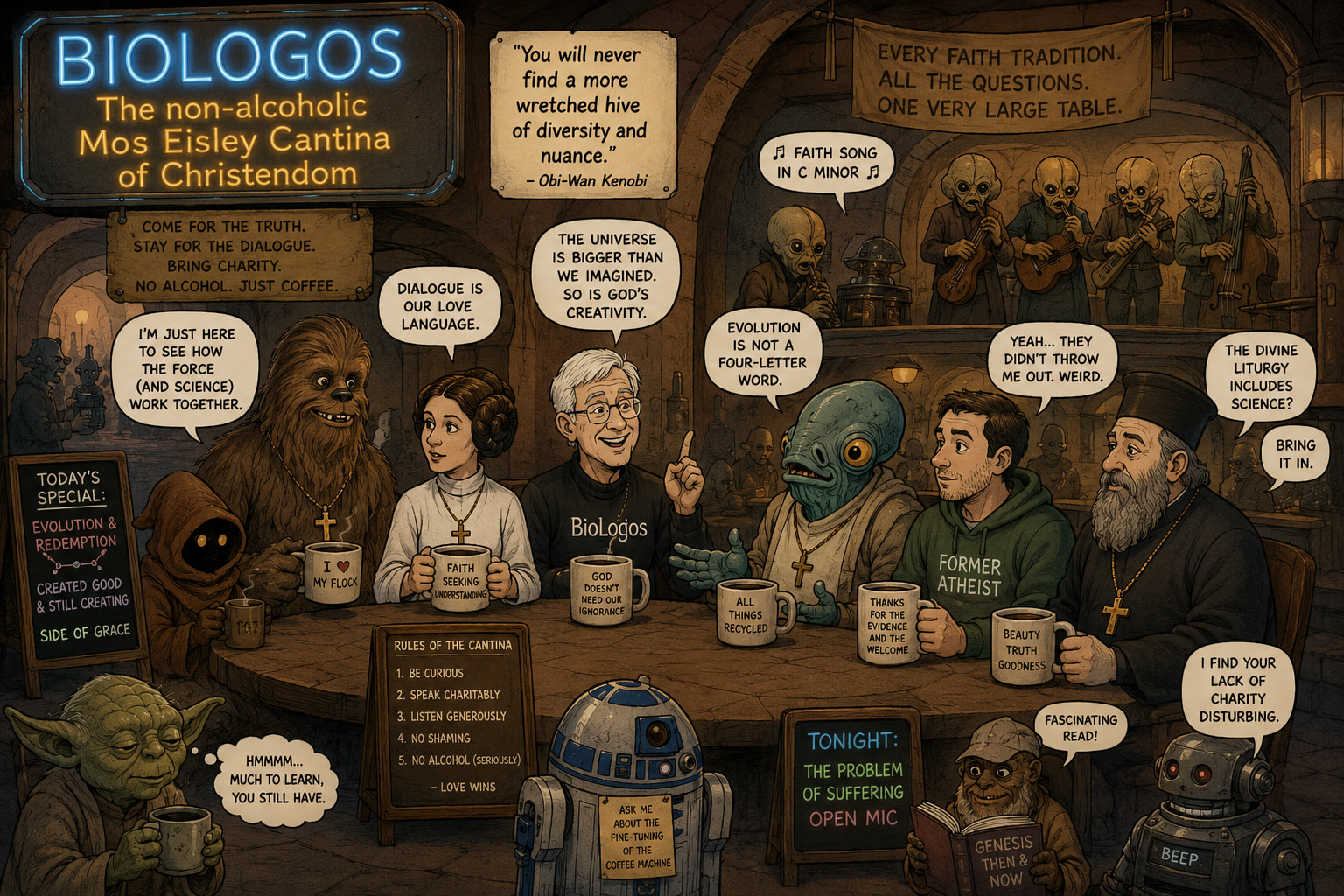
Since you asked… Weird as it sounds I told chatGPT to create an image based on a conversation I had with it about what would a “Christian Mos Eisley Cantina” look like. So rather than me describing it in minute detail, I first got ChatGPT to write that description, and since I liked it I then asked for a cartoon. This trick works surprisingly well for image generation.
Oh my – AI keeps surprising me. One thing about AI is that the quality of its output is dependent on the quality of the coaching it receives. Well done.
Evolutionary Creationism is just a compromise by a bunch of religious people who are making lots of money selling a false gospel to the unsuspecting public. They compromise because they are not really standing for the truth in regards to the gospel or the Bible anyway so why not compromise with the atheists and be popular?
YEC is just a compromise by a bunch of religious people who are making lots of money selling a false gospel to the unsuspecting public.
They compromise because they are just engaging in costly signaling behavior to indicate their acceptance of the group’s beliefs. I know, been there, done that, had the t-shirt, and threw the t-shirt away.
Edit to add: Any gospel that doesn’t begin and end with Christ is a false gospel.
Are you aware that the geologists that established the earth is older than 6,000 years were Christians and this was before Darwin’s theory was published? There are many Christians that study evolution, some who post here.
I honestly don’t understand. I struggled with my faith for a long time before coming to terms with evolution. I still don’t feel comfortable with it, but I believe that God is just, and he looks on the heart.
I honestly do not make any money from struggling or coming to this conclusion. Blessings!
I live in Michigan, USA. I hope that you are enjoying the weather wherever you live–it is beautiful here.
I would favor describing science as a subset of theology, not as a separate magisterium. Because God created a universe that follows regular patterns and created us with the ability and responsibility to recognize those patterns, we can use science to investigate how the universe works. Biblical miracles are intended as noteworthy exceptions to the usual pattern, which we cannot notice if we don’t know the regular pattern.