He’s not bad. Must watch what the goddess Sabine has to say. Fine tuning is an utter fallacy; looking down the wrong end of the telescope.
Well yes but they need to make sure that what they think they’re seeing really is something that others cannot easily see, and not something that others have seen and accounted for.
It’s like when I first learned about the much hyped Three Basic Assumptions of radiometric dating from young earth literature as a teenager. I thought that “evolutionists” must be deaf, dumb and blind to overlook the possibility of contamination or leakage, uncertainties about original conditions, and the like. But then I got to university and was taught about how radiometric dating really works. I learned that scientists fully understood the questions of contamination, leakage, initial conditions and constancy of decay rates—and had figured out ways to account for them, set constraints on them, and in some cases even work round them altogether.
This is where amateur Galileo wannabes all too often go wrong. They think that just because they have the “benefit” of “not being immersed in the consensus,” that somehow means that they can somehow “see what others cannot easily see.” But in reality, the things they think others “cannot easily see” are things that the experts were fully aware of, and had fully accounted for, before they were even born. The only ones who are missing things that others have seen are they themselves.
9 Likes
Invincibly bad arguers. With invincibly bad education. Invincibly bad psychology. Invincibly bad morality. Like Putin, they can’t lose. Knowledge workers are a tiny, vulnerable minority; a single island on a waterworld ruled by waves of invincibly loud, invincibly biased, invincibly anti-social, invincible ignorance on loop.
1 Like
I think you are using a philosophical and moral term I am not familiar with. Maybe you can teach me.
Thanks.
Who am I to teach you anything Randy?
We are entirely natural believing machines, and no one’s to blame. We’re pre-wired for experience and culture does, others (our interacting with other people does) do, the rest, so what we have is normal: 80% bad in terms of being able to transcend that entropy. The disorder. Stick our heads above that, including our own, water.
The brittle, grandiose fundamentalists here helplessly swamp it with noise. The Rogerian cannot work with most of them. Some want to be loved regardless, which is their saving grace.
It would make great comedy.
These kind of experiments have been made; I have seen pictures from these areas. The experiments show an interplay of several factors: decreasing rainfall, the potentially strong impact of grazing, and the ability of closed forests or comparable vegetation to create and maintain a microclimate that is more humid and stable than in the more open areas.
Between deserts and humid areas, there are zones from relatively moist (profitable agriculture possible) to somewhat drier (agriculture not profitable during most years but nomadic herding profitable) to too dry for agriculture and herding. With drying climate, the zones shift so that villages are facing new conditions. For cultural reasons, local farmers do not easily jump to being nomadic herders. Their cattle and especially goats consume the remaining green vegetation around the villages, then the cattle dies, leaving the goats that ensure the destruction of all seedlings. The lack of vegetation makes the conditions more extreme, leading to a worse situation.
There is a relatively dry zone where a large patch of vegetation can produce a microclimate where plants can survive, even when the plants would not survive in open areas. The experimental fences were erected within that zone. It shows that vegetation could return to this zone if we would remove all people with their goats and wood collection. Drying of the climate is the reason why vegetation and the activities of the resident people cannot anymore coexist.
The forest microclimate phenomenon is the same that produces the rains above Amazonia. When the rainforests are harvested or burned, those areas cannot anymore maintain the humid microclimate and rains. That will change the rainforests to savanna-type vegetation and lead to a drier climate within the regions that have benefitted from the rains produced by the closed forests - in the case of Amazonia, a huge part of South America.
2 Likes
I’m impressed! Alhamduillahi, na gode, suna lafiya. (praise be to God, thank you for asking. They are well). I remember that friendly Hausa would ask, much like any country folk, how our sleep (kwana) was, work (aiki), and fatigue (gajiya). It is fun to think on that again! I remember Camel Rock outside Jos, too; and flying a balsa model plane off one of the twin extinct volcanoes between Jos and Miango.
I am really interested in hearing how you came to your position.
Yes, good memory. The agronomist you’re referring to was likely Tony Rinaudo, who worked in Niger to the east of us. He made a TEDx talk. We used to hang out with his kids when they visited the compound.
I would agree with you that there was extensive problem with deforestation. That certainly accelerates desertification. I think that biologist @knor above made a great point about the microclimate not changing the fact that there is an overall, undeniable trend to very harmful global warming. As Katherine Hayhoe, a missionary kid as well (fromCanada to Colombia) quotes a Harvard specialist, we can mitigate, adapt, and suffer–with the mitigation, it’s hopeful that the other 2 will minimize.
There’s the proposed “great green belt,” which may help someday, and I did research on reforestation for my school projects
I’m really worried for those Africans who are struggling. Desertification is a major source of AlQaeda recruitment, with young men looking for income sources.
Allah shi barakace ka! May God bless.
Randy
2 Likes
I worship at the feet of the goddess Sabine! I am not worthy. She and her argumentation are perfection! Your man and his ‘Bayesian’ b… nonsense, with poor Justin the fundamentalist chair desperately trying to wheedle in a need for God, are as good as it doesn’t get, establishing the non-phenomenon of fine tuning. Sabine (peace be upon her), didn’t even have to go rationally beyond the science! Which one can easily do.
She is mostly beyond my meager comprehension. But sometimes she condescends low enough, I love her sense of irony. German humor - yes, it does exist! - at its best.
1 Like
Let’s assume for the sake of argument that catastrophic global warming is inevitable unless drastic measures are taken to reduce carbon emissions.
Here’s my concern. There are currently about 8.2 billion people in the world. We are able globally to produce enough food to keep most of these people alive. But that is enabled by the use of affordable carbon based energy. This energy allows for the farming, fertilizer, transportation, processing, and preserving of food. I am unaware of any alternative affordable energy that will be available in time to prevent the predicted global warming catastrophe. So it seems that to “save the world,” millions or even billions of people will have to forgo eating. Either way, if the catastrophic global warming prediction is right, a lot of people (millions and billions) will die, either from hunger and cold or from failure to prevent the global warming. Either way, the poorest will be impacted the most.
Two recent examples:
First, Sri Lanka. The government there basically banned the use of fertilizers that are manufactured using energy, generally natural gas. Not only did food production decline precipitously, but the national economy collapse. If I recall correctly, the government relented because of the massive protests, and the people of Sri Lanka can eat again.
Next, the Netherlands. The Netherlands is a major exporter of agricultural products, by some accounts, number 2 or 3 in the world. Their farmers also use practices that are the most environmentally sustainable in the world. But recently, the government has been forcing farmers out of business to reduce emissions. That just moves the production of agricultural products to other areas of the world that do not use these sustainable practices. As people do not agree to stop eating, they will find other sources of food.
So to save the world for human habitation, many of those currently alive will have to without their permission go without food and heat–those who are the poorest.
And of course, if nations like India and China do not cooperate in reducing carbon emissions, the point is moot. No amount of reductions by other nations will compensate.
Then we also have the issue of increased energy usage by cloud computing and AI. The demand for energy is growing significantly, and where will that energy come from?
3 Likes
I think we would settle for accepting the evidence that the vast majority of warming since 1900 is due to burning fossil fuels.
3 Likes
Thanks. I totally agree that we can’t be drastic where it hurts people, especially the poor. Katherine Hayhoe specifically addresses that. She says, “let’s make it fun and helpful. If there is a switch in the house that turns off all the lights as you leave at the door andit’s safer for you, that’s a great idea.”
The climate change experts agree that the poor should not suffer for the rich–you likely had the same feeling as I, that the rich seemed to care more about their own hobbyhorses, like climate change and lions, than the poor. But the consensus among the main groups is that the rich (who discard on average 1/3 of our food, to my recollection), and can afford to pilot efficiency, should be the ones; there should be no restriction on the poor.
Thanks.
3 Likes
In the climate change negotiations, a big and difficult question is who will pay the actions (reduction of carbon emissions) in the poor countries. The plan is that there needs to be actions in all countries, even the poor, but the poor developing countries want that the rich countries pay the costs. The rich countries play compassionate but are not willing to pay.
One way how the rich might change their attitude is if they can compensate their own emissions by doing comparable reductions in the other countries. There is an ongoing need and pressure to reduce carbon emissions but domestic restrictions may be politically difficult to do and may cost much. If the same reductions could be achieved in a developing country with much lower costs, it may be politically the easiest solution.
USA may be a temporary exception in the big picture. It is likely that the public opinion in USA will change in the future when the consequences of the climate change hit harder. Unfortunately, at that point it might be too late to prevent the unwanted consequences - what is left may be to adapt and abandon part of the country.
I wrote ‘may be’ because the official policy does not represent the whole country. If the green energy is the cheapest option, good for business and future, official policy does not dictate the choices of companies.
4 Likes
Only, ever, if they hit ‘hard working American$’ harder.
1 Like
I read an article where the authors argued against that, insisting that wealthy nations should clean up their own acts first.
I agree that it is good to avoid wasting food, and we have gotten our food waste close to zero. Maybe I don’t understand what you are saying by “afford to pilot efficiency.” I certainly can’t send my leftovers to Sri Lanka. We have to let Sri Lankans grow their own food, and manufacture their own fertilizer. Are you simply talking about a wealth transfer? And the question remains, how will they farm, in particular, fertilize, and then process and transport food without fossil fuels?
2 Likes
The Third and only possible political way Way is for capitalism to invest in poorer economies. The way China is doing.
1 Like
All good, or almost all good. But a good argument doesn’t cherry pick the data, and that addresses the issue of this thread, good and bad arguments. Hayhoe notes the transition of China to wind and solar from coal. They are closing coal mines and even flooding some with water and floating solar panels on the water. And they are closing coal generating plants.
I went on line, and there were dozens of articles heralding what China is doing in developing wind and solar. Good for them, but . . . There were also articles about the resurgence in building many coal fired electrical generating plants. Xi promises that this does not mean they are backing down on their net zero by 2050 commitment. Please forgive my skepticism.
Here is a graph from Carbon Brief, China’s construction of new coal-power plants ‘reached 10-year high’ in 2024 - Carbon Brief . Note how many coal plants are being decommissioned, and how much new coal generated electricity is coming online.
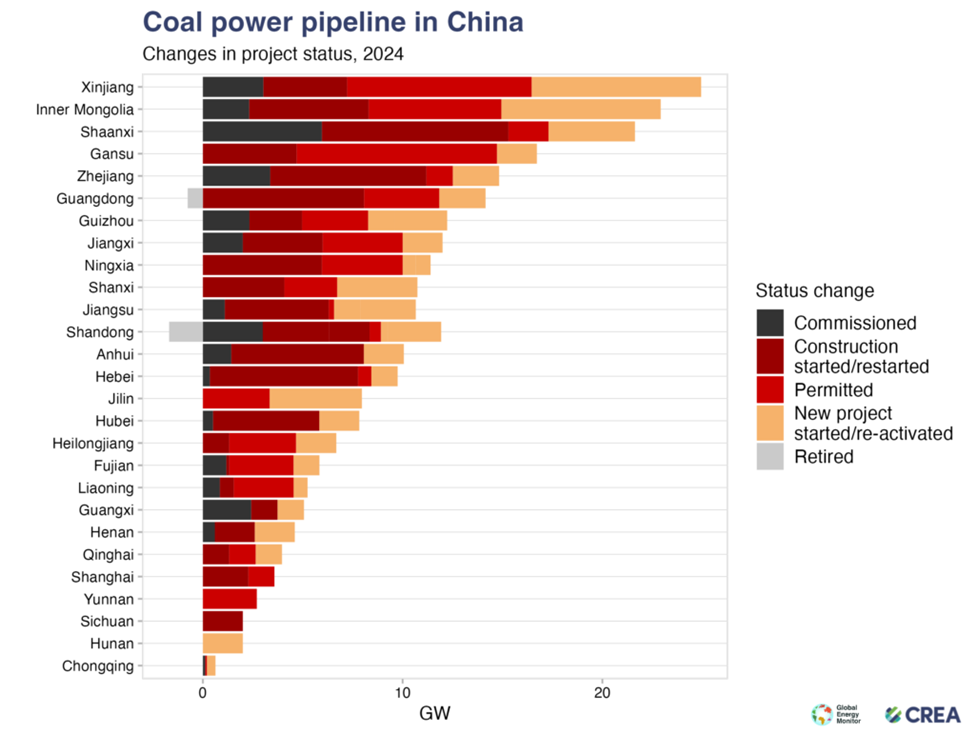
The point relevant to this discussion about what makes a bad argument–you can’t cherry pick the data to make your argument. And of course, when we hear a feel good argument, or maybe in this case a feel bad argument, but we also see that the data is not completely true, that tends to discredit the whole argument–what else are we not being told?
1 Like
Yep. Capitalism can do nothing else. I expect Prime Minister Farage to reinstitute coal. We have vast reserves after all. The Germans too; they never stopped. It’s been increasing since 2020.