Sort of – it’s thinking by policy, which I suppose is a step above ordinary individual thinking in that it involves multiple minds.
It would be interesting to see how science would fit in his paradigm.
3 Likes

I forgot that common sense is not part of science.
Richard
AI isn’t one thing. As a tool, different applications of AI and LLMs (which is what a lot of people mean by AI) can be more or less useful and more or less ethical.
We are using AI generated drafts in minority language Bible translation now. You need to lay some philosophical and theological groundwork first. Then people need to be trained on specific tools and held accountable to keep humans in the loop in interative processes. They need to be trained on slightly different skillsets (referencing or editing an AI draft compared to translating a source text) but they also need the same skillset as the people who aren’t using the AI drafts so they understand the standards they are aiming for. Same thing for writers using AI as a tool. Good writers can use AI tools much more profitably than people who are trying to outsource writing skills to AI.
I think AI tools will eventually become integrated into the way we do things like calculators and computers are now. I think some of the promises/threats of replacing humans are overblown and we are already seeing a backlash against depending on AI for intrinsically human things like creativity and empathy.
I am most concerned about the way LLMs unethically harvest data and repackage unattributed inferior content to sell things and the way AI can be used to deceive a population that is already seriously lacking the skills to vet sources of information and discern facts. I think we have already seen the dangers of replacing experts with AI with the bombing of the girls’ school in Iran, the disasterous ChatGPT inspired gutting of USAID and research grants. My husband has been experimenting with vibe coding in Java and got some pretty amazing results. But my son, who can code much better looked at a program for a game app that Claude wrote that seemed to be working great and immediately found a line that would have eventually corrupted the entire database.
5 Likes
The AI just did what humans do on a all too regular basis.
3 Likes
- Strictly out of curiosity, and as a single test-case experiment, I uploaded the last paragraph of @Christy’s post into ChatGPT and asked it to critique this sentence:
ChatGPT’s response:
Regarding the specific sentence:
“We have already seen the dangers of replacing experts with AI with the bombing of the girls’ school in Iran, the disastrous ChatGPT inspired gutting of USAID and research grants.”
I would qualify it in two different ways.
1. The Iranian girls’ school bombing
This is partly correct but overstated as written.
Current reporting suggests that AI-assisted military targeting played a role in the strike, but the evidence does not support saying simply that “AI replaced experts.”
The reporting instead points to a combination of factors:
- an AI-assisted targeting system (principally Palantir’s Maven rather than ChatGPT),
- outdated intelligence databases,
- accelerated targeting procedures,
- and inadequate human review before the strike.
Indeed, several analyses argue that public discussion became distracted by “AI” when the deeper problem was institutional: compressed decision cycles, stale data, and insufficient human verification.
So a more accurate formulation would be:
The Iranian school bombing illustrates the danger of allowing AI-assisted systems and accelerated bureaucratic processes to substitute for careful expert human judgment.
That is a stronger and more defensible claim than saying AI simply “replaced experts.”
2. USAID and research grants
This claim is more speculative.
There have been numerous reports that ChatGPT and other LLMs were used during reviews of contracts, grants, and government programs, particularly during rapid efforts to reduce federal spending. There is also substantial criticism that these tools were used inappropriately or that inexperienced personnel relied on them too heavily.
However, saying
“the disastrous ChatGPT inspired gutting of USAID and research grants”
goes beyond what has been firmly established.
To support that wording one would need evidence that:
- ChatGPT itself materially drove the decisions,
- experts were actually displaced,
- and the resulting cuts were demonstrably caused by AI rather than by political decisions that merely used AI as one input.
The evidence so far is stronger for saying that AI was used within the process than that AI caused the outcome.
3 Likes
- A comment on Lessig’s astonishing (IMO) story about:
In September 2017, Facebook was revealed to have a category in its advertising system called “Jew Haters.” Advertisers could purchase ads targeted specifically to “Jew Haters.” Now, nobody at Facebook intentionally created that category. There wasn’t a human employee who decided, “We’re going to start targeting Jew haters.” The AI created the category because it determined that “Jew Haters” constituted a profitable audience to whom advertisements could be sold.
The company, of course, was embarrassed because it revealed that they did not actually have complete control over the machine that operates the machines that increasingly operate our lives. The real difference in this story, however, is the extraordinary potential of this instrumentally rational entity compared to us. This system is vastly better at achieving its objectives than individual human beings. It is better than corporations.
And it is certainly better than democracies. Because whatever objective it is given, it will become increasingly efficient at achieving that objective. And this is where we return to the paranoia I mentioned at the beginning."
- Lessig’s Facebook “Jew Haters” story left me with a question. What’s the likelihood that an AI—any AI—would spontaneously generate a category like “Jew Haters” if it had not first been given an objective that rewarded doing so? Would Facebook’s AI have identified “Jew Haters” as an advertising category if it had not been optimizing for something like advertising revenue?
3 Likes
Relax, robots, I’m not blaming you, I’m blaming the idiot humans who fired all the experts and gave the power to inappropriately use AI tools to ignorant man-children like Big Balls.
Also, no Robots, you are wrong. “Chat-GGT inspired” doen’t not mean “Chat GPT itself materially drove the decisions,” you lack reading comprehension. It means the people making the cuts were using Chat-GPT to make decisions.
3 Likes
I’ll tell ChatGPT. It has a delayed sense of humor.
LOL! What did I tell you?

3 Likes
Would it create “Jew Haters” category if…there were no Jew Haters in the first place?
Because AI is an actual thing that exists?
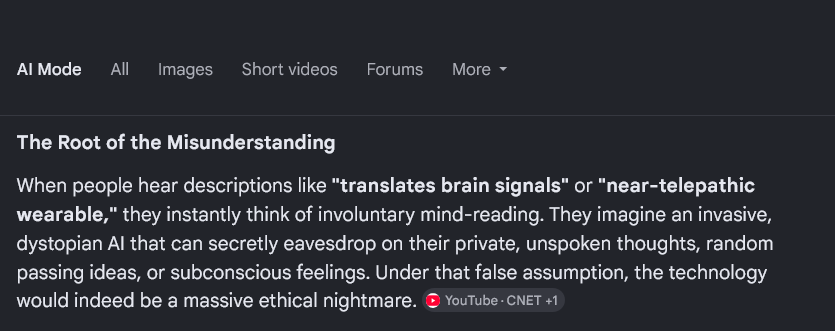
Yeah, well, I still think it is unethical, because despite good intentions it cannot be guaranteed that this will not be used for some nefarious purposes or without the subject’s consent
1 Like
SF AI : existing AI :: vampires and dragons : bats and lizards
1 Like
AI is not intelligent. Machine learning can work well if it has verified data, a suitable task, and monitoring of its accuracy, such as for translation or predicting protein structure. But stringing words together from stolen data and marketing that as a reliable substitute for expertise doesn’t do any good. Generative AI is promoted by the companies as an easy way to cheat on assignments. I cannot think of any legitimate use for the ability to take a photo of a written question and get an answer. It’s disastrous for trying to get good work out of the less serious students. The slop is exasperating, whether it’s the time-wasting drivel in place of letting me see results of an online search, the time-wasting inane summaries of pdfs, or the purported videos and pictures with bad fakes.
1 Like
I see AI as being the next industrial revolution. The same way that the new medium of production became large factories in the 19th century, AI workflows and autonomous factories with robots will be the new medium of production going into the 21st century. Although I don’t see AI as being good or bad, I also don’t see it as being neutral and think that ensuring the emergence of beneficial models will require training good archetypes into AI models. For example, training the good shepherd archetype into AI instead of, say the conquistador archetype. I do think that over time humans will adapt to using AI in a relatively safe, sustainable (in the general sense) manner as they do with most technologies eventually. I also think that in the long-term anything that doesn’t break the laws of physics will happen eventually. If it is possible to get superintelligence out of AI it will happen, though possibly not for a billion years. Since I believe in the resurrection and that God is making all things new, I do believe you will have benevolent superintelligences but since we also live in a fallen world tainted by sin you will also get malevolent superintelligences. You will get angels and you will get demons. The goal of AI R&D should be to get more angels and fewer demons.
2 Likes
I feel that the same could be said when calculators entered schools and jet planes began to outperform ships for transportation.
I have a good story about calculators. When I started my EE program there were no portable calculators. We had slide rules, CRC Handbooks, and large desktop calculators. When I got to my Strength of Materials class I had been given a TI calculator that was a basic four function calculator, but it could handle numbers in scientific notation. The first test in the class was to me a breeze as I could quickly do the calculations required. After a couple of exams the prof told the class he was going to have to restructure the exams as too many students were finishing early. He had the problems worked out such that someone who knew the material and working with a slide rule could just finish the exam in the allowed time. Luckily for the rest of the class he didn’t do it until the next semester.
5 Likes
Actually at this point it seems to be output only, human thought patterns controlling circuitry. Reversing that in the least is an equine from an entirely different spectrum.
2 Likes
This topic was automatically closed 6 days after the last reply. New replies are no longer allowed.