Since we are discussing the claims at the Berkeley site. Lets review it point by point-
Blockquote
The first thing to notice on this evogram is that hippos are the closest living relatives of whales, but they are not the ancestors of whales. In fact, none of the individual animals on the evogram is the direct ancestor of any other, as far as we know. That’s why each of them gets its own branch on the family tree.
So let us acknowledge before hand that no scientist seriously makes the claim that any of the organisms mentioned is an intermediary/ancestor of the modern whale.
Blockquote
These first whales, such as Pakicetus, were typical land animals. They had long skulls and large carnivorous teeth. From the outside, they don’t look much like whales at all. However, their skulls — particularly in the ear region, which is surrounded by a bony wall — strongly resemble those of living whales and are unlike those of any other mammal. Often, seemingly minor features provide critical evidence to link animals that are highly specialized for their lifestyles (such as whales) with their less extreme-looking relatives
Things we can say for sure about the pakicetus:
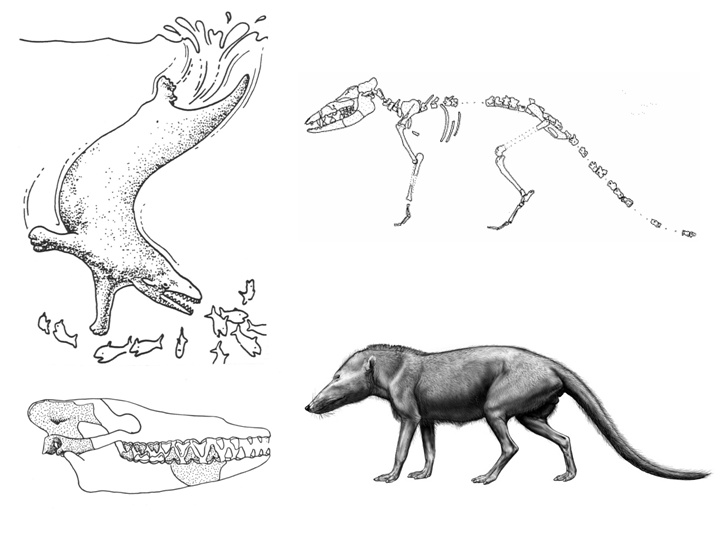
Top left is the initial reconstructions made by evolutionary “Scientists” based on the initial fossil evidence.Later fossil evidence forced them to correct their imaginations and shows the pakicetus is a typical 4 legged mammal. What we can say with certainty about the pakicetus is as below:
- It was mainly a terrestrial animal.
- The pakicetus looks like a fox. Its skull is quite similar to that of a modern day coyote.
- There are supposed similarities in the ear, However, this was not functional. i.e Pakicetids did not hear in water the same way whales do!
Blockquote
Results suggest that these earliest whales probably used normal land mammal hearing in air, where sound vibrations reached the tympanic membrane through the external auditory meatus, and were transmitted further by the ossicular chain to the cochlea. Pakicetids most likely used bone conduction for hearing in water, given the close contact between the periotic bone and the skull, and the relatively massive incus. The lack of a mandibular fat pad and the close connection between the periotic and the skull indicate that the lateral tympanic wall was not functionally significant in their hearing mechanism in water, and the modern odontocete hearing mechanism was not present. Directional hearing in water was poorly developed.
Source:https://onlinelibrary.wiley.com/doi/full/10.1002/ar.20528
Pakicetids heard in water pretty much the same way many mammals do… Through bone conduction.And their ears had many similrities to land living mammals.
Now lets do a few pictures … 
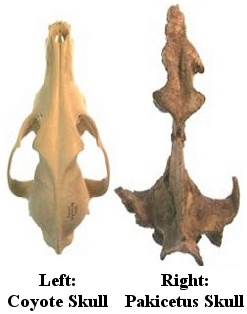
The above is a coyote skull placed next to that of a Pakicetus… yet we call the pakicetus a whale. (Why not the Pakicoyote?)
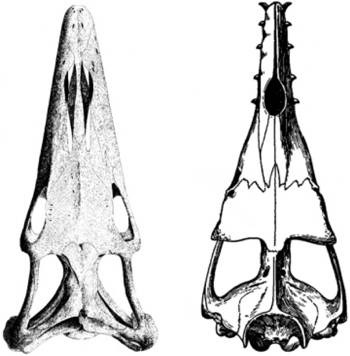
This one is a mosasaurus (Platecarpus coryphaeus) placed next to a Dorudon atrox (a middle eocene whale). They do not share a common ancestor. If this can happen by accident, whats so special about a little pakicetus ear which is not very similar to a whale anyway?
and final picture:
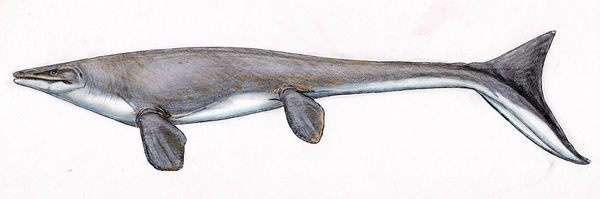
The artistic impression of a platecarpus…(A mosasaurus)
Pretty similar to whales… except that they are thought be close to reptiles and moved their flukes differently…
There are similarities in ear structure too.
Observations such as the above (if viewed from the evolutionary perspective) tell us that environmental/functional requirements corresponds to similarity between creatures which are not related by lineage.
So how can we be sure that the Pakicetus didn’t develop its ears through convergence and the vague similarity to the whale ears is coincidence?