St. Roymond, you point out a few of the facts that make the lithosphere an impossible meaning for the firmament; but calling someone’s honest efforts at understanding a form of “idolatry” is way off the mark. A bit arrogant on your part, wouldn’t you say ?
1 Like
Yes – you strive to force the text to fit a MSWV while I strive to see what the text is saying.
The rabbis at least had enough respect for the text that they didn’t try to force it to be something it isn’t by demanding it conform to an alien worldview.
That’s essentially solipsism; at best it’s relativism. It doesn’t work in science and it is crappy theology: both have data sets that one does not get to redefine to fit one’s preferences.
It’s idolatry because it sets up a worldview that is alien to the scriptures as the proper measure for the scriptures rather than asking what the scriptures actually are and thus working to understand them rather than impose an alien message.
The Creation stories are not about science. They are not history. The closest they come to being history is when a section is mythologized (or theologized) history, but the first Creation story does not qualify.
What every scheme trying to make the Creation accounts talk science is doing is the equivalent of purporting to show that the song Puff the Magic Dragon is about drugs and Coleridge’s Kublai Khan is about a sexual encounter – those consist of positing some message and forcing the text to conform, which is all that YEC or any other science fiction approach to Genesis does.
An honest effort to understand a piece of literature starts with asking what kind of literature it is, what worldview it operates within, what culture produced it, etc. – the “historical” part of the historical-grammatical method. Most of the schemes proposed here skip all of that and treat the text as something like newspaper reports, produced within a MSWV, in a modern Western culture – a guaranteed way to get it all wrong and throw the actual message in the trash. It assumes that the Genesis writer and the Holy Spirit were interested in answering questions that satisfy scientific curiosity rather than asking what they were really up to.
1 Like
No tolerance. Just assertive dogmatism.
Richard
Genesis 1 is not about the relationship between God and humanity. That is the subject of Genesis 2-3.
You misquote me when you refer to my making science the most important thing in Gen !. What I said was that Genesis 1 “is an exact retelling of what we today know about the origin of the universe and the earth.” This is not me saying that science is more important than knowledge of God. Surely you understand the difference.
I read the text and very carefully consider what it says. I do not need to read thousands of pages of ANE writings to understand what it says. If you’ve read a thousand pages of that stuff, your eyes must be hurting.
Creation is a six-day affair. The fist thing created on the first day is light. That’s pretty clear. Some people think the earth already existed before day one. That’s definitely not there.
I could go on, but I’m thinking my efforts would be wasted.
Just try to be more open-minded. It would help.
1 Like
No – I have no tolerance for just making stuff up and treating it as the equivalent of actual data…
It most certainly is! It’s the culminating point in both literary types, and the main point in the polemic purpose.
Which it isn’t.
And there you go putting science above the text – you’re assuming it is about science right off the bat.
- Gen 1:20b and fowl that may fly above the earth in the open firmament of heaven.
‘fowl’ (5775. עוֹף oph) - collective flying creatures, fowl, insects;
‘fly’ (5774. עוּף uwph) - To fly, to soar, To be faint - be wax faint, flee away, fly away, set,
‘above’ (5921. עַל al) - above, over, upon, or against (yet always in this last relation with a downward aspect) in a great variety of applications
‘in the open’, same word for face of as in the Spirit hovering over the face of the waters (6440. פָנִים panim or paneh) - Face, presence, countenance, before
Taking this all together, we can see, really that these ‘oph’ that we already know can fly, will flee away, wax faint or become weary and need to rest upon the earth. This gives some purpose to the dry land from Day 3 to be used on Day 5. So I don’t think this retranslation is so far off:
- Gen 1:20b and flying insects that may set upon the earth over the face of the lithosphere of the heavens.
The earth or dry land is the exposed part of the lithosphere that is “open” to the heavens (plural), so “in the open” lithosphere of the heavens works too.
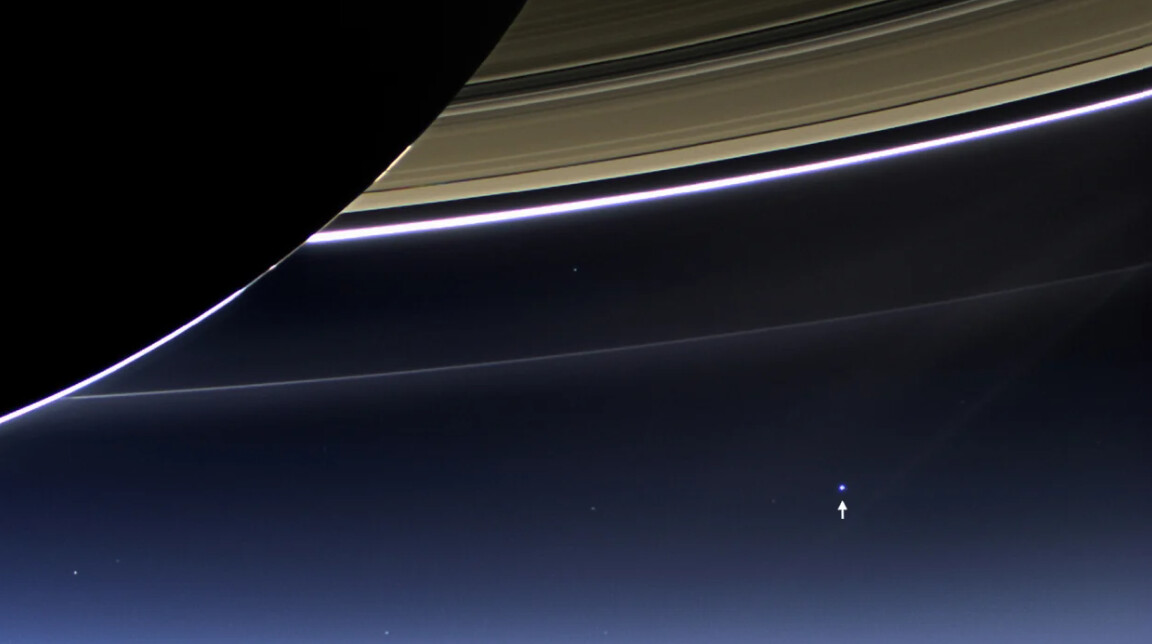
And BTW, the lithosphere, the whole sphere of the Earth really is part ‘of’ the heavens. Here is a picture of us from Saturn… say “Cheese”:
And in verse 22, God comes out and says it plainly. These ‘fowl’ are on the earth:
- Gen 1:22 And God blessed them, saying, Be fruitful, and multiply, and fill the waters in the seas, and let fowl multiply in the earth.
Certainly by standing on the lithosphere we have found the stars and planets.
- Gen 1:14 And God said, Let there be lights in the firmament of the heaven to divide the day from the night; and let them be for signs, and for seasons, and for days, and years:
‘in the’ is not in the Hebrew but is put there by the translators as clarification. This is really just talking about lighting up the surface of the earth with lights from the heavens. Before there was dry land on Day 3 (the lights would be scattered for under sea organisms) and early eye spots beginning to formed with multicellular organisms on Day 4, there was no one to see them for signs, seasons, days and years.
- Gen 1:16 And God made two great lights; the greater light to rule the day, and the lesser light to rule the night: he made the stars also.
‘made’ is in the imperfect tense. God had made the light on Day 1 and is now making greater and lesser lights, i.e. a spectrum of light. Plants can detect light, but fungi can additionally detect a spectrum of lights, with different colors and intensities. He is making these lights as they can be seen.
The stars, almost mentioned in passing are not made here (italicized, not in the text) but were made in the beginning. God is just saying that the lesser light will rule the night and the stars. There is still light at night, with or without the Moon which was likewise made in the beginning with the Sun.
- Gen 1:17 And God set them in the firmament of the heaven to give light upon the earth,
‘set’ (5414. נָתַן nathan) - give, gave, given
‘give light’ (215. אוֹר or) - shine, give light, light
The meaning of ‘set’ is really ‘give’, so where that came from, I don’t know. This verse could translate to:
- Gen 1:17 And God gave them to the lithosphere of heaven to shine upon the earth,
Not so impossible if you take the meaning in my above reply to him.
Way to make false assertions. I am simply pointing out that the Hebrew has a much more limited vocabulary and so the words have a wider range of meaning.
Its about God making a place to have a relationship with humanity.
Faith is not (just) about data.
And besides, you have a narrow view of what constitutes data.
Richard
Bovine faeces. You did much more than that. Such as calculating the ratio between the number of Hebrew words in the Bible with the number of English words in use - as if there wasn’t any Hebrew vocabulary not used in the bible.
And now you’re not only implicitly assuming that Hebrew vocabulary was limited to the words used in the Bible - which is where that 9,000 figure comes from - you’re also assuming that every meaning of every English word was also represented in Hebrew. Which is just as ridiculous since they wouldn’t have needed words for e.g. microprocessor, trebuchet, kangaroo, welly, fax, …
But you’re welcome to shoot me down by providing an estimate for the number of words in Hebrew being just 9,000 that isn’t based on counting the words in the Bible.
Or you could once again try to avoid taking responsibility for saying something stupid by pretending you said something else.
Your choice.
2 Likes
Theology calls it free will. We are all made in God’s image. Solipsism is one aspect of God’s image.
Free will is not Biblical.
Calling God self centred would appear to be blasphemous (to me at least)
Sounds like an excuse to justify sef interest.
Trouble with self interest is it is insincere. You ae not doing it for the intrinsic value, only what you can get out of it. Such hypocrisy is condemned by Scripture.
Richard
In the older Hebrew dictionaries, the Classical Hebrew vocabulary was reckoned at ca. 8,400 different words (lemmas). The discovery in the 20th century of new Classical Hebrew texts has added some ca. 1,400 words to the dictionary, and a proliferation of scholarly proposals to find in our texts Hebrew words not hitherto recognized has produced another ca. 4,000 (though many of these proposals are by no means accepted by all scholars). Classical Hebrew is now attested by ca. 14,000 words or potential words. However, many of these are proper names.
I think the kangaroo is represented by the name Shelah. The joey is the young “sprout” that is born and “sent” to the pouch which is like the hide or “blanket” that is spread out where it has its “meal”.
The verb שלח (shalah) means to send; to send whatever from messengers to arrows. It may even be used to describe a plant’s offshoots or branches.
Noun שלח (shelah) refers to some kind of weapon, apparently a kind of missile. Plural noun שלוחים (shilluhim) means a send-off; a sending away or parting gift. Noun שלוחה (sheluha) refers to a shoot or branch. Noun משלח (mishlah) describes an outstretching of one’s hand (i.e. an undertaking, or referring to the place where the letting go takes place). Noun משלוח (mishloah) also means an outstretching or a sending. Noun משלחת (mishlahat) describes a discharge from service, or a deputation.
The noun שלחן (shulhan) means table. It may actually stem from a whole other but identical verb that originally described the skinning an animal and stretching the hide out to dry. Possibly helped by the previous verb, this outstretching of a hide became attached to the laying down of a blanket (or indeed a hide) in order to stall goods on it (like the elements of a meal). When someone invented a table on legs the word to describe it was lifted from the old custom of picnicking on a blanket: a stretcher-outer.
Using the timeline I have presented in other topics, our common decent with Shelah the son of Arphaxad (or Cainan according the Luke) is approximately 130 mya.
Again, although much that claims to be scientific [from conventional science, not just from YEC or antievolution] contributes to the popular misconception of evolution as ruthlessly eliminating the weak and unfit, this is not an accurate picture of a modern understanding of biological evolution.
Successfully surviving and reproducing can be achieved in several ways. Cooperation can work, or avoiding other organisms, or outcompeting. Evolution does not require “nature red in blood and claw”. It does not say we should be trying to get ahead by putting others down. Science generally, and evolution in particular, does not tell us “should”. But even if we make the unjustified assumption that we “should” do what brings evolutionary success, various strategies are possible. Particularly with the ability of humans to transmit memories, treating others well and cooperating in an effort to mutually advance everyone’s interests is likely to be a smarter long-term successful strategy than harming others.
The science in the Bible is the science observable by those in the ancient Near East.
2 Likes
This statement is nonsense since you’ve made the firmament, the earth, and the heavens all into the same thing.
You’re playing somewhat sophisticated games with the text but failing to honor the text for what it is messaging. Like any other attempt to make the opening of Genesis talk science, you’re throwing the bulk of its theology in the trash. And like most such attempts, the result is something people will laugh at and as a result laugh at the Gospel.
That’s a misuse of the Hebrew prefix. ב covers a range including “on”, “as”, “with”, and “by”.
Incorrect – it’s right there in the text: בִּרְקִ֣יעַ The ב is rendered as “in”, and the definite article הַ has vanished into the structure (it’s not explicit; that would change the pointing from a sirik to a patach, so technically this is “in firmament”).
Nope – it’s the exact same grammar as “Let light be”, the only difference being the shift from singular to plural, so this is “Let lights be” and the specification as to general location.
Incorrect. This is what we might call a specification; light is being tied to specific sources. The “two great lights” dashes the spectrum idea.
What’s going on here is a serious insult to two of the greatest Egyptian gods, the sun and moon. The Genesis writer acknowledges their existence but doesn’t even name them, only identifies them by their function!
Incorrect. The italicized words derive from the Hebrew grammar; they are included in the verb by וְאֵ֖ת .
The “lesser light” is the Moon! That’s a major part of the point of the passage: this Egyptian god doesn’t even get named! It’s a huge theological put-down. The stars – which elsewhere get called “the host of heaven”, which is how the ANE viewed them (as living beings) – are included in the put-down by the way they’re attached, almost as an afterthought, like, “Oh, yeah – and the stars, too”.
No, they’re made right here. The initial light was “free”, not attached to any source (we’d say it was but that’s particle physics); here it is being attached to specific sources (which doesn’t rule out others). This aligns with the mytho-theology of the rest of the ANE, except that the Genesis writer dumps the usual notion that light was something that existed on its own, clearly making it, too, a servant of God.
נָתַן doesn’t map well onto any English word. “Give” is the most common way to translate it, but that’s an artifact of usage; it just as much ‘means’ “put”, “add”, “make”, “apply” . . . The basic/core meaning is to transfer something from one location to another: “give” is just a transfer between persons, “put” is a transfer between places, “add” is a transfer to an existing set, etc. So “set” here is like “put”; God made them and then put them in specific places.
No, it couldn’t – you’re purposely mangling the Hebrew to fit a scheme forced on the text from an alien worldview.
This is why Dr. John Walton firmly insist that Genesis 1 is not about material creation – the details of material creation are there, but they’re only tie-down points for what’s really going on.
2 Likes
The place is secondary. When you put together the image-of-God point (from both genres here) with the temple-inauguration genre and the polemical function of the chapter, the message is that all these things which the Egyptians considered to be gods to rule the world are actually tools made by YHWH-Elohim, and the real rulers are humans since they are Yahweh’s image in His cosmic temple.
It’s about the relationship.
1 Like
One of my biology professors pointed out that “the meek shall inherit the earth” applies to biology: by the numbers, the most common survival strategy we observe is hiding.
Exactly. It could even be used as an example of good conclusions based on the observational capacity/capabilities available.
It shouldn’t be used as science; its place is in the history of science!
1 Like


1 Like
Silly, everyone knows kangaroo means “I don’t know.” 
At least that is what I learned from the movie “Contact”
1 Like