The Apocalypses in the Bible Confuse me

“Soon” is rather open-ended. It is also complicated by the pattern of partial fulfillment in multiple points of history and often subtle transitions between an event in the then-near future and the ultimate end time. For example, the Olivet discourse (Mark 13 and parallels) has reference both to the imminent destruction of Jerusalem (both AD70 and AD135) by the Romans and to the second coming; it also concludes with a warning about unpredictability. The abomination of desolation in Daniel sees some fulfillment both in Antiochus Epimanes’ desecration and the Roman destruction of the temple.

Another challenge of interpretation is that the apocalyptic genre uses many symbolic images. In some cases they don’t make much sense literally, but are trying to convey a mental image. The images are extensively repeated; the New Testament apocalyptic passages draw heavily on Old Testament quotes and allusions, for example, and a careful consideration of the original context is important in understanding the imagery.
One basic summary of Revelation that I have encountered is “God wins.” That captures the point much better than fantasies about dud blood moons.

3 Likes

It should be worrying, as it is the fundamental error behind modern young-earth creationism. Genesis 2:4 refers to one day for all of creation, immediately after the seven day sequence. The grammar of Genesis 1 is not the standard way to refer to the days of a calendar week, but finds parallels in symbolic seven-day periods in other ancient Near Eastern writing. The complex parallelisms of Genesis 1 point to an extended merismus. Just as an ad claiming that an event will be fun for young and old is not trying to discourage attendance by those in between, the “days” of Genesis 1 show that the heavens, the sea and sky, the land, and everything in them are parts of God’s creation, each in its proper place. It also identifies many of the most significant deities and hostile powers of pagan mythology as mere items in creation. For example, Genesis 1 does not actually mention the sun or moon. They are just the bigger and smaller lights - even the names are avoided, eliminating any possible pagan association. Davidson and Turner’s The Manifold Beauty of Genesis One is a good starting place to explore the myriad theological and literary themes that are worked into the text. It is ironic that the Millerite movement that led into the modern version of the error of insisting on calendar days for Genesis 1 also insisted on interpreting the days of Daniel 8 in a particular figurative sense of a certain number of years. William Miller had adopted then-fashionable Deistic views; upon conversion to Christianity, he retained the Deistic reliance on personal “reason” rather than checking his interpretations against the wisdom of others.

2 Likes

Yep – it’s the biggest smack-down to Egyptian deities; not only shown as made by YHWH_Elohim, they don’t even get named. From the framework used the listener would know that the writer is knocking down all the Egyptian (and by association all the other ANE) gods, and the lack of names would have driven home the point that whatever thy are, they are supposed to work for YHWH_Elohim!

I read it back around Halloween and it’s on my list for Christmas reading as well.

1 Like

You are selectively reading only that which suits your existing belief and in doing so you ignore the more detailed narrative that describes exactly how Women was made in Chapter 1:

27So God created man in His own image;

in the image of God He created him;

male and female He created them.e

28God blessed them and said to them, “Be fruitful and multiply, and fill the earth and subdue it; rule over the fish of the sea and the birds of the air and every creature that crawls upon the earth.”

29Then God said, “Behold, I have given you every seed-bearing plant on the face of all the earth, and every tree whose fruit contains seed. They will be yours for food. 30And to every beast of the earth and every bird of the air and every creature that crawls upon the earth—everything that has the breath of life in it—I have given every green plant for food.” And it was so.

Note Genesis 2

21So the LORD God caused the man to fall into a deep sleep, and while he slept, He took one of the man’s ribsf and closed up the area with flesh. 22And from the rib that the LORD God had taken from the man, He made a woman and brought her to him. 23And the man said:

This is now bone of my bones

and flesh of my flesh;

she shall be called ‘woman,’

for out of man she was taken.”

24For this reason a man will leave his father and mother and be united to his wife, and they will become one flesh.g

25And the man and his wife were both naked, and they were not ashamed.

In addition to the above problems for your argument, we should consider the following issue:

the claim that Genesis 1 and 2 appear to have the creation order stuffed up (ie they appear to contradict each other).

  1. Genesis 1 very clearly outlines the entire creation week
  2. Genesis 2 focuses in on just the creation of Adam, Eve, a general statement about the animals, and the planting of the garden of Eden in which he placed Adam and Eve.
    (show me some bible references that prove that im wrong in the above 2 points?)

So your claim that Genesis chapters 1 and 2 are different creation stories is unfounded in the scriptures…so i must demand you explain where it comes from. I think i can pre empt the answer:

  1. God doesnt lie
  2. The fossil record
  3. Darwins finches

To which i must highlight…those are theories. The bible does not claim to be a theory…it claims the opposite actually. What is even more problematic for your theory…Genesis chapter 2 verse 1, clearly belongs to Genesis chapter 1…its a statement of finality…it does not introduce a new creation in chapter 2!

1Thus the heavens and the earth were completed in all their vast array. 2And by the seventh day God had finished the work He had been doing; so on that day He rested from all His work.a

3Then God blessed the seventh day and sanctified it, because on that day He rested from all the work of creation that He had accomplished.

When we dive further into chapter 2, we notice some interesting concepts:

  1. God had not yet sent rain upon the earth (verse 5)
  2. LORD God formed man from the dust of the ground and breathed the breath of life into his nostrils, and the man became a living being (verse 7) - are you suggesting that it was only after God breathed into the nostrils of whatever it was that man evolved from, taht he became a living being? So the precursor to man was not a living being/entity? If so, given we are created in Gods image, what illustration do you draw of God?
  3. the LORD God planted a garden in Eden (this is highly problematic for evolutionary views…the garden God planted clearly already had life sustaining foods ready for human consumption.

the above are just 3 examples of significant problem Theistic evolution faces with the creation account. These 3 dissagree with the naturalistic claim that both evolved together…the bible doesnt allow for that notion…it very clearly says “God formed, God sent, God planted”.

Even if you attempt to play games and go back to Genesis chapter 1…you strike the same sorts of problems:

  1. 25God made the beasts of the earth according to their kinds, the livestock according to their kinds, and everything that crawls upon the earth according to its kind.
  2. 27So God created man in His own image;in the image of God He created him; male and female He created them

As far as i can figure, the above issues leave one with an extremely difficult position to defend…the notion of millions of years gap between Genesis 1 and 2 (not 1:1 and 1:2). Id suggest that is an untennable proposition. Its also unusual to me in that the “gap theory” is traditionally chapter 1:1 and 1:2 and the arguments for that notion arent great.

There’s no such thing in chapter 1 – it just says God made female humans along with males.

No, it’s very solid.

It comes from actually reading the text and noting all the differences that cannot be reconciled.

Since when is “God doesn’t lie” a “theory”? What scientific evidence are you taking and imposing on the scriptures now?

Not in the least – evolutionary theory can’t say anything at all about what God might or might not plant.

We aren’t told if there is any gap or if there isn’t – the Hebrew grammar does not make any such indication.
And since the literary types in the two Creation stories are totally different, we shouldn’t expect any such link.

That’s an understatement especially since in Hebrew 1:1 and 1:2 are part of a single sentence.

1 Like

Anyways, looking at the views of the Early Church Fathers or the Apostolic Fathers (the church fathers that knew the Apostles) on these things may shed light on them. And looking at their views they seem pretty rational. They viewed Daniel 11 as refering to Antiochus Epiphanes and the future antichrist in a kind of doublet prophecy, and in regards to Revelation they were premillinneialists. That is, historic premillinnialists that believed that a rapture would come after the tribulation followed by a thousand year kingdom of Christ on earth.

These people knew the Apostles and were charged with passing down their teachings so I think that they are truly our best bet at getting to the bottom of things.

I appreciate the teachings of the Early Church Fathers. Yet, their interpretations should not be swallowed without criticism. The writings of the Early Church Fathers did not present a homogenous set of accepted apostolic teachings. Rather, the writings show a mosaic of different local interpretations - if you prefer the writings of one, you partly discard the interpretations of another. Some letters (at least Ignatius) seem to reflect more the personal worries and problematic situation of the writer than knowledge of the scriptures and teachings of Jesus and his apostles.

With this limitation and warning, I do appreciate the writings of the early Church Fathers more than the latter ones, for example Irenaeus more than the writings of Augustinus. Irenaeus seemed to support historic premilleniasm while Augustinus turned towards amilleniasm, apparently because of negative experiences with some groups that supported premilleniasm.

Edit:
By the way, practically all mainline churches that are children of the teachings of Augustinus have rejected premilleniasm. Individuals within the churches may support premillenialism but the official church documents are against it. I do not know about the Eastern Orthodox but I assume they also prefer amilleniasm. Does not necessarily mean that these churches have interpreted that part of the scriptures correctly.

1 Like

I know that, but it seems as if premillinealism was the overwhelmingly dominant view before Origen and others came along. There weren’t that many if any Apostolic and Early Church Fathers that expressed a different view. And some of these church fathers knew the Apostle John or were students third hand of those who knew the Apostle John so knew what Revelation was trying to convey because of information on it passed down by its author. Many were also from Asia Minor. I really see no other way to legitimately get to the bottom of what these apocalypses mean, if they aren’t failed prophecies.

Yes, especially the apocalypse of John is difficult to interpret, at least that is my humbling experience.

Looking at the earliest writers from the region is a legitimate way to approach the question. It seems that many (a majority?) did present some support for premillenialist interpretations. Unfortunately, the earliest writers did not write any systematic explanations of how we should interpret these scriptures. At least I do not know any such writings.
These early writings do not even seem to give a uniform view of who was the John writing the text (John the Apostle or John the Presbyter) and give partly conflicting information about who had been a student of John the Apostle.

As the Early Church Fathers give only limited information, it seems that the biblical scriptures are the most useful aid in the interpretation. The writer was probably deeply familiar with the scripture and that must have affected what kind of the expressions he used and the ways how matters are told. The problem is that we may have insufficient knowledge of how the writer understood the scriptures. Anyhow, that is what we have, in addition to the guidance we may get from the Holy Spirit when we pray for help and understanding.

2 Likes

That was a point that Luther made in disputing with Rome. The response was that councils are definitive – and that only Rome gets to say which councils are valid.

2 Likes

They are not failed, just unfulfilled.

They point to a future that Only God knows precisely. It is not our place to judge them true or false at this time.

Richard

2 Likes

Yep, very rational answer.

1 Like

for an individual who is supposed to be so scientific, your literalism is worse than mine. No one said anything about a blow by blow account of how the bits that make up humans was described…i do not know why it is you keep resorting that this kind of nonsensical response…you are worse than a professor who demands that the word “pencil” cannot be inserted into an academic paper without it being referenced in the bibliography.

Sound bible doctrine is not derived from single passages of scripture. I know that you fully accept that view because you are Trinitarian…so stop jumping the fence all the time. Maintain some consistency and with it comes credibility.

Genesis 2 and 3 (which i quoted …and now i include all the cross reference links within the text so that the inquisitive minds that are supposed to reside on these forums actually research before liking ignorant posts a habit i find typical of conspiracy theorist rednecks…its blind wive’s tales leading nitwits)

18 Then the Lord God said, “It is not good that the man should be alone; nI will make him a helper fit for5 him.” 19 oNow out of the ground the Lord God had formed6 every beast of the field and every bird of the heavens and pbrought them to the man to see what he would call them. And whatever the man called every living creature, that was its name. 20 The man gave names to all livestock and to the birds of the heavens and to every beast of the field. But for Adam7 there was not found a helper fit for him. 21 So the Lord God caused a qdeep sleep to fall upon the man, and while he slept took one of his ribs and closed up its place with flesh. 22 And the rib that the Lord God had taken from the man he made8 into a woman and brought her to the man. 23 Then the man said,

“This at last is rbone of my bones
and flesh of my flesh;
she shall be called Woman,
because she was staken out of Man.

1 Corinthians 11:8&9
For man was not made from woman, but woman from man. Neither was man created for woman, but woman for man.

1 Timothy 2:11–14
For Adam was formed first, then Eve; and Adam was not deceived, but the woman was deceived and became a transgressor.

Honestly, St Roymond, your response there is so narrow minded, id wager that if someone asked you to “run over those trousers with an iron” you would literally throw the trousers on the ground, grab your wifes iron, and do exactly that…stomp on them!

May i also add at this point the real dilemma that your Anemic religious habits face is highlighted by the following statement…

“Music fills the space of most evangelical worship, and much of this music comes in the form of contemporary choruses marked by precious little theological content” (“The Antidote to Anemic Worship July 2017”. Dr R Albert Mohler Jr - Professor of Christian Theology, The Southern Baptist Theological Seminary Louisville Kentucky)

The problem remains, if one chooses to read the creation account like a primitive fairytale, then what becomes of the Second Coming in Matthew 26?

Then the high priest said to Him, “I charge You under oath by the living God: Tell us if You are the Christ, the Son of God.”
64“You have said it yourself,” Jesus answered. “But I say to all of you, from now on you will see the Son of Man sitting at the right hand of Powerj and coming on the clouds of heaven.”k

and New Heavens and New Earth in Revelation 21?

1Then I saw a new heaven and a new earth,a for the first heaven and earth had passed away, and the sea was no more. 2I saw the holy city, the new Jerusalem, coming down out of heaven from God,

The real inconsistency with you St Roymond is that you demand adherence to the text with statements like “the text doesnt say that”, then completely ignore that the text specifically uses words/phrases such as:
“made”,
“formed”,
“breathed”,
“day 1”,
“day 2”,
“evening and morning”,
“Noah was a righteous man”,
“God commanded Noah”,
“Noah and his sons, Shem, Ham and Japeth…entered the ark”
“The Israelites could see that the face of Moses was radiant”
“Moses came down from mount Sinai with two tablets of stone”
“Moses gave you circumcision” (John 7:22)
“The Lord said to Moses, the day of your death is near. Call Joshua and present yourselves at the tent of meeting…”

You honestly do not even realise the woefully inadequate support for, and the subsequent inconsistency and direct conflict with the bible in your claims…that is exactly what happens with Anemic Christianity that does not rely on bible theology for its doctrines. You are leading people astray all because of secular scientific theory…and that is despite good Christian scientists demonstrating an ever increasing number of valid evidences that support the bible narrative as written. The fact you trash those individuals with statements of pseudo-science, is evidence that what you do to them, you do to the very God you claim to worship. The difference between their side and your side…they are first and foremost Christians who follow the bible and do not attempt to interpret it through the eyes of secularism or naturalism. Anyone who develops a theory in contrast to the notion of God is a liar and a heretic and there is no place in heaven for that individual by their own admission.
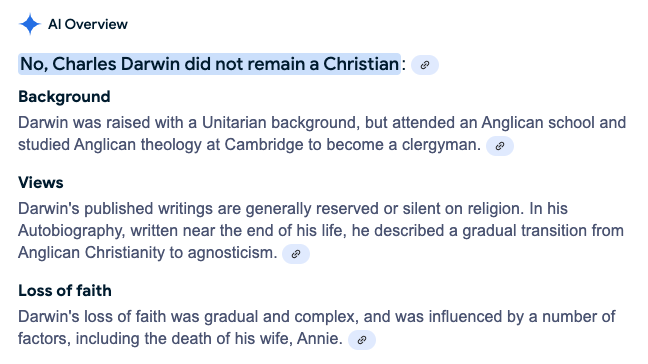
image

Following the lead of Charles Darwin is demonstrably foolish because of the image above i have posted. You can attempt to deny the above image all you like, however i don’t think anyone with any common sense will believe such a denial.

The problem is, I suspect that in the mind of the late Charles Darwin, doubt arose about the legitimacy of there even being a God. His own theory became his own vice and agnosticism is evidence of that. Eve became an agnostic momentarily when she doubted Gods command in the garden of Eden and took the fruit and ate it. Darwin suffered the same fate…the difference being, he doesnt appear to have turned back to a belief in the gospel.

Revelation 14:12 tells us, the saints are individuals who:

  1. follow the law
  2. believe on the Lord Jesus Christ, that he can save us from the wages of sin is eternal death (the gospel)

there is a huge problem with that woefully inadequite argument.

For one, given you are so demanding about what the text actually says, you have made a huge inference that isn’t even in the text.

The so called “second creation account” in Genesis Chapter 2 only consists of Day 6!

See the inference from your claim is that the Garden God “PLANTED Eden”. that this garden is a second creation event.

Read the text amigo…the text actually tells us that Eden already exists before God planted the garden inside it!

That means that this is not a creation event!

Genesis 2:5 only tells us that God watered the earth…nothing more!

therefore it pretty obvious, given the lack of description of anything more than watering the earth, that we must derive our evidence regarding the missing creation of vegetation from somewhere else…ie Genesis Chapter 1. This means quite obviously that Chapter 2…It describes in more detail where God actually placed the man and women he created in Genesis Chapter 1!

you can play games all you like with verse 9 of Genesis chapter 2…even by your own demands “that’s not what the text says” you cannot make the claim that verse 9 specifically tells us that this is when all trees in Eden were created…the text doesnt say that! The only thing we can claim from verse 9 is that the plants in the garden that God planted began to grow. Growth and creation are two very different things. I can argue God planted seeds in the garden, then watered those seeds, and they began to grow. The question is, where did the seeds come from? Obviously, the vegetation on the DRY LAND - EARTH from Day 3 in Genesis chapter 1!

If you want to try to make the theological claim that in Genesis Chapter 2 a new land mass appeared which did not have any vegetation…show that to me in the text!

And whilst you are at it, please explain to me that God commanded Adam he could eat of every seed bearing plant in Genesis 1:29 and that these same seeds were not used by God to demonstrate the planting of a Garden in Eden in Genesis 2?

Based on your belief in how the systematic theology of the Trinity doctrine is derived, and your “what we see now is evidence of the past” scientific premise…prove to me that my claim about the planting of the garden in the east of Eden in Genesis 2 is wrong!

No: my ‘literalism’ sticks with the text, yours imposes an outside human worldview onto the text.

No, but it rests on getting the text right, not on making up stuff and adding it in the way YEC does.

I do: I stick with the text and will not budge. I don’t worry about whether the text fits any of my preconceived notions, or whether it fits science, or whether it fits some denomination’s theology, I pay attention to the text and what it says. Logically that includes analysis of the history and culture and literary type and worldview; that is just the grammatical-historical method.

If by “narrow minded” you mean “stuck to the text”, then I welcome the label. You’re conflating two different accounts that have two very different literary styles, two different orders of events, etc., without any foundation in the text for doing do.

That’s no problem – just read Matthew 26 as the literary type it is, in its historical and worldview context.

No, those are part of the text that I stick with. I just don’t change their meaning to fit a modern scientific worldview the way YEC does, and you don’t like it. Well, tough: the Holy Spirit had no obligation to inspire a writer to make the text easy for you to understand, He expects us to study what His writer actually intended.

So your assertion is, as most of your accusations against people here, a lie.

Another lie, and you know it is. It is YEC that demands the text be fitted to science by insisting that it has to adhere to the standard of being 100% historically and scientifically accurate – a standard that does not come from the Bible but from scientific materialism.

Another lie. That I reject your forcing scripture to talk science does not mean I am trashing anyone.

If by “they” you mean YECists, that is 100% wrong: the main premise of YEC, that the scriptures must fit modern science, comes right out of secularism and naturalism. I refuse to interpret the text using science.

That is not the definition of “heretic” – get a theological education, please, so you’ll know what such terms mean.

So? Talk to someone who cares about Darwin.

Please get it through your head that I don’t care about evolution except to insist that you understand it correctly – it has no bearing on the scriptures. Indeed, in my view if you think that evolution can damage the scriptures then your faith is in the wrong place.

1 Like

No, I denied an inference that isn’t in the text. If you think that the second Creation story is about day 6, show me where the text says that!

Exactly – it’s an account of something distinct from the first account.

Um, that’s contrary to the text, which says that God made a man, that He made the beasts of the field, and that He made a “helper”.

That’s also contrary to the text, which flat out says “out of the ground YHWH-Elohim made to spring up every tree that is pleasant to the sight and good for food”. There’s nothing missing from that.

That’s exactly what the text says!

That’s contrary to the text – it doesn’t say that God planted those plants, it says He made them “spring up from the earth”.

Yes, but the text doesn’t say anything about seeds, it says that God made the plants spring up from the ground.

When no bush of the field was yet in the land and no small plant of the field had yet sprung up

It doesn’t say anything about “a new land mass”, so I don’t know why you made that up. But it does say that there were no plants “of the field”.

Because the two are not connected. The text says God had the plants spring up from the ground, and those plants bore seeds. That has nothing to do with where the plants that bore those seeds came from. God mad the plants spring up; that is enough for me, I don’t have to insert seeds in the text for God to be able to make plants spring up.

That has nothing to do with the text.
Once again you’re not paying attention but are slotting me into a preexisting category in your mind. I don’t fit that category; in fact I care less about forcing the text to fit science than you do – you demand of the Holy Spirit that He had to force His chosen writers to speak science, I just ask, “How did the Holy Spirit have His chosen writers speak?”

It is wrong because you are adding to the text. The text doesn’t say God used seeds, it just says that He made the plants spring up from the ground. If you want to compare with Genesis 1, then seeds aren’t needed – God wills what He wants into existence, He isn’t limited by material requirements.

Again, Genesis 2:4 refers to a single day for the creation of the heavens and the earth; that is not equatable with day 6. If Genesis 2:4-25 is describing just the setting up of Eden, that contradicts the claim that reference to the “earth” must be global when it comes to Noah. The law commemorates not just a week but also a sabbath year and a sabbath of sabbath years. References to creation elsewhere in Scripture such as Ps. 104 do not follow the sequence of Genesis 1.

Darwin developed his model of evolution before he developed agnosticism; many early supporters of his ideas were solidly Christian. The fact that his theology was not very good does not prevent him from accurately observing the patterns that God has created, just as the young-earth inclinations of Roman atheists doesn’t show that young-earth creationism is inherently atheistic.

2 Likes

I haven’t spent much energy on John’s Revelation or eschatology, because it seemd so overdone in my denomination. Mind-boggling I should say. And really more self-congratulatory than useful. I’ve been turned off by the predictive view that makes “us” the good guys, helping the Lord along, and other countries who are currently “our” adversaries the bad guys, etc, etc, etc. The pride that I perceive coming from it all is enough to choke on.

I’ve read one single book that discusses a historic view of Revelation. The historic view is rejected by my denomination, but I think that is hasty. I haven’t had time or motivation to dig farther, but I think looking into that mode of interpretation could be helpful to you, since it seems to matter a good deal to you.

The single book I read is *Apocalypse and Allegiance* by Kraybill. There are surely many more and many better books. But Kraybill’s is fairly short, does a nice job introducing the view, and does a good job explaining the examples he uses.

The references in John’s Revelation to OT prophetic writings can be something other than a continuation of those prophecies. They can be references to then commonly-known texts that could be applied to similar then-contemporary situations. We do this all the time with our own commonly-known texts and “texts.” When people say “There are more things in heaven and earth, Horatio…” they are not attempting to make predictions based on Shakespeare’s play “Hamlet” but to refer a situation they find similar in both the play and the discussion at hand. This is much similar to what Kraybill discusses in his book.

1 Like

A super feature of Internet Archive is that you can have the Internet Reader Window actually read the text outloud to you. The little icon that looks like headphones in the bottom right corner of the reader window will turn on the page-reader.

You know. Like if you’re busy working on something mindless. Or have lost your glasses years ago at work and haven’t made it to the optometrist to get a new pair.

1 Like

That is all too common. There’s so much triumphalistic “We Are the Champions!” attitude about the Second Coming it’s depressing. I agree with a point Corrie ten Boom make once: Christians shouldn’t count on escaping any tribulation, we should (as Jams says) rejoice to be counted worthy to face it!

1 Like