You mean like climate change itself? It must be the mother of all unintended consequences…
1 Like
Actually, no I am not. You are reading and conveying information. Information for which you do not have a background.
I am confused. The weather changes caused by global warming is supposed to be the whole point of this discussion.
You like to read so I would suggest you do some on how chaos would impact a computer model.
In any of your reading have you come across recent work on the effect of increasing cloud cover? Warming produces more clouds, more clouds reflect more incoming radiation, this reduces the warming.
Strange, I have read climate change people who claim, vehemently I might add, there was no pause.
Weather changes are short term things … such as: “my, it’s cooler today than it was yesterday!” or “I’m glad we’re finally getting a week without so much rain!” Neither of these has anything to do with climate - as in we can’t conclude that since today is cooler right here, therefore global cooling must be setting in. And we can’t conclude that since it stopped raining this week that therefore this must be the beginning of a long term drought. Our discussion is about climate. Long term. “Weather” only becomes significant if you look at its average over a long-term longitudinal study (i.e. climate) - and even that would only be “one data point” if it was all at the same location, since it would tell you nothing about the rest of the globe. Hence the silliness of thinking that weather right here and now has any bearing on climate change. But that’s not to say that climate change doesn’t influence weather. It surely does - we just can’d predict the particularities. Chaos means there is randomness on the small scale. But this doesn’t prevent predictability over a large scale. Just because I can’t tell you what the high temperature will be on January 20th doesn’t mean I can’t predict that January will likely be a cold month. And if it does turn out to be cold on January 20th, it will likely have something to do with the fact that that is generally a cold season. Perfectly predictable in general, but impossible to predict this far ahead in its specifics (that’s where the chaos comes in.)
This is ambiguous as it turns out. It depends what kind of clouds are produced. Some (lower stratus and cumulus) clouds do have that negative feedback, but other kinds (Cirrus) actually have positive feedback. So until one is clear what type of cloud cover would be increased it isn’t obvious that this would necessarily be a negative feedback. In fact current consensus is that the cloud effect would be a weak one and may more likely be on the positive side (but if so only weakly). [from a 2010 study by A.E. Dessler as cited in Mann’s: “Madhouse Effect”.]
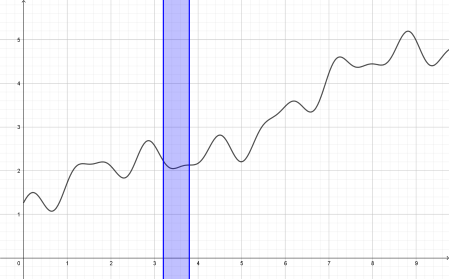
That’s probably why Alan used the word “apparent” as a modifier. Be careful to keep words in context. If I only look at a narrow time sliver of a graph such as the selection highlighted in blue below, I could refer to an apparent “pause” in the function. But anyone taking stock of the rest of the function visible could rightly ask: “what pause?” The function on the whole is increasing. They are both right when limited to their own context. And of course one can fairly ask if the entire view on the graph might not just be part of a larger trend not at all apparent in the portion we see. Sure. If one is willing to zoom out far enough, eventually there will be points where all bets are off and we just have too much uncertainty. But one would be a fool based on what is seen in this graph to predict that it will start a steady decrease just beyond its edges.
3 Likes
So he looked at one model? Did he notify any scientists at all about the problem? What was their response? Don’t you think scientists in general verify their models? Do you think there is a cover-up/conspiracy?
Climate is what you expect. Weather is what you get. The way I read Alan’s statement was the changes in weather are not related at all (note the exact wording he used) to climate change. This is false. They have to be related of course.
Alan pointed out some good reasons for the “apparent” pause. I was just pointing out that I have read people “who claim, vehemently I might add,” there was no pause for the same time period. Sorry if I didn’t make that clear. I am guessing they don’t like the optics of admitting temperatures didn’t continue to climb for the simple reason it would give the deniers something to throw back.
These are models used for forecasting weather, not climate change.
I believe he used at least two for his dissertation, but is familiar with all of the current weather forecasting models. He regularly attends conferences on the various models.
Yes. He did provide the updated micro-physics package to the community.
Thank you.
In this specific case, no. The model worked, it just wasn’t as accurate as it could have been.
Of course not.
That seems pretty glib for someone who admits to also not having any expertise in the field in question. Alan has at least offered sources for his assertions. If you have reason to question those sources you haven’t shared that.
Nearly everything you’ve offered has been off hand, what you’ve heard or what someone you say is more qualified thinks. That is pretty casual.
1 Like
This is a homily, not a proper definition.
I’m neither a climate scientist nor an electrical engineer so you may not care for my lay person reference to wiki. But regarding the difference between weather and climate they say:
https://en.wikipedia.org/wiki/Weather_and_climate
I think you are treating my friend Alan with hostility he doesn’t deserve but I would rather not answer in kind so I’ll give it rest for tonight.
2 Likes
Alan has offered his notes taken from a variety of sources.
Sorry but my son would be fully qualified. Do I have to scan his PhD diploma? You want to see his CV?
Never intended it to be anything but casual.
I thought a homily was a religious discourse.
Sorry but that is saying exactly the same thing I did, just using more words. And, BTW, I love wikipedia.
Generally, there is no doubt that CO2 levels are increasing and from this climate change is inevitable. The sad situation has arisen in that debate on this has overshadowed discussion and action that should be taken to reverse the trend of increasing CO2 levels. This is made more problematic by the zeal displayed by non-specialist in promoting solar and wind as the solution - it is beyond dispute (and credulity) that these are intermittent, and would provide power for only a fraction of the year (just to mention one obvious problem amongst many). Yet the overall debate is stuck with the idiotic views on no-climate change and solar and wind will solve all problems.
We must move beyond these trivial matters and seriously develop solutions to ultimately avoid the consequences of endless increases in the emission of GHG and resulting changes to the plant.
1 Like
Nothing will solve all problems since CO2 and other GHG emissions are so pervasive in our system. Nor is anyone maintaining that the solutions to climate change are necessarily the best ones, all else being equal. The problem is that not all else is equal, so now our second- or third-choice technical solutions must become our first choices. What exactly are the alternatives, if breeder reactors are not yet available?
You talk as if the people promoting solar and wind are not well-aware of the intermittency problem. Here is the quick summary from my paper:
Since renewable energy sources so often suffer from intermittency problems, new solutions are required to deal with them. Smart, flexible grids could shift power by regions. Banks of batteries, pumped storage, and other storage methods could be employed. Redundancy of sources can also offset intermittency. One estimate is that 290% of the power needed for peak times would keep the need for storage back ups to a minimum. [Solar could help offset the intermittency of wind, and visa versa.]
Much new infrastructure will be required to transmit and store the energy generated at different times and locations by solar and wind power. Nevertheless, solar and wind power ultimately should be able to supply 80% of our electricity needs. Considering how much baseline power is already provided by current nuclear, hydroelectric, geothermal, and biomass sources, that 80% will be more than enough to replace the burning of fossil fuels. There is also some question as to whether sufficient supplies of certain rare metals required for solar and wind power will be available at the scale necessary for massive new infrastructure, but people are working on such materials issues.
The Germans committed themselves to having 80% renewable energy by 2050, and are well on their way to succeeding. Even without a local climate favoring solar energy, in 2012 one third of the world’s solar infrastructure was located in Germany. The predicted economic disaster did not materialize. Instead, more jobs were created in new industries.
For general information about climate change, please read the information available from NASA online:
Specifically, for the scientific consensus see:
I am aware of advances in solar (and other renewables) and the measures needed - I am also aware of the increases in the cost of electricity that has resulted. The costs in Germany may be acceptable to the wealthiest country in Europe (although I wonder how the poor cope), and I would challenge you to show how poor countries could cope with such systems.
We have a direct experience in one state in Australia that has used storage batteries with renewables, and with considerable subsidies - yet not one news report has discussed the expensive power generators they bought as back-up, nor the fact that these units that can be rapidly deployed are amongst the highest emitters on the market, and perhaps the most expensive.
There are countries with natural resources that can reach high levels of renewables, and I say good - New Zealand has over 90% renewables, and these are mainly hydro, and little solar. The UK on the other hand, has built a nuclear plant funded by the Chinese (mostly) which is probably the costliest power sold anywhere.
Coal plant can be designed to operate with lower emissions, and plant has been proven that can produce a stream of CO2 for storage on site, and used as a raw material to synthesise valuable material. This hybrid concept has the potential to produce low cost power, and such a plant would have two income streams. Renewable (solar, wind and other) can be integrated in a grid that would use excess power at low (off-peak) demand, in the synthesis plant. The result would be zero-emissions, with an affordable use of renewables where appropriate.
People have been so intent on opposing coal, they may prevent advances such as these - as I have stated previously, old coal power plant should be closed down methodically and replaced with low, to zero-emitting plant, while keeping the cost of power at affordable levels.
1 Like
Well, there was no actual pause in warming caused by climate change. Instead, the warming was offset by cooling because of natural variability.
Please remember that many denialists do not argue in good faith. They jump on such issues to try to create doubt about the science, exactly to delay useful action. It’s no wonder people get short with them. Scientists really are doing their jobs.
As for cloud cover, yes I have read about it. Modeling the behavior of clouds is one of the more difficult problems in computer simulations, and scientists are well aware of it:
" So in summary, these are the things we know:
- Clouds cool the present day climate overall,
- We are now able to represent cloud processes much better in at least some global climate models thanks to learning from much more detailed models – and doing this improves results,
- Satellite observations of clouds have been helping to test our models,
- Projections of future cloud changes vary due to approximations of cloud processes in the global models and differences in the future large scale circulation patterns between models."
I would guess that poorer countries will have to learn to live with the problems of intermittency unmitigated by expensive technologies, or resort to fossil fuel backups in a pinch. That may very well entail dire results in some circumstances. We are really up against a wall.
The emphasis in developmental effort by rich countries must be on high efficiencies at relatively lower costs - if solar and wind can meet such criteria, well and good. If they cannot, then we should move to other technologies. The results should be offered to poor countries as this will benefit all of us.
Yes, richer countries will likely have to help out poorer countries so that we can all adapt.
Some economists recommend a revenue-neutral carbon tax, incrementally adopted, to effectively deal with climate change. Such a tax is much simpler than cap-and-trade. Because a carbon tax would hit poorer people harder, it can be implemented so that taxpayers will be paid dividends, or given tax cuts, making it revenue-neutral. This will encourage behavioral changes without increasing overall taxes. Such an approach would allow the marketplace to make investment decisions rather than the politicians. Some economists recommend a carbon tax of $40 per ton of CO₂ to discourage emissions, but with current subsidies we actually pay $15 per ton to encourage them. The IPCC projected that if a carbon tax was ramped up to $80 per metric ton of CO₂, it would stabilize global temperatures by 2050. A carbon tax could also make nuclear power competitive again.
That would encourage CCS schemes like you have mentioned, if indeed they are cost-effective relative to solar and wind.
Taxes equals politics and handling large sums of money = an explosive and difficult mixture. My view is that we should encourage entrepreneurs who can make money from low to zero-emissions technologies. If they take the risks, they should take the rewards, and governments can than enter into agreements that help poorer nations. This approach may be disruptive and also cause political agitation, but it has practical merit.
1 Like
Yeah, I started the argument at the end. The problem is that the playing field is not level because of externalities. Without correcting that problem through a carbon tax, or some similar approach, you won’t harness the full power of capitalism to deal with climate change.
Externalities are costs which are not figured into the prices of commodities. In the case of fossil fuels, there are many such externalities, including the health costs of pollution, the military costs of defending oil-producing countries overseas, and the subsidies and tax write-offs which fossil fuel industries receive.
Such externalities are market failures, since the true costs aren’t reflected by market prices. The prices are wrong for nearly everything because of embedded CO₂. Those who benefit don’t pay the costs they should, which creates perverse incentives within our economic system to engage in climate-changing behaviors.
Global subsidies for fossil fuels run at about $500 billion dollars a year, many times what is spent to encourage renewables. If consumers paid directly for the subsidies, tax breaks, and military protection for oil, one estimate is that costs would run about $2 a gallon higher at the pump. Plus industries pay nothing for using our common atmosphere as a carbon sink. And that doesn’t even include the huge and growing economic impacts of climate change. If those funds were merely redirected, we could encourage renewables without enlarging the government. A true free market would charge both companies and the individuals who use the fuels. Instead, we privatize the profits and socialize the costs of fossil fuels.
Although our own environmental standards have tightened, companies get around them by moving manufacturing to countries with less strict regulations. That effectively moves our fossil fuel emissions across borders and overseas, and incurs huge transportation emissions as well. But the emissions all end up in our common atmosphere. Between 1995 and 2005, Europe reduced its domestic emissions by 6% while its total carbon emissions got worse by 18% due to such imported emissions. Similarly, we are moving our deforestation to other countries as well.
For these reasons, economists encourage us to make the costs of emissions a part of the costs of the products we buy, so there will be a strong incentive to find better ways to produce products without emissions. This could also bring jobs back to America.
A cap-and-trade system is complex, requires the creation of markets, and is not transparent. Fluctuating prices make it difficult for companies to plan for a clean energy future. Such problems lead to abuses of the system, so that a cap-and-trade system broke down repeatedly when it was tried in Europe. It is, however, working in some places like California. Nevertheless, cap-and-trade sets a floor rather than a ceiling on emissions, results in reductions which are less than targets because of offsets, and exposes the whole system to potential market failures because of its complexity. In 2009, Congress voted down a cap-and-trade system designed to cut U.S. carbon emissions 70% by 2050.
3 Likes