@Jay313 thanks for posting your questions about these estimates. Your confusion here is probably very common, but your effort to closely read the paper helps everyone.
Except there are now. There are now. My estimates are pear reviewed.
They do not explicitly model these changes. Moreover, the discuss exactly what it is that incerases wait times:
Unrealistically low amounts of migration.
Very remote islands (which are only colonized within (about) 3,000 years.
Population size. There is 8 billion alive now, but 5 kya there are just 18 million. 10kya there are just 2 million.
Yes, but that will most likely overestimate the time to UGA. Several types of migration are not accounted for in their model. This one of the big critiques advanced, that they were too conservative.
The variance of the IAP is very high. The variance of the nearly IAP is much much lower. So 15 kya is not what the range for the nearly IAP is.
This calculation is not valid on the high end of the range, because the variance of nearly IAP is much lower than the variance of IAP. Moreover, for a couple in Mesopotamia, the IAP is not really relevant. Only the nearly IAP is relevant, because that is a nearly ideal position. Taking into account the population boom of the agricultural revolution that spreads across the globe from here about 10 kya to 8 kya ago, we just expect that Adam was ancestor of everyone when civilization begins. As knowledge of agriculture spreads, so would his ancestors.
Note, the Rhodes paper does not at all consider the population boom of the agricultural revolution at all, which caused a massive amount of global migration. They do not consider any population level migration at all, which would reduce the estimates dramatically.
I did give ranges (see figures). I also erred often towards more conservative estimates. The goal was to give a likely estimate (but also conservative) given what we know now. I also discuss how those estimates could be improved.
This is only applicable if, for example, Easter Island and Hawaii needs to be colonized. For the time ranges we consider in theology, that makes universal ancestry much easier.
I will point out too that this only matters if you must place Adam 6 kya. Most people who want to preserve the genealogies are not trying to do this. They just want Adam within 10 kya and in an agricultural setting. In that context, there is just no difficulty at all. It would be difficult to imagine how they would not be ancestors of all without positing genealogically isolated populations (which are unobservable).
However I never place Adam with MRUGA. I place instead with a vanilla UGA. We expect they arise everywhere, are often in couples, and there is much higher certainty in estimates about them.
Think about it, if Adam was monogamous and a UGA then for a fact Eve was too. That is just by basic logic. Your objection here is not correct.
Even in the case of Kahn or Charlemagne this is not a problem. Because at least some of their wives are also UGAs too. So then that would be a paired couple. (this is also contingent on them leaving far enough in the past that they are UGAs)
Regarding your second question. That gets to the heart of the confusion. You are trying to transfer your instincts about genetics to genealogy that does not work, and will confuse you every time.
The difference is that m-MRCA and y-MRCA are singular. UGA (do not confuse this with MRUGA) are plentiful and every where. Even MRUGA is not singular but arises simultaneously everywhere. There is no reason, however, to think Adam and Eve must be MOST RECENT, so UGA is just fine.
This figure is helpful…read it in detail and more of this will make sense…
Genealogical ancestry is not genetic ancestry. Illustrating the story in the text, we show a cartooned pedigree, a genealogy, from past (top) to present (bottom). Squares and circles denote men and women, respectively, with lines indicating parentage. Red and blue individuals are those in the genetic lineages to a single ancestor, Mito-Eve and Y-Adam, respectively. In contrast, every individual with a black border is a common genealogical ancestor of all those in recorded history (grey box). The Scriptural Adam and Eve (the black box and square) are created from the dust and a rib less than 10,000 years ago, have no parents, are in the Garden of Eden (black box), and are genealogical ancestors of everyone in history. This story is entirely consistent with the genetic data.
We are not talking about MRCA or MRUGA. We are talking about UGA, which is what many people believe is taught in scripture. There is no claim about MRCA or MRUGA, but there is a claim (some people think) about UGA.
It is critical to understand the form of this argument they are making. They are arguing for a very difficult to believe conclusions, so they built the simulation with a whole range of barriers against recent UGA to (1) make it match the theory closer, (2) head off criticism that making the simulation more accurate would increase time to UGA (in fact it woudl decrease time), and (3) test the dependence on several variables. They find..
The only important variable is migration levels, nothing else they tweaked with had a strong effect.
Several features they did not model are all expected to decrease time to UGA.
IAP has high variance (so they cannot really find strong relationships to variables here), but MRUGA has lower variance, and nearly IAP has lowest variance. We care most about nearly IAP (and I explain why in the paper)
Now regarding the migration (and other details), they intentionally used a model designed to increase the time to UGA, so their final conclusion would be most strong.
Ony move per person per lifetime. No offspring before move.
Lifespans are high, just as you noted (which increases time to UGA), and has the effect of reducing migration (see #1)
Migration (except when demanded) was as individuals, no populations), which dramatically decreases intermixing.
Unrealistic high limits to migration between continents (e.g. only about 100 individuals / generation between europe and asia) so simulation would match their theoretical analysis, and to support their argument that more realistic migration would continue to support their conclusion (making UGAs more recent).
Ignoring known large scale migrations and trade routes (e.g. the Silk Road)
Assuming all couples are monogamous (unless absolutely required not to do so). So prostitution, infidelity, polygamy is all ignored, which would all dramatically reduce time to UGA (but also be much harder to model).
Ignored outbreeding (anti-incest taboo) cultural push entirely.
Used very low levels of migration, and it is only in even lower unrealistically low migration that MRUGA increases.
It ignored the effects of large scale population interactions like refugees and war which has an effect of totally mixing populations over long ranges.
It ignored entirely modern transportation like global travel in airplanes. (@Chris_Falter, does this help with your question?)
So each of these simplifications pushes the UGA estimate farther back in time. That is why this result has stood the test of time (13 years now). A more realistic simulation is possible, but because they biased their simulation so heavily against recent UGAs, a more realistic simulation is expected to reduced time to UGA. That is why no one has even attempted to challenge their results, and this is accepted by population geneticists.
Whatever skepticism you may have, I am certain they have faced more from more trained people. Getting a paper like this into Nature is no joke. It is very difficult.
Is this you just being difficult? None of the criteria we are explicitly worried about has to do with “genetic contributions” … it is principally about “genealogical contributions” - - which are much less technical, and easier to track.
And from what I’ve seen of the Federal Headship discussions… it seems the phrase “Federal Headship” to be a virtual synonym with “Divinely Created Universal Genealogical Source”!
1 Like
T_aquaticus
(The Friendly Neighborhood Atheist)
12
Isn’t “multiple UGA’s” a contradiction in terms?
As to the UGA being a couple, I will look into it and work through the concepts.[quote=“Swamidass, post:7, topic:37071”]
The Scriptural Adam and Eve (the black box and square) are created from the dust and a rib less than 10,000 years ago, have no parents, are in the Garden of Eden (black box), and are genealogical ancestors of everyone in history.
[/quote]
How can they be the genealogical ancestors of everyone in history? Perhaps you misspoke?
First, they can’t be the ancestors of generations that existed before them. Second, they wouldn’t become UGA’s until well after they had their children. If I was reading Jay’s review of some of the references, the UGA’s of modern population didn’t become UGA’s until very recently meaning that there were still lineages in the past that were not directly tied to the modern UGA.
And I will repeat my the caveat that I often use. I could be completely wrong about this and am open to any correction.
1 Like
T_aquaticus
(The Friendly Neighborhood Atheist)
13
Not at all. Have you had a chance to read the preprint yet? That will help make sense of it. You are scientist too, so you will enjoy reading the references. It is really interesting body of work I am tapping into here.
Everyone in “recorded” history in this case. “Everyone” is totally ambiguous term, so is “human.” Admittedly, this is a bit ambiguous in its wording. It is also the wording used in the literature to refer to “all those alive today.”
Put a more precise way, when recorded history begins about 6 kya, everyone is a descendent of UGAs alive 10 kya.
Alternatively, we could also say an Adam 6 kya might be the ancestor of everyone mentioned in Scripture after Genesis 11 (with a few exceptions like, say, Melchizedek if want it so), and also would be the UGA of all Homo sapiens across the globe by AD 1. This is, admittedly, pushing things to the limit (except for the fact this is a conservative estimate). It is more as an illustration than a serious proposal.
That is about correct. Those other lines, by definition, are not what I mean when I say “everyone.” Also none of them appear to be in recorded history. Put a more precise way, when recorded history begins about 6 kya, everyone is a descendent of UGAs alive 10 kya.
You are, but it isn’t your fault. This is a really subtle issue. We have a tendency to translate “ancestry” into “genetic ancestry” with all its entailments. This just misleads intuitions entirely.
They are actually nearly opposite in discourse, though potentially the same as you recognized here. @Jon_Garvey can comment.
The representative model of headship was proposed because UGA seemed impossible. Now, in theological discourse, “headship” and “representative” are often used interchangeably. But this is an error. As you have noticed, genealogical ancestry is another way Adam could be the “head” of the human race. It need not be by representation. It is possible @LorenHaarsma might comment.
Though I am not a theologian, I think genealogical headship is much more plausible than global representative headship. We cannot even have that conversation though, till we separate representative from headship, and this will take some time.
How so? Christ’s federal headship over the church, to which Adam’s federal headship is a parallel, has nothing to do with ancestry. It’s a purely spiritual concept. So is the concept of Gentiles being “grafted in” to the Jewish family of God, despite no “ancestry” with Abraham.
Yes I know. Except, we also all also genealogical descendents of Abraham.
The issue, which @LorenHaarsma points out in his book, is that Adam as representative has precedence and coherence when we think about a “tribe” of people in a localized place. Especially if this is a single group that chose to be together, they bear consequences for the leader they chose.
However, this is not the situation we see in a representative Adam model. Here, people are spread across the entire globe. It is not clear how or why God would choose to hold people in the America’s immediately responsible for the actions of Adam in the Middle East. Because those in America are certainly not locked in a social exchange or common community with Adam, it does not makes sense to they would bear guilt for his actions. There has not yet been a good explanation of that put forward, at least as I understand it. Though @Jon_Garvey and @LorenHaarsma can jump in of course.
A more plausible approach is @JohnWalton and @tremperlongman’s cultural pollution model. However, at least some theologians, and myself too, find its interaction with Christology to be inadequate. I do not feel it gives adequate explanation of why Jesus is subject too all the temptations we are, but was able to resist them. It also looses the traditional importance of the Virgin Birth in explaining this resistance to traditional sin. Maybe it is correct, or part of the story, but there seems to be some large holes in the theory.
I do agree no one has yet put forward how this can make more sense in genealogical transmission, but I have seen a very good proposal that is currently unpublished. Give that time. Aside from the traditional emphasis on a genealogical transmission, there is more coherence to this that avoids the problems of “cultural pollution” and “representative”.
I think it is correct, nonetheless, to consider these all different types of headship models, with variations on transmission of headship. They are not all equivalent, however, in their coherence.
How is this problem solved by ancestry? How is it less problematic for God to hold people responsible for ancestors their people have no knowledge of or connection to than “leaders” their people have no knowledge or connection to? You don’t choose your distant ancestors on the other side of the globe either.
It’s difficult discussing any federal headship model in what is the most abnormally individualistic culture the world’s ever produced. The idea of corporate responsibility doesn’t sit comfortably with us ever - and yet we still recognise it is some way: only yesterday our Prime Minister apologised to people who were prosecuted under laws she and her government had no part in making (centuries ago!) - and they still talk about reparations for the Second World War when most of those involved have died.
Federal headship in Reformed theology was a way of viewing our accountability for Adam’s guilt (including explaining why we die) forensically in the context of a broadly literalistic understanding of Adam as the first man.
I know good people who retain the same view of accountability for an Adam representing (unelected!) an already existing, rather than a future, race. “Horizontal” accountability, rather than “vertical”, you might say. Representatives don’t need to be blood relatives.
Yet on the face of it, as Joshua says, that seems a rather diffuse model of human solidarity compared to being descended from Adam. And it really doesn’t answer the question of the transmission of the sinful nature. However, as I suggested, it’s hard to know for sure if God shares our opinions on representative democracy (including the very recent idea that if unless you vote for someone, they don’t represent you).
The examples I mentioned in modern politics are quasi-genealogical: decisions made by previous generations bind ours (eg the US constitution or ancient laws) as “the descendants” - and yet they also bind immigrants into a nation - but not people in other lands. We still recognise the “rightness” of that, so it seems to me there is still a strong instinct of family/tribal solidarity for which the genealogical Adam hypothesis makes sense. It may have been my great grandfather who confiscated Old Masters for the Nazi party, but if they’re hanging on my wall, I’m guilty too.
Hi there @Swamidass, I confess I haven’t read this entire thread, but I perked up at this discussion of federal headship. Federal headship, as far as I can tell (not being a theologian), is by definition headship by representation. I don’t know the full history of headship theology, but most of the people in my own community, who embrace covenant theology, wouldn’t doubt UGA because they are YECs who think we are of course directly related to Adam. So federal headship is not a modern innovation to deal with problems raised by evolution.
@Christy is right in saying federal headship is a theological concept. That isn’t to say it settles whether or not the Adam you have proposed did or didn’t exist. It seems to me, though, that genealogy is overshadowed in importance by the biblical notion of adoption.
We are not welcomed into God’s family because of our ancestral relationship to Jesus (which nobody has, since he had no children). Our relationship to Christ–who, it should be noted, is called in Scripture our “elder brother”–is co-heir (8:17). So we are not related by blood but we have all the same rights as if we were.
Working backward from NT to OT, it seems clear that Adam is our representative first and foremost, and is perhaps (but may be only incidentally?) a relative genealogically speaking. Genealogy would only seem to matter if our sin nature was biologically passed down (a la Augustine), but it need not necessarily be, as you have already pointed out.
In any case, please forgive me if I’m treading over ground you’ve covered lots of times elsewhere! It’s an interesting discussion for sure.
5 Likes
gbrooks9
(George Brooks, TE (E.volutionary T.heist OR P.rovidentialist))
21
No, I don’t think I am. The whole point of Swami’s efforts is to separate the conventional arguments about genetic contributions (from Minochondrial Eve and Y-Chromosome Adam)… from the more relevant issues - - more relevant to issues like Original Sin (with Federal Headship as one of the more popular corollaries) - - which are not about genetics but about Genealogy.
So, after he posts a dozen or so discussions on these distinctions between Genealogy and Genetics, to have someone say:
. . . it would seem someone is missing the point - - but how could this be, after all these preparatory discussions have already been laid down?
1 Like
T_aquaticus
(The Friendly Neighborhood Atheist)
22
Then I don’t think I am being overly difficult. Problem solved. ;)[quote=“gbrooks9, post:21, topic:37071”]
. . . it would seem someone is missing the point - - but how could this be, after all these preparatory discussions have already been laid down?
[/quote]
I am not confusing genetics and genealogy. I understand the difference. That is why I used MRUGA instead of MRCA.
1 Like
gbrooks9
(George Brooks, TE (E.volutionary T.heist OR P.rovidentialist))
23
Something you wrote (above) kind of stopped me in my tracks! Okay . . . if Federal Headship is a “representative” mechanism, is that the same as saying that Federal Headship does not work like magnetism … and only attracts the right kind of metal?
If God uses evolution to create 10,000 humans in one valley (this is the group that Cain marries into)…
and God creates 2 humans in the other valley (the offpsring here will eventually be the Adam & Eve population).
If God releases the Adam & Eve group and releases them into the other valley - - mixing thoroughly with the other population,
Is God going to
A: Consider that “spiritual Adam” (since he is dead now) has Federal authority over all the humans, regardless of genealogical connection?
B: Consider that “spiritual Adam” (since he is dead now) has Federal authority over all the humans, but only for those who have Adam in their ancestry?
There is a precedent on this “representative” status as established by God. Israel was the Chosen People. Then they fell away, and followers of Christ became the chosen people. It seemed clear that Jews, unless they became followers of Christ could not be chosen.
But what if someone from one of the first Christian groups Ever (!) became Jewish? Even though he is genealogically connected to the new Chosen People (the Christians), stepping away from the Faith disqualifies him.
So, would we agree that Representativeness is really not about genealogy, but about faith and devotion within the mental state?
Another thing to add to this (excellent) comment is that even though God worked through the Israelites as his people, there was always an option for non-Jews to become part of the people of God. Ruth is one example of many. God doesn’t seem to care about genealogical ancestry as a barrier to being one of his followers.
True. Another example is the Kenites. Moses had a Kenite father-in-law, and the Kenites were allowed to settle in Israel. Of course, when foreign wives introduced the worship of foreign gods things were not so friendly.
Whatever concept the first century Jews had of ancestry, they definitely did not conceive of everyone in the world as having Abraham as their ancestor. Take for example John 8. The people’s pride in being descendants of Abraham, “legitimate children,” and their insult of Jesus as a Samaritan don’t make any sense if everyone counts as a descendant of Abraham.
So whether or not modern genealogical science can show everyone then did indeed have Abraham as an ancestor seems pretty irrelevant to me. How does this new concept of ancestry help illuminate Scripture if it wasn’t the concept of ancestry the people had back then?
John 8:48: The people retorted, “You Samaritan devil!
Jesus wasn’t a Samaritan. But it was an insult to call him one because they were not legitimate children of Abraham.
Oh, okay. The Samaritans were actually half-breeds: Israelite commoners not carried off by the Assyrian conquerors and the non-Israelite foreign peoples imported into the area. And the Jews did hate the Samaritans. But the Samaritans also were children of Abraham.
But they didn’t “count” theologically as children of Abraham in the minds of the Jews. So why would everyone in the world “count” theologically as a child of Abraham just because in 2017 we can model the ancestry and show Abraham was an ancestor of all? That’s my point. What we can model ancestry-wise today is irrelevant when it comes to interpreting first century Jewish texts.
What mattered to first century Jews was membership in the covenant community, which was defined by Torah observance, not genetics or genealogy. Paul re-defined how community membership was attained (through faith in Christ) and attested (access to the Holy Spirit) and that was his basis for welcoming Gentiles into the covenant community. Ancestry did not matter. So why should it matter now?
What’s your point? Samaritan’s didn’t write the New Testament, and they weren’t considered Jews by Jews, so their religious practices aren’t relevant to interpreting the New Testament either.
The matters that matter, and cause so much bother (oops ) are the genesis of Abrahamic faiths, the genealogy of Christ that goes back to Adam, and the gospel message that we are all sinners, starting from Adam, and in need of salvation in Christ. All of these matter, and we are not (and should not) in a position to re-write biblical passages, or introduce novelty to the Gospel message.
In one sense this is the crux of the matter, but I would rephrase it:
We as humans are still debating the question, “What is a human being?”
The biblical view gives us an idea of what constitutes a human being, and what we can consider of human communities, and the central idea has been, how we respond to God and goodness. Part of this view is that we are responsible for our actions and choices, before God and man. The fact that we can speak of individuals who were firm in their faith in God, even when entire communities turned away from God and His righteousness, is also a historical fact.
The debate should not be imo simply on details of an ancestral Adam (since the biblical narrative contains all the information we need), but the stark difference regarding “what is a human being” put forward by materialists, which differs greatly from that taught by the Gospel.
Before I answer, I just want to clarify my purpose here. I understand that people are very passionate about these theological points and that I am explaining “minority” positions on the forums. I want to emphasize that I am not actually promoting my personal position here. I am instead advocating for the empty chair, those historically excluded from this conversation. I’m explaining what I have come to understand from places like TEDS, Concordia, Multnomah and other interactions I have had with theologians outside the BioLogos tent.
Also, I want to request (from everyone) to hold off on pressing their concerns about identifying populations as sub-humans. I do not want to get into that now, and it has been dealt with on my blog and Jeff Hardin’s post last weekend. It has no relevance to this conversation.
Federal headship is a theological concept that most theologians agree too, but is not the same thing as a “representative model of Adam” or “headship model of Adam” in evolution. The reason why many people who affirm federal headship reject it in relation to Adam in evolution is because that is a fairly large innovation on the standard conception of Federal headship.
The Starting Point
The theologians I’ve talked to always identify federal headship as a feature of covenantal communities. Covenantal communities are formed in different ways and have different ways of propagating. Usually, there is some combination of:
Adoption into the community (as is emphasized in the new covenant and at times happened in Abrahamic covenant).
Genealogical Descent (usually consecrated by, for example, baptism or circumcision).
Founders of the Covenant themselves.
Examples of different covenants are, Abrahamic covenant, Mosaic Covenant, the Marriage covenant, Covenantal friendships (David and Jonathan, Ruth and Naomi), and the new covenant in Jesus. All appear to follow some variaiton of just these three rules.
Moreover, in all these cases, the covenantal community requires some sort of positive action to maintain connection to it. That is why, for example, some of Abraham’s offspring were able to leave the covenantal community, and so we are not all considered Jewish. That positive action an dparticipation is why it is called a covenantal COMMUNITY. There is presumption that we must be part of the community to be subject to the covenant. In no case that I know of (correct me if I am wrong), nothing binds one to a covenant community. One can leave the covenant when they want.
In these contexts, we can imagine the importance of “federal heads,” and we can see naturally how the actions of the “head” can transfer blessing and punishment upon the whole community. This is how most people understand covenantal communities and headship.
The Problem with Representative Adam
In this section I am referring to Representative Adam as is usually understood within BioLogos, see Origins by @LorenHaarsma for a primer.
The problem with transposing federal headship onto Adam in evolution is that this requires a large revision of our understanding of federal headship, essentially divorcing the concept from covenantal communities.
There is no global covenantal community that links all our ancestors across the globe when Adam lives. If they are not in a covenantal community with him, how is their head? In every other case there is a “head” there is a covenantal community. How is that possible?
Why are all our ancestors across the globe inextricably bound to the Adamic covenant and cannot leave it? They never joined the community (which does not appear to exist), but some how they are bound to it nonetheless. How is that possible when every other covenant can be broken and left?
It appears that God imputes original sin on all humans independent entirely of their participation and collaboration with Adam’s sin. It makes sense why Eve is bound to Adam (she participates with him), but why are people in America held equally responsible? It does not make sense unless somehow we think God wanted to make them subject to original sin, so he set up the covenant to implicate those who did no wrong. That is just too hard a lift for many theologians, though I imagine some who affirm predestination might have no problem. At the very least, it is hard to motivate from God’s nature, and seems to be therefore very ad hoc.
It raises a substantial Christological problem, and this is a tipping point for many people (if #3 was not enough). How could Jesus have been fully human without being subject to Adam’s representative Fall. Most theologians hold Jesus as an unfallen human, and all orthodox humans hold that his fully human. Other than divine fiat, what makes him different yet fully human but not subject to Adam’s representation?
Once again a Christological problem, the traditional way this issue of Jesus’s nature has been resolved is by way of the Virgin Birth. This is lost in the representative model. If God can just by fiat declare that Jesus was not naturally born so he was not fallen, it raises the question about why he did not by fiat just say that naturally born children of Adam/Eve are not fallen either. There does not appear to be a satisfying answer. Traditionally, the Virgin Birth is supposed to be the key hook to resolve the riddle, even though several different approaches have been put forward.
All this extra twists (#1, #2, #3, #4, #5) all raise a great deal of concern among many theologians about the coherence of this solution. At the very least, it is a fairly large revision of federal headship that disconnects it entirely from an visible covenantal community. This disconnection undermines its continuity with historical conceptions of federal headship quite substantially.
How Genealogical Transmission Is Helpful
Now, one way to think about a representative Adam is that it is exactly right, but all its problem arise because the transmission mechanism is not specified. That failure to identify a transmission mechanism calls for too many deus ex machina jumps in how we become to Adam’s headship.
Genealogical transmission of that headship is a pretty direct way to make sense of that. All the problems identified in the prior section evaporate, and we immediately link into an immense amount of traditional theology here too. We still claim that Adam is our federal head. We say that he becomes our head as his offspring spread across the globe.
There is some important questions about why God would have set it up this way. I will say that there are some very interesting (and unpublished) solutions to this that root it directly in God’s nature and the Genesis nature. To see those, we will have to be patient. The key thing is that there are some first principles ways to understand why…
we cannot opt out of Headship by Adam,
God did not set it up this way per se, but i tis a natural consequence of the interaction between Adam and His nature (unpublished),
this still allows for adoption into Adam’s line, but from our point of view it is all (at least) genealogical now, and
Also this makes sense of the Virgin Birth in a more coherent way than before.
we are still subject to headship by Adam in the absence of a covenantal community.
I will defer to @Jon_Garvey to fill in some of his thoughts. THough I do not think he knows of the genealogical Fall theory I am referencing.
This, many would say, is a contrast between the Adamic and the Messianic covenants. Adam is by genealogy, Jesus is by adoption. We do not have to agree with it, but that is how many see it.
Exactly.
Cultural pollution also has similar problems in Christology, which is why is not accepted by many theologians. It also renders irrelevant the Virgin Birth, which is a fairly large departure from traditional theology. I think they are partily correct, but this cannot be the whole story. It leaves too much unanswered on the table. May people call it semi-pelagian, and I see why.
No one is talking Augustinian here. I am certainly not. His mode of transmission is impossible.
Nor am I talking about biology. I am talking about genealogy. There is some fairly important distinctions here.
Your contribution is welcome. Glad you can join us. I hope you can follow up too!
I also want to repeat that I mean no disrespect with this critique. I am just trying to explain why representative Adam has not been acceptable to many theologians. I understand many people hold to it, and I am okay with them continuing to do so.
Yeah, but you still have the issue that people are “inextricably bound” to this ancestry by no choice of their own and can’t leave it. How is it any less problematic that you have specified a different mechanism? Sin nature is still spreading through procreation choices that an individual had no control over. People are still being counted as part of a community they never joined and can’t leave (fallen humans).
Yes, but universal ancestry doesn’t “solve” this. It still appears that God imputes original sin on humans independent of their collaboration with Adam’s sin, just based on who their ancestors had sex with. How has the “problem” evaporated and God’s character been vindicated? It still looks pretty arbitrary to me.
How is he not fallen if Adam is his ancestor through Mary’s family tree? You still have the same issue. The Incarnation was special, not just because of the Virgin Birth. The Virgin birth was a sign, it wasn’t some biological necessity to prevent Jesus’ from being tainted by the evil that comes from sperm. Jesus was unfallen, because he was God incarnate. I personally think he was able to live as a faithful image bearer in all the ways humans always fail because he was God incarnate and he had a uniquely intimate relationship with the Holy Spirit empowering him to overcome his human frailty. Through being united with Christ, we have the opportunity to experience that same intimacy with the Holy Spirit and we too can overcome our human frailty. But we absolutely needed God to become incarnate and make the way for us. [quote=“Swamidass, post:36, topic:37071”]
Other than divine fiat, what makes him different yet fully human but not subject to Adam’s representation?
[/quote]
He is God incarnate. He is God’s reboot of the creation of humanity. He is a new kind of image bearer, an unbroken eikon. I think God is allowed to do that, by fiat or whatever you want to call it.
Because every single one of them proved by their actions that they were fallen.
How is transmission by ancestry any better than transmission by sperm?
As I understand it, we can’t opt out of being in Adam because we are exactly the same kind of humans as he is. We share the same identity, we all fall in the same way, and we need to be given a new identity by a different kind of human, Jesus. It doesn’t have anything to do with our relatives, it has to do with our identity as humans in a broken world.
These are metaphors for identity construction. It is our identity that Jesus and Paul are concerned with, whose children we are, whose slaves we are, what nation we are citizens of, what kingdom we pledge allegiance to.
I think - and I may be wrong here - that it hinges on what, exactly, is being passed down genealogically. Josh, have you specified somewhere what is being passed through genealogy?
But saying we are all like Adam is the same thing as saying all of us have the same nature and thus descended from Adam. Talking of sperm (begetting) is simply another way of saying we are descendants as human beings with the same nature.
Christ is the Son of man, just as He is the Son of God. The difference is that He was able to choose to follow God, unlike Adam - this is a huge difference.
I would like to remind everyone that I am not presenting my perspective. I am presenting how many theologians think about this, even if they are ultimately wrong. These are theologians outside the BioLogos tent, so you may be unfamiliar with their perspective.
All those problems do evaporate from the perspective of those I am discussing.
However, in the traditional theology, this is solved in several ways. In covenantal theology, the notion here is that everyone is born into this covenant, in the same way we are all born into families. That is how it has been understood, for example in the Westminster and Ausburg confession. This does not explain why this is the one covenant you cannot opt out of, but this is why “natural descent” becomes a critical piece of the equation.
I do agree it raises questions about ad hoc committments, but at least it is in traditional theology.
Nonetheless, in an evolutionary context, this turns to be a problem with a solution. We will just have to be patient to see it published first. There is a way to justify this not as a covenant with arbitrary rules but a natural outflow of God’s nature and ours. A this point, we will just have to be patient.
Once again, this is a problem with a solution. A key doctrine in traditional theology is how we are all subject to sin even before we sin. We are all sinners, even before we are born. There are several nuances to this, but a key challenge is making sense of this in theology.
As I have said, this is an excellent theological question with some really coherent and interesting answers.
We also hold he was (1) fully human in nature, (2) was tempted in every way we were tempted, (3) did not sin, and (4) none of us could have possibly done this. How is all that possible at the same time? That is the puzzle that original sin is supposed to solve. He is fully human, but he does not have a Fallen nature like us. E.g. your appeal to a unique intimate relationship seems to subvert #2.
Augustinian transmission is incorrect, but it would have at least logically solved the problem in a non-evolutionary context.
I think the key thing is that many theologians do not believe God propagated original sin by intention or fiat. Instead we need to show how it propagated by first principles. As I have said before, there are ways to think of this.
Give it time. It will become clear. What do you think the differences could be?
But why? There are answers in traditional theology. We have to replace those answers with something better or equally good to move from it.
That is the question. As is well known, I am practicing studied agnosticism here. Theologians are working out answers to this. It will take time for the theological dust to settle.
I will say, I personally do not see much sense to seeing God’s Image passing by genealogy (I like Walton’s model). So any personal interest I have hear is in finding coherence in understanding the Fall, not God’s Image.
Exactly. And the sperm idea was never canonized, and immediately disputed by everyone. We can say for certain it is not consistent with anything we know about in biology. Augustinian transmission should be shelved. That is not the same thing, however, as genealogical transmission.
Once again, I am not even saying that this my perspective. However, the questions of genealogical transmission of original sin are much more sensible and salient than those of God’s Image. For many of the reasons you would dispute transmitting God’s Image genealogically from Adam, I would dispute them too. Nonetheless, I can acknowledge there are some conceptions of God’s Image (e.g. not human dignity or rights, but perhaps appointment to a role) that may not be problematic if transmitted genealogically. Those are not models I am, however, drawn towards or have ever proposed or supported.
Once again, I reiterate that I myself have not put forward any solution. That has not been my intention. I expect there will be a plurality of models built from the science, to suite the individuals who build them. Promotion of any specific theological model has never been my goal.
There is quite a bit written on this on @Jon_Garvey’s blog. It is a misreading of me to think I have ever implied God’s Image began with Adam (and was then passed to everyone by genealogical transmission from him).
We all (all humanity) have the same nature as Adam -genealogical descent from Adam is consistent, or identical (as human identity) with this fact. Biblically the genealogies are there to show how covenants were made (and some broken) with God, and from there we discuss Israel. Ultimately this takes us to Christ and the Church. This includes genealogical decent - appealing (if some indeed do) to evolutionary and genetic data simply does nothing to change or modify this clearly articulated aspect…
Can you get some of them to come by and argue with us? Tell them it will be fun!
Okay, thanks for conceding that. The thing is, “traditional theology” (are we really just talking about Reformed theology?) has its intractable problems. Sometimes you talk about “genealogical Adam” as if it’s this theological philosopher’s stone that changes all the theological lead into gold. I’m skeptical. A lot of it still looks like lead, from my perspective at least, which is admittedly different than the people whose views you are expressing.
The doctrine of the hypostatic union states Jesus is one person with two natures, divine and human. But I think that “human nature” is a slippery term that deserves just as much care as you are advocating for “human.” Some people use “human nature” to refer to human brokeness and fallenness. I’m pretty sure that’s not what Athanasius was referring to when he talked about the union of divine and human natures in Jesus.
I believe that our righteousness is not just imputed but actual, because in the power of the Holy Spirit we are truly made holy and actually live out that holiness like Christ. I think in Christ we normal fallen humans can be tempted in every way and not sin because we are united (like Christ was) to the Spirit of God. I skew kind of Wesleyan in that area, so I’m not seeing the disconnect. Do you disagree that Jesus had a unique relationship with the rest of the Godhead, compared to every other human whoever lived before? Isn’t that factoring his divinity right out of the equation? He wasn’t like any other human, because no other human was also God.
I don’t think a sinful nature is “transmitted,” period. So no dog in that fight, I guess.
Why can’t we opt out of being in Adam? It’s our reality according to divine revelation. We can’t opt out of God’s reality.
I disagree. So all I’m saying is you shouldn’t impose your concept on my words.
2 Likes
gbrooks9
(George Brooks, TE (E.volutionary T.heist OR P.rovidentialist))
48
I have never had a YEC acknowledge the problems you (rightly) describe about New Testament inuendo about the ethnicity of Jesus. Try it for yourself. Ask your Sunday School class (not just the instructor) if they would all agree that this text confirms that Cain survived into the “Kenite” kin group (where the former was “a murderer from the beginning”, and where the latter is the namesake community descended from Cain.
John 8:37-44
I know that you are descendants of Abraham; . . .you seek to kill me, because my word finds no place in you.
They answered him, “Abraham is our father.” Jesus said to them, "If you were Abraham’s children, you would do what Abraham did, but now you seek to kill me, a man who has told you the truth which I heard from God; this is not what Abraham did.
You do what your father did." They said to him, “We were not born of fornication; we have one Father, even God.”
Jesus said to them, "If God were your Father, you would love me, for I proceeded and came forth from God; I came not of my own accord, but he sent me.
[They said: "You are of your father the devil [Greek Transliteration = diabolos], and your will is to do your father’s desires. He was a murderer from the beginning…[this is an implicit but clear reference to Cain, who was “a murderer from the beginning”, and who lied to God about his brother] … When he lies, he speaks according to his own nature, for he is a liar and the father of lies. The authorized version of the Flood story is that nobody of Cain’s lineage survived the flood.
The Jews answered him, “Are we not right in saying that you are a Samaritan and have a demon?”
Jesus answered, "I have not a demon; but I honor my Father, and you dishonor me.
gbrooks9
(George Brooks, TE (E.volutionary T.heist OR P.rovidentialist))
49
If you don’t believe in Original Sin (which I think reflects excellent judgment), that is a good thing. It should not be “a problem” if someone who already endorses Evolutionary historical interpretation also doesn’t happen to endorse Original Sin either!
I really appreciate this invitation. That is really a great gesture.
Observing the forums for a couple years, you do have a few here who lean this way. In particular, I’ve noticed. @grayt2 and @Jon_Garvey . Once again from observation, they do not appear to be having fun on the forums. As minority voices, (who actually affirm evolution!!!) they do not appear to feel their perspective is welcome here. I imagine this is because of the strong non-concordist, non-literal or non-traditional majority here.
One without a negative experience yet (probably because he is good natured and ignored?), but also someone I brought here is @JustAnotherLutheran .
If the forums can change here to be more welcoming, I think we will see @Jon_Garvey and @grayt2 around more. When they are having fun, you will know we can invite more.
Except some of them I think are actually solved by evolution. I think evolution actually brings clarity to the difference between genetics and genealogy, which then leads (I"ve seen) to a much more robust and coherent traditional theology.
Regardless, even if I am wrong there, people are comfortable with the mess they are used to. E.g. reformed theology (imho) has issues, but if it is your theology then you are accustomed to those problems. Trading in these problems for whole other set is not something people are willing to do.
I am not reformed, but I do appreciate how Jack Collins has explained this. I think part of the Gospel message is to recognize that we have all be sub-humanized by the fall. There is actually a more true way of being human that we can see in Jesus. Jesus is actually more human than us; and our fall we mistake as our true nature, but is really a distortion of our true nature. That is why we can have confidence to turn from sin entirely and put our sinful nature to death. The fall dehumanizes us. In this sense, Jesus is fully human more than we are even human.
I digress however. The key thing is that there are traditional solutions that genealogical transmission leaves intact.
Okay, I’m fine with that because you affirm the bodily resurrection of Jesus. This has never been about convincing you to change your point of view. I"m trying to help other people (who are not here) with their theological hangups. You have come to peace with mainstream science, so this has never been about you. Rather, I am trying to show others how their deeply held beliefs are not threatened by evolution. There may be problems with traditional theology, but I do not see how there are more problems with traditional theology in the context of evolution. Actually, it seems like there are fewer problems.
Look up the two-seed theory for one way this was put forward.
I just mean it as is expressed in historic confessions (e.g. Augsburg and Westminster), often without even using the term “original sin.”
gbrooks9
(George Brooks, TE (E.volutionary T.heist OR P.rovidentialist))
53
Well, it’s actually the same story …
Those heckling Jesus are presented as knowledgeable of the Books of Enoch: " . . .the first Book of Enoch devotes much of its attention to the fall of the Watchers. The Second Book of Enoch addresses the Watchers (Gk. egrḗgoroi) who are in fifth heaven where the fall took place. . . . "
“. . . The Aramaic irin “watchers” is rendered as “angel” (Greek angelos, Coptic malach) in the Greek and Ethiopian translations, although the usual Aramaic term for angel malakha does not occur in Aramaic Enoch.”
“Some have attempted to date this section of 1 Enoch [to] around 2nd–1st century BC and they believe this book is based on one interpretation of the Sons of God passage in Genesis 6, according to which angels married with human females, giving rise to a race of hybrids known as the Nephilim.” Based on the Enochian accusation that the “Devil” was a fallen angel, the Nephilim are, mathematically speaking, the Sons of the Devil.
To some, the Nephilim have apparently survived the Flood or Jesus could not have been accused of being so descended.
Interestingly, both sides of the Nephilim equation are criticized and associated with Jesus:
The Nephilim, as children of the angels are spawn of the Devil and his brother fallen angels - - while Cain, who marries into the Nephilim kinship group, was “a murderer from the beginning”.
“Therefore, entirely consistent with the genetic evidence (Figure 1), it is possible Adam was created out of dust, and Eve out of his rib, 10,000 years ago in a divinely created garden where God might dwell with them, the first beings capable of a relationship with Him. Perhaps their fall brought accountability for sin to all their descendants.17 Leaving the Garden, their offspring blended with their neighbors in the surrounding towns.18 In this way, they became genealogical ancestors of all those in recorded history.19 Adam and Eve, here, are the single-couple progenitors of all mankind.”
If Adam and Eve “are the single-couple progenitors of all mankind”, then anyone who isn’t a descendant of Adam isn’t part of mankind - i.e. isn’t human - unless I am mistaking your meaning here. If someone (something?) isn’t human, then how can they (it?) be made in the image of God? Also, if Adam and Eve are the first beings capable of a relationship with God, but then you say the imago dei doesn’t start with Adam, are you saying that there are entities who are made in the image of God but nonetheless were incapable of having a relationship with him?
No, traditional theology is not Reformed theology. Traditional theology includes, for example, Lutheran theology (and Luther hated Calvin’s theology) and also historic creeds (who had no knowledge of Calvin). Biologos is heavily skewed Reformed to its detriment.
There is a much more out there. Reformed theology has its good points, but I personally am much more attracted to Lutheran theology. Even though I am not german enough to be Lutheran. =)
You are right. I did write this, but you misunderstood it:
I would also point out that I had to cut down from about 3,500 words to 2,000, so large amounts of critical text had to be moved to footnotes. They changed the rules to allow footnotes because of me (or so they say). Let’s take your points one by one:
the first beings capable of a relationship with Him
As you know “capable” cannot be construed as any sort of biological capacity here, because there is not enough time for genetic ancestry to become universal, nor would it be reliably transmitted to his offspring. When I wrote this, I meant “capable” as in “first capable because they were first with opportunity.”
I have come to realize that capable is a trigger word for people, especially when not trained in biology. For this reason, I changed the illustration to opportunity in the blog post. This is an entirely inconsequential change, because I never proposed this as a coherent model. It is merely an illustration, a scientific test case. I do not advocate for this specific model, nor do I see at as anything other than an illustration.
I expect that as others understand the science, they will make theological models of their own, a plurality of them. I have no specific model here at all, but am merely saying that science is silent on this matter. That has been my point all along. Remember, I wrote…
Now I face a mystery. We do not know all the details; a very large number of scenarios are consistent with science and Scripture. What are the details? How could we know? Facing a grand mystery, I fall into the worship of creative curiosity.
Now let’s deal with this:
Adam and Eve, here, are the single-couple progenitors of all mankind."
In no place do I mean that there are no other “humans” in all sense of the word (remember, it is a totally ambiguous term, and I make a big point of that). I am only stating in the illustration that it is possible to imagine a theological definition of humans as we understand human today that makes Adam and Eve sole progenitors. FOR EXAMPLE, Others could still be entirely human (e.g perhaps they are God Imaged Homo sapiens), however they were just not be human as we understand it today (e.g. God Imaged and Fallen). This is, essentially, Walton’s definition of “true” human with a variation on how the Fall is transmitted. Let me remind you how I explained this in the blog:
In contrast, those “outside the garden” are God Imaged, but not yet Fallen. They are not sub-human, to be clear, but they are also different than humans as we understand them today; C.S. Lewis might say they were better than us.
This finding of non-contradiction extends to terms like sole-progenitor, first parents, “all the living,” “de novo” creation, without parents, etc. Keep in mind that sole-progenitor has several meanings, and does not forbid intermixing with other lines (see, for example, AiG’s many views on Nephilim).
Footnote 4: For example, if we define theological humans as “Adam, Eve, and their descendents,” then by definition they are the sole-couple progenitors of all humans, by definition.
Footnote 6: Once again, recall that sole-progenitors does not preclude mixing. Its definition here is that people are conferred with a specific theological status solely by way of a connection to this single-couple alone. In this sense, they are our sole-progenitors, sole source of any theological status (like original sin) conferred by being in their line.
By “theological human” here, I mean human as we understand human in theology today. And this is entirely clear from how I apply this to Walton’s model.
In context, I was responding to your book, where the focus was on Paul’s understanding of Mankind, whom are all fallen and subject to sin. So I am not talking about Homo sapiens. I declare up front that there is ambiguity in the term “mankind” and “human” in the distant past, in both theology and science. As Paul uses the term, it is legitimate to think (as even Scott McKnight thinks) he intends to refer exclusively to the descendents of Adam, which he believes are all “humans” alive in his day.
To be clear, I am not endorsing this view or advocating it. I am rather showing that it is permitted in the scientific account. Now, I am also showing you that it does not declare others as sub-human. I would point in particular to CS Lewis’ work here, that makes this clear: http://scientificintegrity.blogspot.com/2010/04/religion-and-rocketry-by-cs-lewis.html . Of course, there is also Walton’s approach too, which I have repeatedly referred to.
You are mistaking my meaning, as I hope is clear now. I could have just changed the dates to 150K (or so) years ago, so Adam is ancestor of all anatomically modern humans (as I discuss in the PSCF paper). I changed “capable” to “opportunity” with zero impact on my meaning. It was just an illustration.
This gets to the crux of the reason why so many theologians panned McKnight’s contribution to your book. Many have a problem with revising Paul’s understanding of Adam, but are entirely okay revising our understanding of Genesis. McKnight concedes Paul was starting from a genealogical Adam, but then just declares him wrong, for no clear reason. This is all the more strange when we realize there is no reason from science to doubt Paul’s understanding of Adam.
A lot of theologians found that to be jumping the shark (see the videos by my dialogue partner). I did my best to make the argument on his behalf, because there are better arguments then he offered. And I am open to a figurative Adam (as I understand you believe it), but McKnight did not make the case well.
Let me remind you also how I finished both this talk and my Sapientia piece…
Now I face a mystery. We do not know all the details; a very large number of scenarios are consistent with science and Scripture. What are the details? How could we know?
Facing a grand mystery, I fall into the worship of creative curiosity.
I fall into the “theologized fiction” of C.S. Lewis. Instead of clinging to a fragile theology unsettled by intelligent aliens, The Space Trilogy “imagined out loud” a vision of Jesus in a universe with life on other planets. Instead of grasping at fine-tuning arguments, The Chronicles of Narnia embraced the multiverse with a vision of Jesus too. “I am in your world,” said Aslan. “But there I have another name. You must learn to know me by that name. This was the very reason why you were brought to Narnia.”
Our generation needs fearless creativity. Come let us worship with curiosity, imagining new stories of Adam that give a clear vision of Jesus to our scientific world.
It seems I have misunderstood you. Just for clarification, are you proposing two human natures or identities, one Adamic, and the other something else?
You said that “What mattered to first century Jews was membership in the covenant community, which was defined by Torah observance, not genetics or genealogy.” I merely pointed out that Samaritans accepted the Torah.
“Dennis has not had an opportunity to learn French.”
These are not equivalent statements. 1 indicates that I would not be able to learn French, even if given the opportunity. Capable relates to the abilities or capacities of a person. If you intended opportunity, using “capable” would very likely lead to confusion.
[quote=“Swamidass, post:56, topic:37071”]
As you know “capable” cannot be construed as any sort of biological capacity here, because there is not enough time for genetic ancestry to become universal, nor would it be reliably transmitted to his offspring. [/quote]
In your model, Adam and Eve are specially created beings, the first capable of a relationship with God. As written in your Sapientia piece, that sounded to me a lot like Adam and Eve were the first to have the imago dei. If one takes a relational / vocational view of the image, then this especially sounds like the imago dei.
Again, if Adam and Eve are the first “theological humans” it sounds a lot like they are the first bearers of the imago dei.
The distinction between “theological humans” and “non theological humans” was also what I was getting at in my response. Genealogical models of Adam and Eve have to draw a line of some kind between their descendants and everyone else. I don’t like that. I think everyone with an anatomically modern human skeleton is just as human as anyone else. I don’t think that when someone’s lineage finally encountered Adam’s that the children born from that meeting had any different status than the children born the generation before. Others might disagree.
This might deserve its own topic, but I hoped to just tack it on here for those already engaged in this Adam discussion, and let people continue this thread of the conversation elsewhere: RJS over at Jesus Creed has posted about Adam interpretations today, if anyone wants to jump into the comments.
They had their own syncretistic religion. They weren’t Jews.
No. I don’t know what an “Adamic nature” means. I think all humans are born into a sinful identity as members of humanity. I don’t think “humanity” must be traced, genealogically, genetically or otherwise, to Adam. I think the idea of being “in Adam” is a descriptive construct that helps us understand our human condition, not a literal description of all humanity’s ancestry.
Josh, here is where I get confused. You claim to be advocating on behalf of those who you think are being unduly excluded. OK, fair enough. But your arguments (which claim to be representing “their” arguments) are not fully representative of any “traditional” views on Adam and Eve that I have ever encountered. (And yes, I am familiar with their perspectives. I was raised in a traditional, conservative Christian community, I minored in theology in my undergraduate education and I have a MDiv degree. And I would say most people you are dialoguing with here are fully aware of what “traditional” theologies think about Adam and Eve).
I think the word “traditional” is hard to use precisely, so instead, perhaps we can use “conservative Evangelical Protestant” (CEP) in its place, because it seems most of the people you are trying to represent here fall under that category. The CEP view of Adam and Eve was expressed nicely by Hugh Ross in a recent blog post about the Keller/Duncan video:
a supernatural de novo creation of Adam and Eve as the first humans and sole progenitors of all humanity.
By this, I take them to mean that every organism that has ever existed that can properly be called “human” descends from a single pair of humans named Adam and Eve. I have never encountered any CEP who uses that phrase to mean anything different than that. I have never seen any caveats about “all humanity (since 0AD)” or “all humanity (with a sin nature)” or “all humanity (minus a certain percentage of the human population before the time of Jesus)” or so on, until I read your ideas. You are the first person I have ever encountered who introduces these caveats. I am very interested to hear of these “theologians” whom you claim you are representing, who are OK with these caveats. I read very widely on these issues and I have never heard of them before this. I’m not trying to be snarky; I’m genuinely curious.
As I’ve said to you many times, I think your ideas about Adam, Eve, science, and human origins are interesting, and thought-provoking. I am enjoying this conversation, and I think you raise a lot of very important points about the insufficiencies of certain proposals about Adam and Eve. Thank you for explaining the difference between genealogy and genetics; as a non-scientist that distinction had never occurred to me.
But as far as I can see, the novelty of your ideas is two-sided: It pushes both evolutionary creationists AND conservative evangelicals (who are skeptical of evolution) to rethink Scripture and science. I’m all for that; I love anything that moves the conversation forward. However, I think we should be clear about what conversation we are having. Many of the criticisms that you leveled against Loren’s ideas could easily be made of both your position and the position of CEPs. Which is not to say that your ideas are wrong or bad at all, but I confess to being very confused about who you are arguing for, and who you are arguing against. And it appears from this thread that I am not the only confused one.
Amen! I think CEPs are the main group who need to hear this message, though, not evolutionary creationists.
P.S. I don’t see any reason to exclude this topic from the discussion. Deb’s request was that there would be no speculation about your departure from BioLogos, or conversation about the size of the BioLogos tent. Your ideas logically require there to be populations of homo sapiens distinct from those genealogically descended from Adam and Eve, and it is legitimate and necessary to clarify what you mean by that (as you have already done in subsequent posts).
I would be more inclined to take these objections seriously when we can actually identify a group of theologians that take these objections seriously. I not found any; have you?
It also appears this has nothing to do with genealogical transmission, but with a historical Adam. Because in all historical Adam models, Adam has a special theological status that is somehow conferred on everyone else.
I do understand that my request is not being honored. I do understand that it is important to many people at BioLogos to argue against genealogical science on theological grounds, even though this precise objection has been dealt with several times. I was just requesting to move past it, as no theologian has sustained it and it is being inconsistently and unfairly being applied to me alone.
As I have written several times:
Recognizing ambiguity in “human” raises premature concerns about naming others as “sub-humans.” Here, John Walton’s model, based on a textual analysis5 of Genesis 1 – 3, is helpful. Without reliance on extra-Scriptural sources, he argues that Genesis 1 and Genesis 2 are sequential. God first makes “mankind” in His Image, and then later identifies, or perhaps specially creates, a single man Adam and a woman Eve, who together become important because of his Fall. Walton calls Adam and Eve the first “true” humans, who are both God Imaged and Fallen. In contrast, those “outside the garden” are God Imaged, but not yet Fallen. They are not sub-human, to be clear, but they are also different than humans as we understand them today; C.S. Lewis might say they were better than us. A related two-creation interpretation of Genesis, also, is found in The Book of Enoch (from before 200 BC) and elsewhere, so this solution may carry both traditional and textual support. The two-creation model of mankind is just one theological approach; many more are possible. Nonetheless, I personally refrain from endorsing any specific solution at this time, and offer this primarily to abet premature concerns.
Moreover, because of the necessary entailments of the science, proposals within this framework cannot be construed as polygenesis, a false theory of origins sometimes marshalled in support of racism. Instead, this framework continues to affirm monophylogeny, which is the way modern science came to reject polygenesis as a falsified theory. All humans alive today are the same kind, and all would share ancestry with Adam and Eve if they existed. Adam and Eve, if they existed, were not important for bringing advanced biological abilities to those “outside the garden,” but for a unique theological role they played.
I did not ever say non-theological humans. I said theological humans as we understand human in theology today, and emphasize then that there are other types of humans possible that are no less human than us.
On the other hand, what the Bible does record as occurring under the wise counsel of God are distinctions. Evolutionary theory actually implies that there are no real or ultimate distinctions between living things, but that the whole tree of life is a continuum. That is why modern genetics, whilst it may falsify racism, cannot actually affirm “humanity” as a moral category, because the universal called “human” has no distinct meaning under Darwinian assumptions. In the Bible, though, man is classed as different from the animals, for all his animal characteristics. If, as Venema says, we should not call hominids “subhuman animals” if they are not in genealogical relationship to Adam (which only he has – societies have long used other, more nuanced, categories), then does he contend that human ancesters were never “subhuman”? If, in evolutionary terms, they were however, there was necessarily a gradual and irregular transition to “humanness” over time and geography, if you discount a supernatural creative act.
…
But theologically, as well as biologically, the biblical story is also founded on distinctions between people. Leaving aside the possibly arguable distinction between Cain’s line and the “holy” line of Seth, there is no doubt at all that, for the entire Old Testament period, God saw fit to relate to mankind covenantally exclusively in his chosen people Israel, with the exception of those few who, like Naaman the Syrian, might have converted to Yahwism. As Paul says to his gentile readers, before Christ came “you were without God and without hope in the world”.
There are so many reasons why this objection fails. The scholars (other than @DennisVenema) who have engaged this find the sub-human objection has no coherence or validity. This is why Jeff Hardin wrote in his article affirming the science and also retracted (now it seems inaccurately) @DennisVenema’s objections.
Josh’s main goal was to make a scientific point; he left open the theological implications raised. When Dennis was asked to respond to Josh’s Sapientia piece, however, he commented on those potential theological implications. Dennis’ questions arose from particular ways of construing important theological ideas, such as the Imago Dei (image of God), the transmission of original sin, and other fundamental theological categories. Dennis has told me recently he has apologized to Josh for his blunt and forceful response and is sorry that he didn’t use more measured language. With Josh’s recent blog post, Dennis now recognizes that Josh was not advocating for a particular theological construal. All of this was unfortunate, because Josh’s genealogical insights are scientific. Just as in so many other areas at BioLogos, there are multiple ways that science, including genealogical science, and theology can be brought into dialogue. We look forward to continued thinking about these things together.
I am actually arguing the opposite. I am saying that “human” is ambiguous and has no fixed meaning, so we have autonomy to define in any way we want in the distant past, as long as (at minimum) every one alive that Paul is referring to ends up being human by that definition. There is no such thing as a “proper” way to use “human” in the distant past, because there is such a large range of uses.
These caveats are made all the time.
John Walton makes them in his book when he discusses Adam as the first “true” human. Kidner makes a similar distinction (in a far more problematic way) with a hybrid race of true humans between evolved Adam and specially created Eve (who are not ancestors of us all in his conception). Dennis Lamaruex also describes behaviorally modern humans as the first true humans. The same is for the Homo divinus discourse in Catholicism.
It is standard discourse in theology to make distinctions of before and after Adam in any evolutionary context includes him. It is also standard discourse in those that do not include him, because at some point we have to decide of “Human” applies to Homo sapiens alone, or also Homo erectus.
“Human” has no fixed meaning in the distant past. Not in science. Not in theology. This is well known.
It is standard in the theological discourse to draw lines in origins between different theological classes, even if they are fuzzy lines. In traditional theology it is common to posit “biologically compatible beings” that existed before Adam, but were not the subject of Scripture. Because everyone agrees humans are distinct from the rest of the creation. But how is that line drawn? That is why everyone makes distinctions here.
The stranger thing is that objecting to this is being applied selectively to genealogical science. Given the precedence for this, I just do not understand.
As Jeff Hardin writes:
Josh rightly reminds us to use caution in using the term “human” in scientific claims; the ambiguity and theological weight of the term “human” can create confusion about what science does and does not say.
And specifically about the intended audience. They appear to love it.
T_aquaticus
(The Friendly Neighborhood Atheist)
70
I have always found your view the best way to approach the subject. In the NT, Jesus said that everyone has sinned and needs forgiveness which makes the whole Original Sin idea somewhat superfluous, IMHO. It’s a bit like arguing over the idea that a pig sty used to be clean. To me, Genesis makes a lot more sense as an allegory for the emergence of human morality, empathy, consciousness, and sapience. It isn’t so much about Original Sin as becoming a species that knows what sin is.
Exactly. It’s right there in the text, the tree of the knowledge of good and evil. I think it’s important to read the New Testament by starting with the Old Testament and working through the Second Temple Period texts, rather than starting with the creeds and medieval theology, then working back through the New Testament to the Old.
3 Likes
gbrooks9
(George Brooks, TE (E.volutionary T.heist OR P.rovidentialist))
72
I do want to clarify @BradKramer I appreciate your contribution here. There has a little edge that has come out, but it is not directed at you.
I need to just accept the reality of the situation, but it sometimes feels like everyone is piling on before understanding. However, it is clear in your post that is not what you are doing. Sorry if you felt grouped in by that.
I find this to be a very difficult outlook and I cannot fathom how you reconcile this with biblical teaching. I would agree that we do not need to add genetic or genealogical details to the Genesis narrative, and such detail are brought in to help those who feel insecure with regard to evolutionary ideas. However, it is from the first Adam to the last (Christ) that takes us from sin to redemption.
gbrooks9
(George Brooks, TE (E.volutionary T.heist OR P.rovidentialist))
75
I think the trick to fathoming it is to think about the piles and piles of cross-referenced evidence showing us the world is billions of years old. That’s not in the Bible.
So… what to do? Are we going to forge a great Syncrhonization? Or just sit there, trying to decide which part of science is “all wrong” ?
You seem to miss the point entirely - the unfathomable notion is:
From the first Adam to the last (ie Christ as the last Adam and perfected, thus enabling our salvation). If we remove the first Adam, we remove that biblical teaching, and that is not acceptable for Christians.
I just do not get your obsession with geological times - I have never disputed such matters.
gbrooks9
(George Brooks, TE (E.volutionary T.heist OR P.rovidentialist))
77
You have never disputed such matters… but the average YEC surely has. And that’s why many of us are here … to cope with YEC objections.
The @Swamidass scenario includes Adam & Eve. The question that some of us are tackling is whether this couple’s mere Presence on Earth is enough to accomplish his Federal Headship?
Or… is it his inescapable “Degrees of Kevin Bacon” that accomplishes the necessary? If everyone one on Earth has “met someone who met someone who met someone … who met Adam” … is his role accomplished in that way?
Or, do we really need “descent”? For it to be about descent, doesn’t that suggest that Original Sin is a genetic inheritance?
While Federal Headship seems to be more about either one’s Psychological/Spiritual Stance .. or about what God does with the souls that he puts into each new born human.
The constant deflection to YEC would be described in my part of the world as “YEC bashing”, meaning it is used to obscure a discussion by constantly criticising their outlook.
Adam and Eve are shown to have made the choices we all make - IF they had chosen otherwise, they are shown in the NT, to foreshadow Christ - the choice to obey God and live in communion with Him would have made that available to all of humanity.
This is why it is ancestral sin - humanity exists because of our ancestors - it is ALL genealogical.
Christ is the head of His Church - Adam had a chance to be the head of all of humanity that would have partaken of the tree of life (which btw is Christ - remember the last supper?) Adam made the wrong choice in spite of being placed in a sacred place and with God - the enormity and importance of this cannot be brushed to one side by these juvenile discussions.
1 Like
gbrooks9
(George Brooks, TE (E.volutionary T.heist OR P.rovidentialist))
79
First you ask for an explanation for “why your obsession with geological times…”, then you bash me for giving you the answer.
Look, I have put the same answer below - - but with no waffling around on the issue of Federal Headship vs. Genealogy. I regret trying to interest you in the distinctions.
@GJDS,
You have never disputed such matters… but the average YEC surely has. And that’s why many of us are here
… to cope with YEC objections.
The @Swamidass scenario includes Adam & Eve.
^^^^^^^^^^^^^^^^^^^^^^^^^^^^^^^^^^^^^^^^^^^^^^^^^^^^^^^^^^^^^^^^^^^^^^^^^^^^^^^^^^^^^^^^^^^^^^^^^
I hardly think it is bashing the YECs to point out that YECs oppose any scenario that involves more than 6000 years … that’s definitional to their position, right?
The idea that it is actually Cain, is found in pre-Christian Second Temple Period literature, and was also followed by a few of the early Christian expositors, including Clement of Alexandria.
Hi Joshua, I have been mostly absent from the forums for a while. Would you conclude that I absconded because I wasn’t having fun? Or might it be that I was simply busy with graduate school, work, family, and ministry?
My point is that it is perhaps not wise or useful to make assumptions about the perceptions of some individuals, particularly when that assumption paints a negative portrait of other individuals. Better to let folks like @Jon_Garvey speak for themselves, IMO.
Speaking of the Camel’s Hump, I always enjoy Jon’s posts here. I click the like button for a good many of them. Others I disagree with, but would it be fun if I always agreed with him?
Finally, it is undoubtedly wise to distinguish between the forum participants on the one hand and Biologos on the other. Plenty of non-Biologos folks participate on the forum, and express opinions that do not conform to the Biologos Statement of Faith.
I hope you have found this post useful, Joshua. And if not, I hope you will forgive my bleary-eyed confusion.
Chris
gbrooks9
(George Brooks, TE (E.volutionary T.heist OR P.rovidentialist))
91
Your various circumlocutions would suggest that the people who "affirm evolution, but do not enjoy themselves on these fora, are I.D. proponents? Do I undestand the nuance correctly?
I have found very few people arriving at these doors who both enthuse over I.D. and they affirm evolution. We’ve had people who fabricated their zeal for evolution… but when push came to a little more pushing … they publicly challenged Speciation. This is quite a bar to winning popularity contests here.
But, again, I could have things wrong about what you are trying to say. I just find it a little hard to believe that people who are “out in front” on the issue of Evolution, Speciation and Natural Selection wouldn’t be a smash hit here…
gbrooks9
(George Brooks, TE (E.volutionary T.heist OR P.rovidentialist))
92
When ruling powers were looking for creative ways of ruling over small groups of tightly knit foreigners, for example, the Jewish community, they would frequently choose an Ethnarch:
Ethnarch | Define
noun. the ruler of a people or province, as in parts of the Roman and Byzantine Empires. ethnarchy, noun. Word Origin. C17: from Greek ethnarkhēs, from ethnos nation + arkhein to rule.
Ethnarch, pronounced /ˈɛθnɑːrk/, the anglicized form of ethnarches (Greek: ἐθνάρχης), refers generally to political leadership over a common ethnic group or homogeneous kingdom. … Strong’s Concordance gives the definition of ‘ethnarch’ as “the governor (not king) of a district.”
An Ethnarch could be picked for any number of reasons:
wealth;
wisdom;
political influence;
An unlikely disqualification for such a position would be if the Ethnarch was like, some tribal chieftains, related by well traced kinship lineages to most of the population.
Judah, one of the 12 sons of Israel, was the geneaological head of the tribe of Judah. But he didn’t live forever. So, after a handful of generations, there would be a chief of Judah who was not the common ancestor of everyone in the tribe - - only that he was a descendant (like all of Judah was supposed to be) of Judah. This chief would “represent” the personage of Judah.
@Swamidass, sometimes you work too hard to create distinctions that will just get in your way later.
 )
)

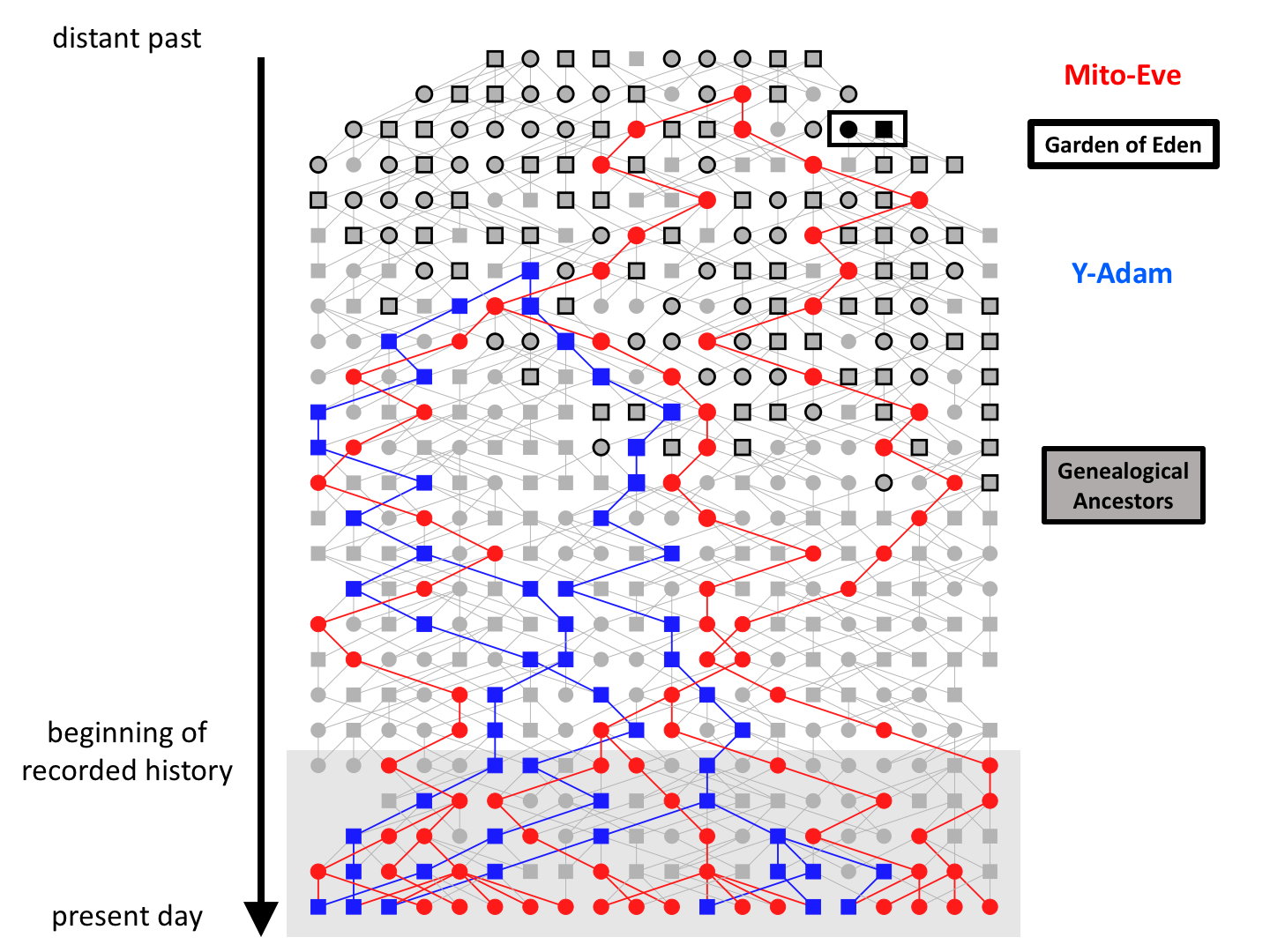

 ) are the genesis of Abrahamic faiths, the genealogy of Christ that goes back to Adam, and the gospel message that we are all sinners, starting from Adam, and in need of salvation in Christ. All of these matter, and we are not (and should not) in a position to re-write biblical passages, or introduce novelty to the Gospel message.