A Christian should live life in a way that does not make sense unless God exists.
–Dorothy Day, as quoted by David Brooks
A Christian should live life in a way that does not make sense unless God exists.
–Dorothy Day, as quoted by David Brooks
“I worship at the altar of Rationalism”
-the Detective Benoit Blanc Character in “Knives Out” - “Wake Up Dead Man” movie, as he’s speaking with the beleaguered and accused priest in the local cathedral.
I thought of you some, @T_aquaticus, associated with the good detective - not because of the particular quote above necessarily, but just because of how he carried himself and the relationship that developed between him and the priest in the film. Fascinating storyline even if I still can’t connect some of the dots in plotting. It’s more about insights into humanity anyway.
“Are you OK?” - Alex Pretti
The bag of Doritos steps up an says, “Hold my beer”.
Not from a book but an article that I think anyone who has an obsession with books or who buys far more books than they will actually read (raises hand) could relate to:
Books are possessed and possessing, they exist to fortify, to preserve, to radiate their own charged auras. Owning them isn’t the same as possessing the knowledge within, but it’s the second-best thing. There is a sense that I’m keeping these books for when I need them, what Eco compares to having a stocked medicine cabinet for when a certain ailment might strike. Sometimes, like a monk eyeing the encroaching vandals, I feel like I’m fortifying myself as I pile them up on windowsills, leaving the ever more-prevalent censors on the other side. Their very physicality is central to this, because unlike an e-book or text entombed in the cloud, my books don’t rely on the good will of algorithms or tech billionaires; they’ll still be readable long after the lights have gone out (at least by daylight).
Vinnie
From “Sinners in the Hands of a Loving God” by Brian Zahnd
The centrality of Christian ethics is found in Christ himself. Though Elijah called down fire from heaven to burn up his enemies, God says to us, “Listen to Jesus!” And what Jesus says is “Love your enemies.” When a Samaritan village refused hospitality to Jesus and his disciples, James and John wanted to go “shock and awe” on the Samaritans and call down fire from heaven. They did so by finding biblical warrant from the actions of Elijah in the first chapter of 2 Kings. But Jesus didn’t say, “Well, that’s a biblical principle, all right. So let’s nuke ’em!” No, Jesus, says something else: “You do not know what manner of spirit you are of. For the Son of Man did not come to destroy men’s lives but to save them.” War-affirming Biblicists who desire to justify drone strikes and carpet bombing can cite Elijah, but Jesus says something else.
Moses says this. Elijah does that. But Jesus says and does something completely new and different. And what does God say? Does God instruct us to find a healthy balance between Moses, Elijah, and Jesus? No! God says, “Listen to my Son!” If we want to rummage around in the Old Testament and drag out Moses or Joshua or Elijah or David to mitigate what Jesus teaches about peacemaking and loving our enemies, we are trying to build an Old Testament tabernacle on the holy mountain of Christ’s glory, to which God says, “No!”
The role of the Old Testament is to give an inspired telling of how we get to Jesus. But once we get to Jesus we don’t build multiple tabernacles and grant an equivalency to Jesus and the Old Testament. This was Peter’s mistake on Tabor. Jesus is greater than Moses. Jesus is greater than Elijah. Jesus is greater than the Bible.
Does he talk about Matthew 5:17 in there?
Vinnie
I deleted all social media as a result of this and Reddit. Scrolled through too much hate sending me into complete meltdown mode. I might be happy if my country was nuked at the moment. We need a great deluge like reset. My life will be much better if I never lapse and use it any social media ever again.
Vinnie
Here’s what I found (from the very same chapter!)
At the beginning of his ministry Jesus said, “Do not think that I have come to abolish the law or the prophets; I have come not to abolish but to fulfill.” What Moses and Elijah—the Law and the Prophets—had begun, Jesus would fulfill. The goal of the Law and the Prophets was to produce a society of fidelity and justice. Jesus and the kingdom he announces and enacts is where that project finds its fulfillment. The new society formed around Jesus was what the Law and the Prophets were aiming for all along. The Transfiguration is where Moses and Elijah find their great successor. The Transfiguration is where the Old Testament hands the project of redemption and restoration over to Jesus. The Transfiguration is where the old witness (testament) yields to the new witness (testament).
Agreed that social meda has devolved. I don’t use it and I didn’t get that quote from social media, but a newspaper. And the quote has brought about a lot of additional reflection for me, particularly with rereading about Hannah Ardent’s phrase, the ‘banality of evil’.
Mostly. But format has become (mostly) irrelevant to me. My eyes simply can’t endure the exponentially expanding task set before them. I hear more books than I can read with my eyes, because that’s how I am going to make headway. I find them by hook and crook, not by algorithm.
They clutter my house, my phone, my ipad, my computer, my extenal hard drives…
And then there are the ones the fill the library I work at…
Yeah. I have a problem.
That’s Aherndt, I think.
It’s a very pointed phrase, BTW.
I read faster than I listen, though I’m starting to see the advantage of audiobooks for long drives – but they’d have to be recreational; I don’t want to start puzzling at some concept and forget I’m supposed to be steering! Also maybe for evenings after a day of staring at a screen.
Hannah Arendt (1906–1975) was a
prominent German-American political philosopher, theorist, and public intellectual, known for her analysis of power, authority, and totalitarianism. A Jewish refugee from Nazi Germany, she became a major 20th-century thinker, most notably coining the phrase “the banality of evil” to describe how ordinary people can commit atrocities under systemic oppression.
I rarely use traditional audio books. I have
A subscription to Bookshare, which has books in many digital formats
Including for braille display. I use screen readers or digital book readers which read at much faster rates than audio books.
Some books I just don’t grasp well this way, or it takes a few listens. It’s better than not at all, and my comprehension has improved.
We do what we need to.
That’s T-shirt, hoodie, and/or bumper sticker material.
More from Brian Zahnd; “Sinners in the Hands of a Loving God” - a bit where he’s speaking on the book of Revelation to a group on a middle-eastern tour with an Israeli tour guide.
If we combine all of John’s creative symbols, the message is clear: Jesus wages war by self-sacrifice and by what he says. Jesus combats evil by cosuffering love and the word of God. This is the righteous war of the Lamb. Christians are called to believe that cosuffering love and the divine word are all Christ needs to overcome evil. A fallen world addicted to war does not believe this, but the followers of Jesus do, or should! If Jesus conquers evil by killing his enemies, he’s just another Caesar. But the whole point of John’s Revelation is that Jesus is nothing like Caesar! The idea that the world would continue to be run by the violent ways of Caesar and Pharaoh and all the rest was the bad news that made John weep when the elder told him there was none worthy to open the scroll of God. John the Revelator is giving us the gospel, not the antigospel. The war of the Lamb looks nothing like the war of the beast. Jesus is not like Caesar. Jesus does not wage war like Caesar. To miss this point is to misunderstand everything the Apocalypse is trying to reveal!
Think about how Jesus waged war against demonic evil in the Gospels. Did he do it by taking up arms against evil? No. Jesus set the demon-possessed free by his words. When a demon-possessed man in the country of the Gerasenes had broken his shackles and terrorized the outskirts of the city, did Jesus overcome demonic evil by killing the demon-possessed man? No. He overcame demonic evil by his word. Jesus said, “Come out of the man, you evil spirit.” We might say Jesus waged war on demonic evil with the sword that came from his mouth. Jesus doesn’t wield a sword in his hand to kill people; Jesus wields a sword from his mouth to set people free. The war of the Lamb is the same war the apostle Paul describes to the Corinthian church.
We are human, but we don’t wage war as humans do. We use God’s mighty weapons, not worldly weapons, to knock down the strongholds of human reasoning and to destroy false arguments. We destroy every proud obstacle that keeps people from knowing God. We capture their rebellious thoughts and teach them to obey Christ.
This is the kind of war that is symbolically depicted in Revelation with a rider on a white horse called the Word of God who wears a robe drenched in his own blood and wages a righteous war with a sword coming from his mouth. This is not a literal war; this is a symbolic war. This is not a future war; Christ is waging this war right now. I know Christ is waging this war right now because I am among those who have been slain by the sword of his mouth and raised again to newness of life! Jesus slays me. He slays me with his divine word. And in slaying me, he sets me free. This is salvation. John the Revelator is showing us how Jesus saves the world.
…
…I concluded by telling our group that Jesus is not coming back to renounce the Sermon on the Mount and kill two hundred million people. While our guide listened, I told our group that this is a false and pernicious reading of Revelation and that it needs to be once and for all renounced. When I concluded my talk I noticed that my guide had a wry smile on his face. I knew what he was thinking. So I said to him, “You haven’t heard it taught that way before, have you?” He replied, “No, I haven’t. I always hear about how Jesus is going to come back as a violent warrior.” Then I asked, “What do you think about what I said?” He answered, “I like the way you talk about Jesus so much better. It sounds like good news.” It sounds like good news. That Jewish Israeli got it right. If it doesn’t sound like good news, it’s not the gospel!
The book of Revelation is not where the good news of the gospel goes to die. The Apocalypse is not where the gospel becomes the antigospel. The book of Revelation is where the good news of the gospel finds its most creative expression.
I just got around to watching the movie Cider House Rules and I have to say how happy I am to have read the book first. The movie shaves it down to the just a couple relationships and doesn’t bring you to the deep insights about abortions and orphans which the book gets to by giving more insight into the inner life of the orphans, especially Homer Wells who is groomed to take the doctor’s place. In the movie we hear that Homer is adverse to participating in an abortion but get no sense of what it means to him. The movie stays on the surface where the book goes deeper, not surprisingly.
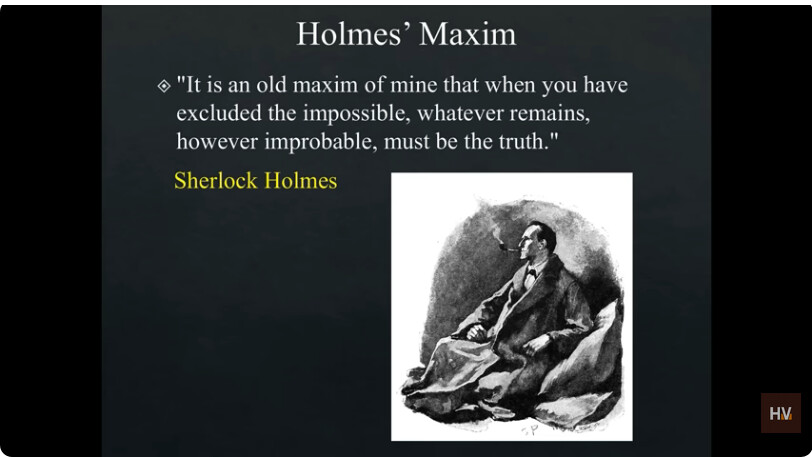
I find this helpful in looking for things I have lost. If I have looked everywhere else, whatever it is must be in some improbable place.
“Let your conversation be always full of grace, seasoned with salt, so that you may know how to answer everyone.” -Colossians 4:6
This is a place for gracious dialogue about science and faith. Please read our FAQ/Guidelines before posting.