A God who is Spirit could guide evolution to the point where physical creatures were capable of relationship and love both with their fellow creatures and with himself. Yet we collectively turned away from God, so he left us on our own for a while and eventually brought Jesus onto the scene – the God-Man who unites the physical and spiritual worlds and makes communion with God possible again. That’s the simple version.
The subconscious isn’t the product of random neural networks; it’s the product of memory. Similarly, psychosis isn’t random. The human brain, because it’s more complex than animal brains, is subject to mental illnesses like schizophrenia and depression, which can be the product of neural networks malfunctioning. Like every other human who ever lived, you’re a product of biological (brain) and cultural evolution. Things occasionally go wrong in both those dimensions.
This reminds me of Wittgenstein, the greatest philosopher of the 20th century. An article by Roy Monk, his friend and biographer.
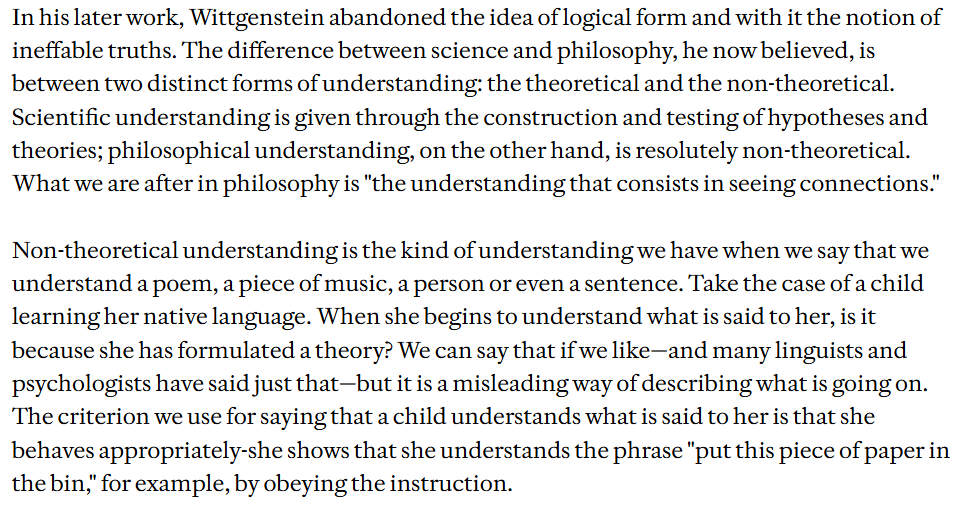
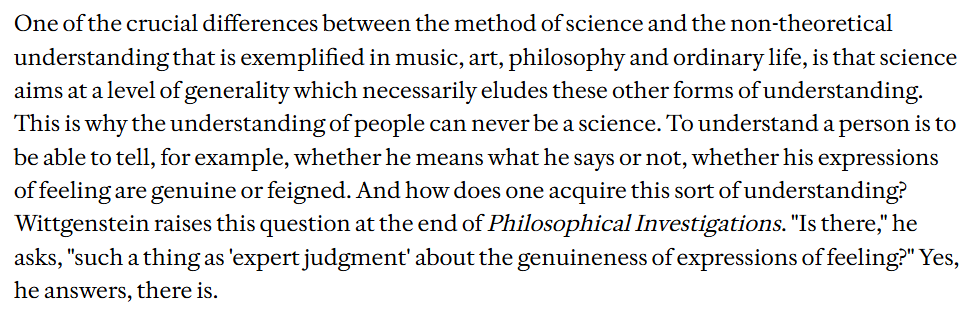
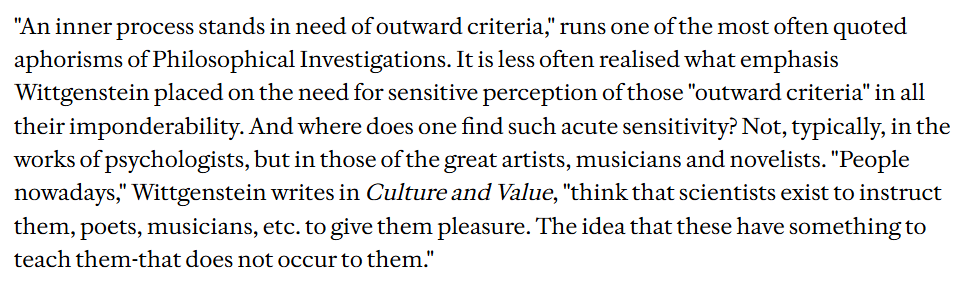
From the article:
Nearly 50 years after his death, we can see, more clearly than ever, that the feeling that he was swimming against the tide was justified. If we wanted a label to describe this tide, we might call it “scientism,” the view that every intelligible question has either a scientific solution or no solution at all. It is against this view that Wittgenstein set his face.
There are many questions to which we do not have scientific answers, not because they are deep, impenetrable mysteries, but simply because they are not scientific questions. These include questions about love, art, history, culture, music-all questions, in fact, that relate to the attempt to understand ourselves better. There is a widespread feeling today that the great scandal of our times is that we lack a scientific theory of consciousness. And so there is a great interdisciplinary effort, involving physicists, computer scientists, cognitive psychologists and philosophers, to come up with tenable scientific answers to the questions: what is consciousness? What is the self? One of the leading competitors in this crowded field is the theory advanced by the mathematician Roger Penrose, that a stream of consciousness is an orchestrated sequence of quantum physical events taking place in the brain. Penrose’s theory is that a moment of consciousness is produced by a sub-protein in the brain called a tubulin. The theory is, on Penrose’s own admission, speculative, and it strikes many as being bizarrely implausible. But suppose we discovered that Penrose’s theory was correct, would we, as a result, understand ourselves any better? Is a scientific theory the only kind of understanding?
Enough for now. My apologies to the other 60+ posts I didn’t have time to read.