T_aquaticus
(The Friendly Neighborhood Atheist)
41
For me at least, the show is asking questions about the basic foundation of personhood and what it means to be a human. Would you be willing to give up your ability to make decisions for yourself? Would you be willing to meld your mind with the rest of humanity so that it is no longer separate from them? If you were promised a blissful existence in exchange, would that be a fair trade? For that matter, if the hive mind is telling you that you will be happy beyond belief if you sacrifice your personhood to be with them, would you trust it?
At least in my eyes, it is a question of how much you would require to give up your humanity.
“giving up your humanity” is a pre-loaded phrase. It presupposes the answer that something essential will be lost. From the “hive’s” perspective, they might insist that they’ve finally found their full humanity! From a Christian perspective, I think we’re being asked to hold both of these things somehow - to honor individuality and simultaneously give ourselves (all of ourselves - sacrificially even!) to community. But that latter gift has to be voluntary at a minimum - we seem to all agree on that.
So individual marriage is no more, but the church is corporately married to Christ. Hmmm. At the least, this means we’re all female in heaven. Don’t tell the Theobros!
Yes. It’s just the first attempt to describe a perfect society that I’m aware of. I wonder if anyone outside the Western tradition attempted it before (or independently of) Plato?
You seem to know far more than the average person. No worries. I regard H. erectus as the first member of the human family. Behavioral modernity was definitely a gradual on-ramp and not a sudden breakthrough, but there’s no denying that between 100-50,000 years ago sapiens began producing novelties (symbols, grave goods, technologies) at an increased pace. For example, sapiens and Neanderthal lived in close proximity in Israel prior to 100,000 years ago, and their toolkits were nearly identical. Both species disappeared from the area at the beginning of the last glacial period. When sapiens encountered Neanderthal again in Europe 50,000 years later, we had far surpassed their ancient Mousterian toolkit.
If you enjoyed the other link, try this one.
The main points (bolding is mine):
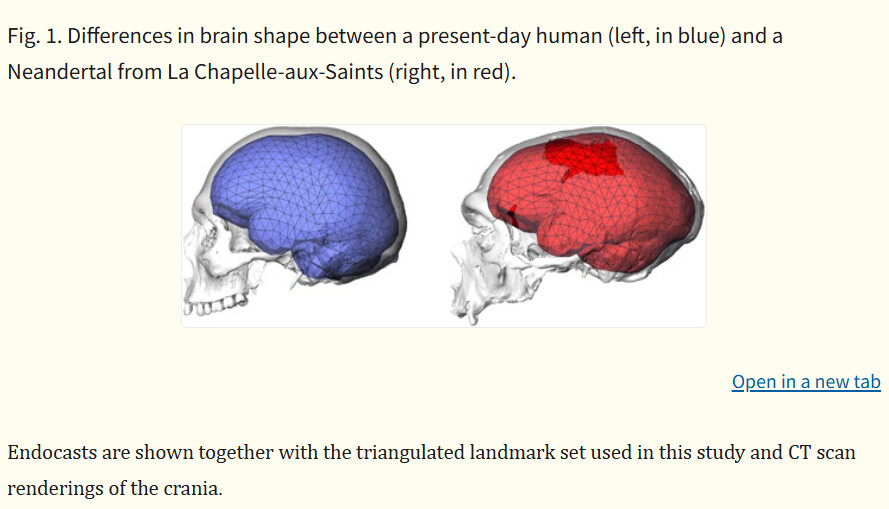
“Two features of this process stand out: parietal and cerebellar bulging. Parietal areas are involved in orientation, attention, perception of stimuli, sensorimotor transformations underlying planning, visuospatial integration, imagery, self-awareness, working and long-term memory, numerical processing, and tool use.”
“The cerebellum is associated not only with motor-related functions like the coordination of movements and balance but also with spatial processing, working memory, language, social cognition, and affective processing.”
I’m guessing that’s due to the Breaking Bad creator. My wife and I really enjoy a bunch of Apple TV shows.
For all Mankind (amazing show), Severance, Slow Horses, Ted Lasso etc…. Other good ones as well but these really stand out for us.
I don’t work for Apple. But some of these shows are pure cinema. For all mankind was great because it’s an alternate history and space-race where Russia lands on the moon first. It’s incredible.
Vinnie
1 Like
T_aquaticus
(The Friendly Neighborhood Atheist)
45
I would consider loss of free will as giving up my humanity. Perhaps the show is forcing people to consider what is essential to them which may differ from person to person.
But should we believe them, especially when it comes to a decision we can’t take back?
Yeah - I’m with you there too. But I’m not yet convinced that the characters in Pluribus have necessarily been robbed of free will. Maybe what they have gained is just so good that they are literally all on board with it? (After all - isn’t that kinda also the hope of Christians with the gospel and the eventual “…and every knee shall bow”? - what a satanic notion that would be turned into if it was thought to be involuntary homage!) Of course, the answer as regards this particular story is all in the hands of the writers, who, so far as I would guess, have nothing to do with Christianity per se apart from using some of its concepts as grist for their plotline.
Us too (for many on your list anyway - haven’t seen For all Mankind or Slow Horses). We like Severence. It just seems like an even darker version of what Pluribus is doing, but sharing many similarities. Ditto on “Lasso”! - one of my most enjoyed shows ever I think! We’re also enjoying the Foundation Series produed by Apple. We read Asimov’s series many years ago, but my memory is spotty enough that the film version is pretty fresh for me, and I depend on my son to point out where the written story Characters (like Seldon) were a lot different.
There is also a third one, the fear/power culture.
I have noticed that global maps about the distribution of these cultures do not tell the whole truth. Maybe differences between subcultures within countries play a role, or differences between generations.
For example, one map I saw painted Africa mostly as a shame/honor continent. IIRC, there is much fear/power culture within Africa.
Another example might be Finland, that has been traditionally listed as a strongly guilt/innocence culture. At least today, the shame/honor culture is probably stronger than the guilt/innocence culture but there are differences between subcultures. One contributing factor may be that Finland is now mostly a post-Christian country, so the former preaching of guilt by churches does not have as strong effect on people. The underlying shame/honor culture is therefore becoming more visible. In addition, immigrants bring with them the strong shame/honor thinking.
I continued thinking about the subject and noted that we may have strongly differing cultures even within a congregation. And differences within an extended family, for example the older generations having a differing culture than the young generation.
For example, the majority of the members in our congregation are ‘children’ of the modern western society and (mainly) the guilt culture but we have also many who belong to the Romani people. In Finland, the Romani are traditional and maintain an extreme shame/honor culture. All maintain some level of individualism but the individualism within the traditional Romani groups resembles the type of individualism that was common in patriarchal societies more than a century ago. For example, parents and other older people are respected without questioning and obeyed with very little questioning. The patriarchal leader, at the family level the man, should be obeyed and wifes should always obey their husband, throughout her life.
Some may see that as questionable but the same was true in the whole country a couple of centuries ago.
Such traditional cultural habits, for example that children respect and obey their parents, may look as a positive model. Combined with an extreme shame/honor culture with hundreds of behavioural rules, outsiders may view the lifestyle sometimes peculiar or even as not good.
One of the peculiar features is that the Romani do not usually have weddings although they expect a life-long marriage. In weddings, the relationship between the groom and the bride hints of a sexual relationship and such matters are forbidden topics in public. When a young man and woman want to marry, they often ‘run away’ from their families, get married privately and after some time together, they can return to their society as a married couple.
One of the not good habits is how the rebellious women are treated. If a teenage girl decides to wear the traditional clothes (a voluntary decision), it is expected that she follows all the traditional rules during the rest of her life. Obeying the husband is one of the rules. If the wife does not obey her husband, the man feels shamed and has a cultural right (even expectation) to correct his wife until the wife obeys. If beatings and shaming are not enough, the man and his relatives may feel that murdering the rebelling wife is an acceptable way to restore honor.
Those Romani who think they are believers do not murder anyone and put the Christian teaching above their cultural habits. Gladly, they are also understanding and forgiving to those ‘whiteys’ who break their cultural rules unwittingly. Although we others do not know all their cultural rules and behave in ways that would be grave insults or shame from another Romani, we have managed to live together with warm and loving relationships. Christ unites differing cultures.
I’d never heard of fear/power culture. Had to look it up. From what I can tell, it’s mostly a subculture talked about by Christian missionaries to classify people groups who are dominated by beliefs in animism or spiritism. The people fear the power of the spirits, and the shaman serves as the intermediary and thus wields power in the community. Strangely, the missionaries’ strategy is that Jesus is a better intermediary to the spirit world – demons, angels, powers and principalities. I guess it makes sense, especially in Charismatic theology that’s popular in the Southern hemisphere.
Unless it’s escaped my notice, I don’t think there’s a single nation where power/fear culture is dominant. It seems a subculture within honor/shame cultures. The primary feature of both is a patriarch who holds all the power in the family/clan/tribe/nation. The political version of power/fear is a system of patronage, which would characterize ancient Rome as well as the aspirations of the current occupant of the White House. But, again, the Roman patronage system was a subset of the Mediterranean honor/shame culture in which it arose. That tells me it probably won’t work to try to recreate that system in a modern individualistic society.
Anytime we’re talking about culture, we’re making sweeping generalities. Within any nation, there are subcultures, counter-cultures, foreign cultures, etc. You’re right to point that out. For instance, the US is no longer primarily made up of Protestants, yet Protestant individualism still reigns supreme and will for a long time, just as it does in Northern European countries that no longer have a majority of Christians in their population. Individual rights are “baked into the cake” here and there, and I, for one, am glad that’s the case.
Belief in a spiritual world and spirits that can affect the life of living seems to be part of the fear/power cultures. People are afraid that the spirits, or curses said by spiritually powerful people, harm their life. That fear affects their life more than the feeling of shame. In that sense, it is not a subculture of the shame-honor culture, it is a separate culture.
This kind of fear about spirits (demons) and what shamans and witches can cause to the life of the other people is not common in modern western societies. That is why the fear/power culture is strange to us. In Africa, it still affects the life of many people. Perhaps the culture can be found as a subculture in Americas too, in the areas where vodun (vodou) and comparable beliefs play a role.
I listened to what a theologian told about her experiences and studies on African Pentecostalism in some countries. It was an interesting mix of traditional worldviews and biblical teachings. Jesus is preached as the victorious king and ruler over the spiritual world, and the charismatic gifts demonstrate the power.
The teaching of the missionaries coming from most mainline denominations do not convince these people because that preaching does not show power. Talks about guilt or shame do not help the everyday life of the traditional people, what they need is being set free from the oppressing powers of the spirits (demons), local gods and the people who rule through fear. That is the reason why Pentecostalism thrives in areas where the other denominations have not been successful. It can also partly explain why African Christianity has produced so many movements whose preaching may seem strange or even heretical when they send missionaries to us.
Today, the southern churches in Africa and elsewhere are sending more missionaries than the so called ‘Christian’ western societies. At least in Europe, there is plenty of space and need for these missionaries. It is good to remember that many of the sending churches originated within the region of a fear/power culture - it helps to understand why the preaching sounds so different.
Edit:
If we go back in time, African Christianity has affected Christianity quite much. For example, persons like Tertullian and Augustine of Hippo originated from North Africa. Their teaching, especially that of Augustine, has shaped strongly the western tradition, RCC, calvinism and the Lutheran churches. What is a bit different now is that the new teachings originate from the southern rather than the northern Africa; the northern Africa is now dominated by Islam.
Now that our family finally took in the 4th episode, I’ve got a few more reactions.
The “hive” people are doing a pretty good job acting as if they have no free-will left (blank eyes, synchronized automaton-like behavior, etc.) I’m really hoping the story won’t continue to be just another run-of-the-mill zombie apocalypse (even if with a “we’re cheerful zombies who will take care of you before we eat your brains” kind of twist). I hope the writers have more creativity that just to produce yet another of that dime-a-dozen genre.
I’d love to see some scenes of the “hive people” by themselves (no un-converted individuals present to occupy all their attention) doing something to demonstrate at least some residual humanity … enjoying music, children playing, anybody just doing anything (other than eating/sleeping) that isn’t just task-oriented. But so far the world revolves around our American protagonist’s agenda - as I’m guessing it will remain. (Just like the American imagination likes it.)
After some hiatus - I finally caught up and took in the remaining episodes of the rest of the first season. And in some small areas, I guess I got at least part of my wishes expressed above. At least I got to see members of the “hive collective” apparently enjoying themselves, albeit with Carol and the motivation of enticing her to get more comfortable with them. (spoiler alert here - I’ll be mentioning more specifics below.)
Big parts of my frustration were maintained though, when Carol makes an astute (and tragically rhetorical) throw-away comment about the dear waitress in the nostalgic diner - “well, she’s not married any more, is she!?” And then Carol just went on, not giving Zosia any chance to reply to the marriage question. Yeah - what about that? Are husbands and wives no longer together at all?
Of course the end-of-season cliff hanger leaves us with Carol re-awakening her original resistance passions and re-joining her new Paraguayan friend in their world-saving mission. And the thing that tipped her back over again from her dalliance with her special hive friends was the renewed discovery that they were still working on her eventual conversion without regard to her consent. And that would be a tipping point for me too - even if I turn my back entirely on individualism as any kind of flourishing life. As a Christian, even one who accepts and tries to pursue the eventual and universal Lordship of Christ, I still think it’s a sacred pillar of Christian love that nobody is ever converted against their will. Compare it to some happy and gentle Borg collective if you will, but this collective would never go about with the Satanic nonsense of chanting “Resistance is futile”! In Christianity, resistance is allowed - even protected as sacred, and can persist forever if it wants. Hence the population of hell can remain populated indefinitely to the happy doctrinal relief of any of us who, in our lesser moments, can’t let go of our pleasureful conviction that some other group somewhere ought to be tortured for their sins. But what if the gospels and apostles are right, and Love does win in the end? Persuasive love - not compulsive! If the writers are finally deciding for compulsion (no matter how velvet-fisted), then the cause loses me too - and Carol has my sympathies mainly for that alone. Okay - yeah, individuality is still a prized possession for me too; how could it not be for a westerner? But on that front, I enjoy being poked and can imagine other valid approaches legitimately encroaching on that value, so long as it is never entirely vanquished.
Great question. I believe it ultimately comes down to the very nature of free will and how one interprets it. For some, free will is understood as libertas indifferentiae—the ability to choose between alternatives without being inclined toward one or the other. However, from a Thomistic perspective, true freedom is the freedom to choose the good. The more a person is inclined to choose evil, the less free * they actually are.
In other words, we won’t sin in Heaven not because we lack freedom, but because we are so completely free that the very idea of sinning would be utterly absurd to us.
One of the greatest sources of beatitude in Heaven, I believe, will be the knowledge that we are no longer bound by time. We will have infinite opportunities—to learn an instrument, to travel wherever we please, to grow in wisdom and knowledge—without the burden of time pressing upon us as it does in this earthly life.
* In Italian, an evil person is called “cattivo” (or “cattiva” for a woman), a term derived from the Latin captivus, which meant “prisoner”. The very opposite of a free person.
You are using many words that are at least partly matters of opinion or interpretation, like Heaven, free will and freedom.
Whatever we think of these terms, I would say that the Thomistic perspective you are using may not be the whole truth. At least, it is a skewed perspective as it uses a skewed classification - if you do what we like you to do, we define that as ‘freedom’; if you do something else, you are not ‘free’.
What is the reason why the resurrected people in the future Kingdom of God do not sin is a matter of speculation - we do not really know. My guess is that truly knowing God and knowing the consequences of the wrong decisions are important factors. Freedom of some desires of the mortal body may also help - no sexual desires, probably no desire to obtain material stuff that would have elevated the social status among mortal humans, the fulfilment of the desire to get true acceptance and love, etc.
I agree and while the show raises interesting questions, it never lived up to making me wonder which side is right even by the end of season 1. The entire episode showing how bored she was really tried to immerse us in that boredom. To be honest, it had creative value but it was just utterly dry. I felt exhausted by the end. I would say an implication here is that humans are social creatures (for me an objective fact) and our wellbeing and morality is tied into this.
In my view, humans are a composite of matter (body) and form (soul). The soul is the substantial form of the body and each person has a unique one created by God at conception. So I don’t think we will lose our individual identity. In fact, it makes no sense to say I go to heaven if that I does not refer to me. It is largely a mystery how all these things will play out. I mean, I am mortified by Jesus’s comment there is no marriage in heaven. I want my wife to put up with me for eternity!
Well said. This ties in with the morality discussion and our natural ends of final causaulty. We sometimes can confuse having many options and our basic desires for them as a full definition of freedom.
Blue jeans
Black jeans
Skinny jeans
Baggy jeans
Relaxed fit
Slim fit
Straight leg
bootcut
Bell bottoms
cropped
ripped
Low rise
High rise
carpenter
raw denim
selvedge
Having options (freedom of indifference) is only one part of what it means to be truly free (freedom for excellence). In so far as we choose things that go against our objective nature and final ends, we are basically choosing to enslave ourselves.
I just think one day we will see sin for the abomination it truly is. Right now, it appears to our intellect as something desirable, but that’s only because we live in a corrupted reality. And also our intellect and our hearth still bear the mark of original sin.
I’m not entirely convinced that resurrected bodies will be asexual—that remains a matter of theological speculation (If we’re speaking of the intermediate state between death and resurrection, then I agree—the disembodied soul can partake only in spiritual bliss. However, as Aquinas noted, a person’s beatitude remains incomplete until the soul is reunited with the body * ) I don’t see sex as something inherently evil in the eyes of God, and I’m inclined to believe that even our resurrected bodies may participate in heavenly bliss in ways far beyond what we currently imagine. Of course, we will be completely free from all evil and disordered impulses—otherwise, it wouldn’t be Heaven. But I do believe that the five senses will participate in Heavenly bliss.
I’m also convinced that Christianity has emphasized the spiritual bliss of Heaven to such an extent that many Christians seem to overlook the reality of the bodily resurrection—that even our bodies are meant to partake in eternal beatitude. I’m inclined to think this emphasis emerged, at least in part, from a perceived need to distance Christian theology from other religious views, such as certain portrayals of Heaven in Islam, which can resemble something more akin to a sensual fantasy (the 72 virgins) than a sacred reality
So we went very far in the opposite direction.
Of course.
*”I answer that, It is manifest that the happiness of the saints will increase in extent after the resurrection, because their happiness will then be not only in the soul but also in the body. Moreover, the soul’s happiness also will increase in extent, seeing that the soul will rejoice not only in its own good, but also in that of the body.” SUMMA THEOLOGIAE: The happiness of the saints and their mansions (Supplementum, Q. 93)
This response appears trivial to me. I thought this was obvious granted he defined two different opinions or interpretations of freedom too tart off with:
For some, free will is understood as libertas indifferentiae
However, from a Thomistic perspective,
Skewed? Not true at all. I’d say the skewed perspective is following Newton, Descartes and some 17th century thought in rejecting final causality and adopting a mechanistic image of God and the universe that removes teleology. The part I put in bold is complete nonsense. Given final causality, there are objective ends towards which a human is oriented (just as eyes are for seeing, the heart is meant to pump blood etc). You can disagree with what those ends are but to claim this is someone just saying “what they like is freedom” is very uncharitable. Freedom is being tied into what it objectively means to be a human being.
I’d say it is an objective fact of reality that people consciously and repeatedly choose to do bad things knowing full well the negative consequences of doing so.
How is removing options freedom? Sounds more like the opposite. Imagine if I gave my child $50 but wouldn’t let him buy the first 50 things he wanted because I didn’t deem them appropriate? But once he gets to item 51 and it’s something I like, I now allow it. Who really spent the money here?
 ) than a sacred reality