Don’t want any money honesty will suffice
Read the Nicene Creed, there you can find my Faith.
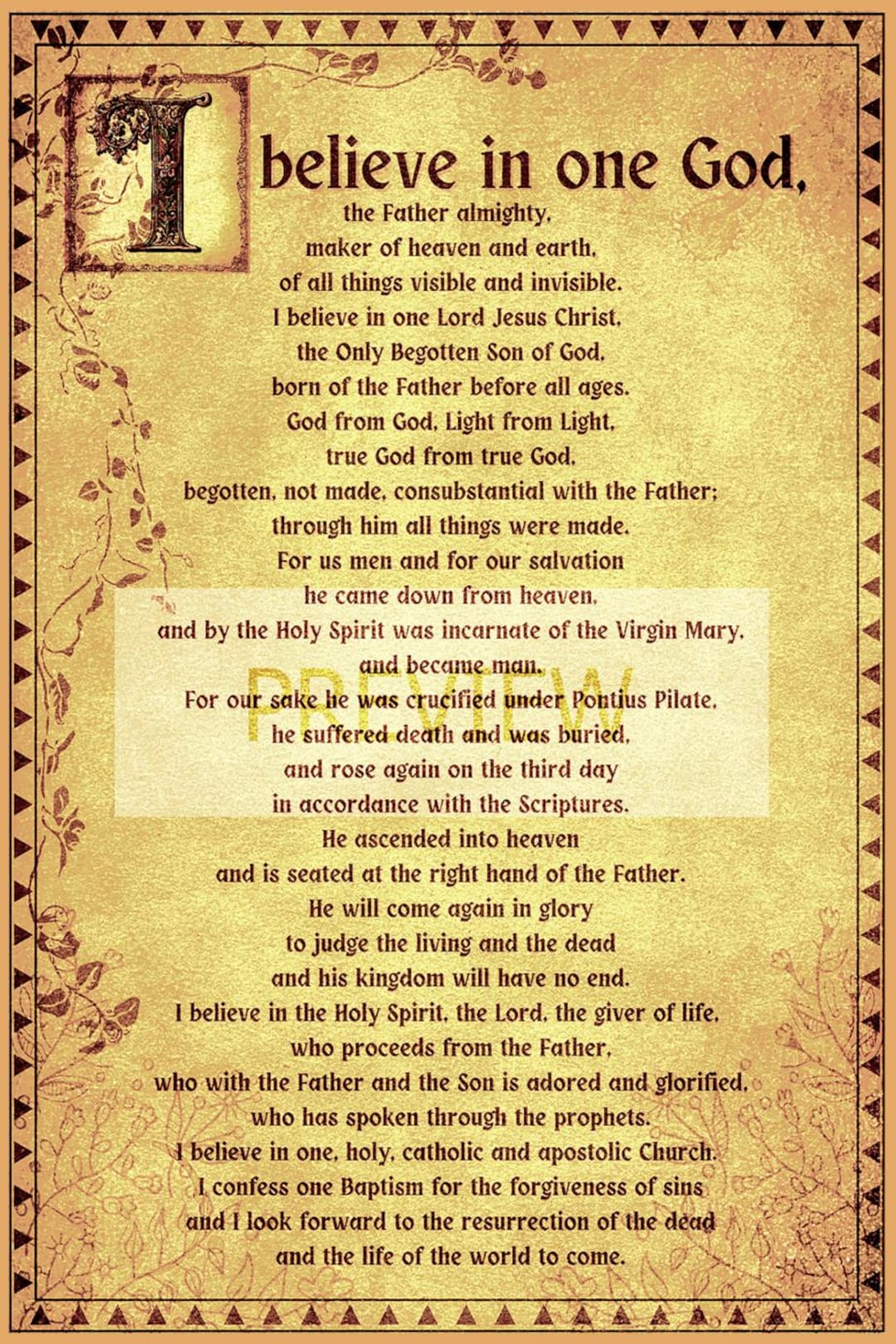
This is my faith.
And how does that contradict the fact that nothing impure may enter Heaven ( Revelation 21:27)?
Also 1 Corinthians 3:15: “If anyone’s work shall be burned, he shall suffer loss, but he himself shall be saved, yet so as by fire.”
Then there is the book of the Maccabees of course but it’s not the only biblical passage that testifies to the existence of a purgatorial intermediate state.
Christ doesn’t cover our filth, He actually changes us, in this life first and then in the afterlife.
1 Corinthians 3:15: “If anyone’s work shall be burned, he shall suffer loss, but he himself shall be saved, yet so as by fire”
1 Like
Then anyone abiding by that creed hold the true Christian faith, correct?
Christ does cover our sins though but covering our sins isn’t the same as ruling out the pursuit of holiness and of a godly life
1 Like
The entire creed, sure. Obviously professing faith (“I believe in”) in one, holy, Catholic and apostolic Church is flatly incompatible with the belief that she may formally teach heresy and that we are the final arbiter of the meaning of Scripture.
Systematic doubt and the assumption that we may correct the very Church we profess faith in is the very opposite of faith.
Is teaching heresy akin to departing from Jesus teachings? Who says the final arbiter of the meaning of Scripture needs to be decided by councils and traditions of men though? If you say men rules only some men are the final arbiter of the meaning of Scriptures and thus they can disobey scriptures, that‘s clearly not asserting a faith in conformity with the apostolic church
The alternative is leaving each man to decide the meaning of Scripture (which are may things but there is one thing they aren’t : obvious and easy to understand. They are obscure in many parts and very easy to misunderstand, as Peter himself aknowledged in his letters).
With the results that we can see.
I have never claimed anything of the sort. The one, holy, catholic, and apostolic Church in which we profess our faith in the Creed does not create divine revelation. Rather, she faithfully preserves, authoritatively interprets, and proclaims it to the faithful
1 Like
No, you can‘t have a creed that affirm a faith according to scriptures and claim the same scriptures are too obscure to teach, correct and reveal anything clear. The claim of obscurity is held to protect late oral traditions and innovation that has nothing to do with the creed.
Catholic and Apostolic doesn’t mean Rome and Rome indeed does create non scriptural innovation like Mary as the new eve, the rest of your statement is only true if we turn a blind eye on the doctrinal errors, the factions that exist within Rome or the scriptural warnings about false doctors and teachers rising from within the church. You talk as if Pope Francis wasn’t, well, your pope. Faithfulness to your traditions and faithfulness to God are two different things and none of that explains us how your councils could enforce the faith on anyone
Yep – thus “deutero canon”, second-level canon. As I recall they could be used to support doctrine establish in the primary canon, and for edification, but not for founding doctrine.
Yes. It was common for theologians to pronounce on whether they regarded certain books as canonical.
This is why I hold to the ancient legoumena/antilegomena/deuterocanon distinction, where the antilegomena and deutero - books were treated essentially the same, as a lower-level canon.
1 Like
Sorry, i should have worded it better. What I meant is that their full meaning is anything but obvious. The Arian controversy is the best example of it. The ecumenical council of Nicaea exposes the only correct understanding of the Scripture, but this understanding was anything but obvious and easily demonstrable with the Scripture alone.
It means universal. Catholic means exactly that.
And it’s the entirety of the Church that decided what means what, not you or i.
“Full of Grace”. I have zero problem with that. You can continue to follow whoever you want.
Which doctrinal errors were taught as a definitive truth to be believed with Catholic and divine assent?
He was. Being a Pope doesn’t make you necessarily orthodox or holy, but he couldn’t impose any of his personal errors on the Church.
It someone lacks faith in the one, holy, Catholic and apostolic Church mentioned in the creed it’s obvious that he will not believe the councils or anything and that they will trust their own understanding first and foremost.
It doesn’t look like this strategy bore good fruits though, unless we want to call the endless sectarian fragmentation * that is plaguing Christianity since the 1500’s a good fruit.
*Which is something that, right after the sins of many Christians from any denominations, delivers an incredibly letal blow to the credibility of the Kerygma.
A Lithuanian Luther theologian wrote a manuscript arguing that everyone goes through fire: some will be like Daniel in the fiery furnace, others will be like those who had rushed through a wall of flames, others will be as those who were caught in a burning house and barely escaped, and others will be like thrown on a pyre.
Luther distinguished between a hypostatic union and a sacramental one; the Patriarch was wrong. Some later theologians used the term though with serious qualfications emphasizing that Christ did not take on any new nature and the comparison was only an analogy. Luther himself rejected impanation and said that the Body of Christ in the Eucharist is “in, with, and under” the species of the bread in a “sacramental presence” that we ought not try to explain but leave as a mystery.
Only if the error is Christological or tied to it, e.g. the nature of salvation.
Well, the Church is the Body of Christ. I would say that tearing the Body of Christ apart to such an extent that it may well remain divided until the end of time, barring extraordinary divine intervention * , is an extraordinarily grave matter.
*Because, unlike the division between Catholics and the Orthodox, I cannot see how the damage inflicted upon the Body of Christ in the sixteenth century could ever be healed without extraordinary divine intervention..
“We shall be like Him, for we shall see Him as He is.”
1 Like
You are correct on that particular point, and I have no difficulty acknowledging it. The Formula of Concord explicitly distinguishes the Lutheran doctrine of sacramental union from a personal or hypostatic union.
However, this doesn’t eliminate the substantive doctrinal disagreement between Lutheranism and the Orthodox (and Catholic) position defined at the Synod of Jerusalem in 1672.
In Article VII, §35, the Formula of Concord explicitly affirms that the essence of the bread remains unchanged, thereby rejecting transubstantiation.
The Synod of Jerusalem, on the other hand, explicitly teaches in Decree XVII, §2, that the substance of bread and wine no longer remains after consecration.
These are mutually incompatible propositions.
Therefore, while Dositheus’s attribution of impanation to Lutherans is inaccurate, the underlying doctrinal disagreement is entirely real.
I believe the purgatorial “fire” to be metaphorical, though. The “fire” will be God’s love that will eradicate any vice and attachment to vice that still hampers our holiness and our love for Him and our fellow humans.
I think I have received a “preview” of that at the beginning of my conversion, when I was plunged in that deep sorrow that wasn’t the “desperate” human sorrow but something that made me deeply realize how much I was falling short and how much more good I could have done. I
I suffered a lot but it was a “good” kind of suffering. It went away after like a couple of weeks and it remained the joy of my conversion, but I have never felt anything like that before or since.
I suffered a lot but it was absolutely unlike anything I have ever experienced, I could feel that it was the work of God, unmistakably.