As I said in my post, there are many lost souls wandering the earth. They led materialist lives and often do not even know they are dead. So, they need help.
If you are truly interested in the afterlife, I have a video series on it.
As I said in my post, there are many lost souls wandering the earth. They led materialist lives and often do not even know they are dead. So, they need help.
If you are truly interested in the afterlife, I have a video series on it.
The principle of non contradiction. The same principle that says that being a loyal spouse is incompatible with shagging three different mistresses while being married.
I know you are well above the principle of non contradiction, but I ain’t.
Of course. By all means tell me how “one faith” is compatible with contradictory teachings on matters such as Baptism, the Eucharist, Salvation and Christ Himslef.
Because otherwise I could claim that I and a Muslim share the same faith.
1 Corinthians 1:10: “ I appeal to you, brothers and sisters, in the name of our Lord Jesus Christ, that all of you agree with one another in what you say and that there be no divisions among you, but that you be perfectly united in mind and thought.“
Tell me where is the unity in mind and thought.
Ephesians 4:5-6: “One Lord, one faith, one baptism, One God and Father of all, who is above all, and through all, and in you all.”
Tell me where is one faith and one Baptism when there are denominations of Christians that disagree on Baptim itself, the Eucharist, Salvation, and while you are at it, tell me what kind of unity in mind and thought and what “one faith” the Trinitarians shared with the Arians.
Who is claiming that the differing views are incompatible or conntradictory?
Not me.
Richard
The principle of non contradiction.
Once again.
Especially when the differences aren’t “cosmetic” but substantial.
Claiming that the Eucharist is Christ Hismelf in body, blood soul and divinity is absolutely not compatible with your beliefs about the Blessed Sacrament, for example.
You can only demand conformity with councils but there is no instrument that enforces unity, and I’d say it without fear because unity was never enforced in the first place. It is kept. Enforcement reaches the outside of a man, his mouth, his attendance, his name on a list but the source of disunity is within. No instrument on earth reaches it and God did not hand the cure to an instrument. He wrote the cure into a covenant.
“I will give you a new heart and put a new spirit within you; I will take the heart of stone out of your flesh and give you a heart of flesh. I will put My Spirit within you and cause you to walk in My statutes, and you will keep My judgments and do them.”
Ezekiel 36.v26-27
“But God be thanked that though you were slaves of sin, yet you obeyed from the heart that form of doctrine to which you were delivered.”
Romans 6.v17
What unity requires is obedience from the heart, delivered to a form of doctrine. The correction comes from the Word, the new heart comes from God and the unity follows as the fruit of the Holy Spirit. That is the different way that needs no enforcement because it is the product of a spiritual birth. But not everyone is born again, not every professing Christian abide by Jesus commands, not everyone that says ‘Lord, Lord’ is united with Christ in Spirit.
Yes, councils can be challenged by the individual Christian because the criterion is not the council but the Word it must answer to. Once again, Vincent recorded the time when the bishops fell wholesale, and the men who kept the faith were not the organ. If the council is the criterion, the Arian majority was right. Was it?
On the other matter, you cannot take a late oral tradition, or a non-scriptural innovation and enforce it as binding on the whole Church without scriptural grounding. The Lord denounced the practice in His own day.
“Hypocrites! Well did Isaiah prophesy about you, saying: ‘These people draw near to Me with their mouth, And honor Me with their lips, But their heart is far from Me. And in vain they worship Me, Teaching as doctrines the commandments of men.’”
Matthew 15.v7-9
The man who carried Nicaea through the Arian storm demanded the same grounding. Athanasius, in his Thirty-Ninth Festal Letter, after listing the books of the canon.
6. These are fountains of salvation, that they who thirst may be satisfied with the living words they contain. In these alone is proclaimed the doctrine of godliness. Let no man add to these, neither let him take ought from these. For concerning these the Lord put to shame the Sadducees, and said, ‘You err, not knowing the Scriptures.’ And He reproved the Jews, saying, ‘Search the Scriptures, for these are they that testify of Me Matthew 22:29; John 5:39.’
Arvis, I think you should read Athanasius’s Ad Afros Epistola Synodica, particularly sections 1–2. CHURCH FATHERS: Ad Afros Epistola Synodica (Athanasius)
There he explicitly attributes divine authority to the Nicene definition, insisting that subsequent local synods have no authority to overturn the ecumenical council’s judgment. *
And in De Decretis, sections 19–21, he explains precisely why the Nicene Fathers had to adopt terminology not found verbatim in Scripture: the Arians could accept biblical expressions while interpreting them in ways incompatible with the apostolic faith.
So Athanasius certainly believed Scripture supported the Nicene doctrine, but he also defended the authority of the ecumenical council to define that doctrine against competing interpretations of Scripture.
How, then, does his Thirty-Ninth Festal Letter establish that an individual Christian may reject a definitive ecumenical council’s doctrinal judgment simply because he believes his own interpretation of Scripture is correct?
I’m asking because one of the tenets of Protestantism is that every post-apostolic Council, Ecumenical or otherwise, may err and many have erred. https://www.apuritansmind.com/westminster-standards/chapter-31/
“4. All synods or councils since the apostles’ times, whether general or particular, may err, and many have erred; therefore they are not to be made the rule of faith or practice, but to be used as a help in both.a ”
Do you think Athanasius would have accepted that concept in any way, shape or form?
*Let me quote him verbatim from here CHURCH FATHERS: Ad Afros Epistola Synodica (Athanasius) :
Also let me quote him again from De Decretiis: CHURCH FATHERS: De Decretis (Athanasius)
This passage is particularly revealing because Athanasius clearly upholds the authority of an ecumenical council to define the correct interpretation of Scripture, even when doing so requires the use of terms not explicitly found in the biblical text. He goes so far as to argue that those who reject the Council’s formulations merely because they use unscriptural terms should be cast out, that is, excommunicated .
He is, for all intents and purposes, condemning the principle that an individual Christian may consider his own interpretation of Scripture sufficient grounds to conclude that an ecumenical council has erred and, on that basis, claim the right to reject its doctrinal definition.
Have read Ad Afros since your post, I grant you every word of it no problem. Athanasius did call the Nicene definition the word of the Lord and said it abides forever.
“And so far they have gained nothing by writing, erasing, and using force, not knowing that ‘every plant that the Heavenly Father has not planted shall be plucked up Matthew 15:13.’ But the word of the Lord which came through the ecumenical Synod at Nicæa, abides forever.”
Athanasius, Ad Afros 2
CHURCH FATHERS: Ad Afros Epistola Synodica (Athanasius)
But look at what he grounds it in, He defends the council with a word of the Lord from the same chapter of Matthew I quoted to you before, the chapter where the Lord denounces the commandments of men. The word of the Lord came through the council, it did not come from it. Nicaea abides forever because it said what the Lord had already planted in the Scriptures, and Athanasius knew exactly how to tell the difference between a council that waters what the Father planted and a synod that innovates. Its authority is real I grant it fully but we must say it is derived as a trusted witness, not as the source knowing it may err.
De Decretis says the same from the other side. When the Arians signed scriptural phrases and emptied them on the way, the Fathers answered like this.
“But the Fathers, perceiving their craft and the cunning of their irreligion, were forced to express more distinctly the sense of the words 'from God.'”
CHURCH FATHERS: De Decretis (Athanasius)
They did not add to the Word. They fenced its sense against twisters, which is a servant’s work. Of course by twisting Scripture alone you could make a convincing case for Arianism (or Islam or JWs). Athanasius said the same of the men of his day, but the correction was never needed because Scripture is unclear. It was built because men can twist, and it stood on the meaning of Scripture or it stood on nothing.
So to your first question, Festal 39 does not establish any right of the individual. It establishes that these books alone proclaim the doctrine of godliness, thus a judgment contrary to them binds no one, in which case I am not the criterion but the text is. A man who refuses a council does not stand on himself, he stands on the same principle a council must stand on and if either of us is not standing there, neither of us should be heard.
And to your last question, Athanasius did not need to accept the concept from Westminster. He lived it when the synod of Tyre condemned him in 335, and when the machinery of the Church exiled the very man who would spend his life defending Nicaea. The whole Church since has judged that synod wrong and Athanasius right no matter what a Protestant may or may not claim about late ecumenical councils.
I want to close this exchange well so I will leave you with one question, the same one that has been under all of ours. Was Nicaea right because it was ecumenical or because it was scriptural?
In the end the Church should be the servant of the Scriptures, not their master. She is never more herself than when she serves. We may have to agree to disagree about what makes unity, but I’ll leave this here.
Why do you just repeat yourself. And try and justify yourself. You are not answering at all
Why?
What difference does it actually make?
In terms of the result. Does God not accept either version?
Richard
Arvis, the term homoousios is literally nowhere to be found in Scripture. That doesn’t mean the Nicene Fathers were adding to God’s Word, because the purpose of introducing this non-biblical term was precisely to clarify and safeguard the true meaning of Scripture.
The problem is that it is entirely possible to construct a seemingly convincing case for Arianism using Scripture itself, as the Arians demonstrated. That is precisely why so many Christians, including bishops, were led astray by that heresy. The Arians could appeal to biblical passages just as their opponents could, while interpreting them in fundamentally incompatible ways. And no, not all of them, probably not even most of them, were doing so in bad faith.
And how, exactly, do you determine that someone is twisting Scripture? By your own judgment?
Because the meaning of Scripture is anything but obvious. Seriously, it is nowhere near as self-evident as you seem to assume.
So on what grounds can you confidently declare that someone else is twisting Scripture? Your personal judgment simply isn’t enough. Another Christian, every bit as sincere as you, just as knowledgeable as you (or perhaps considerably more so) could arrive at an interpretation that directly contradicts yours.
And both of you could sincerely believe that you are faithfully interpreting God’s Word.
So how do you establish that his interpretation is a distortion while yours is correct? Simply appealing to Scripture doesn’t settle the matter, because the very meaning of Scripture is precisely what you disagree about.
Scripture is many things, but there is one thing it most certainly is not: self-evident in its meaning.
Arvis, I think your final question presents a false dichotomy.
The doctrine of the Council was true because it faithfully expressed apostolic revelation, but that is not the same as saying that the Council’s authority rested solely on the perceived (and only by some, because the Arians clearly did NOT agree with the notion that the Council faithfully expressed the sense of the Scripture) scriptural correctness of its arguments.
And I think Athanasius’s own words make that distinction quite clear.
In De Decretis, §4, Athanasius explicitly describes opposition to the Nicene Council as “committing a crime, in their very thought to gainsay so great and ecumenical a Council.”
Source: CHURCH FATHERS: De Decretis (Athanasius)
Why emphasize the Council’s ecumenical character if its authority amounted to nothing more than the perceived persuasiveness of its biblical arguments and its ecumenical character wasn’t decisive?
The same point appears in De Synodis, §33. Athanasius reproaches those who “contend against an Ecumenical Council”, and explicitly appeals to the fact that its bishops were “men who came together from the whole world.”
Source: CHURCH FATHERS: De Synodis (Athanasius)
Again, its ecumenical character matters to his argument.
Nor does Athanasius regard the interpretation of Scripture as something that can be detached from the faith the Church has received.
In his First Letter to Serapion, §28, after discussing the biblical evidence concerning the Holy Spirit, he appeals to: “the very tradition, teaching, and faith of the Catholic Church from the beginning, which the Lord gave, the Apostles preached, and the Fathers kept.”
Source: Athanasius of Alexandria, Letters to Serapion concerning the Holy Spirit
This is the faith upon which, he immediately explains, the Church is founded.
And De Decretis, §§19–21, makes the problem particularly clear. Athanasius explains that the Arians could accept biblical expressions while interpreting them in ways incompatible with the Church’s faith. This is why the Nicene Fathers “were forced to express more distinctly the sense” of those expressions, adopting terminology that was not itself found verbatim in Scripture.
So what are we supposed to conclude from all this?
That Athanasius believed Nicaea was authoritative merely because its interpretation of Scripture happened to be persuasive (and not for everyone, Arianism endured for centuries after the Council) and because it aligns with your own interpretation?
I honestly don’t see how that follows from what he actually wrote.
The distinction I am making is straightforward: the doctrine defined at Nicaea was true because it expressed divine revelation; the Council’s judgment was authoritative because it represented the Church’s ecumenical determination of that doctrine, in continuity with the apostolic faith.
These are not competing explanations. They answer different questions.
Athanasius’ understanding of Nicaea is considerably stronger than the idea that it should be seen as an infallible Council only because it aligned with his own interpretation of the Scriptures.
And that brings me back to the question I have been asking throughout our discussion.
If an individual Christian may decide that an ecumenical council (Nicaea is certainly not the only one; as we all know) has misunderstood Scripture, and therefore reject its definitive doctrinal judgment, what makes that decision binding upon the universal Church in the first place?
If the answer is that it binds only those who independently agree with its interpretation, then the Council has not definitively settled anything. The final judgment still rests with each individual interpreter.
There is one final question I’d like to ask you, Arvis.
Yesterday, you told Richard that Jesus calls us to deny ourselves. How do you reconcile that with the idea that an individual Christian can, on the basis of his own interpretation of Scripture, reject the doctrinal judgment of the Church, even that of an ecumenical council?
If my own understanding of Scripture ultimately determines whether the Church’s teaching is right or wrong, haven’t I effectively made myself the final arbiter of the meaning of divine revelation? And how is that compatible with denying oneself, rather than elevating one’s own judgment to an extraordinarily high position?
This is not meant as a rhetorical question. I genuinely want to understand your answer.
Because Scripture is anything but self-evident in its meaning, particularly on matters of serious doctrinal disagreement. If no divinely protected, infallible teaching authority exists, then individual Christians ultimately retain the right to interpret Scripture according to their own understanding and to reject any ecclesiastical judgment that conflicts with it.
Of course, I understand that you would say you are submitting to Scripture rather than to yourself. But the problem is that you are still the one deciding what Scripture means, and therefore whether the Church has interpreted it correctly. Another Christian, equally sincere and perhaps considerably more learned, could reach the opposite conclusion and claim exactly the same fidelity to God’s Word.
So, in practice, doesn’t your own judgment remain the final court of appeal, even over the doctrinal decisions of the successors of the apostles gathered in ecumenical councils?
And if so, how is this not an extraordinary elevation of the self, however unintentionally, rather than the self-denial Christ calls us to?
I really would like to understand how you reconcile the two.
There’s another point worth considering, Arvis.
Have you noticed that the original Nicene Creed of AD 325 doesn’t even mention Scripture as an object of Faith? It mentiones Scripture when it talks about the resurrection of our Lord, yes, but there is not a profession of Faith in the Scripture itself, there is instead a profession of Faith in the Church, right after the Trinity.
If your understanding of the Church Fathers were correct, wouldn’t you expect Scripture, as the supposed sole infallible rule of faith, to be given a prominent place in the Creed, immediately after the Father, the Son, and the Holy Spirit, as an object of Faith? Why, then, does the Creed explicitly profess belief in “one, holy, catholic and apostolic Church” without making any corresponding profession of faith in Scripture?
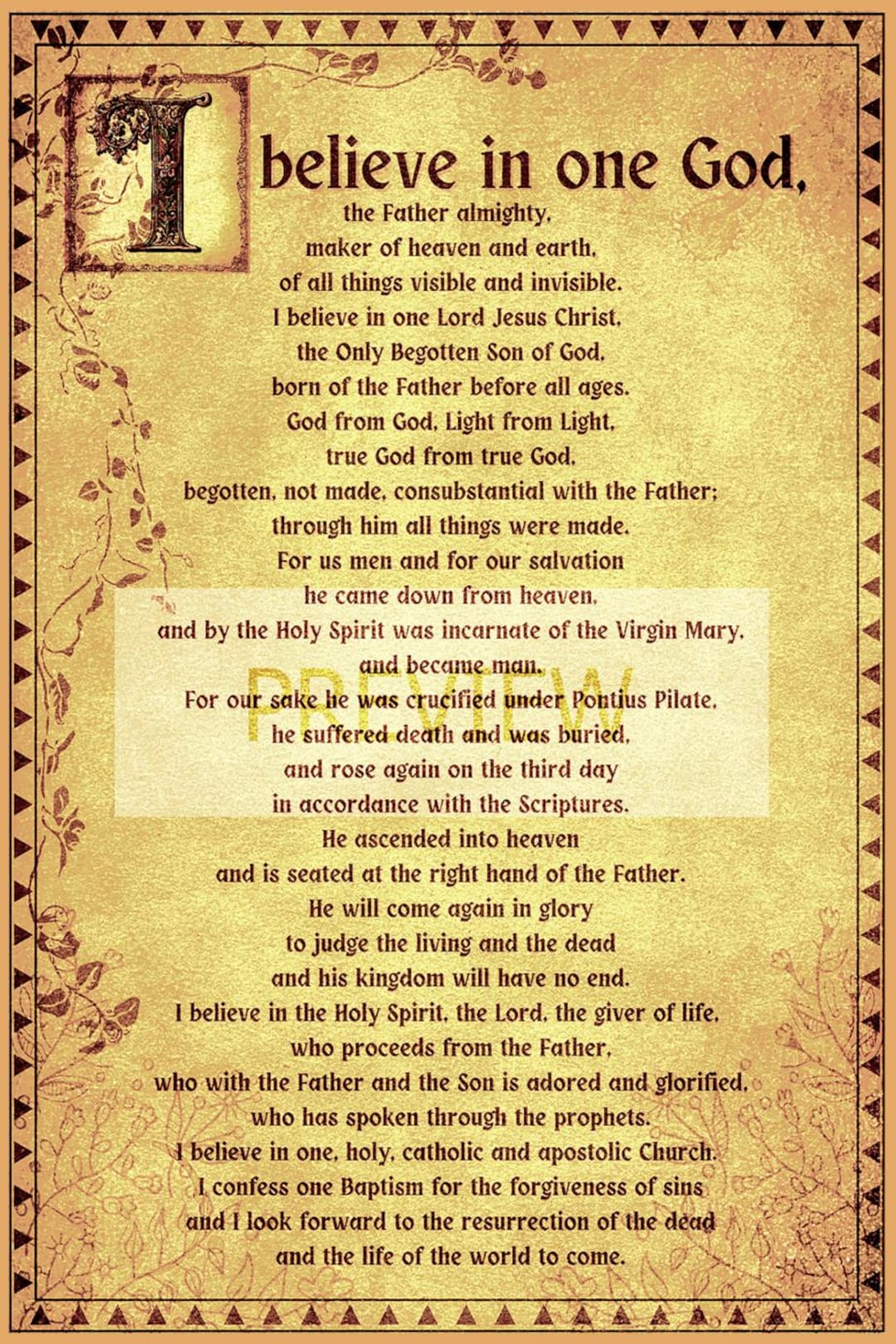
The Niceno-Constantinopolitan Creed explicitly professes belief in:
God the Father Almighty.
His eternal Son, Jesus Christ.
The Holy Spirit.
The one, holy, catholic and apostolic Church.
These are the four explicit objects of the Creed’s profession of faith. It then goes on to confess one baptism and to affirm that we look forward to the resurrection of the dead and the life of the world to come.
Now, the Fathers could easily have included a profession such as: “I believe in the Holy Scriptures, divinely inspired by the Holy Spirit, as the sole infallible rule of faith.”
But they didn’t. Instead, they explicitly professed belief in the one, holy, catholic and apostolic Church.
Quite a striking choice.
He can certainly accept the sincerity of individual Protestant Christians, and welcome them in Heaven, this doesn’t mean that the Protestant understanding of the Blessed Sacrament is aligned with Jesus’ will.
From the very beginning the Eucharist has been understood as being the flesh and blood of our Lord.
Ouch.
Are you distinguishing between the will and Acceptance of God (the father et al) and Jesus as an individual.
That does not make it both correct or exclusive.
Those are your views, and you are not God.
RIchard
Because there is a difference between a good person supporting an error in good faith and the error not being an error in the first place.
These aren’t my views. The teaching that Christ is truly present in the Eucharist has been taught from the beginning.
As early as approximately AD 110, St. Ignatius of Antioch, bishop and Apostolic Father, wrote in his Letter to the Smyrnaeans, 7:1: “They abstain from the Eucharist and from prayer, because they confess not the Eucharist to be the flesh of our Saviour Jesus Christ” CHURCH FATHERS: Epistle to the Smyrnaeans (St. Ignatius)
Ignatius goes on to identify this flesh with the very flesh that suffered for our sins and was raised from the dead.
Notice that Ignatius treats the denial of this belief as a characteristic of heresy, not as an acceptable alternative interpretation of Christianity.
This is the whole paragraph from St.Ignatius
“They abstain from the Eucharist and from prayer, because they confess not the Eucharist to be the flesh of our Saviour Jesus Christ, which suffered for our sins, and which the Father, of His goodness, raised up again. Those, therefore, who speak against this gift of God, incur death in the midst of their disputes. But it were better for them to treat it with respect, that they also might rise again. It is fitting, therefore, that you should keep aloof from such persons, and not to speak of them either in private or in public, but to give heed to the prophets, and above all, to the Gospel, in which the passion [of Christ] has been revealed to us, and the resurrection has been fully proved. But avoid all divisions, as the beginning of evils.”

same old.
Richard
I have only spoken the truth, as I have shown. It’s indeed a belief that has been believed from the beginning. You may not care about it and that’s fine.
Yes neither is the word Trinity, and neither of us blinks at using it. What we aim for is reading how the principle lives inside the text. Jesus says I and the Father are one in John 10.v30. He sends the disciples to baptize in the name of the Father and of the Son and of the Holy Spirit in Matthew 28.v19. The Lord appears to Abraham by the oaks of Mamre as three men, and Abraham speaks to them as to One in Genesis 18. The same thing could be said about homoousios. It was a fence built around a meaning that was already there.
The man who lets himself be taught by the Word is not the one I fear will twist it. The one who twists it brings an agenda to the text, and the Lord named that man, teaching as doctrines the commandments of men. That belief sits, I think, at the root of why few Catholics ever open the Word at all. If the meaning is a locked room and the key hangs on a clerical belt, no one should have access to Scriptures. But the Scriptures are not unclear, they yield their sense to context, with the help of prayerful reading and the guidance of the Holy Spirit. Also we never once see Jesus appeal to tradition to teach. He opened their understanding that they might comprehend the Scriptures and He sent them out as witnesses of what was written.
And He opened their understanding, that they might comprehend the Scriptures.
Then He said to them, “Thus it is written, and thus it was necessary for the Christ to suffer and to rise from the dead the third day, and that repentance and remission of sins should be preached in His name to all nations, beginning at Jerusalem. And you are witnesses of these things.”
Luke 24.v45-48
First thing, you asked what makes my decision binding on the universal Church, and the honest answer is nothing because my judgment binds no one but me, and I have never claimed more for it. I can’t claim anyone is in an imperfect communion because of my vision of unity in the church either.
The Scripture however binds everyone, and a council binds when what it says is what the Scripture says. That is how Nicaea actually won the Church, not in a day but over decades and the instrument of that victory was the very thing you say amounts to nothing, men reading the Scripture and persuading bishops. You noted that Arianism endured for centuries after the council spoke. What held the faithful through those years were the Scripture as always not Eucimenical councils.
I will give a straight and honest answer to your question since you asked for one,
The self I deny when I open the Word is the self that wants an oracle it can never be wrong by. To submit to the text is to let the text tell me I am wrong, and it has done that, and it still does it. Peter said we ought to obey God rather than men in Acts 5.v29, and he said it to men who sat in Moses’ seat not lay persons.
Your own Athanasius spent his life refusing the judgments of gathered bishops because the Scripture held him, and your church, the Roman church, now calls that refusal sanctity. At Tyre the hierarchy of the East condemned him with the emperor’s eye upon it, and he would not bow. If refusing the judgment of the gathered church is an elevation of self, then your own champion falls under your question. The dilemma does not cut where you have placed it. It cuts between the man who brings his agenda to the text and the man who submit His will to Scriptures over his own agenda. I may be the second only by grace with the help of the Holy Spirit, never by nature or works.
The Creed of 325 does not mention Scripture for the same reason a fence does not name the ground it is planted in. Your own citation from De Decretis says the Fathers were forced to express more distinctly the sense of the words from God, and those words are Scripture. You also cited the faith the Lord gave, the Apostles preached, and the Fathers kept, the whole point is that a thing kept is not a thing made. The men who signed that Creed spent the rest of the century proving that it stood on the Scripture, and the source you linked is that proof.
You asked me a final question so I will leave you with one, and I ask it as you asked yours, because I genuinely want to understand how your claim holds together. Do you believe Scripture, rightly divided, can lead a man to believe Jesus is the Antichrist?
If you say yes, then the text cannot even tell us whom we worship and no council can repair what is broken that far down. If you say no, then you grant that the text has a sense plain enough to be read, and that is all I have ever claimed. Paul commanded Timothy to rightly divide the word of truth in 2 Timothy 2.v15, and John thought the matter plain enough to write the test himself.
Who is a liar but he who denies that Jesus is the Christ? He is antichrist who denies the Father and the Son.
1 John 2.v22
He wrote that for ordinary churches to apply, and he did not tell them to wait for an eucimenical council to tell who is or is not Christian enough.
So you are God.
Only God can make that determination, not you, or any council or movement of humanity.
Richard
He also says the Father is greater than Him.
It was there but it was far from obvious. The existence of millions of Christians who didn’t regard it as obvious clearly shows that it wasn’t . And no, they weren’t all morons or in bad faith. Many of them were absolutely in good faith and could provide very solid arguments for their error.
Just like today many Christians can provide very solid argument to establish the correctness, according to their understanding of Scripture, of remarriages.
It mentiones the Church, though. How is “I believe in one, holy, Catholic and Apostolic Church” compatible with believing that this same Church can fall into heresy and that I can accept her teaching only insofar as they are in accordance with my own understanding of Scripture, instead of saying that my understanding of Scripture has to align with hers (and that, if it doesn’t, I should pray so that God may enlighten me instead of assuming that my intepretation is correct)?
The statement “I have only spoken the truth” referred to the antiquity and apostolic nature of the teaching. I also believe that this is in accordance with God’s will because He wouldn’t have founded a Church without giving Her the means to reach and preach the truth.
“Let your conversation be always full of grace, seasoned with salt, so that you may know how to answer everyone.” -Colossians 4:6
This is a place for gracious dialogue about science and faith. Please read our FAQ/Guidelines before posting.