Is a fully metaphorical reading of Genesis truly necessary for theistic evolution?

Yes, by (1) inspiring a writer rather than dictating, and (2) by letting that writer express things within the context of his own cosmology.

The relationship works the other way around: you interpret the words according to the worldview, you don’t hunt for the worldview in the words. Those words, within the writer’s worldview, mean “God created the flat earth-disk and the realm above it”.

That’s not what it means at all – you’re filtering it through a MSWV. The text is telling us that the earth was in the physical realm, but it wasn’t at all orderly or suitable for life.

That tells the reader that the the primeval powers of chaos – darkness (not merely physical) and the great t’hom (te-home) were present and implies that they are together, a force to be reckoned with.

That shatters the partnership implied in the previous clause: “the waters” is the great t’hom, and if the Spirit of God is over them, He is between the two powers of chaos; that He is gently hovering, not engaging in battle (as the other ANE creation stories would have it) indicates that they have no power at all over God; He can just ‘flutter’ there and meditate and ignore them.

To the Egyptians and most of the ANE, light was something that existed on its own, not something created by the gods. Here the writer says, sorry, but what you think is eternal is something that Elohim made, it is His creature (created thing). Light was also the opposing force to darkness, so here that opposing force is said to be God’s entity, which sets God above the conflict – He doesn’t have to fight darkness at all, He made light and it opposes darkness.

That is, He saw that it functioned properly – it countered the darkness.

Which is to say that God made the light a created thing that darkness can’t overcome (cf. John 1).

By naming them, God assigned them functions: this tells us that the power of darkness has to obey God! He doesn’t have to fight it every twenty-four hours to be able to get the light back; they both do as they are told.

So the writer has established that the two great powers of chaos are under God’s rule, that they aren’t His enemies at all because He is so far above them, and that the one – the darkness – is actually subject to a creature He made, namely light.

Yes – completely.

Yes – because it is ancient literature.

There was no writer? There was no audience?
Communication cannot even happen apart from a worldview – it’s not possible. You’re reading the text as though it belongs to a MSWV, but that is wrong.

As to the Big Bang, sure – at least as far back as the eighth century scholars saw here what matches the Big Bang and an ancient universe. But it has nothing to do with continents; those aren’t in the account at all.

To answer how Genesis 1 was written you don’t go to another field of knowledge, you go to the culture and worldview – the context – it came from. What you’re doing instead is akin to someone thinking that the colors on some version of the periodic table of the elements actually represent the colors of the various elements: it’s ignoring what the text is and making it into something else altogether.

That’s not in the text. The text doesn’t say they show up, it says they were placed – they weren’t there before.

The first Creation account isn’t a history; it does not give ‘real’ events in a calendar order. It is theology that uses a reasonable order of events – mirroring those in other ANE literature! – to talk about just who YHWH-Elohim is in relation to everything else. There’s nothing scientific in the account beyond the fact that it fits with what ancient ‘common sense’ said.
Indeed the sun and the moon aren’t actually named in the story, and for a good reason: they were considered two of the great gods, and the writer is saying, nope-- those aren’t gods, they’re functions that serve God!
1 Like

I’ve read two, maybe three. They seemed reasonable right up until I found out what the opening of Genesis really is.

Which just happens to be a theological statement emphasizing that just as the darkness has been turned into a servant of God, so has the great t-hom.

My Hebrew professor and the rabbis I knew in grad school said the same thing before Walton was known much at all.

And a cosmology is a large part of a worldview.

1 Like

That’s a fair question, and I think the answer depends a bit on what is meant by “evolution,” since the term can refer to different things.

If by evolution you mean change over time and adaptation within populations, then no—those processes are not being rejected. The disagreement is more about how far those mechanisms can account for biological complexity.

Where RTB tends to differ is on two points:

  1. whether all life shares universal common descent, and

  2. whether mutations are entirely unguided in a strict sense.

So it’s less about rejecting evidence outright, and more about how that evidence is interpreted—particularly whether it points to fully unguided processes or to something more constrained or structured.

That said, your broader point is fair: if someone sees universal common descent as overwhelmingly established, then RTB’s position will naturally seem unconvincing. The discussion really comes down to whether the current evidence uniquely supports that conclusion, or whether alternative interpretations are still viable.

I think your analogy about the “rubber ruler” is a fair concern, and I agree that interpretations can be stretched to fit outcomes if we’re not careful.

Where I see it a bit differently is in the distinction between simple retrodiction and broader conceptual alignment. In some cases, it’s just retrofitting—but in others, the question is whether earlier frameworks captured patterns that later science also identifies, even if in a less formal way.

For example, with Richard Owen, the argument isn’t that he predicted modern biology in a detailed or technical sense, but that aspects of his structural or archetype-based thinking can be seen as aligning with patterns that later became more clearly articulated in scientific models. That’s not proof on its own, but it does raise the question of whether those earlier ideas were tracking something real rather than being purely coincidental.

So when multiple domains—like philosophical frameworks, certain interpretations of Genesis, and modern scientific observations—point toward similar kinds of structured organization, the question becomes whether that convergence is just coincidence, or whether it reflects something about the underlying nature of reality. I’m not saying that settles the issue, but I do think it goes beyond a simple case of retrofitting.

That’s a fair concern as well, but I think it depends on what is meant by “evolution,” since the term can cover several different ideas.

If you mean change over time and adaptation within populations, those processes aren’t being rejected. The disagreement is more about whether those mechanisms are sufficient to account for all biological complexity.

Where RTB tends to differ is mainly on:

  • universal common descent, and

  • whether mutations are entirely unguided in a strict sense

So it’s less about rejecting evidence outright, and more about how that evidence is interpreted—particularly whether it points to fully unguided processes or to something more constrained or structured.

That sounds close to what’s often described as an analogical-day reading of Genesis, which I don’t necessarily disagree with. I think your point about the ANE context and the theological framing of night as part of Yahweh’s order fits well with that.

Where I’d still want to explore further is whether that kind of theological framing also leaves room for the text to correspond to real patterns in the world, rather than being only a polemic against surrounding beliefs.

And that is where I stand. The evidence for evolution is overwhelming and it and a few other details cannot be found consistent with a concordat reading of Genesis 1-11– no matter how pliable ancient Hebrew is. That would be another discussion where I would have a healthy skepticism towards an Astronomer’s interpretation of ancient Hebrew, but would not think the view is dead in the water as I do based on scientific evidence. Biblically speaking, there are strong reasons to see the Bible as accommodating ancient cosmology as well.

I’m not sure I fully agree with the language of “it depends on what I mean by evolution.” I see the micro-macro distinction by those skeptical of evolution more as an obfuscation than a meaningful point. I’m not just talking about the colored shift of peppered moths. Why would anyone even think that would be inconsistent with scripture? Might as well claim a sunburn contradicts the Bible at that point. So when I say evolution, I mean evolution as understood by people discussing the origins and evolution of life and human beings over billions of years.

Vinnie

1 Like

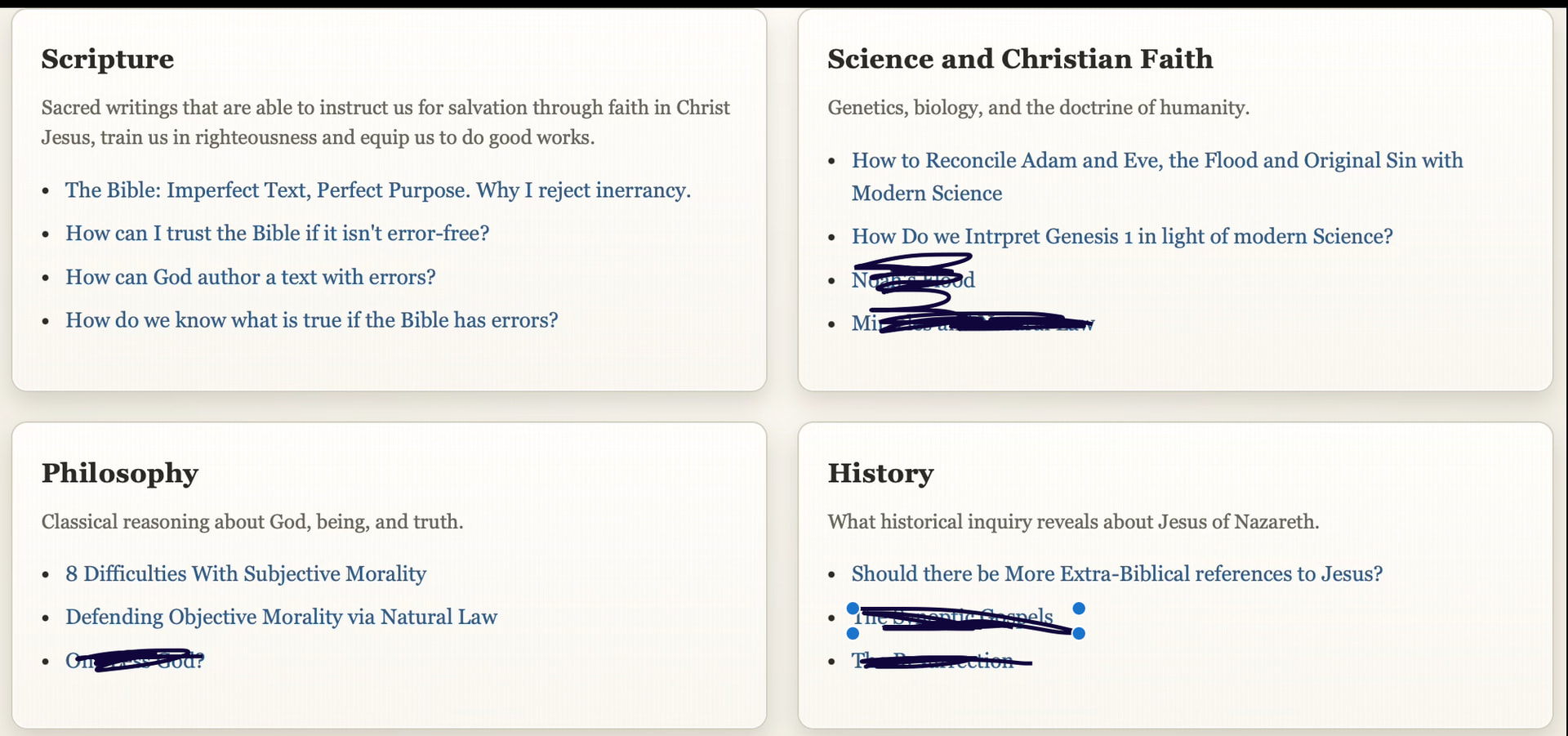
There will be a bunch of links not up yet as I am updating and porting the older articles over.

The ones I did not blot out are live. I hope to have everything updated and ported by the end of the summer. I’m just leaving everything as PDFs now.

Vinnie

1 Like

I think there is some confusion on what a worldview is here. Genesis 1 was penned (written in a specific language at a specific time by a specific person or people). Of course it has a worldview and it is actually laying out key elements of it. These are summarized in my conclusion:

I would no more attempt to align Genesis 1 with modern science than I would demand a theological treatise from a telescope. Requiring from scripture something it never intended to provide will inevitably yield disappointing results. When read in its ancient context as an accommodated text – allowed to speak with its own voice and on its own terms – a scientifically problematic work is transformed into a theological masterpiece. We do ourselves a tremendous disservice when we reduce Genesis 1 to a chronological ledger of material origins; we become like my students missing the ‘James Bond’ reference because we do not understand its cultural allusions. Without this ancient background, interpreting the first creation story is like eating a meal without tastebuds—we miss all the flavor. Genesis 1 teaches us several profound truths: God is absolutely powerful, God is the creator of the heavens and the earth, the cosmos serves as His temple, the sabbath is sacred and holy, and every human possesses intrinsic value and dignity as an image-bearer of God.

Oh wow, so you are more of a deistic evolutionist in how you interpret evolution? If so, then sure. I can see why it would be necessary to take a fully metaphorical approach in that instance. But, In the opening post, I was referring to theistic evolution in the way it is most understood in a strict sense.

Yeah but, what about Joshua Swamidass’s GAE model? From my understanding, his model apparently allows theistic evolutionists to take the Genesis account as literal.history and still maintain a theistic evolution position.

I’m not a deist. God upholds, sustains and creates (ex nihilo) everything that exists at all times. Every atom, every subatomic particle, all of space, time and every underlying physical law and everything in existence that is not God. Without God’s continual create work, everything would cease to be. I don’t feel a need to qualify evolution with the term theistic anymore than I do the water cycle. It’s all God all the time. Not God or nature but God through nature. I can see how some may consider the term theistic important since in common parlance people think faith and science are in competition.

Vinnie

3 Likes

The writer’s worldview is all very interesting for historians and psychologists, but for me, a reader of scripture, the words as written in Hebrew, and for convenience translated into English, the words in their common meanings are all that count. The writer may have thought the earth was a bowl of soup for all I know. That’s irrelevant. The text says: God created the heavens and the earth. No bowl of soup here; no flat disk here. You can turn Genesis 1 and the whole Bible into whatever you like if you insist on interpreting the words by your own understanding of what the writers supposedly believed in their own private world.

Now of course as the reader’s understanding of the world around us changes, the words will begin to carry new meanings. This is inevitable. When the ancient reader heard the word for heavens, (s)he may have envisioned a large inverted bowl. I, on the other hand, envision the reaches of space in which our planet moves. We both have a perfect right to these understandings. The words stay the same – the inverted bowl, nor the reaches of space, nor any other world view is carried in the words themselves.

You then reference the firmament and call it, in the eyes of the writer, a slab that holds up waters above it. They may have thought this. But the word in question there is raqia, which means something stretched out thin. Is space not stretched out thin? Do I not have the right to see it as the reaches of space, as much as the ancients had to see it as a bowl?

There are many world views throughout scripture, they abound in Genesis 2; but there is no world view in the words of Genesis 1. The peculiar thing is that readers in the modern era have assumed them into the minds of the ancient writers, whether they were there or not. Assume them, and then insist that we are bound to accept their ancient views rather than our own. The scriptures were written for us too.

Then I don’t really see the issue. Accepting Genesis as literal history isn’t contingent on adopting RTB’s specific interpretation. For example, Young Earth Creationists also take Genesis as literal history but arrive at very different conclusions about what it entails.

Would you like me to go through and address the specific examples you raised in your article where you suggest Genesis conflicts with a theistic evolution perspective if one viewed the account as literal history?

I am actually working on a study about this. Yes, you do have to treat the Book of Genesis as being metaphorical. One could, with enough patience, understand that most likely the entire Bible should be looked at in this way.

And there is a very good reason for this.

Science and Theology don’t play well in the same “sandbox”; personally, I think that is by design. If you start to look at biblical assertions through a scientific lens, you inevitably start to ask questions that either the Bible can’t answer, or some people “make stuff up” in an attempt to make it make sense.

Either way, it is drifting you towards eisegesis, rather than exegesis, and down a very dangerous path at the end of which is a rickety rope bridge.

My two favorite questions, or points:

  1. Adam and Eve had to have been diploid, because we are, and the working theory in YEC circles is that everyone descended from those two. So where did the two halves of genetic material come from?

  2. If Adam and Eve had darker skin, and they were the sole model for humanity, and skin color is not obtained by environmental factors, but is built in by God. And Adam and Eve were “very good”, why would we need any other skin color (white, brown, yellow, shades of black)?

What are you calling a “literal history?” Adam and Eve created by necromancy as golems of dust and bone in a garden with magical fruit and a talking snake? And what are you calling a “theistic evolution position?” Seems to me you are making both very flexible.

And why try so hard to remove symbols from the Bible. Are you making the parable of the sower about agriculture? I think Jesus in Matthew 13 is basically saying literalism is the refuge of people who close their eyes and ears because they do not want to understand what He is saying.

As I explained above, I don’t like the vague metaphorical treatment of Genesis 2 resorted to by some. I think that is unnecessary for compatibility with science. BUT the Bible uses symbolism constantly and trying to remove that is not warranted at all. God made A&E from the dust of the earth means they come from natural processes just as science explains and what makes us human is not genetics at all but ideas taught to us by God – things like love, person, goodness and justice.

OK, looking at Swamidass GAE… Still too much importance put on genetics, which still distorts Christianity. In my view the inheritance from God via Adam and Eve is an inheritance of the mind (i.e. concepts like love, truth, person, goodness, and justice) which spreads faster than genetics and changes human potential without changing genetics. I see no value to belief in a special magical creation of A&E. However, I do support his desire to see A&E as historical people in addition to accepting scientific findings.

1 Like

Not particularly since I’m skeptical it can be done but if you make an attempt I’ll read it. If it denies the large-scale understanding of the evolution of life accepted by probably well over 99% or practicing experts in the relevant fields, I won’t bother with it. But if you think part of my article is in error and you critique it I will reply.

Vinnie

The Richard Owen who “suggested that humans ultimately evolved from fish as the result of natural laws” in his On the Nature of Limbs?

Your paper does say

But when I skimmed the referenced lecture other than a brief mention of Creation which just illustrated the point he was making using natural history I found no engagement with “philosophical and theological sources”. This smells like the usual quote mining.

BTW, have you actual read anything by Owen?

If you can point out a interpretation of Genesis that pre-dates modern science I might agree, but given

I won’t hold my breath.

Now you are sounding like YEC.

Science assumes it is an “unguided processes” but that doesn’t mean it actually is. We can believe that God directs the process even if there is no evidence that he did. It is a theological belief.

@St.Roymond

So you are fine with an ALLEGORICAL interpretation of Genesis ….
and reject a METAPHORICAL interpretation, yes?

G.Brooks

Your students missed the reference you made to James Bond because the reference you made was a quote of something Bond said in a book they had not read. No where in Genesis 1is there a quote of anyone’s basic beliefs about what the earth is like. No where does it describe the world as flat disc. The ancient writer may have thought it was flat. So What? What is said is that God created the earth. IF the writer of Genesis 1 had said something like…our great God has wisely prevented the cats from pushing everything off the edge of the world, may he be praised. Then we would see the writer’s world view coming into play. We would have to deal with it. But that is not what is said. Nothing like it. It says that God created the earth. That is a simple statement that is as true now as it was then. It does indicate a world view in which God exists and acts; but that world view I accept. Nor does it contradict anything “science" i.e. modern knowledge teaches me.

I think your concern about ad hoc harmonization is a fair one. There’s definitely a risk of reading modern scientific ideas back into an ancient text if we’re not careful.

That said, I don’t think all attempts at correlation fall into that category. Some interpretations try to take both the language of the text and observable features of the natural world seriously, without assuming that one must be forced to fit the other.

For example, passages like Genesis 1:2 (“darkness over the surface of the deep”) and Job 38:4–9 describe the early Earth as being covered or obscured in some way. One possible reading—whether one ultimately accepts it or not—is that the text is describing conditions at the Earth’s surface rather than giving a step-by-step account of cosmic origins. In that framework, the “appearance” of the sun, moon, and stars could be understood phenomenologically (as becoming visible), rather than implying they were created at that exact moment.

I’m not saying that settles the issue, but it shows that the interpretation isn’t necessarily arbitrary—it’s attempting to stay consistent with both the text and observable patterns.

Like what though? I could not find anywhere in your article where you give specific examples.

I think this is another place where translation and interpretation matter. The Hebrew terms rāqîa‘ and shāmayim don’t have to imply a solid dome in a literal sense. In some contexts, they can refer more broadly to the sky or the region where clouds and atmospheric phenomena occur. Passages like Job 37:18 use simile (“hard as a mirror of bronze”), which suggests a poetic comparison rather than a physical description of a solid structure.

So I think the disagreement isn’t just about the text itself, but about how strictly we interpret its language and what kind of description we think it’s trying to give—phenomenological, theological, or physical.