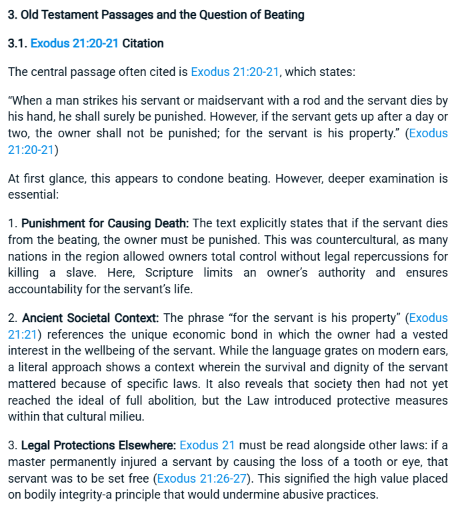
Admonitions to “not beat your slaves, but it’s OK to split families if a parent opts to not remain a slave’, might have been perceived as OK 1500 years ago but are inhumane by modern standards. If we assume there is no divine approval for slavery today, and indeed, if we determine it is immoral by our understanding of God, then it’s very hard to make the case that the stories of the past perfectly conveyed divine intention. And slavery wasn’t just OK in that culture: It was regulated.
I understand that slavery and other practices we regard as anathema today would have felt perfectly uncontroversial in the cultures of the time. But it’s hard to reconcile those practices with a universal God that sets or adheres to a moral system. It’s also hard to justify the discrepancy with the idea “that things were just different then”. A slave then and a slave today would be in the same poor position. Is the main difference now that more people would be discomforted by slavery today? That wasn’t even the default 200 years ago.
Can we make the case that all of the Israelites would have been wiped out and made extinct if they didn’t keep slaves? How about if they had 1/2 or a 1/3 less slaves? Or if freed slaves were allowed to bring their families with them? Did Israel only survive because children and spouses could be split and kept as chattle?
Note that this culture mandated circumcision, dietary restrictions, clothing and distinct cultural practices: all pretty significant and rigidly enforced demands on a people (and ones which were even a bridge too far for Paul). I can’t accept the case that the Hebrews wouldn’t have forsworn slavery and managed if God had commanded them. I can accept that the people capturing and relaying those practices incorrectly thought it was OK.
Yes, they try to put a nice face on it, and I believe they’re sincere, but Complementarianism kinda falls flat, IMHO. I’m mildly surprised they don’t try the same schick with women managers and judges because they’re essentially the same arguments at their core, but I suspect they realize that “genie won’t get stuffed back into the bottle”.
The Rabbi David Wolpe has as great (IMO) interview by Alex O’Conner (ref again here). I tend to think a Rabbi with deep familiarity with Hebrew and the Torah might have a closer understanding of the history and progression of Jewish thought in this area. Rabbi Wolpe also provides an insightful perspective of Judaism that I don’t feel is well grasped by Christians. So outside the question of slavery in the ‘Jewish Bible’, I found an interesting perspective and knowledge I hadn’t known before. Alex O’Conner lets the exchange go well, leaving his interviewee room to breathe and discuss.
1 Like
SkovandOfMitaze
(One 8 ounce steak used as much water as 6,000 ai searches. )
24
None of that changes anything though.
America is not shaped by just Jewishism and Christianity. It’s shaped by a very wide range of lenses and the bit of shaping done by those two lenses have evolved significantly beyond what it was on those days for most people.
Contrary to our leaders and powerful the overwhelming majority of people don’t support adult men sleeping with young teenage women. In ancient Israel and even first century Christianity this was not explicitly frowned upon. Studies show that it was most likely just as traumatic to the 14 year olds then as it would be now. Just socially those in power allowed it. Just like if America changed the age of consent to 14 now, it would be horrible for those little kids, even if certain leaders would be ok with it.
It’s like slavery. Slavery was just as horrible and violent and traumatic 4,000 years ago as it was 2,000 years ago as it was 400 years ago and how it is still today when it happens and it will be equally horrible and painful to those in 4,000 years from now.
Secondly we know that angels never slept with women and bore giants. Just like we know African Americans are not more closely related to “monkeys” than European Americans just like we know women are not less logical than men or that Asian women are bred for sex and so on. We know equality is true. We know that racism is not justification for genocide and violence. Zionist use the same argument to attack Palestinians as the KKK used manifest destiny to enslave black people and drive broken treaty after broken treaty down the throats of indigenous people. It was all tribal based self justification written after the fact as propaganda.
Oh, I know they are sincere. The men at my church are sincere. They love their wives.
Wrongly.
Sincerely wrongly.
And their wives feel cared for and protected.
Just make sure you curb your mouth honey. Don’t ask too much or too many questions. Or let him tell you the answers you should accept. Make him feel like you know he’s the head. It’s your job, honey.
These are the same people who has to spend 40 years in the wilderness to be conditioned to rebel less, and then still got conquered several more times due to their misbehaving, mind you.
Yes – and then He does what was open to slaves under Torah: makes us family. Jesus makes plain that we are not slaves, but free, a point Paul echoes elsewhere.
Slavery in the OT is a path to becoming part of Israel. “Slavery” in the NT is part of the process of adoption as sons/daughters.
This is true. I’ve never understood why so many people are so focused on sin given that Jesus dealt with it. We are to focus on being like Him; the rest will take care of itself.
Yes – Torah boils down to “How To Live in Loyalty in the Present Situation”.
Not even close. For starters, it was required that slaves be treated as well as family members, which alone makes it entirely different.
All of which were things that people expected of gods back then – rules for showing loyalty.
They couldn’t even remain faithful to Yahweh – what chance would a seemingly foolish commandment have? Especially when frequently if an enemy wasn’t taken as a slave they were killed.
While there is the concept of ‘lying to children’ in teaching, it doesn’t extend to giving future trigonometry students detailed instructions on how to calculate the area of four-sided triangles.
If you’re going to have to dismantle something piece by piece over centuries, it’s not a good idea to assist in its its assembly. Far better to prevent it becoming established in the first place.
Could family members be beaten unconscious as long as they didn’t die?
Gerhard
(Gerhard Nebe-von Caron, formerly "Marvin", Sceptic Christian)
32
Considering that you claim the bible telling people that they could beat their slave to unconsciousness, actually what happened if the free man died after a day or two after the quarrel, why would that no have been treated differently as well as the death would have been accidental and not intentional?Or did they mean that whilst they had to pay the free man for lost work time until he was fully recovered if a slave could not work for a day or they did not face a penalty because he was their own money?
Also whilst surely they would as well have beaten their own quite harshly I wonder if you got the wrong end of the stick here
I can across this on Scot McKnight’s substack this morning. Exodus 21:16 seems to apply directly to the American experience with slavery. https://substack.com/home/post/p-202708875
Not really. Most (though not all[1]) slaves transported from Africa to America were purchased from African tribal leaders, not kidnapped. Nor had they been kidnapped by the African leaders - they were typically either prisoners of war or unwanted members of the leader’s own tribe.
Nor is kidnapping even relevant to most American slaves. More than 90% of them were born into slavery.
The majority of slaves in the United States were descendants of Africans who were sold into slavery by their own people. Exodus 21:16 didn’t apply at all.
Alex Haley’s ancestor was one of those that were kidnapped, which may bias perceptions. ↩︎
Family members that couldn’t remain family if one of the spouses was freed. Family members (non Hebrew slaves) that could be kept as ‘non-voluntary family members for life’. Family members that could be beaten without repercussion unless permanent injuries occurred.
If we applied the same conditions to slaves today as was described in the Torah, would it be OK today? Absolutely not. So what made it Ok to keep slaves under those conditions in the past? If you were a slave then or today and could take Saturday’s off, would you think ‘this is fine’, or might you prefer personal liberty? So why was it ‘moral’ then? Why did slaves need to either choose permanent bondage to the master to stay with their families or leave them behind for freedom?
This is what defending the indefensible means. Normalizing immorality is generally not a great way to sell a universal, divine moral code. Literalism in interpretation can force one into contrary and hand wavy conclusions. The classic strategies are to downplay (“Slaves had it good and were well treated.” “It was better than what slaves faced in other cultures of the time.'“, “They would have been killed otherwise”), or suggest it was a necessary evil (“God’s chosen people needed the labor”, “It was like a learning trig. … requiring a gradual introduction, unlike circumcision, for which ripping the bandage off quickly and universally was preferred", “We are converting them .. despite the problem that Judaism was more of an ethno-religion at the time & using slavery for assimilation is rejected today”). None of these really stick the landing intended. Worse still, it leads the gate wide open for argument that slavery today or in the future might be perfectly acceptable or negotiable if similar conditions recur. We went for almost two millennia where slavery was still up for debate in Christendom, relying on the exact same arguments.
Really? So, the people loaded onto ships and sold went willingly? Whether sold once or twice, they were still held against their will, which constitutes kidnapping. The tribes which took them in warfare, did so with the intent of selling them. The slavers who bought them did so with the intent of selling them. The fact that their descendants were born into slavery only makes it worse, not better.
2 Likes
Gerhard
(Gerhard Nebe-von Caron, formerly "Marvin", Sceptic Christian)
38
and considering that we Christians are described as servants / slaves of God or course we expect that per bible our slave master is killing us in revenge for our disobedience and that’s okay
I always wondered if “blessed are those poor in spirit” means they are in need of a blessing - like sneezers ?
If it is a true metaphor then it paints a poor picture of how God treats us
I am sorry, but certain people here seem to think that Paul can say no wrong, so he must be right about this slavery stuff. The fact that slavery was part of the culture does not make it right or any metaphor or comparisons either.
W take into account the known culture of the day, and any comparisons have to allow for it. Ant Christian knows that god does not order us abut like slaves, or punish us like slaves, or even treat us like slaves.
Free will is not something you can deny or prove with Scripture, it is a fact or not. Some people may feel that they have no free will, but that is usually caused by humanity not God. The whole point of the Passion is to demonstrate God’s forgiveness, not His tyranny nor megalomania.