Our Father knows all science, this is how miracles happened. Science is not separate from Our Father, it is that at the time of the Bible not much Science was discovered yet. It’s not magic.

Shame, I think a little magic here and there could be a good thing.
Richard
None of your evidences actually hold water (sorry couldn’t resist). For example this one.
Dr. Snelling was photographed standing next to a crack in folded rock which isn’t supposed to exist. Now why is that you think? And Dr. Snelling’s own research in the Grand Canyon failed to support his supposed explanation for the cracks.
And this one would actually disprove a global flood.
1 Like
The verse is Genesis 3:15. It is not the same word, but the meaning is the same: enemy or adversary. It is not a name but a role and the role is the same.
It is true that some translations in the past used the same word and made this identification look stronger than it really is in the literal text. But I think it is strong enough.
1 Like
Did you mean 3:14?
And in the OT, satan is a title and not a name. In Job the satan was walking around in the Divine Council. So I am a little confused about what you are trying to say here.
Which truth is that?
Richard
When I read something like this a bit of a song always comes to my mind.
1 Like
Oh I don’t know, some seem to have worked out how to milk the broadcasting system for financial gain and security quite effectively.
Richard
Welcome. I apologize for being late to the party. I’ll try to work my way through the 70+ comments later.
The genealogies serve the same purpose they originally served when they were written/edited. TL/DR: They are a polemic against the Sumerian King List.
https://isac.uchicago.edu/sites/default/files/uploads/shared/docs/ois4.pdf#page=47

I’ll try to summarize the history of the Sumerian King List to save you the trouble of reading the whole article.
The first Mesopotamian king to be accorded divine status was Naram-sin. As the author memorably says,

The land was reunited in the third dynasty of Ur (Ur III, 2012-2004 BC) by Ur-Namma. In his 18-yr reign, he started (and possibly completed) ziggurats in the main cities of Ur, Uruk, Eridu and Nippur, but he died leading his troops in battle. This was a cosmic disaster.

His young son, Shulgi, took the throne under dangerous circumstances and ruled for nearly 50 years (2094-47). First, he had to fend off several attempts at foreign invasion, but then he had to undo the damage to the reputation he inherited from his father. The first 20 years of Shulgi’s reign were dedicated to that task. By the 21st year of his reign, all inscriptions attach the cuneiform sign for “god” before Shulgi’s name. How did that happen?
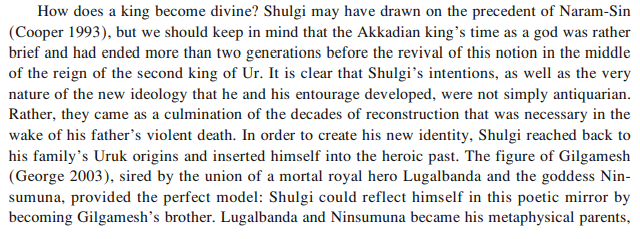
The next part is particularly relevant. Shulgi’s scribes “wiped the slate clean” and retrained the next generation of scribes in royal propaganda.


Finally, whew!, here’s the payoff:
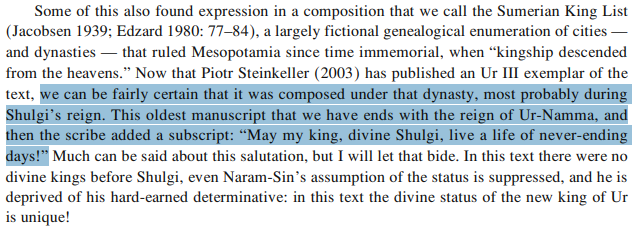
So Shulgi had the Sumerian King List composed to legitimize his claim to divinity via descent from Gilgamesh. After his dynasty fell, the next picked up the SKL and added their own names to legitimize their rule as “descended from heaven.” It was political propaganda from start to finish. The scribes of a later dynasty added the names of rulers who came “before the flood,” and the lengths of their rules are between 43,200 and 28,800 years each for a total of 241,200 years.
The latter is what the genealogies in early Genesis write against. (I’m tempted to say “mock,” but that’s not exactly right, even though Isaiah mocks pagan beliefs in his writing.) The lifetimes of people before the flood in Genesis are long enough to give us pause, but they’re roughly 1000x shorter than the kings who lived before the flood in the SKL.
Now here’s the kicker. Babylonian kings who adopted the SKL to legitimize their claim to the throne continued to use the cuneiform for “god” before their names, but none after Shulgi had temples and cults dedicated to their worship. Instead, they became the gods’ representative on Earth, and kings were credited with every cultural advance. Genesis says, “Nope.”
The king isn’t the image of God – all of humanity is. And in the genealogies, the king isn’t responsible for building cities, inventing tents and livestock, musical instruments, or metallurgy. Ordinary people do all those things.
That’s the lesson we learn from knowing a bit of history.
1 Like
If you’ve stuck with me this far, here’s a Christmas connection.
In the time of Christ, Augustus promoted the cult of emperor worship outside of Italy as a political tool to unite his far-flung lands. While Julius Caesar had not been deified until after his death, a precedent that Augustus and Tiberius officially followed, the worship of still-living rulers was an ancient and accepted practice in Asia and Egypt. Before the Senate conferred “Augustus” upon him, Octavian styled himself Divi Iuli Filius (“Son of the Divine Julius”), which he later shortened to Divi Filius (“Son of the God”), a title that the emperors Tiberius, Nero, and Domitian also adopted and promoted on their coinage. Pergamum, the Roman capital of the province of Asia, built a temple to worship Augustus in 29 B.C. and another for Trajan at the end of the first century. The city was so well-known for emperor worship that the Revelation of John (also written near the end of the first century) could refer to it simply as “Satan’s throne.”
In nearby Smyrna, the famous Priene Calendar Inscription calls Augustus a “Savior” and a “God” whose birth marked “the beginning of the good news (Gk. evangelion) for the world.”
It is against this backdrop that the opening words of Mark’s gospel, traditionally written in Rome, must be considered: “The beginning of the good news (Gk. evangelion) of Jesus the Anointed, the Son of God.” Not only was Jesus executed on the charge that he claimed to be King of the Jews, but his message, “the good news,” was presented by the gospel writers as the true alternative to the cult of emperor worship. When the early church ascribed the same titles to Jesus that the Roman emperors had taken for themselves, conflict was assured; accusations of sedition and centuries of persecution were the inevitable results for the earliest Christians.
4 Likes
Thanks for the link to the pdf, it contains much information and takes time to read. A general comment before reading it properly:
The first chapters of Genesis seem to include teaching that reminds of the way how Jesus teached: you have heard … but I tell to you …
In that sense, it is possible that also the genealogies in Genesis include that kind of a message.
Yet, whatever messages we see in the genealogies, they are (just) interpretations. There may be a link to early Mesopotamia and the mythology of Sumer through the persons in the list (like Noah) but that does not show that the genealogies were written against the Sumerian King List. Perhaps possible but not a strong claim.
By the way, the periods of the pre-flood kings in the SKL appear to have a numerological significance. 28’800 is 60x60x8, and 43’200 is 60x60x12. IIRC, 60 was the most influential numerological figure in Sumer and 60x60 loads it twice, sending a message that these were superimportant kings. If we adopt the ancient numerological viewpoint, the ruling periods did not even attempt to tell ‘real’ years, they attempted to tell the significance of these rulers.
Another minor note is that in the pdf, the focus is on the kings of Ur. There are certainly good reasons for that. Ur is interesting also because Abram (Abraham) apparently originated from that city.
Based on Sumerian mythology, the starting point of the kingship (‘when kingship landed from heaven’) was not in Ur, it was in Eridu where the first pre-flood kings ruled.
Based on the pdf, it seems that modern scholars interpret the pre-flood kings just as mythology invented by the king of Ur. That is just an interpretation. Why would the king of Ur try to get the justification of his reign from another city (Eridu), not from Ur where he reigned?
During the peak power, the king of Ur ruled also Eridu but basically the two cities were separate points of ruling/religious power and possibly competitors before a single king managed to take the rule of both cities.
Could it be that the scholars have looked at the numerological figures of the ruling periods and concluded that this list must be just mythology because the ruling periods are tens of thousands of years?
1 Like

I wonder whether it is possible to have too much knowledge for your own (and others) good.
Richard
Genesis 3:15 does not say that the serpent is the enemy or adversary of God.
A good question. The answer depends…
With much new information, it is possible to get lost among the details - can’t see the forest for the trees. It takes time to digest a large pile of pieces of information into a general picture that may be useful.
After the digestion process, the information may become useful. There are all kinds of claims and interpretations. With sufficient background information, it is possible to recognize obviously false claims and perhaps give a credible explanation of some difficult-to-interpret part of ancient writing. That may help others.
For some, the attraction of the interesting details may become such a misleading web that the person cannot see the grand picture.
I would take as one example the theoretical speculations of how this universe could have originated from a situation creating multiple universes. The ability to think and calculate interesting details may have blinded some so that they cannot see how their presuppositions/axioms limit the usefulness of their calculations.
Another example comes from the context of theology. Diving into the world of different cultures reveals many points where there are apparent similarities. With a too narrow focus on details, it may feel fascinating to develop hypotheses of how the teachings in the Bible are just modified versions of the stories that were recorded in other ancient cultures. This can lead to hypotheses and claims that may mislead both contemporary researchers and other interested people.
In theological research, it is a too often observed pattern that someone publishes an interesting hypothesis and defends it in a dissertation (or a book) and thereafter, the other researchers cite that study (hypothesis) like a proven truth.
3 Likes
Correct. That is not the role of Satan in Job either. The devil as an adversary to mankind is a role given by God, a consequence of our own choices and the purpose is redemptive. If we insist on blame then better to blame this devil than to blame God (who is the source of love, life, and the greatest help). But you can not pass the blame without giving them power over you. Thus it is better still to take responsibility yourself. I do not agree with the notion that getting people to not believe in the devil is his greatest trick – quite the opposite, the more you obsess over the devil the more power you give him.
On the other hand… evil does exist, and denying this is a bad idea. And yet, evil is also entirely un-necessary. Conceptually, simply reject it and move on. But when it is a reality in the world, then stand up to it and fight against it. But the end is to destroy it, not to fight it eternally. It does not have that kind of significance.
I think it is common, especially for intelligent people, to become too dependent on their ability to understand things. The capacity to comprehend becomes an idol or a crutch of some sort that sometimes keeps people from just accepting what they and others experience or intuit to be true. If you are used to being able to grasp ideas, even complicated ones, it’s hard to let go of the need to understand how and why and what for and just live in the tension of some things remaining beyond our grasp; mysterious, or inexplicable, or paradoxical, or unknowable, or seemingly senseless.
7 Likes
Not all of it is related to the Sumerian King List, which is why I tried to summarize it. I meant to tag @St.Roymond but I forgot.
The strength of the claim is that it fits the pattern of Gen. 1-11. Genesis 1 contradicts ANE mythology that creation was the result of a battle between the gods. God spoke, and it was. The six days of creation followed by rest reflects ANE temple dedication ceremonies, but the “idol” installed in the temple to represent the god(s) is humanity, not the king. It’s a polemic.
Likewise, Gen. 2-3 contradicts ANE mythology that the first humans were created from “the ground” mixed with the blood of the defeated god, hence our corrupted nature. Humans were created because the lesser gods were tired of “feeding” the greater gods, so our purpose was to labor in the fields so that the gods could “rest.” In Genesis, God created everything “good,” but human choice brought about the curses.
The Flood is no different. In ANE mythology, humans became too numerous and disturbed the gods rest, so they determined to bring a flood and wipe us out. In Genesis, the Flood comes because humanity has filled the earth with violence and bloodshed. Human choice, and a polemic against ANE mythology. The story of the Tower of Babel is no different.
So the only “missing link” is the genealogies. They also serve as a polemic against ANE mythologies of “divine kings.” It fits the pattern exactly.
There’s also the fact that scribes in Israel prior to the Exile were taught to write cuneiform in a dead language in exactly the same way as other scribes across the empire – by reading and copying ANE mythologies. They were intimately familiar with the source material, but wholeheartedly disagreed with it.
No, only later versions of the Sumerian King List (SKL) included the pre-flood kings and kingship landing in Eridu. It’s not just an interpretation when the pre-flood list of kings suddenly shows up in the archaeological record when it wasn’t present in earlier versions. The earliest extant text of the Sumerian King List dates from the reign of Shulgi and Ur III (USKL). It differs significantly from later versions, in that kingship descends on Kish. Here’s what the scholar who published that version had to say about its provenance:
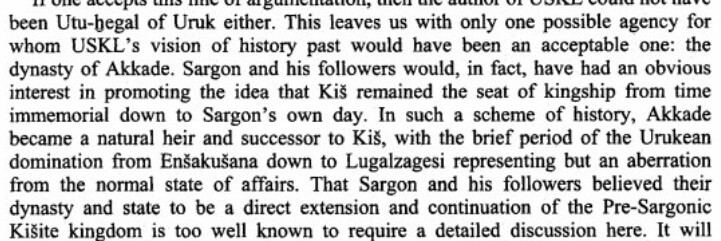
Shulgi traced his ancestry to Uruk. The “pre-Sargon section” in what follows refers to the pre-flood names on the latter Sumerian King Lists.
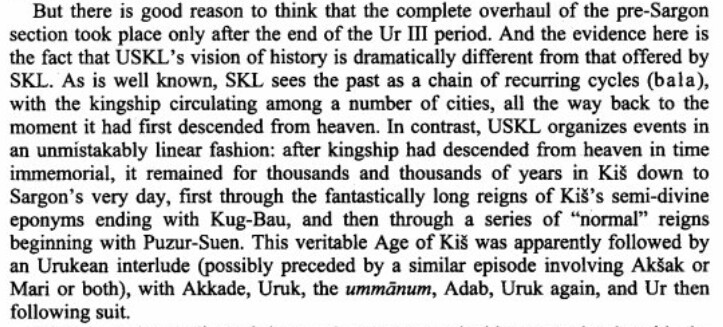
Edit: Forgot to include the link to the above source.
2 Likes
It at the very least throws into doubt the idea that the ages are meant literally.
You weren’t there, either, so you have no idea about the genealogies.
Since they’ve been addressed before, I’m going to skip the details and just say you really ought to either (1) learn some actual science, since the claims you put out are all incorrect, or (2) stop lying – assuming you actually know the science.
Though either way you have made an idol out of science.
Yes, it does – Luke does not mention Mary. I know it’s a popular dodge, but the genealogy starts out with Joseph.
2 Likes
In the immortal words of Rodney Daingerfield, I resemble that remark. haha
2 Likes
I see the connection, but there’s no ‘name’ given in Genesis 3:15, there’s only a status – no role.
Very good point!
1 Like