That is a really shallow view of things.
That if something isn’t scientifically correct it can’t be true.
Please stop lying about people here.
Huh? I just did!
Besides which you really need to get loose of the idea that everything can be settled by quoting Bible verses.
Please stop lying about people here.
I didn’t change anything. Just because the text doesn’t agree with your narrow understanding doesn’t mean that someone has changed the text.
I thought you claimed to be a Christian! If salvation is not spiritual then we are stuck with our sins – indeed if salvation is not spiritual then Christ’s death was useless.
I didn’t say it did – that’s an idea you invented.
Please stop lying about people here.
Please stop lying about people here.
Are you actually reading what people write? I ask because this question has absolutely nothing to do with what I wrote, and that’s something you do a lot.
Please stop lying about people here.
So you recognize that the Genesis Creation stories are not scientifically accurate? That would be progress!
This is the equivalent of having a box of shirts and because you found a red one you concluded that all the shirts in the box are red.
Jesus disagrees: He never told people to study history in order to be able to come to Him, in fact He didn’t even tell people that sin was why they needed Him – He said, “Come to Me all who are weary and heavily burdended . . .”
This insistence that certain knowledge is necessary is very gnostic.
Here again you demonstrate that you don’t understand what a worldview is: that seems obvious to you because you are stuck in a modern worldview, but it would not seem at all obvious to people in the late Bronze Age.
So? That is your basis for thinking something is correct, but that doesn’t make it so. This is actually an example of idolatry because you are putting your definitions above God, using your standard to judge what He must do!
In the Bronze Age and even most of the Iron Age the notion that something being fiction means it can’t be true would have been laughed at. You’re using the modern idea that it is the content of a story that makes it true, but two, three, and four millennia ago that was not a measure of truth; their measure of truth was who something came from – and if something came from deity, nothing else mattered.
THAT is the sort of difference involved between divergent worldviews!
He most certainly did! You like to put “spiritual” and “physical” into two very separate boxes, but that is not the biblical view; there, the physical and the spiritual are intertwined – if they aren’t, then the Gnostics who said that nothing you do with your body matters at all. Humans are by definition embodied spirits, and that isn’t like pouring Jello into a mold, it’s more like having a clay pot be naturally red – the red is such a part of the clay that you cannot make it another color without changing the clay into something else.
Sure, and rocks falling to Earth proves that the Earth loves rocks so much its love pulls them to it (which BTW was an idea that was once defended as being biblical).
Your claim is no different than claiming that since snow does in fact fall then Robert Frost’s Stopping by Woods on a Snowy Evening is literal.
That’s something he can’t see because he has never actually grasped what it means to have a different worldview.
Depends on the scholar; I haven’t read enough to be able to say how common that was. I don’t really see a chiastic structure there, though, so I’m going to guess it wasn’t common.
Human physical death.
Intriguing.
That’s wrong just from the understanding of man: spiritual death necessarily entails or leads to physical death since the spirit was understood as giving life to the body, thus if the spirit died the body was sure to.
I just found a long lecture about Adam as viewed in second-Temple Judaism, but I’ve been awake too long already and will have to save it till morning. [Just reading the analysis of môṯ tāmûṯ and company strained my concentration.]
edit: Very disappointed; the matter of literary genre wasn’t even addressed. Since the source was from Dallas Theological Seminary I suppose I shouldn’t be surprised, but I hoped for better.
They (it turned out to be a panel presentation) at least acknowledged that Genesis does not provide a way to date the Garden stories, just that it was “a long time ago”.
Not really worth much.
1 Like
I don’t know what to make of Adam. I would view the entirety of the primeval history as myth but we have doctrine and an NT that seems to put a lot of stock in Adam that complicates the issue. Augustine’s original sin goes a little beyond Paul (and is based partially on a mistranslated item) but it would be wrong to say the seeds of it are not clearly in Romans and the Pauline corpus. Then there is science which seems to clearly indicate we don’t all come from two people as best as I can tell. The world does very much. seem fallen and broken to me on some deep level. I sometimes wonder if evolution is the fall. In some ways, we have primate aggression and strong sexual urges as part of our biology. I think in some ways we are meant to rise above our station and become reconciled with God. That could be entirely made up by me though.
Putting all those puzzle pieces together is not easy.
That part was a very slow read for me. Especially since I know a little bit more than nothing about the language. But it does offer a potential explanation for an otherwise mystifying verse. The harmonization/apologetic of just labeling it spiritual death, whether right or wrong, never sat well with me.
1 Like
A doctrine, maybe But both Ezekiel and Jeremiah would seem not to agree with it.
Original Sin is a myth, as much or even more so than the Garden narrative itself. Genesis does not claim that sin has become endemic. It suggests that God did not wnat Adam to have the knowledge of good and evil, IOW sentience. Do you think that Adam could have dominion over the earth without sentience? DO you really think God would deny Adam sentience? Do you also think that God is incapable of preventing Adam from getting sentience? Or do you think that God cruelly tested Adam (and Eve) knowing the result ?
Why would God come down so hard, not only on Adam and Eve but all of humanity?
Are birthing pains a curse from God ?(or a necessary stimulation) Do you think that weeds are a curse from God? IOW do you think any of the Gaden Narrative as any basis in reality? Where is Eden? Where is the flaming Sword? On another planet maybe? Or another plane of existence? What about the fourth river? It dried up perhaps?
When will you understand the purpose of Genesis 2-4? It has nothing to do with Original Sin! and everything to do with the price of free will? The moment we gained sentience (however it occurred) we were barred from Eden. Eden is a pipe dream. If the New Heaven and New Erath really is Eden then we will have to lose our sentience again to live there.
Sin is the by-product of freedom/free will… You cannot have one without the other. Sin is choosing evil. If sin is not our choice then we do not need forgiving for it.
Richard
It’s not Genesis 2-4. It’s how Paul in the NT spun Geneis. There is no devil in the garden. That is also a later addition. As I mentioned the Christian has to contend with many things.
How it was understood originally.
How it was understood during the exile.
How it was understood by Paul
How it was understood by the Chirch the last 2 thousand years.
What science says on the matter
What the rest of scripture says.
Relax, I don’t even subscribe to “original sin.”
You like just saying something then ignoring everything else. I’m just doing my best to assess all the pieces of the puzzle as I see them. I have questions. You seem to just have answers. Let me be frank. I’m willing to listen and learn from your interpretations but you pontificating on high does nothing for me.
And you claim that Genesis has to do with the price of free will. That is possible but Adam and Eve already had free will/sentience before choosing the fruit. They were banned from Eden for disobeying God, not gaining sentience, which the story presumes they already had to some degree.
Not to mention the story means something very different during the exile where the people were kicked out of their promised land (Exiled from Eden). Maybe it’s just a mythical story and we should just accept it as teaching Israel’s sin got them Exiled. Done. Or maybe there are other levels and we have to contend with Paul in the NT and see the pretend the Devil and Jesus crushing his head on the cross.
You seem to oversimplify things, ignore/dismiss all evidence that doesn’t agree with your oversimplification out of hand, and then confuse your limited interpretation with Gospel.
1 Like
I can’t imagine there not being a “first contact” so to say. An original awakening that was intellectually and culturally transformative. These things do happen now. I believe Israel was chosen by God in all of its weirdness. There is a real history to redemption. Whether Adam and Eve were their actual names isn’t a hard line I would draw.
I appreciated how Longman explained that for me the first time I read it.
Solipsism is a real issue in philosophy. Augustine might have been the first person to put it into words. For me, its possibility is a significant piece of evidence that this world is in a post-Edenic state.
1 Like
The issues not first contact to me. The issue is what the sin of Adam has to do with everyone else.
You have a quote handy?
1 Like
But first let’s make one thing absolutely clear, because it is frequently misunderstood. Paul asserts that Adam’s sin introduces sin and death into the world. Notice that he says nothing about guilt. Paul’s point here is not that we are all guilty because of Adam’s sin but that we are guilty because “all [including you and me] sinned” (Rom. 5:12).
Augustine, the rightly revered theologian who lived around AD 400, was not so accomplished a Greek scholar. He mistranslated the Greek of Romans 5:12 so that it read (in Latin), “Therefore, just as sin entered the world through one man, and death through sin, and in this way death came to all people, in whom [rather than “because”] all sinned . . .” This misunderstanding led to the idea that Paul explicitly stated that Adam’s sin is counted as our sin, that we inherit our sinful nature from Adam’s act.
Confronting OT Controversies, Longman
2 Likes
I apologise. It is very easy to slip into such a mode on this forum., and I am passionate about fighting this doctrine.
To be honest I have never made this connection. An interesting notion.
I think Paul must be turning in his grave with all the things that are assigned to him. He tried so hard to be precise and in doing so confused the people wh cannot follow a complex argument. Adam was the original sinner as in the first and Jesus is the instigator of the solution. First and first. I really think it is as simple as that. In with Adam and out with Christ…
Perhaps some people read too much into things? I really do not think that faith is based on theology , or study, or knowledge. You probably have seen me criticising some people for studying too much? knowledge is power, but it can also cause problems whereby we think we know more than we do. You know “the Devil is in the Details” maxim. I think some people find that offensive if applied to Scripture, but Scripture was not written in verses and chapters. It is so easy to split passages down and take them stand alone. I really think that if Paul wanted to initiate the doctrine of Original Sin he would have put a whole section to it rather than a passing comment (twice) Perhaps he was toying with the idea? But he never made it the specific focus of his writing.
I apologise again. It is not my place to tell you or anyone else what to believe (or not), I can only say what I myself believe, and as such I am gong to be confident about it.
Richard
1 Like
Maybe something is fuzzy rather than clear-cut. You couldn’t read as an infant. Now you can. So does that imply there must have been an exact and absolute “first contact” for your ability to read? As in … you couldn’t. But after some day or some instant, suddenly you could? I’ll suggest to you that such a day never existed for you. But that doesn’t put your present ability to read into doubt. We like hard boundaries. They make sense to us and our need to neatly categorize things. Science has challenged this need in so many ways.
As a symbolic archetype. Adam is us. It’s our own sin that dooms us. We are “in Adam” just as we are called to be “in Christ.” The attempt to reduce this all to some trivial literal or biological thing is to turn it all into nonsense. Sort of like arguing about which city it was where the prodigal must have traveled.
4 Likes
That basically is how I see it. Our biologic urges and nature is a synonym for what it means to be “of the flesh.” Our being made in the image of God is what allows us to rise above it.
2 Likes
- “Archetype” is, IMO, a useful concept. Another is “Serpent”. I recently read, for the firs time, that Apep was:
- "the ancient Egyptian deity who embodied darkness and disorder, and was thus the opponent of light and Ma’at (order/truth. Ra was the bringer of light and hence the biggest opposer of Apep.
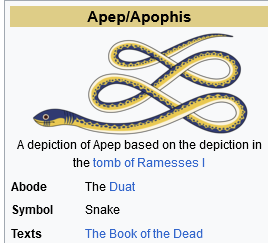
- Hmmm, Apep “the Serpent Egyptian god of darkness and disorder”, condemned by God to slither about on it’s belly?
2 Likes
Interesting. It is another example of how we need to understand the cultural soup the early Hebrews were immersed in, if we are to understand what record they left.
3 Likes
- Want another?
- Ma’att: the Egyptian goddess who personified the ancient Egyptian concepts of truth, balance, order, harmony, morality, and justice. Ma’at also regulated the stars, seasons, and the actions of mortals and the deities who had brought order from chaos at the moment of creation.
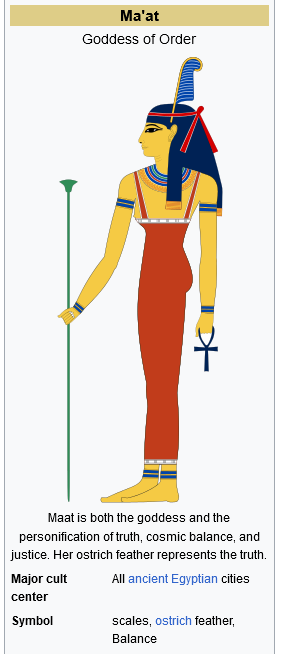
- Eve is the Hebrew equivalent of Ma’at, and both are archetypes???
1 Like
Do you suppose hard “boundaries” are purely fictional?
I can see them in Scripture and even throughout recent history
This makes me think of Keener’s analogy to hair length in his book Miracles Today
This would also touch on the concepts of inerrancy and fallibility as it applies to Paul. I don’t think it would be blasphemous to say that Paul was a fallible human, but Paul’s writings are considered inerrant and infallible where it concerns theology. If Paul mistook the Genesis account as a literal history, would that impact the accuracy of the theology? I don’t think it would, but I’m not exactly the right person to be making that judgment.
1 Like
In addition to sounding trivially literal or a biological thing, it also feels unnecessarily legalistic. It’s as if someone is pouring over the fine print to find loopholes. I think Jesus had the best take on the whole thing when he asked those who were without sin to cast the first stone. He didn’t ask for people who claimed not to be the descendants of Adam and Eve to cast the first stone. Jesus’ message, in my estimation, is all about the sin each of us has committed, not the sin we may have been born with due to the actions of a specific ancestor.
And my usual caveat . . . These are just the opinions of a nonbeliever that should not be given the same weight as the opinions of believers on this board or elsewhere when it comes to valid Christian theology.
3 Likes
I would say more that they’re conventional (or ‘definitional’). I.e. for practical, educational, or political reasons we do need to establish hard boundaries … We need some sort of definite age before which it is illegal for you to drive and after which you become eligible for obtaining a driver’s license. But we shouldn’t be under the illusion that this represents a sudden change of actual driving capability happening instantly on somebody’s birthday. Or in education, we find it useful to speak of categories of things in order to aid communication and understanding. So human development people can speak of infants, adolescents, adults, etc. But there is no magic single instant of transition between those things. Of course there are instances where hard boundaries may exist. Either the high jumper cleared the bar or they didn’t. Or somebody is pregnant or they aren’t - and we can pretty well pinpoint the transition or the boundary. But in general, a lot of our categories involved blurred transition.
I think I speak for more than just myself around here in saying that your opinions are valued on the merits of their insight to truth. Your self-imposed humility of thinking yourself an outsider is noted - maybe appreciated by some. But your voice is all the more valuable, I think, because of insights it brings from your own particular faith journey - even if you recognize it as a journey away from the faith of your childhood.
3 Likes