Yes, it would suggest that. I think the pagan gods may be represented by the giants (nephilim) both before and after the flood (Gen 6:4).
Pagan kings would made themselves out to being gods, descending from gods and reigning for several thousand years. We don’t know how long the patriarchs really lived, but by having them all live less than a thousand years shows them to be mortals. One thousand years is as one Day (2 Pet 3:8), and Adam would die (930 years later) in the same Day he ate from the tree.
I think the Tower of Babel represents a resumption of these pagan thoughts of wanting to be as gods… building this tower to heaven.
Abraham who founded the Hebrews was originally from Ur of the Chaldeans which was a Sumerian city-state. God tells Abraham to get away from his country and family (Gen 12:1).
I have just learnt about the Amazon molly, a freshwater fish that doesn’t need two parents to ensure diversity completeness - one suffices - but does need a second parent from a different species to trigger reproduction.
I’d like to send you the chapter on Genesis from my forth-coming book, Can We KNOW God Is Real?. I grew up as you did, but after learning Hebrew in seminary and reading some rabbinical commentaries, it dawned on me that the fundamentalist reading of Genesis is wildly off. Let me know if you want it: roy.a.clouser@gmail.com
I dont know what you are reading, but its nothing I said. Nature changed its working when animals arrived on the scene. Animals have a sin nature while plants dont. Animal sin is not accounted for though because they dont have the law, while humans do.
This is a misrepresentation. Shelah was not a kangaroo, but I believe was a real person (based one of the Sumerian kings). Using the meaning of his name, I show that he was also a type representing our common descendent with all therian mammals, and indicates where marsupials split off. When you count back from the birth of Isaac (who is a type of Christ), multiplying all the begat ages of the patriarchs by 365 thousand (based on 2 Pet 3:8) you arrive at approximately 130 million years ago.
100+70+29+30+32+30+34+30 = 355
355 x 365K = 130 Ma
2 Pet 3:8 But, beloved, be not ignorant of this one thing, that one day is with the Lord as a thousand years…
If one day with the Lord is a thousand literal years, then one year with the Lord would be 365 thousand years (365 days per year times 1,000). The patriarchs ages are in type measured in years with the Lord.
Meaning of Shelah’s name explained part way down in this earlier post from the thread you linked to:
OFCOL why do people insist as taking this as a mathematical constant. It was never meant to be such.
Scripture does not express or justify Old Earth science.
Scientifically incorrect. There is Male and female (equivalent) in plants.
And as for all animals sinning…
You would appear to have a false, if not common, view of sin.
Scripture claims Eve was the first, and that animals existed before humanity. Use your maths.
Humans did not suddenly change the dynamics of the whole of creation by disobeying God. God made humans with the full knowledge of their capacity to sin. Sinning was inevitable, and the Scriptural reaction to it is purely human. Scripture does not understand God at page 1. That was never the point of it.
Thanks for the summation, Ben. I don’t know what one’s views on climate change and vaccines have to do with six-day creation. But—maybe your family has developed a philosophy that goes unilaterally in one direction.
I know you don’t have time, amidst your studies, for a lot of things. But learning continues after college…yes, I know!! A shock! Really! You can dig into all these things eventually if you want. It’s not a sin to still be studying and learning at…gasp! 40! There! I have said it! or even 80! (Don’t faint!) And when you do that, you will find that not everyone --even conservative Christian people --thinks the same. Your own beliefs and thinking about these things may continue to change as you learn more and see more.
As for six days versus billions of years—I was raised an atheist but when I became a Christian (born again), all I heard was six days and how they had found sea shells in the desert–various stories like the few missing seconds that someone at NASA had to come up with in calculating some space mission —thus verifying the lost day or so in Joshua etc. I heard all this and accepted that this is what Christian people of the evangelical variety all believe…and what the Bible teaches.Until , like you, moments came in life where I couldn’t simply repeat stories like that any more.
But you and I are not alone. Augustine asked similar questions. And he did not know that we would ever walk on the moon! There also may be a certain amount of regionalism in some young-earth — or even old-earth —thinking. Do followers of Jesus in the UK or Greece (for example) all hold to young earth anti-evolutionary views? I don’t know but I have heard that the statistics are different on that. The idea that one’s interpretation of Scripture may be influenced by the politics of one’s country or region–is itself an interesting one, and not often addressed. Maybe we have to accept that all of us are limited in our thinking.
I don’t have family members who believe in a young earth, so I cannot tell you what will go on at the dinner table when these topics come up–although I can guess . Maybe you can all agree to disagree—and talk about something safe like politics (ha!). Or the high cost of living. My relatives all worked in the sciences so even suggesting something like a young earth would be high comedy to them.
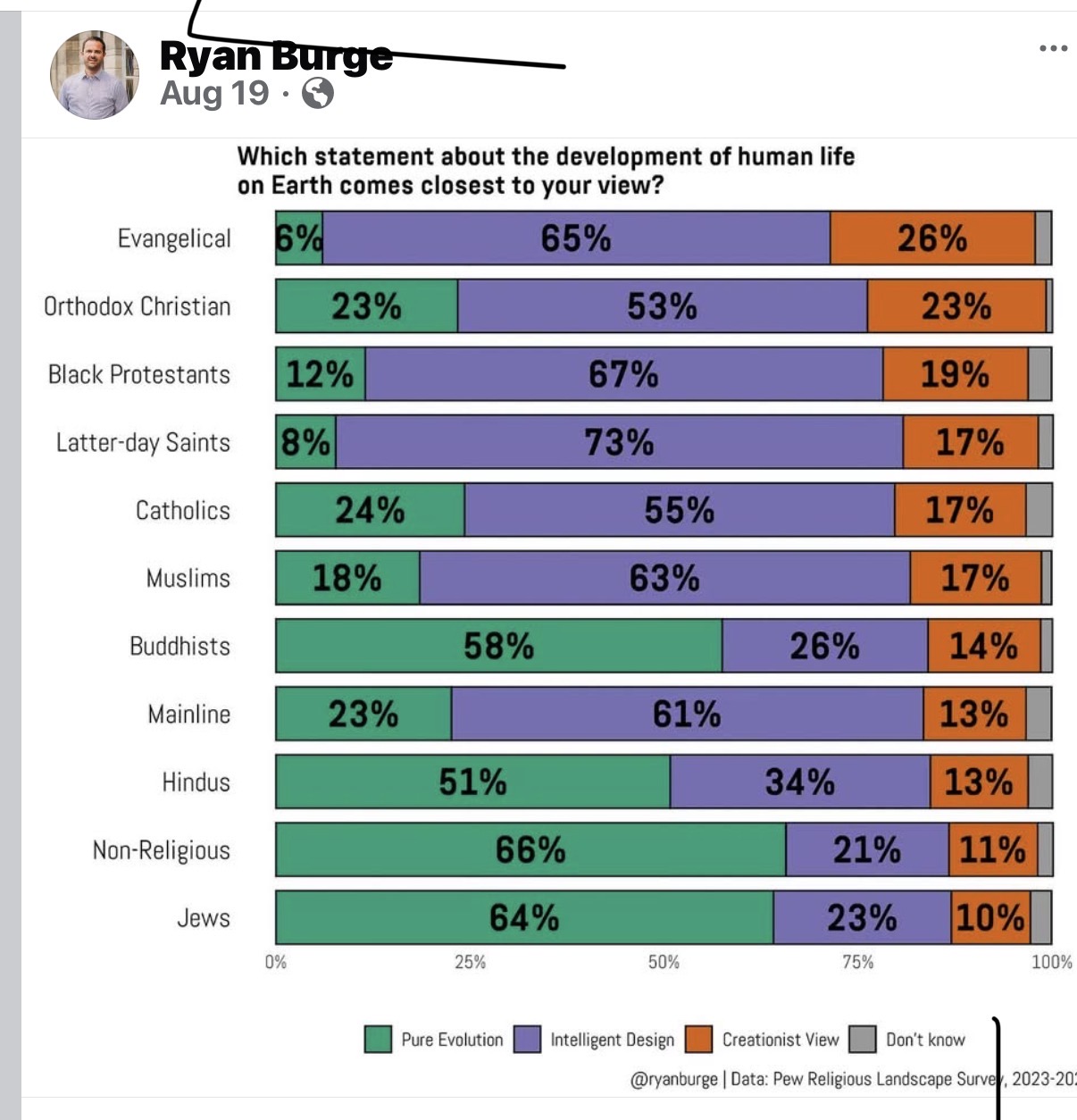
It’s behind a registration wall at this point, but statistician, Ryan Burge, who is often interviewed over at HolyPost.com recently published an article “Young Earth Creationism Isn’t Nearly As Common As You Think”. I can’t remember the numbers. But even in the U.S. it’s a small minority of Christians, and worldwide it’s even smaller. Will have to see if I can put numbers to that.
Go with the evidence, the truth. Archaeological, paleontological, physics, chemistry, geology, and biological evidence does not conflict with Genesis unless people choose to discard it. I labored with the same concerns as you and still have differences with my friends. Some just cannot accept the science; I think it’s the way it is. But remember that Jesus never declared that our position on Creation and Genesis was a litmus test for salvation. Stick to your beliefs because it strengthens your faith to know the science, and do not disparage those who do not embrace the science. You cannot convert them to your side, so just be satisfied with your beliefs.
I have just published a book titled Reflections on Genesis, available on Amazon. I wrote it to satisfy my own concerns like those you described above. Aligning the evidence with Genesis 1-11 has given me the confidence to defend the faith. Not against fellow Christians but those seeking. I make no money off the sales; my only goal is to inform along the lines of where you are.
Lastly, a bottom line for me is that the Bible tells us what God did in Creation, why He did it, and sometimes when He did it. Scientific evidence tells us how God created and when he did it. Both are marvelous.
You may be thinking of this graph which I copied from his facebook page. I suspect the numbers are even smaller than that, depending on how you ask the question. It does show a big number agree with intelligent design, but that to is deceptive, and technically all Christian’s believe in God’s intelligence behind creation, or else they are functionally deists.
Yep! And as I recall, those results are entirely about the U.S. right? Since that’s the data he has most available to work with. But I thought I had heard somewhere that the ‘creationist’ categories fall even farther if the scope is broadened to include Europe or the International scene generally.
Have you truly reflected on why your faith shifted toward evolutionary perspectives—and what real science and real truth ultimately are?
Much of modern scholarship rests upon evolutionary thinking, chance, naturalism, probability, uncertainty, and relativism—frameworks built on hypotheses rather than absolute truth. It is worth pausing to reflect seriously on these foundations. One should ask why they are not declared as absolute truth but instead are built upon hypothetical assumptions. Such reflection prepares you for meaningful dialogue between evolutionary perspectives and biblical truth. Moreover, considering how some have maintained faith rooted in Scripture despite receiving the same education, reflecting on the process of their struggles and the reasons behind their conclusions can be deeply valuable. After all, the conflicts and questions you face are ones that others have also passed through. Therefore, taking time to study and understand the reasons for your own inner struggles, while also engaging with the processes and conclusions of others, can greatly enrich genuine reflection and meaningful dialogue.
Indeed, present company included. A number of us were raised on creationist literature, and only came out of that with a great deal of soul searching and internal conflict, as it became evident that what was presented was just plain false.
That becomes the issue. Some look at their interpretation as being absolute truth, when in fact it is a product of a particular viewpoint. Evolution has moved far from the hypothesis stage into the area of being a well supported theory, but of course nothing in science is ever absolute truth. One problem with lay people, is they really do not understand the distinction. And trained scientists may agree on 99% of something, but argue the final 1% with zeal and vigor, which is what their critics seize upon.
I deeply sympathize with how difficult it must have been to go through such inner conflict and agony as your original worldview shifted into a new one.
If you don’t mind, I would love to hear a bit more detail about your experience. We spend over 20 years—from kindergarten all the way to graduate school—immersed in an environment where textbooks, exams, educators, and media all operate on the absolute premise of evolution. Even for someone raised in a strict Christian home, the sheer weight of that physical time and environmental exposure is immense.
Given that, I naturally wonder about the nature of your struggle back then. Was it simply that the prevailing evolutionary consensus you were exposed to for decades made it easy to dismiss creationist literature as false? Or did you actively guard against that overwhelming system and critically examine both sides?
I would be really interested to know which specific creationist texts you read, what exact points led you to conclude they were wrong, and conversely, how you validated the claims of evolution rather than taking them at face value. Specifically, what kind of direct or indirect efforts did you make—such as engaging in debates, asking questions, and investing your time—to thoroughly examine both perspectives?
I appreciate your distinction between scientific theories and absolute truth. However, looking at this strictly from a logical and foundational standpoint, a critical issue remains regarding how we evaluate that “99% consensus.”
A theory’s validity depends entirely on its core premise. If the primary root—the foundational assumption—remains an unverified hypothesis, then no matter how much secondary data or internal logic makes up the remaining 99%, the entire framework is built on an unproven base. High consensus within a system simply proves that its internal logic is consistent with its own rules, not that the starting premise itself is true.
In reality, no human discipline can claim “99% factual certainty.” We see this structural limitation even in biblical studies and theology: despite having a clear foundational text, human bias, flawed interpretations, and historical heresies have constantly corrupted the field, making pure truth difficult to extract. If systems based on divine revelation are so easily compromised by human error, secular frameworks built purely on naturalistic assumptions are certainly no exception.
Rather than scholars passionately debating the final 1% while taking an unverified 99% for granted, shouldn’t true scholarship critically re-examine whether that initial 99% was built on a proven foundation in the first place?
 . Maybe you can all agree to disagree—and talk about something safe like politics (ha!). Or the high cost of living. My relatives all worked in the sciences so even suggesting something like a young earth would be high comedy to them.