Because “reconciling YECs to evolution” to me implies they keep their worldview and beliefs as YECs, they just add evolution on top.
This sentence reads to me a lot like “If you like waffles, why do you hate pancakes?”
No. And no. And so what?
It sounds like you are trying to be confused on purpose to find things to argue about. Me saying “I don’t think GAE is a helpful model, but I’m not going to get into it AGAIN” is not confusing. It’s very straightforward.
1 Like
gbrooks9
(George Brooks, TE (E.volutionary T.heist OR P.rovidentialist))
368
I would not personally accept that interpretation as “reconciling to evolution”.
Can you propose a sentence that include whatever term or terms would reassure you
that by reconciliation I mean a FULL ACCEPTANCE of the current evolutionary model?
I would like to see people who currently subscribe to YEC positions on science and Scripture leave that framework, accept the validity of scientific facts and culturally appropriate Bible interpretation, and adjust their Christian beliefs accordingly.
2 Likes
gbrooks9
(George Brooks, TE (E.volutionary T.heist OR P.rovidentialist))
370
Then we agree on what is a possible goal for YECs.
I’m not sure how I created the impression that I was okay with YECs
embracing a GARBLED notion of evolutionary science.
If I ever say something like it, be sure to ping me.
It might have been simply using the word “reconcile” …. which I suppose
can have a rather broad range of meanings. Maybe I should use the term
”accept” instead?
Yeah, accept would be better. I hear reconcile and I think make it fit or make it acceptable without addressing that what it’s fitting is wrong. I feel like GAE tried to accommodate their misguided Genesis and Romans readings to make evolutionary history “fit” or be more acceptable, and I’m just not a fan of that kind of exercise. I know some people think we should humor wrongheaded ideas if we can get people to a place where they are causing less harm, but I think we should aim higher.
And there’s the rub. YEC has led directly to an anti-science belief system. You can pretty much draw a straight line from fundamentalism to Culture War to our present situation where the NIH and CDC are gutting research programs and slashing public health benefits and the White House is killing every climate-related agency. The only solution is the end of YEC as a worldview. Thankfully, their younger generation is defecting by the boatload, so they’ll eventually disappear as a cultural force. Meanwhile, we wait.
Me either. It doesn’t solve the underlying problem.
He wasn’t paying attention, then. The “rise of the religious nones” has been noted for at least 15 years. I first picked up on the trend as a parent of teens and a teacher of high school kids in the 2000s. Dave Kinnaman, CEO of the polling firm Barna, put his finger on the pulse with his 2011 book, You Lost Me: Why Young Christians Are Leaving Church and Rethinking Faith. The trend has been downhill since then. MAGA only accelerated the exit out the back door. As I’ve asked Southern Baptists before: Is there a word for the opposite of evangelism?
You’re right that the dam may go slowly, then all of a sudden. I pray that’s the case.
There were multiple belabored discussions here. Maybe try searching for Genealogical Adam and concordism.
From Jeff Hardin’s essay, when BioLogos commissioned a series of scholarly essays responding to the book:
The central possibility Swamidass suggests is that a specially created, biologically compatible pair of individuals in the recent past (circa 4,000 BC) would not be detectable today, yet might have been UGAs of everyone at the time of the writing of the New Testament. Swamidass sets this time frame because it comports (a) with how many conservative Christians read their Bibles, and (b) with how many interpret Paul in Acts 17:26.
So from the very beginning, the endeavor is to make evolution “fit” their special creation, sole progenitor of humanity, and original sin transmission ideas by proposing something miraculous that “science cannot disprove.” That just seems like a theological game that invokes the language of science to play it. I don’t see how it increases people’s confidence in the credibility of science. It’s not saying science is trustworthy, it’s saying you don’t need to be so antagonistic towards it because we found this way of showing it can’t contradict or undermine your doctrines.
It’s definitely not proposing better exegetical and hermeneutic methods, since from the very beginning it’s accepting that their literalist interpretation and a priori assumptions about events and timelines shouldn’t be challenged. Challenging the entire interpretive framework and simultaneously helping people gain confidence in the trustworthiness of science as a tool can help people reframe their views on lots of different topics in addition to the age of the earth and evolution (vaccines and climate change, for example) that their literalist Bible interpretations influenced.
But GAE getting them to move from “evolution undermines my literalist beliefs” to “evolution does not undermine my literalist beliefs” doesn’t help them “accept science” writ large, it just maybe helps them feel like it’s less threatening and personally antagonistic. So they can focus their culture warring on other topics like immigration or diversity, equity and inclusion? I don’t see how it’s a big win.
I think you are confusing MAIN LINE PROTESTANTS and CATHOLICS with FUNDAMENTALISTS.
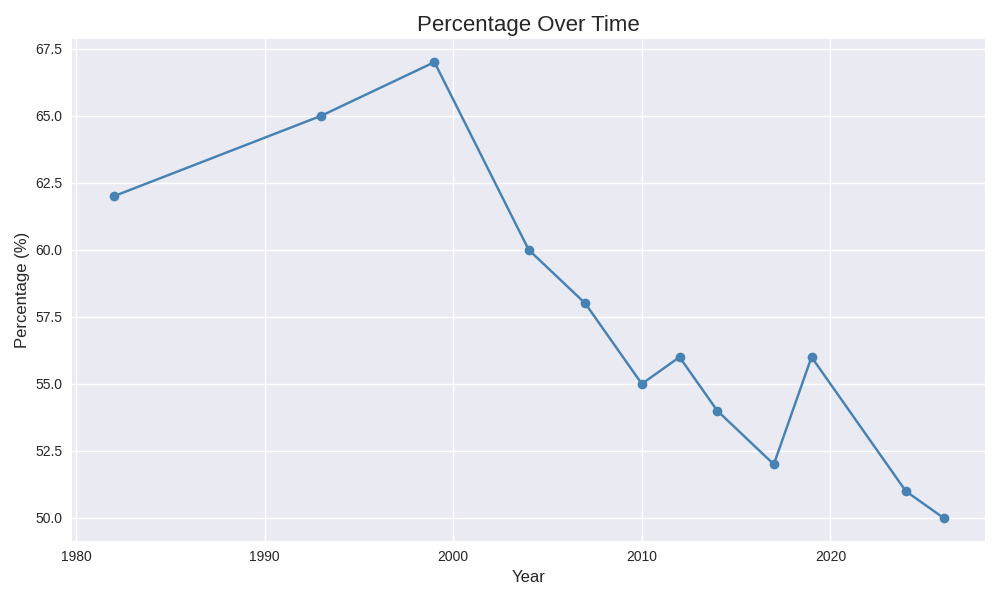
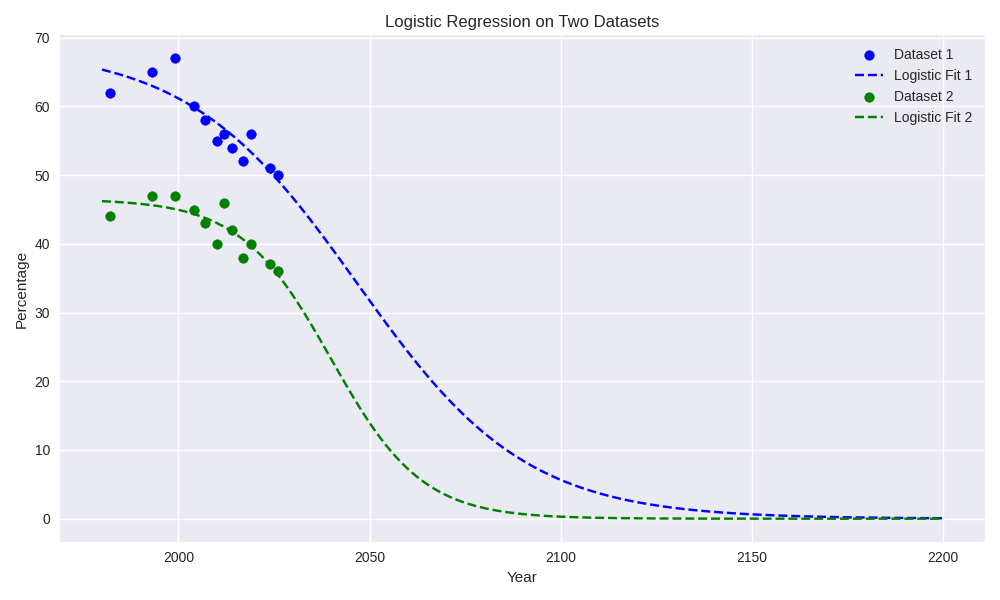
Precise year-by-year data specifically for “American Protestants” is not released annually; however, major surveys from Gallup and Pew Research provide consistent data points for this group over the last 40 years.
The following data tracks “strict creationists” (those believing God created humans in their present form within the last 10,000 years) among Protestants compared to the national average.
Protestant vs. National Creationist Belief (1982–2026)
Here in Finland, YEC exists but is not a big issue (yet). Young women have been more against traditional Christianity than males, although about a third of the young women have been telling that they are spiritual seekers (mainly among those who told they are ‘anti-Christian’).
That was the situation with generation Y and the early gen Z (those born on both sides of the year 2000). The late gen Z and gen Alpha are different.
Local Lutheran church makes yearly questionaries for the 15 year-old teenagers that participate in the activities of the church in Finland. The yearly sample size is >20’000.
The latest results tell that the belief in the God of Christianity has increased among both boys and girls. The change started with boys and there was a growing gap between the ‘conservative’ boys and ‘liberal’ girls. After the year 2023, the proportion of girls believing in the God of Christianity has also increased. Now about 60% of those girls that answered the questionary told that they believe in God, when the figure was a few years ago between 30-35%. Boys are still leading: the comparable figure for boys is about 75% (IIRC).
The results seem to reflect a broader trend in many European countries. I have read about the increasing numbers of young men turning to Jesus in many countries and the latest reports tell that the same has started to happen among girls.
The ‘patriarchal mess’ is a separate issue. I assume that the girls that turn to Jesus do not have a patriarchal worldview, although a small percentage may like the ‘trad wife’ thinking. After the girls start to follow Jesus, they adopt biblical teaching as their guideline. It may be that their interpretations about the scriptures may deviate a bit from that of the most patriarchal men - not sure, I have not discussed about these matters with the girls..