Just responding to a few things I didn’t have time to address before Christmas:
There are other characters given genealogical details and referenced later where we still don’t take them literally. For instance, God’s wife Jerusalem in Ezekiel 16. We know her parentage as well as two of her sisters (vv. 3, 45–46), and Jesus even refers to the woman Jerusalem in Matthew 23:37 (though many translations obscure this).
For God’s wife Jerusalem and Human and Liv in Eden, the clues are the same: symbolic names, surrounding references that clarify a name means more than a person (e.g. Genesis 1:26–27; 5:1–2), accounts that are only historical when allowed to be extremely stylized, anthropomorphic pictures of God, genealogical details crafted to serve the story’s purpose, a death of a character that actually means an exile of a people, etc.
Later church tradition is a fine reason to go with a literal first couple. If one doesn’t give that tradition veto power, the Bible allows for a wider range of options.
It doesn’t come up much because the critical word – “ancestor” or sometimes “man” – is not in the text. It says from one he made all peoples. Does that mean from one people he made all peoples or from one blood or from one person? That’s left to inference (and a few later manuscripts).
But while Paul doesn’t mention Adam or even one man in that text, he does call us all God’s offspring (v. 29). Here he’s using a pagan poem that actually declares we’re all Zeus’ offspring, but he reframes it for his purposes.
This is what Paul does with texts. He shapes them to fit his point. He does it with Genesis and he does it with pagan poetry. Whatever has currency with his audience he uses, becoming a Greek for the Greeks and remaining a Jew for the Jews.
Given that neither of those passages mention Eve, do you feel more constrained to believe in a literal Adam than a literal Eve?
For me, the fact that neither passage mentions Eve – that Paul is quite happy to sum up humanity as “Adam” alone – is a strong reason why I don’t think the literal existence of either of them is that important. Genesis 3 says a woman and a man both trespassed. Paul says either it was one trespass by one man (Rom. 5) or many trespasses by many people (Rom. 1). Neither shows that he cares much for maintaining the individuality of the characters in Eden. We only see that in passages like 1 Timothy 2.
Paul’s willingness to present both pictures as not being in opposition suggests he doesn’t see a conflict. To say one man brought sin in the world (Rom. 5) is just another way of saying that humanity rejected what was revealed to them and chose to worship the creation over the Creator (Rom. 1).
Well said. I hold the view of Morna Hooker and J.D.G. Dunn that Romans 1:18-25 is his version of the Fall. As Dunn noted in his commentary on Romans, there’s an “obviously deliberate echo of the Adam narratives” in Paul’s sequence of events. “It was Adam who above all perverted his knowledge of God and sought to escape the status of creature, but who believed a lie and became a fool and thus set the pattern (Adam = man) for a humanity which worshipped the idol rather than the Creator.”[1] As Hooker observed, it’s from “this confusion between God and the things which he has made that idolatry springs.”[2]
[1] James D.G. Dunn, Romans 1-8, Word Biblical Commentary 38A (Nashville: Thomas Nelson, 1988): 53.
[2] Hooker, “Adam in Romans I.” Anthropologist Steven Mithen explained totemism and anthropomorphism as a “mixing up” of the natural and social domains.
So far behind with computer issues (finally resolved) and I think we are discussing the same general topic on in three different threads.
I am not following this. Because one part of the Bible figuratively (obviously and unmistakably) refers to Israel as God’s wife, we are justified in treating Biblical genealogies–who as Walton and others tell us–are political and would not have their purposes served by made up characters–we can what? I don’t see a genealogy in that chapter. I see figurative language referring to as group of people as God’s wife (presumably unfaithful).
Now you could say, see, the Old Testament uses the idea of a singular person to represent a whole nation. Sure, I have no problem with that or seeing ourselves in Adam. What I have issue with is limiting the text to that interpretation because I just don’t see it as encompassing the total picture of scripture. I don’t think it’s possible that during the exile, countless Jews would not have saw themselves in the garden narrative But there is no comparing this chapter to an actual genealogy in my mind. Luke’s genealogy:
23Jesus was about thirty years old when he began his work. He was the son (as was thought) of Joseph son of Heli, 24son of Matthat, son of Levi, son of Melchi, son of Jannai, son of Joseph, 25son of Mattathias, son of Amos, son of Nahum, son of Esli, son of Naggai, 26son of Maath, son of Mattathias, son of Semein, son of Josech, son of Joda, 27son of Joanan, son of Rhesa, son of Zerubbabel, son of Shealtiel, son of Neri, 28son of Melchi, son of Addi, son of Cosam, son of Elmadam, son of Er, 29son of Joshua, son of Eliezer, son of Jorim, son of Matthat, son of Levi, 30son of Simeon, son of Judah, son of Joseph, son of Jonam, son of Eliakim, 31son of Melea, son of Menna, son of Mattatha, son of Nathan, son of David, 32son of Jesse, son of Obed, son of Boaz, son of Sala, son of Nahshon, 33son of Amminadab, son of Admin, son of Arni, son of Hezron, son of Perez, son of Judah, 34son of Jacob, son of Isaac, son of Abraham, son of Terah, son of Nahor, 35son of Serug, son of Reu, son of Peleg, son of Eber, son of Shelah, 36son of Cainan, son of Arphaxad, son of Shem, son of Noah, son of Lamech, 37son of Methuselah, son of Enoch, son of Jared, son of Mahalaleel, son of Cainan, 38son of Enos, son of Seth, son of Adam, son of God.
This is just a list of people the author believed existed. This is not a figurative statement about a nation being God’s wife.
Not really. Commentators tend to blame Eve or ignore Eve. Could just be all part of the patriarchy. Genealogies are also traced back through males. I don’t doubt any of the other figures had their wives mentioned in the Biblical accounts because their wives are not mentioned. Or maybe Paul actually considered Adam and Eve one flesh. Or maybe we overlook the fact that Eve was actually created out of Adam’s side in the narrative. I prefer looking at what authors do write as opposed to speculations about what they didn’t write.
Or possibly Luke is retelling the substance of what Paul said in his own words (e.g. Thucydides and speech writing in antiquity). This ties in with Luke’s own genealogy which clearly has “son of Adam, son of God” in his first book.
That is probably why most translations find Adam here. As Keener writes:
“A majority of commentators find here an allusion to Adam.[3446] Paul’s hearers in the narrative world would not catch an allusion to the creation of Adam, but Luke’s own audience probably would; early Christians (and especially Paul’s circle) frequently discussed their Bible’s comments on Adam and Eve (Rom 5:12–21, esp. 5:14; 1 Cor 11:8–9; 15:22, 45–47; 2 Cor 11:3; 1 Tim 2:13–14; Jude 14).[3447] In support of such a biblical allusion, we should recall Luke’s inclusion of the patriarchs in the scheme of his metanarrative (e.g., Acts 3:25; 7:2–9; Luke 1:55, 73; 3:8, 34; 13:16, 28; 16:23–30; 19:9; 20:37; Acts 7:32); how his reversal of Babel (scattering peoples descended from Adam) supports the Gentile mission (Acts 2:5–11); and how he, unlike Matthew, traces Jesus’s genealogy back to Adam, the first “son of God” (Luke 3:38).[3448] Further, that God created people to “dwell” all over the earth probably recalls God’s plan for people to “fill the earth” (Gen 1:28; 9:1; cf. 1:22; Exod 1:7).[3449]”
“[3446]. E.g., Conzelmann, Acts, 142; Grant, Gods, 51; Johnson, Acts, 315; Barrett, Acts, 842; Chance, Acts, 310. Cf. ἑνός twelve times in Rom 5:12–21,” “though it is missing in the parallel discussion of Adam in 1 Cor 15:22, 45.”
Acts: An Exegetical Commentary : Volume 3: 15:1-23:35
Craig S. Keener
That is fine. Appropriating a text does not negate historicity. Allegorical and literal interpretations existed side by side without conflict to ancient authors. NT authors constantly found typology in scripture. They constantly shaped OT texts to serve their point. I believe as Christians we need to be open to stories having multiple interpretations that are not at war with one another. As a person predisposed to modern history, I would not as readily find Jesus in some of the places early Christian authors did. But I suspect there is a lot of continuity between this and the actual ministry of Jesus and as one who believes in inspiration I am bound to the canonical dimension of scripture and what I think it teaches as a whole.
I see humanity repeating what the first couple did and think this simply accounts for more of scripture and of course, church tradition in my case.
There is no reason that pattern does not stem from a literal first couple as opposed to a mythological or made up first couple. Paul clearly took Adam as literal. Many references from others who did the same could be cited easily and I don’t think any of you pushing a mythological Adam can find one contrary reference. Reading Paul otherwise is forcing modern science onto him.
Finding a fall in echos and hints in Romans 1 could be fine but doing it at the expense of the plain and obvious fall narrated in Romans 5? Rejecting what is clear based on what is obscure?
Apart from the jumbled grammar, why political rather than theological? I see the post-David political slant, but before that?
Of course the Romans would regard Luke’s (and Matthew’s) genealogies of the Christ as political; “Jesus is Kyrios” was a political proclamation whether they intended it to be or not and the whole point of the genealogies is to show that Jesus is indeed Kyrios. But to Jews those were also theological, so theo-political is more accurate.
Kabalistic Judaism has some interesting views on this, such as that once Eve realized what she’d done she made a calculated effort to get Adam to join her act, or that Eve was clueless and Adam made a judgment call that it was necessary for him to stay united with his woman even in her foolishness.
Almost undoubtedly. But key elements would be verbatim.
Which leads to fun arguments over what are “key elements”.
BTW, Conzleman makes a good point without stating the underlying probability that most early Christians came from both synagogue and “God-fearers”, Gentiles who ‘followed Moses’ but without circumcision (sociologically those might have outnumbered the Jewish converts). “God-fearers” would have known the big stories quite well.
AN observation about that: Christian theology arises from the OT but is not an obviously logical derivation/conclusion. It begins with the premise “Jesus fulfilled all this” and uses that to go back and re-view everything.
I vaguely recall a paper arguing that Paul saw Adam as royal representative . . . I haven’t the first clue as to how to track that down, and I’d have to sit down and re-read all of Paul’s letters to make any kind of call on the matter. That said, I can’t think of anything that would contradict it.
I’d guess there was not a sharp distinction between theology and politics back then. I think they would have recoiled at separation of Church and state since their “state” was a covenant with God who called them directly.
There is no evidence ancient genealogies included individuals who were not believed to have existed. We know the many individuals in the ancient Mesopotamian king lists did exist. As Walton writes, “Consequently there would be no precedent for thinking of the biblical genealogies differently. By putting Adam in ancestor lists, the authors of Scripture are treating him as a historical person.”
From the Lost World of Adam and Eve:
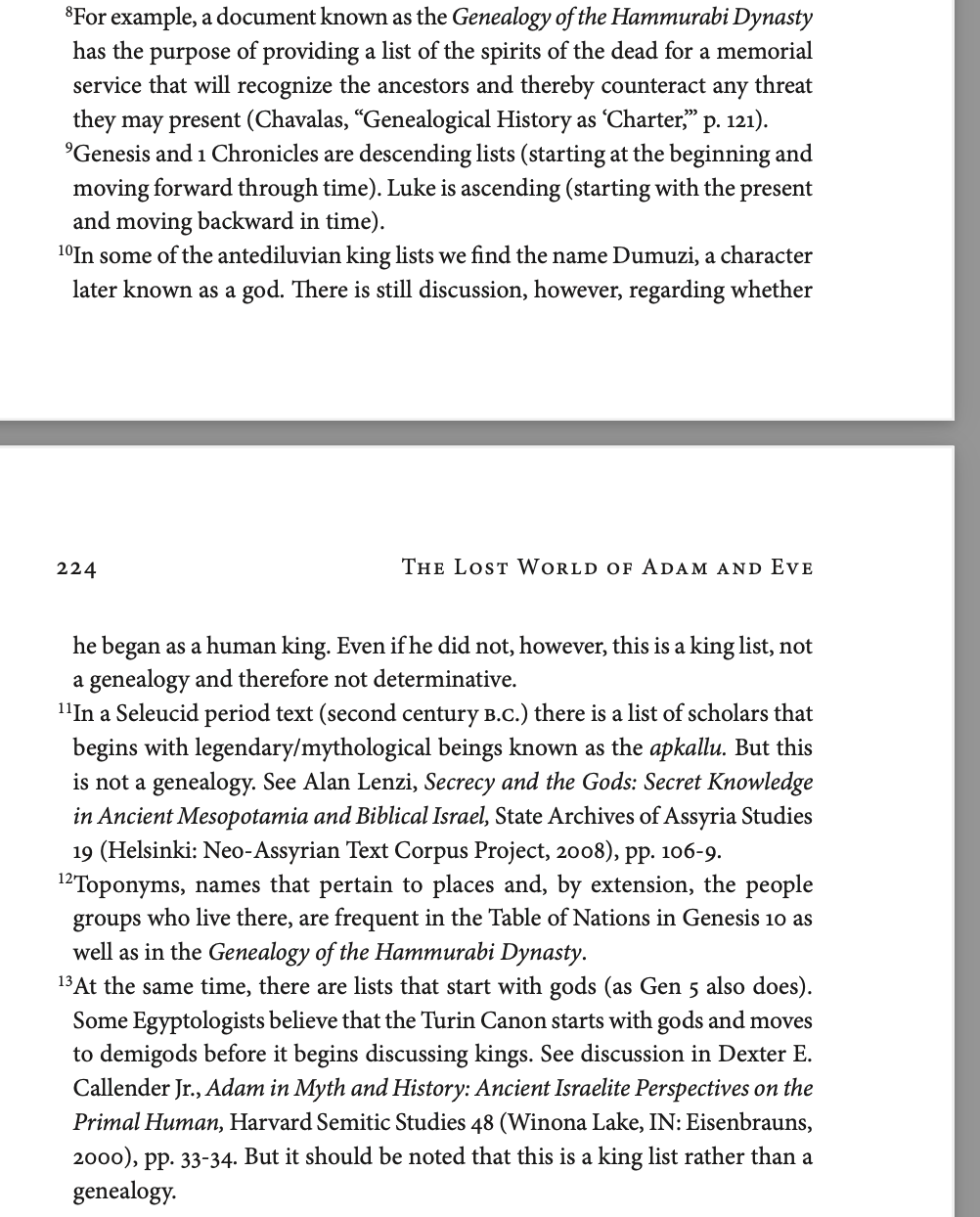
Genealogies. The genre of genealogy can function differently in dif- ferent cultures.7 We cannot assume therefore that any genealogy we encounter in another culture’s literature is governed by the rules that govern ours or that the genealogy will function in the same way and serve the same purpose.8 So the question that we must ask is whether there is evidence that lists of ancestors in Israel or in the ancient world could contain characters that do not represent actual individuals who lived in the past. This is important because Adam is included in ancestor lists in Genesis 5, 1 Chronicles 1 and Luke 3.9
As we explore the genealogies from the ancient world, we are interested in whether they include in their list any who are not human individuals. Deviations might be that they would include gods,10 legendary characters11 or toponyms.12 Studies in the ancient world have concluded that genealogies typically are more interested in political unity than in lineage ties, but as such their objectives would not be achieved if imaginary or legendary characters were used. Future discoveries may yet provide an example that could lead to a different conclusion, but based on the information currently available, genealogies from the ancient world contain the names of real people who inhabited a real past.13 Consequently there would be no precedent for thinking of the biblical genealogies differently. By putting Adam in ancestor lists, the authors of Scripture are treating him as a historical person.
You wrote in another thread:
I beg to differ with Walton: including legendary characters in genealogies meant for political unity purposes makes perfect sense; lineages showing descent from deities was fairly common for kings and even priests. OTOH, there were transition points where the lineage came to historical figures or even derived from historical figures.
There is a difference between saying:
There is no evidence ancient genealogies included individuals who were not believed to have existed.
and
Every individual or entity listed must have existed.
The genealogies in scripture includes Adam because the authors thinks he existed!
Walton distinguishes between genealogies and kings lists in his footnotes.
Bill Arnold relays similar thoughts in his Baker commentary.
The Bible’s genealogies are thus a means of providing social identification for a person or people group, making important assertions about identity, territory, and relating them to others in the narrative.24
I’m not sure how made up, imaginary people help with this. I mean, why would an ancient author or reader distinguish between Abraham or Adam on a historical level? And if Abraham didn’t exist, what are we to make of God’s supposed covenant with him?
Paul could see Jesus as a royal representative. That doesn’t mean Jesus didn’t exist as a flesh and blood individual. He can be a representative for God (The Son is the radiance of God’s glory* and the exact representation of his being, sustaining all things by his powerful word). This is my issue. Seeing Adam as all of us does not negate his apparent historicity. That is denied on scientific grounds.
With respect to what each figure spoke in argument, whether about to make war or already embroiled in it, it was difficult to evoke fully a precise account of the things said, both for me recalling the ones that I myself heard, and for those conveying reports to me from whatever other places. What, in my own opinion, each figure would most effectively have said what was requisite concerning situations that are ever present, that is how I have set forth the speeches: adhering as closely as possible to the intention of what was said in reality.
He (an orator) basically composes some speeches based on what he thinks would have been most effective for them to have said. Ancient historians were not very good by modern standards. As one Redditor wrote on AskHistorians:
“It’s ironic to think that If Herodotus, Livy, Josephus, or Thucydides were undergraduate historians today, and wrote the way they did, they wouldn’t graduate.”
I am not as confident in verbatim as you. I think Luke would try to get the substance right but could even make up something he thought appropriate if data was missing. Fortunately, if the we passages are taken as a a traveling companion of Paul, we can have a higher degree of confidence in Luke getting the substance of most of Paul’s speeches correct. Not to mention we believe in this case there was a little help from a Divine author!
True, but there are some places where the historicity of the text is ruled out by facts that Paul and other NT authors were unaware of, unless God by inspiration revealed it to them by dictation.
There was never a literal first couple. Gen. 2-3 speaks of ha’adam and ha’issah, “the man” and “the woman.” If the author meant to refer to a literal man named Adam and woman named Eve, he wouldn’t have appended “the” to the putative names. It’s like calling me “The Jay” and you “The Vinnie.” Doesn’t work in English or Hebrew. That’s the reason the pattern doesn’t stem from a literal first couple. The “plain Hebrew” of the text says the characters aren’t literal people.
I don’t hold to inerrancy, so I don’t feel the need to argue about Romans 5. Perhaps Paul believed in a literal Adam or perhaps not. Doesn’t matter. The doctrines of inspiration and inerrancy apply to matters of faith and practice, not facts of history. Scripture is full of examples of ancient science, but the purpose of scripture isn’t to teach the history of the world; the purpose of scripture is to lead us back to God, from whom we are estranged. Paul can get facts of history wrong and still give authoritative teaching about faith and practice. Simple.
gbrooks9
(George Brooks, TE (E.volutionary T.heist OR P.rovidentialist))
331
An Evangelical audience would find your summation above as “falling flat”.
Even ancient critics noticed the difference between Genesis 1 and Genesis 2.
Text critical analysis would find the differences so profound that it seemed to
be intentional … to draw attention to the difference between the creation of
humanity, versus the creation of a specific “holy couple”.
Yes, Jay … you reject such things. But this could be VERY interesting … even
compelling to some evangelical audiences.
Your efforts to REJECT these views ON BEHALF of all evangelicals is almost humorous.
And my counterpoint is that with a GAE those facts are no longer ruled out. I think most “TE” Christians just assume a historical A&E are incompatible with evolution. The towel was thrown in too early. Some are using a cleaver when a scalpel is necessary. A literal Genesis 1-11 is ruled out. Sure. So is a literal Exodus. This doesn’t say much. Neither an actual Exodus or a historical first couple that fell are ruled out by science. You seem to believe in a first population that fell. Not exactly wildly different…
It’s a little odd that virtually every one who talks about it believed Adam and Eve were actual people in the ancient world, yet you are maintaining everyone not only got it wrong but interpreted and understood it wrong until evolutionary science showed us proper exegesis? Maybe the original author alone and his first audience? I don’t restrict the meaning to that.
Bill Arnold: The word translated “man” in v. 7 (ìa ̄da ̄m) will later become a personal name, Adam (4:25, where see comment). In this verse, however, it is a common noun comprised of the same consonants as the word “ground” (ìa ̆da ̄maˆ) and therefore forming a word play: “ . . . the Lord God formed man (ìa ̄da ̄m) from the dust of the ground (ìa ̆da ̄maˆ).” The terminology solidifies the human’s connections to the earth: he was created from it, his job is to cultivate it (2:5,15), and at death he will return to it (3:19).108
This may be an irreconcilable interpretation issue between us. When I interpret scripture, I try to look at all of it. The meaning of any story will change over time. You seem to be atomizing parts of the story and trying to understand what some ancient person long ago may have understood about just a single part. I have a whole canon in front of me and I am looking at the final form of the whole codified primeval history and also what the New Testament says. This means recognizing the multiple sources and authors the Pentateuch was drawn from. That certainly complicates things but it is this final form that is scripture.
I don’t subscribe to inerrancy either and I probably disagree with you that it even applies to matters of faith and practice depending on further clarification/pushback. Sure, not a science or history or philosophy text. But sometimes they overlap as you think they do in science denying a literal first couple. So your distinction doesn’t say much to me in particular. The idea that there is no overlap between there bible and science/history/archaeology/philosophy is delusional nonsense. It overstates that they generally talk about and are interested in different things. Sometimes the purpose of the Bible overlaps with history as Christianity is a historic faith. We at least agree Jesus has to have been a real person that died right? The metaphor of God incarnate isn’t doing much for me even if it were a true myth expressing God’s love. I have to draw a line somewhe and while I don’t treat the Bible as a modern historical document but I tend to think the big moments happened. I believe I am simply following Jesus (and all the authors of scripture) in this as well though I understand there are different interpretations of Jesus here.
For me it is simpler just to treat the Bible with a hermeneutic of trust until I have reason not to and have exhausted alternatives. It is my sacred scripture and forms the basis of my most important beliefs about the world. Since the GAE makes sense of the data extremely well, as @gbrooks9 put it, “miraculously,” I do not have any reason to disagree with Paul, the Biblical genealogies, Luke, Peter or pretty much the entire ancient world including Jews and Christians up until modern times in thinking Noah, Adam, Eve (etc. were real, historical people). Simple.
I don’t consider myself evangelical anymore, and I couldn’t care less what evangelicals believe about Adam & Eve. (I would be happier to see them follow Jesus’ teaching about the poor and the immigrant, but even that’s a bridge too far these days.) It’s why I abandoned writing the book I spent five years researching. I reject a literal Adam & Eve because they don’t fit the evidence, and they’re unnecessary for Christian theology.
gbrooks9
(George Brooks, TE (E.volutionary T.heist OR P.rovidentialist))
334
Naturally, it depends on WHICH PART of Exodus is compatible with a historical view!
To my surprise and amazement, the idea of crossing a PART of the Red Sea
is entirely proven to be possible (but not crossiing the ENTIRE WIDTH of the
Red Sea)…. even without suggesting the Red Sea intended in Exodus was
actually more of a REED SWAMP!:
SEASONAL TIDAL EFFECTS:
On December 28, 1798/1799, Napoleon with a small mounted escort crossed the Red Sea (technically crossing a bay of the Gulf of Suez just east of the Port of Suez) at a predicted time of an especially low tide - - to visit the Wells of Moses. Overestimating the time available, on his return the coming tide (which was higher than normal), Napoleon and company were almost drowned by the quickly rising waters. This phenomenon is sometimes referred to as a NEAP TIDE (higher low tides than normal), when in fact it is a SPRING TIDE (LOWER low tides + HIGHER high tides). Both kinds of tides occur about every 14.5 days. But Napoleon was there at the less frequent “King Tide” or Perigean Spring Tide (aka a Proxigean Tide): “the Moon hits perigee roughly once a month, but its exact timing shifts, and a Perigean Spring Tide happens only a few times a year (and not necessarily during the Spring) as the phases and perigee alignment don’t perfectly match monthly.” Technically, there is always ONE Perigrean Spring Tide that is the most extreme per year (awarded the modern term “Supermoon”), but lesser ones happen multiple times a year.
Various sources say Napoleon’s crossing was in December of either 1798 OR 1799. Diving deeper into the data, we find the following observation:
”The largest supermoon—defined as the full moon occurring closest to its perigee (closest approach to Earth)—during the years 1798 and 1799 occurred on December 24, 1799.”
VERSUS
“In 1798, the largest supermoon (the full moon occurring closest to its perigee) was on November 23, 1798. This event was part of a sequence of supermoons that year, which included full moons on August 26, September 25, and October 24. Of these, the November full moon achieved the closest alignment with the lunar perigee for the year.”
Below is a current tide chart for the Suez port region, which apparently had or will have a Spring Tide:
My plan was to next explore the powerful effects of regional winds (which is actually
mentioned in Exodus). But this post is already long enough… the SECOND explanation
for a natural cause for allowing someone to cross a part of the Red Sea will be coming soon….
A literal A&E as the “first breeding couple” and origin of H. sapiens is ruled out by population genetics and fossil evidence. That towel was correctly thrown in about 2010, except by YEC. GAE doesn’t negate those facts. If Paul believed in a literal Adam & Eve, he believed that they were the origin not just of sin, but the biological progenitors of all humans on Earth. Ancient science.
The “fallback” position for other evangelicals and some Catholics was that God selected (or “elected”) a representative couple, gave them the gift of a soul (plus some other stuff), and placed them in the Garden for the purpose of his test.
Loren Haarsma wrote a book outlining evangelicals’ four main options (also fit for Catholics) that I reviewed for Christianity Today in 2022. Here’s the BL discussion of it:
It’s wildly different in that humanity arose as a population, as do all species, and it logically follows that we fell as a population, if one wants to take the Fall seriously. Such a scenario not only agrees with science, it makes more sense out of ha’adam and ha’issah in the context of Genesis 2-3. Why didn’t the author simply name them Adam and Eve, rather than giving them titles? (Not to mention the symbolism of the names themselves.)
Back to GAE. Correct me if I’m wrong, but I recall your Thomistic position that original sin is a corruption of human nature; we inherit a nature that “lacks” original righteousness and the other gifts given to A&E. Right?
The only benefit of the GAE scenario is that it’s faster than “natural” generation at passing along the corruption of original sin. But unless you’re YEC, to whom it was specifically designed to appeal, that’s not really necessary.
A more ancient literal Adam & Eve chosen from among an African population doesn’t require genealogy for them to pass their flawed nature to everyone else. Suppose God chose two individuals from East Africa about 100,000 years ago. Admixture among ancient African populations was common and frequent. By the time of the Out of Africa event 30,000 years later, all of humanity in Africa is related by blood, not just genealogy, and the H. sapiens who depart Africa across the globe are likewise lacking “original righteousness” because they didn’t inherit it from their parents.
On the other hand, no one yet has explained how original sin is passed down by lines drawn on a family tree
It’s not odd at all. The ancient world had no concept of deep time or evolution. They interpreted according to the evidence at hand. The discovery of fossils and, later, evolutionary science simply showed the flaws in prior exegesis, as the discovery of heliocentrism overturned earlier exegesis that insisted on geocentrism. Time marches on.
Hubris, my friend. As I said earlier, I’m drawing quite extensively from Richard Middleton, who holds to a canonical exposition of scripture.
That’s fine, but I never said the latter. You’re projecting. I can point to a lot of overlap between my views and science/history/archaeology/philosophy. I’ve put them in writing.
GAE makes a mess of the data. You’re talking to the original critic of the idea, which is why George Brooks is so opposed to me here. But, honestly, it’s like revisiting a five-year-old discussion that’s not so interesting anymore. The idea is dead; the book didn’t even merit a second printing, which I predicted.
3 Likes
gbrooks9
(George Brooks, TE (E.volutionary T.heist OR P.rovidentialist))
341
If we are going to “reach” Evangelicals where they actually are, SOME of them INSIST
on an Adam & Eve. If it wasn’t for the fact Genesis 1 differs from Genesis 2 dramatically,
I would probably fixate on REJECTION of A&E like you do.
But Genesis 1 and 2 DO differ …. which opens up some logically sound alternative
ideas which BioLogos has demonstrated can be interesting to some Creationist sub-groups.
”Read the room.”
I’m not trying to reach them. Been there, done that. It’s a lost generation wandering the desert until they die off. Then maybe Joshua (Yeshua) will lead them to the promised land.
C’mon, George. I take the difference between Gen. 1 and Gen. 2 seriously. Your last sentence makes no sense. I reject a literal A&E for the same reasons you do, out of conscience. I just don’t bother to pretend in public something other than what I believe in private.
You demonstrate an inability to understand what I write …. or is it intentional?
Are you in a bad mood today? Otherwise would you imply I’m somehow a liar?
I am a Unitarian. Unitarians don’t embrace Creationism (none I’ve known anyway).
Your assertion that there is (just?) a lost generation of Creationists you can ignore
seems to ignore generations of consistently large percentages of Creationists - -
not to mention their current activities for influencing civil laws and institutions
geared to make their presence known even more profoundly.
My interest in the difference between Genesis 1 and 2 is not in using the difference
as a justification for ignoring Evangelicals … but in showing some Evangelicals that
they can have their Cake and Eat it too (or vice versa).
It’s not ignoring them if you insist that making stuff up to humor their presuppositions and pretending it’s science is not a good plan. And the fact of the matter is GAE, despite what we were promised, DIDN’T and DOESN’T convince YECs to accept evolution. Maybe it gave some ID/OECs a different rabbit trail for a while, but I didn’t even see many of them budging on their a prioris about evolution either. It remains a fact that people think what they think because of their in-group loyalties, not because of arguments or evidence. People aren’t going to change their mind about the answers to questions they aren’t asking because someone writes a book or posts an article. They are going to change when their community tells them to.