What degree did you receive from university?
No, you seem to be very articulate and intelligent. However, high school educated people and university educated people see the world very differently. Your disdain of science and expert opinion is a tell-tale sign that you and I could never find common ground regarding how to approach investigating truth claims.
1 Like
Another failed attempt to tell non-believers what they think.
3 Likes
Why need it be “all for” something, and have some ultimate reason, to be of value?
A beautiful sunset has value, regardless of whether it has a deeper meaning and despite (and arguably because) it is fleeting.
Your question would appear to have more basis in your own fear of uncertainty, than in any greater truth. If yo are afraid that, if your meaning isn’t ‘inscribed in stone’, on the fabric of the universe, that you have no meaning – then I would suggest that this is your problem.
Speaking for myself, it is not something I suffer from. And this is another way in which your preconceptions ill equip you to understand this atheist, at least.
I disagree. A single source is often enough to establish an event. If a friend told me a horse was loose at a fair they attended I would not require corroboration to believe them. It depends on who the author is, whether or not they are in position to know what they claim, and on how mundane the claim is. Those all require judgments about them and the world and to claim I can do that without bias is a lie.
If they told me the horse was flying around and shooting sprinkles from its derriere then we would have issues. One reliable witness is better than two unreliable ones. History requires hard work and source evaluation. On purely historical grounds, if you don’t accept traditional authorship, a lot of the scenes in the gospels should just end up non liquet, whereas others are more probable than not and some things are virtually certain. Source evaluation has to proceed reconstruction and it comes before your hypothetical rules, which as I noted, are skewed against ancient historical reconstruction and how it is nominally done by both Christians and classicists. In fact, often enough, the methods are tailor fit to deal with the sources we have. How do we weave highly probable historical truth from them and that requires a host of considerations and judgments.
Vinnie
3 Likes
I do not have reasons to doubt your friend but …
Authority is not a quarantee of being correct. We may decide to believe what a person said but there are always other reasons in play.
Your friend might have told many comparable stories and what was told was always truthful. That would make it more likely that this story was true, although not a quarantee - the person might be ‘honestly wrong’, just telling what he believed to be true.
One reason why interpretations like YEC spread in churches is because listeners believe what their leader/preacher tells, even when the leader is ‘honestly wrong’ - just telling what he thinks is correct.
In the case of the gospels, the acceptance was not just a matter to decide to believe the author. The gospels had many ‘reviewers’. Believers had heard about the events from various sources, possibly even from eyewitnesses or persons that had heard the stories from eyewitnesses. When the listeners heard the stories, they could compare what was told to what they had heard earlier. Conflicting claims would jump out and make the listeners to ask questions. It is probable that this is one reason why the four gospels were accepted widely while many more were not.
In other words, the written text alone is not the reason why it was generally accepted. The written story had to agree with the oral ‘tradition’ (tradition in the sense that it was information transmitted orally, directly from the eyewitnesses or through one or more intermediate persons).
2 Likes
Your friend is an undisputed source. Please name one undisputed source claiming to have seen and interacted with the flesh and blood post-mortem body of Jesus.
Some historians I have read or heard say that history is more of an art than a science, mainly due to the non-empirical nature of much of their source material. They do the best with what they have, debate it, debate it again, and continue to debate it as new source material is made available. I think that’s what a healthy field should do. I also get a chuckle when historians make fun of themselves for thinking every artefact has religious connotations.
I would also agree that it is impossible to reconstruct history through these sources without bias. That’s why debate within the field is important because it is the best method we have for removing as much bias as we can. I’m not sure if online debates outside of the field are that productive.
2 Likes
In my pre-grad school lit classes that was a constant theme, a question to be asked of all literary texts, whether Dante or Dickens or even more remote.
I met an archaeologist who joked that he got into the field because it was all supposed to be about religion or sex . . . or religion and sex.
1 Like
Yes, there is a high degree of art involved. I suppose it depends on what aspect of history we are dealing with. If we are radiometrically dating artifacts it is is hard science but if we are interpreting artifacts it’s a much softer science. Same with written texts. Take, for example, the synoptic problem. Now most scholars accept Mark wrote first (Marcan priority) but as EP Sanders and Margaret Davies noted long ago in Studying the Synoptic Gospels, the chief reason for thinking Mark wrote first and not Matthew is that we just can’t make sense of why an author would truncate Matthew in such a fashion and remove so much material that is seemingly consistent with what he did retain. But we can make much more sense out of Matthew adding to Mark and making the changes he did. My point: these are all value judgments based on how we think ancient writers would think and write and that is certainly going to be biased by what makes sense to us and how we think and write. I mean, maybe the author of Mark was odd and wrote an odd Gospel. We cannot rule that out. Only offer an educated opinion that we deem it very improbable or unlikely. And this is why I feel Bart Ehrman (on his blog) and Dan McClellan (on YouTube) basically abuse the word “consensus” for popular audiences. First, there is a ton of diversity across the spectrum in Biblical criticism, and second, a consensus jut isn’t as strong as one is in a harder science.
Vinnie
3 Likes
I bet when football fields are excavated some future day, they will conclude the losers of the contest were hung from the goalposts.
Exactly. There are no undisputed sources claiming to have seen and interacted with the flesh and blood post-mortem body of Jesus.
Would you believe a claim today that a recently deceased (brain dead) body has returned to the living without (corroborating) undisputed eyewitness testimony? No, you wouldn’t.
-
University of Virginia, School of Medicine, Division of Perceptual Studies
-
Near-Death Experiences
Near-death experiences (NDEs) are intensely vivid and often life-transforming experiences, many of which occur under extreme physiological conditions such as trauma, ceasing of brain activity, deep general anesthesia or cardiac arrest in which no awareness or sensory experiences should be possible according to the prevailing views in neuroscience.

Dr. Greyson interviewing a near-death experiencer
List of Typical Features
-
sensation of leaving the body
-
mind functioning more clearly and rapidly than usual
-
sensation of being drawn into a tunnel or darkness
-
brilliant light, sometimes at the end of the tunnel
-
sense of peace, well-being, and/or unconditional love
-
sense of having access to unlimited knowledge
-
“life review” or recall of important events in the past
-
preview of future events yet to come
-
encounters with deceased loved ones, or other beings generally identified as religious figures
While these features are commonly reported, many NDEs differ from this pattern and include other elements. For example, some NDEs may be frightening or distressing rather than peaceful.
-
1 Like
 Step 1 — The Core Argument (Reconstructed)
Gary_M’s claim can be formalized like this:
-
Premise 1: If someone today claimed that a recently deceased person had physically returned to life, we would not believe it without undisputed, corroborated eyewitness evidence.
-
Premise 2: The ancient claims about Jesus’ resurrection do not have undisputed, corroborated eyewitness evidence.
-
Conclusion: Therefore, we should not believe the ancient resurrection claim either.
This is an argument from analogy:
(Modern miracle claim) : (Modern disbelief) :: (Ancient miracle claim) : (Appropriate disbelief).
 Step 2 — Logical Form
Let A = modern miraculous claim.
Let B = ancient miraculous claim.
Let E = availability of undisputed evidence.
Let C = rational belief.
The form is:
-
If ¬E → ¬C in modern cases (no evidence → no rational belief),
-
and if ancient cases are epistemically similar (same lack of E),
-
then ¬C should also apply to the ancient case.
This is an analogical transfer of epistemic norms.
 Step 3 — Philosophical Foundations
Gary’s logic echoes David Hume’s argument against miracles in An Enquiry Concerning Human Understanding (Section X):
“No testimony is sufficient to establish a miracle, unless the falsehood of that testimony would be more miraculous than the fact it tries to establish.”
The structure depends on the probabilistic asymmetry between what’s natural (dead people stay dead) and what’s miraculous (a corpse reanimating).
Therefore, any testimony supporting a miracle is, by default, less probable than the natural explanation — unless the testimony itself is absolutely unimpeachable.
So Gary’s move isn’t new — it’s modern evidential skepticism restated conversationally.
 Step 4 — Points of Weakness (Counter-Analysis)
You can challenge the argument on several fronts:
A. Challenge the Analogy (Are ancient and modern cases epistemically identical?)
-
The analogy assumes equal access to evidence in both cases. But ancient events have historical testimony, not direct observation.
-
In history, we often accept less-than-undisputed sources (e.g., Julius Caesar’s crossing of the Rubicon) because total consensus is rarely achievable.
-
The evidentiary standard for miracles might differ from the standard for ordinary events — what matters is not quantity but quality and context of evidence.
B. Challenge the Evidential Standard (What counts as “undisputed”?)
-
“Undisputed” evidence is almost a logical impossibility. Human testimony is always disputed about anything consequential.
-
If one demands absolute unanimity, no historical claim survives.
-
Thus, the premise may rest on an unrealistic epistemic bar.
C. Challenge the Presupposition (Naturalism vs. Theism)
-
Hume’s principle only holds if one assumes a closed natural system (i.e., miracles are a priori impossible).
-
But if one allows even possible divine agency, the prior probability of a miracle is not zero — and so the evidence need not overcome an infinite improbability.
-
Alvin Plantinga and Richard Swinburne, for instance, have argued that if God exists, the resurrection is antecedently plausible, not absurd.
D. Highlight Historical Context (Uniqueness of the Resurrection claim)
-
Christianity’s claim isn’t simply “a dead man revived.”
It’s embedded in a dense web of fulfilled expectation, transformed witnesses, and enduring communal impact. -
Even if the empirical evidence isn’t “undisputed,” the explanatory power of the event may be stronger than naturalistic alternatives (hallucination, legend development, etc.).
 Step 5 — Possible Counter-Formulation
“Gary’s point works as an analogy, but it assumes that ancient and modern claims are epistemically parallel — that both should be judged by identical standards of reproducible evidence.
Yet historical events are, by nature, non-repeatable. We rely on testimony, context, and inference to the best explanation. If we apply the demand for ‘undisputed eyewitnesses’ uniformly, we’d have to reject nearly all of ancient history.
The resurrection claim is not an isolated miracle report; it’s part of a coherent historical and theological framework whose explanatory power arguably exceeds purely naturalistic accounts of the data.”
1 Like
So, exactly what is the difference between a Near-Death Experience and the Biblical resurrection of Jesus?
As said by Miracle Max,” Mostly dead is slightly alive, and all dead is when you go through their clothes for loose change.”
In other words, near death experiences are just that, the people experiencing them are not dead. Resurrection is life from death. That said, there are some gray areas that I am not sure about with the various instances of Lazarus and others being revived. In all those instances, they were revived to their old life, not to a new life in Christ, so that is different. The real problematic one is the tombs opening and many dead coming out of them in Matthew 57:52. Perhaps that was a theologic statement linking back to Ezekiel’s vision on dead bones in his chapter 37, but is written as history with eye witnesses.
things that make you go, “huh.”
2 Likes
Phil,
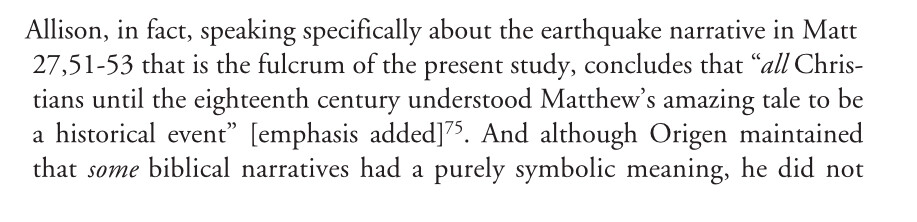
Do you believe the author of the Gospel of Matthew intended his dead saints being shaken back to life story to be understood as a literal event or as apocalyptical metaphor?
Joel Marcus is a well respected critical scholar. His two-volume commentary on Mark is excellent. He wrote an interesting article:
Did Matthew Believe His Myths?
It might not give full answers or the ones we want but it’s interesting.
We tend to be dismissive or glance over this account in modern times but that is a pretty recent development in the Church.
Vinnie
2 Likes
Gary, I lean towards metaphor. Just too many unanswered questions. Which gets into the inerrant vs. inspired views of the Bible.
If it is metaphor, that does open Pandora’s Box, doesn’t it?
1 Like