I think that applies to all YEC since they make science the measure of Genesis.
What a pointed analogy! Though I’d add the patterns of your keystrokes.
Especially when it drags in the “historical science” category.
I think that applies to all YEC since they make science the measure of Genesis.
What a pointed analogy! Though I’d add the patterns of your keystrokes.
Especially when it drags in the “historical science” category.
Thus “survival of the fit enough”.
This piqued my interest, so will share a bit of what I found (as a non-expert in population genetics).
First, the probability of a neutral mutation reaching fixation is 1/2N for a diploid genome, with N being the consensus population, not the effective population size. All mutations will scale by this factor, including neutral and beneficial mutations, not just deleterious mutations. Therefore, the percentage of deleterious mutations will stay the same regardless of population size.
I would agree that every population is going to carry a certain load of deleterious mutations. However, the 2.5% seems to be a good number in my eyes. That would be a deleterious mutation for every 4 mutations in functional DNA. If we include effectively neutral mutations that are slightly deleterious to any significant degree I don’t see this number increasing by any more than about 30%. As one example, there’s about a 35% higher fixation of amino acid substitutions in primate populations with low Ne compared to rodent populations with higher Ne.
That 35% increase is in open reading frames which will tend to have higher constraint than noncoding DNA. Since only a 5th of functional DNA is open reading frames, I think the 2.5% is pretty close.
The time to fixation for a neutral mutation is 4Ne. The fixation of a beneficial allele is indirectly proportional to its selection coeffecient. I will agree that beneficial alleles will drift randomly at first, but once they reach a small percentage of the population positive selection will take over and fix the allele in a time period much shorter than that seen for neutral mutations.
In fact, that whole review paper is worth a read for this subtopic.
Some other back of the envelope calculations. With a mutation rate of 50 per person we will get 1-2 deleterious mutations. With 150,000 haplotype blocks, that’s a 1 in 75,000 chance of a deleterious mutation in any given haplotype block, and a 1 in 37,500 chance on either side of any given recombination hotspot. With 50 recombination events per meiosis, that’s a 1 in 3,000 chance of a recombination happening at any given hotspot. So the recombination rate looks to be 10 times higher than the deleterious mutation rate for any given hotspot.
I find that hard to believe. If someone truly wants to believe in God, they’ll find a way. I think people don’t believe in God bcoz God means nothing to them; they have no spiritual need.
I think it would be a good idea for you to talk to people and ask them questions rather than making up stories about them that make you feel better.
As @T_aquaticus has pointed out, that’s not the right way of thinking about. Put another way, what matters to the fate of, say, a new beneficial mutation occurring in a haplotype block is the probability that there is already a deleterious allele in the particular copy of the block it occurs in – i.e., we’re interested in that single genetic history. You can also do the calculation in terms of the whole population, but you’ll get a similar answer, via mutation-selection balance.
Yes, very slightly deleterious mutations can persist for a long time. No, the 2.5% is an estimate for any mutation that is subject to selection. I’m not sure where you get your information about the fraction of deleterious mutations that have slight effect. The distribution of fitness effects is actually quite difficult to determine, but every study I’ve seen concludes that there is a broad distribution for deleterious mutations.
Sure, some deleterious mutations hitchhike with beneficial mutations, and other prevent some beneficial mutations from fixing that otherwise might have. Exactly how this plays out depends on the details of the recombination rate as it varies across the genome, the density of functional elements, the variation in mutation rate, the distribution of fitness effects, and the variation of selection over time. The bottom line is that both positive and purifying selection vary in effectiveness across genomes (see, for example, this study and this one in humans), but there’s no evidence that these forces are overall incapable of keeping genomes from accumulating deleterious mutations on net – except for species that have undergone large reductions in population size (e.g. this study).
As @T_aquaticus wrote, this is incorrect.
A broader comment… Quite a large number of reasonably bright people spend years working full time probing various aspects of evolution, including every subject you’ve raised in this thread. Does it really strike you as plausible that none of them have noticed obvious facts that would invalidate the entire field?
Thank you all for your comments. May be that these subjects were already addressed for many years by the geneticists. That is nice. However, I like to understand this topic for myself. That is the way, I am trained and it satisfies me more than assuming that others did their job properly without thinking for myself. I take your comments seriously and learn from them. And I hope that I am not the only one.
The presence of haplotype blocks has triggered me. If I am right, haplotype blocks are the basal unit of selection and not the gene. However, I haven’t seen that in publications until now. But this is an implication of the following statement:
And this makes sense for me.
Given that there is (almost) no recombination within haplotype blocks, I have the very strong feeling that the presence of these blocks extremely influences evolution. For such a block it is not possible to collect beneficial mutations from differenct ancestors. Each block has to collect the aimed beneficials for itself. And that seems not to be a simple job.
When I applicate this to ID: when for a new function a specific combination of 10 nucleotides is needed, located within one haplotype block, the chance that this occurs is extremely low in 250 000 generations. With and without selection during the process of collecting mutations. But this will be denied here. And that is not a problem, that is a difference in how we experience biology.
May be we have to calculate a selection coefficient of the entire haplotype block, which is a balance between beneficial and deleterious mutations present at the same time.
The total capacity of selection is limited. You can’t select for the best for all 150 000 haplotype blocks at the same time. If you stongly select for the one, you have to select less or not for another. Animal breeders are aware of that. Therefore I wonder that selection coefficients for lactose tolerance or blue eyes in humans is that high, that must have serious negative consequences on the selectability of other beneficial human features.
Yes. Try this:
Now I’m going to wait and see if an ID proponent will suggest that a bias towards beneficial mutations being retained is evidence of design.
I’m struggling just to follow you guys!
Understatement of the year. 
I am the same. I learn by doing. The questions you have posed sent me on a mission which led to some interesting finds, so the feeling is mutual. Population genetics is one of my weaknesses, so I often enjoy learning more about the field.
Selection still occurs between alleles of a single gene. However, genetic hitchhiking still occurs.
Since you haven’t shown us a haplotype block that required a specific combination of 10 nucleotides in 250 000 generations there is nothing to deny.
First, there is Mendel’s Law of Independent Assortment:
https://www.khanacademy.org/science/ap-biology/heredity/mendelian-genetics-ap/a/the-law-of-independent-assortment
Of course, the genes that violate this law are genes that are close to one another on the same chromosome. Interestingly, this law and the linkage that violates the law allowed geneticists to create gene maps before DNA sequencing came along. I did some of those experiments at university using fruit flies, both in the lab and in simulation.
This means that if both blue eyes and lactose persistence are both being selected for then both alleles will move towards fixation in parallel as long as they aren’t close to one another on the same chromosome. There will be genetic hitchhiking for haplotype blocks that are close to one another so not all 150 000 blocks will be independent of one another, but a lot of them will be.
As to human controlled breeding programs, these are severely limited by what humans can do. We humans don’t have the patience or resources to select for many different traits because it would take massive populations over long periods of time. Instead, we focus on a select few traits and just hope that the resulting breed is capable of reproducing in a human created environment. Selecting for milk production in Holsteins worked out great, but they aren’t the epitome of what would survive in the wild.
Selection in natural habitats is very different. In this setting many different traits are under selection at the same time, and there are large populations that allow beneficial traits to move towards fixation in parallel as long as they aren’t strongly linked to one another.
“When I applicate this to ID: when for a new function a specific combination of 10 nucleotides is needed, located within one haplotype block, the chance that this occurs is extremely low in 250 000 generations. With and without selection during the process of collecting mutations. But this will be denied here. And that is not a problem, that is a difference in how we experience biology.”
The chance that random mutations in a stretch of DNA will produce a combination of 10 nucleotides is essentially 100%, as long as the mutation is not a complete deletion of the relevant DNA. It might be one combination, it might be another combination. Whichever combination it is, it probably has some potential functionality, either coding for some functional molecule or serving in gene regulation. The probability of randomly generating a certain pre-specified sequence is often low (though keeping in mind that there’s a lot of DNA out there, making the number of attempts quite large). But in actual biology, we are looking at sequences that already exist, not specifying in advance that a particular sequence is the desired target. Natural selection favors anything that works. We don’t know how many specific combinations of nucleotides would have worked just as well for the particular function, nor how many alternative biochemical systems might be out there that would be an alternative version of life that would not need the particular function. ID thus is basically finding a bullet hole in the side of a barn and painting a target around it. Of course, proving that there are alternative options is also challenging. (I was at a talk years back where this problem came up and Dembski said his next book would deal with it, but I haven’t seen a solution.)
As an analogy, what is the probability of the invention of the automobile? Well, it’s 100%; it has already happened. Well, what is the probability, given a planet with natural resources similar to Earth and inhabitants with similar intelligence and manual dexterity to ancient humans, of inventing the automobile? The odds that a caveman would pick up a chunk of iron ore and think “Hey, I could make a 1956 DeSoto!” are quite low. But the likelihood of eventually developing some sort of motorized, wheeled vehicle seems pretty high.
Today’s dairy cows would die in the wild within weeks – they need milking machines to get the milk from them, and if they aren’t milked the udder can burst, and the resulting infection ends up being fatal.
No-milking is harmful for high producing cows, but udders don’t burst. The pressure increases to high levels which causes pain but this pressure opens the teat canal and milk drips out. In addition, the high pressure inhibits further milkproduction. However mastitis is likely to occur by invading bacteria such as E. coli and that can give serious disease. In the end, yes Holsteins are at risk in nature.
I was learning some surprising ‘modern farm’ stuff myself yesterday - speaking of animals surviving (or not) in the wild - or even where they are ‘warehoused’. Apparently a lot of modern swine operations can have thousands of pigs crowded into the same big building (sort of a ‘standing room only’ situation, I guess - a far cry from your grandparent’s picturesque farm where animals have a bit of room to run.) Anyway, the presence of so many heat-producing bodies in such a small space means that if the massive ventilation system fails, the pigs will be dead … not within days … not within hours … but within minutes from overheating! Apparently one pig operations manager lost 8000 swine recently because his phone failed to notify him of a ventilation system failure. Apparently, without the forced air movement, temps in the entire space will climb something like several degrees per minute (I forget the exact number he said - but it was startling.)
What we do for cheap food - raises all sort of ethical concerns; nevermind evolution!
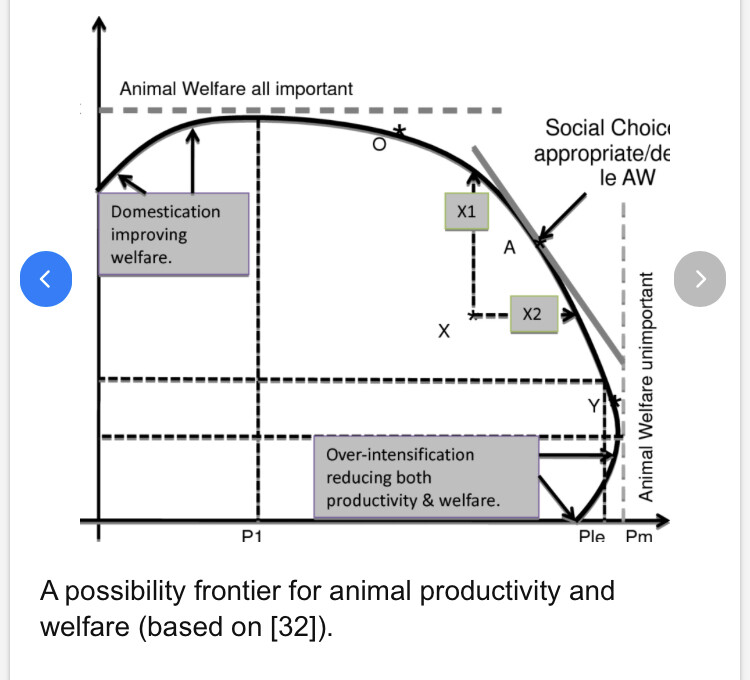
The graph giving animal welfare against productivity is a strange one. Initially, welfare increases but it ends in cruelty if we don’t stop increasing productivity.
I had thought that such practices were diminishing because people want more muscle in their bacon, which only happens when the pigs get out and get exercise.
Best bacon I’ve ever had was at the family ranch of a friend where they raised about a hundred swine – and they said it was the second-tier stuff; the best got sold.
Unless the researchers who are trying to grow meat in the lab succeed on a big scale!
Long ago a science fiction writer wrote that the only muscle tissue they’ll be able to grow in a tank would be the heart muscle, but it would have to have artificial lungs attached. Another science fiction writer write a story where mutton was grown in tanks, using sheep genetically engineered to have only as much brain as was needed to keep a body functioning. Both of those addressed the big problem in tank-grown meat: circulating nutrients to the tissues.
An alleged process that is allegedly be explained by mindless, aimless, natural mechanisms represents the Fingerprint of God? How did you work that out? That’s like claiming the evaporation of water represents the Fingerprint of God.
… except those who find ID convinving. A lot of people find ID a convincing argument for the origin of life on earth, for example.
Because evolution is at least as grand in elegance and operation as anything in the heavens. As the couple of computer majors in our informal intelligent design club put it, it is a masterpiece of programming that makes human software look like child’s play.
“Let your conversation be always full of grace, seasoned with salt, so that you may know how to answer everyone.” -Colossians 4:6
This is a place for gracious dialogue about science and faith. Please read our FAQ/Guidelines before posting.