Did Jesus Claim to be God? (and the trilemma)

AI: The overwhelming majority of critical scholars believe the Book of Daniel is pseudepigraphical. There is a near-consensus in modern academic biblical studies that the book was written in the 2nd century BCE, centuries.

Gary: The author of Daniel did not live during the Babylonian captivity, as he claimed. The evidence is overwhelming that he lived during the Greek occupation. He was a fraud. So if Jesus quoted the author of Daniel, he was quoting a fraud.

1 Like

Welll GAry, I thought you were talking about the concept of a Trinity, so I addressed that one. And I did quote Isaiah. The writings of Isaiah figured (then and now) heavily in the Gospel accounts as they related to Jesus. Since most of Jesus’ early followers were Jewish, I will pass on the percentage who took a different perspective. But it has been argued that writers composing such a work (as Daniel) in the alleged second-century BC would never have bothered to give the characters Babylonian names. And details about the Babylonians taking items from the Jewish temple and putting them in their own temple–fit the pattern of behavior for that earlier time, not necessarily later…

But now we are veering into othe subjects.

2 Likes

Regarding the Trinity, would you agree that Jesus never explicitly claims to be God in the Synoptics?

1 Like

Do the synoptic gospels portray Jesus as God? Even Bart Ehrman changed him mind on this around 2013.

Bart’s Blog

Until a year ago I would have said – and frequently did say, in the classroom, in public lectures, and in my writings – that Jesus is portrayed as God in the Gospel of John but not, definitely not, in the other Gospels of Matthew, Mark, and Luke. I would point out that only in John did Jesus say such things as “Before Abraham, I am” (8:58; taking upon himself the name of God, as given to Moses in Exodus 3); his Jewish opponents knew full well what he was saying: they take up stones to stone him. Later he says “I and the Father are one” (10:30) Again, the Jews break out the stones. Later he tells his disciples, “If you have seen me, you have seen the Father” (14:9). And in a later prayer to God he asks him to “glorify me in your own presence with the glory that I had with you before the world was created” (17:5). None of these sayings, or anything like them, can be found in the other canonical Gospels. John is clearly portrayed as a divine being in John, but only in John (I would have argued).

Most of the article is behind a paywall but for those who can’t access it, he says : “So yes, now I agree that Jesus is portrayed as a divine being, a God-man, in all the Gospels.”

But he thinks they gospels do so in different ways (e.g. adoptionist, vs exaltation at birth and as preexistent in John). Keep in mind that Ehrman–for decades–would defend a completely dubious and ridiculous view that was completely contrary to the one he now espouses. He would teach his students this mistaken and defend it against any number of detractors. To his credit he has accepted evidence and changed his mind. But he still can’t fully let go of his old way of thinking. This is what critical scholars like him sometimes like to argue:

  • Jesus was originally exalted at his resurrection.
  • Then later on Christians pushed it back to his baptism (the alleged adoptionist Christology of Mark–though some now prefer exaltationist due to a lack of adoptionist terminology).
  • Then Christians pushed it back to his birth via a virgin as God’s son (e.g. Matthew and Luke and any sources they used)
  • Then later as pre-existent Word (John)

So yes, Jesus is clearly portrayed as God in all four gospels but not pre-existent God God and this belief did not go back to Jesus but the early church.

If this thread does anything, it is showing how wrong and to be honest, ridiculous this view is. The methodology is broken.. The only way to reconstruct the life of an individual that left nothing behind of his own is through the views of his earliest followers who knew Him. As we have seen with at least 4 different incidents in the synoptic gospels above, Jesus is clearly portrayed as fully God, sometimes even in the context of a creator. And the transfiguration shows all these adoptionist and exaltationist Christologies are simply wrong. They reveal Jesus was not a human turned divine but a heavenly being who was now human. The face of God in the flesh. That it what the transfiguration shows.

The highest Christology shows up in all our sources including our earliest ones and goes back to the original followers of Jesus. There is no plausible reason to even consider Jesus creator so early on the basis of God resurrecting him --as a purely human being–from the dead. The best historical explanation is there is continuity between what Jesus taught about himself and what his earliest followers believed. All the evidence suggests this including numerous non-miraculous scenes in the gospels that the majority of scholars attribute to the Historical Jesus. We saw one above about hating one’s parents. Now we turn to another:

2 Likes

No one is good but God (Matt 19:16–22; Mark 10:17–22; Luke 18:18–23)

Mark 10:17–22 17 As he was setting out on a journey, a man ran up and knelt before him and asked him, “Good Teacher, what must I do to inherit eternal life?” 18 Jesus said to him, “Why do you call me good? No one is good but God alone. 19 You know the commandments: ‘You shall not murder. You shall not commit adultery. You shall not steal. You shall not bear false witness. You shall not defraud. Honor your father and mother.’ ” 20 He said to him, “Teacher, I have kept all these since my youth.” 21 Jesus, looking at him, loved him and said, “You lack one thing; go, sell what you own, and give the money[d] to the poor, and you will have treasure in heaven; then come, follow me.” 22 When he heard this, he was shocked and went away grieving, for he had many possessions.

Luke 18:18–23 18 A certain ruler asked him, “Good Teacher, what must I do to inherit eternal life?” 19 Jesus said to him, “Why do you call me good? No one is good but God alone. 20 You know the commandments: ‘You shall not commit adultery. You shall not murder. You shall not steal. You shall not bear false witness. Honor your father and mother.’ ” 21 He replied, “I have kept all these since my youth.” 22 When Jesus heard this, he said to him, “There is still one thing lacking. Sell all that you own and distribute the money[c] to the poor, and you will have treasure in heaven; then come, follow me.” 23 But when he heard this, he became sad, for he was very rich. 24 Jesus looked at him[d] and said, “How hard it is for those who have wealth to enter the kingdom of God!25 Indeed, it is easier for a camel to go through the eye of a needle than for someone who is rich to enter the kingdom of God.”

Matt 19:16–22, 16 Then someone came to him and said, “Teacher, what good deed must I do to have eternal life?” 17 And he said to him, “Why do you ask me about what is good? There is one who is good. If you wish to enter into life, keep the commandments.” 18 He said to him, “Which ones?” And Jesus said, “You shall not murder. You shall not commit adultery. You shall not steal. You shall not bear false witness. 19 Honor your father and mother. Also, you shall love your neighbor as yourself.”20 The young man said to him, “I have kept all these;[c] what do I still lack?” 21 Jesus said to him, “If you wish to be perfect, go, sell your possessions, and give the money[d] to the poor, and you will have treasure in heaven; then come, follow me.” 22 When the young man heard this word, he went away grieving, for he had many possessions.

This verse is often cited as evidence Jesus did not claim to be divine and it can also be used to claim that Jesus did not view himself as sinless (no one is good but God). A few quotes will illustrate this:

“So far was Jesus from teaching the dogma which later arose—that he was the Son of God and one of the three persons in the Godhead—that when someone hailed him as “Good master,” Jesus replied, “Why callest thou me good? There is none good save one: God.” Strauss, Jesus of Nazareth, 289.

“Here Jesus so tenaciously maintains the distinction between himself and God, that he renounces the predicate of (perfect) goodness, and insists on its appropriation to God alone.” 77. Klausner, Jesus of Nazareth, 364–65

“Why do you call me good? None is good, except the one God.” (Mk 10.18)…. [This] does not mean that Jesus was really a liar or a thief: it simply means that faced with the One God himself, Jesus did not feel perfectly good…. This is what Christian commentators have been unable to cope with, because of their belief in Jesus’ sinlessness…. Jesus did not feel that he was perfectly good, and it is long past time that his sinful modern followers noticed that. Casey, Jesus of Nazareth, 286–87.”

Adela Collins tells us:

“In the first part of his response in v. 18, the Markan Jesus shows his modesty and piety by not claiming for himself qualities or prerogatives that belong to God alone. This portrayal of him contrasts with the accusations of the scribes and the high priest and council else- where in Mark” Hemeneia Commentary on Mark

So the argument of some critical scholars might be that, while there are numerous instances in the Gospels where Jesus claims to be divine, and where others accuse of him of blasphemy, this one verse allows us to get behind the made up high Christology of the early church and see a Jesus who clearly did not put himself on par with God.

This interpretation is sensationalistic but by no means is supported by the text or the rest of the Gospel and is contrary to all the other recurrent evidence we do have. Jesus—who was fond of riddles or parables, may have been simply giving a hint to his divinity here (why do you call me good if God alone is good?). In fact, this is very much the only plausible interpretation by how the scene plays out where he adds a commandment to the decalogue that is needed to follow him!

Robert Gundry wrote the following in his commentary on Mark:

“No one would be surprised to hear that God is good. But neither Jew nor Greek would say that God alone is good. Jesus says so, however. Again Mark means his audience to see the explosiveness of Jesus’ pronouncements. That God alone is good lays the ground- work for the inadequacy of keeping commandments, even God’s commandments (vv 19-21). ‘Since in 2:1-12 some scribes asked, "Who is able to forgive sins except one, [i.e.] God and Jesus proceeded to heal a paralytic for proof of his own divine prerogative to forgive sins, here he borrows those scribes’ phraseology and proceeds to answer the present question for proof of his divine possession of goodness (cf. his self-references to divine sonship [13:32; 14:62 with 14:61 and passages outside Mark, such as Matt 11:27; Luke 10:22] as well as others’ references to it in Mark [1:1, 11; 3:11; 5:7; 9:7; 14:61; 15:39, not to list many such references outside Mark]). The demonstration of Jesus’ divine possession of goodness lays the groundwork for following him as the only way to inherit eternal life, have treasure in heaven, enter God’s kingdom (v 21).

As the dialogue with the man ensues, it seems he has kept the commandments. But it is quite clear that to Jesus, keeping the commandments—God’s commandments-- is not enough here. He flatly denies the man can acquire eternal life in such a way. Jesus tells him to sell all he has and then he can follow Him – which is to gain eternal life. This entire scene is steeped in some of the most important Jewish traditions from the Old Testamant. As Joel Marcus wrote in his Anchor Bible Commentary:

Jesus’ preliminary response (10:18–19) is firmly embedded in the realm of the Law, and specifically the Decalogue (Exod 20:1–17; Deut 5:6–21). Its initial part alludes to the Shema in Deut 6:4–5, viewed by many early Jews and Christians as the functional equivalent of the first table of the Decalogue, which deals with relations between humans and God (see, e.g., Philo, On the Decalogue 108–10, and cf. Allison, “Mark 12.28–34”). The second part of the answer (10:19) quotes from the second table of the Decalogue, which refers to relations between human beings. These observations suggest a closeness between our pericope and the dis- cussion about the heart of the Law in 12:28–34: in both cases Jesus is addressed as “teacher,” is asked a question related to the central requirements of the Torah, and responds in terms that summarize the two tables of the Decalogue; in neither, however, does observance of these commandments suffice for entry into God’s dominion (“missing one thing”/“not far from the dominion of God”; cf. Sariola, Gesetz, 204). S

Joel Marcus also writes:

10:21–22: the call rejected. Jesus’ gaze burrows into the rich man’s soul (“looking at him”) and with an intuition guided by fatherly affection (“moved with love for him”) brings the obstacle to light: “You are missing one thing” (10:21a). Ironically, then, this “man who has everything” still lacks the one necessary thing (cf. Luke 10:42)—the gift of being free enough from his possessions to follow Jesus’ call wholeheartedly. As pointed out in the NOTE on “looking at him” in 10:21, Jesus’ discernment of a spiritual lack in the man demonstrates the sort of supernatural insight that is often ascribed to holy people. But it also helps answer the implicit question that was raised by 10:18 about the relation between Jesus and the good God, who in the biblical and Jewish traditions shows his goodness not only by being good in himself but also by doing good to others (see the common rabbinic formula “who is good and does good,” m. Ber. 9:2; etc.) and whose oneness is inseparable from this overflowing kindness (see above on the second benediction of the Shema). If now, a few short verses after the reference to God’s unique goodness, Jesus is portrayed in a way that combines benevolence with an extraordinary spiritual capability, the implication must be that Jesus’ outreach to the rich man is a manifestation of the divine power and mercy. Another way of understanding the Shema’s affirmation of the unique goodness of God thus begins to emerge: No one but God is good, and so when Jesus demonstrates a godlike beneficence, he is not acting through a human capacity but through the eschatological power of God (cf. the COMMENT on 5:18–20). In its canonical context, then, our passage does not deny Jesus’ goodness but ascribes it to its divine origin, so that the question in 10:18a comes to mean, “Do you realize that I am good only because God is?”

Brant Pitre reaches a similar conclusion.

“Jesus adds a commandment to the Decalogue that is entirely focused on following him. In a first-century Jewish context, it is difficult to overestimate just how striking Jesus’s act of adding a requirement to the Decalogue would have been. In Jewish Scripture, the Ten Commandments alone are written by the very “finger of God” (Exod 31:18). As such, they have a unique and supreme place in the Mosaic Torah. Hence, for Jesus to presume to add anything to the Decalogue raises the question: Who does Jesus think he is? It is difficult to overestimate just how problematic “the extreme nature” of Jesus adding a requirement to the Decalogue is for those who argue that Jesus is denying both that he is good (and that he is God). If Jesus is actually denying that he is good, then how can he possibly make “following” him as a disciple a condition for obtaining “eternal life”? How could it be necessary for salvation to follow a sinful human teacher who insists that he is not even “good,” much less that he is not God?”

I reiterate that last part, if Jesus is actually denying His goodness in this conversation, and not instead affirming it, how on earth does he add a commandment to the decalogue and make it a requirement for following Him (Jesus!)?

As James Edwards reminds us, the rich man who sincerely kept the commandments went away sad:

“ It is often supposed that the rich man cannot have been sincere in claiming to have kept all the commandments. We should remember, however, that the Ten Commandments speak of acts that could—and were meant to—be kept (even if one intended otherwise). We should doubtless accept the truthfulness of the rich man’s claim, “All these [commandments] I have kept since I was a boy” (10:20), for (1) Jesus does not challenge his declaration, and (2) Jesus would scarcely look on insincerity with “love,” as he does in verse 21. It is often imagined that if the law were perfectly kept, one would gain eternal life. To a man who has, in fact, kept the law, Jesus declares, “One thing you lack. . . . Go, sell everything you have . . . give to the poor. . . . Then come, follow me” (10:21). Jesus offers himself as a substitute for the man’s possessions. The man’s full adherence to the law, good as it is, is no substitute for knowing and following Jesus. This offer, however, the man cannot accept. Standing on his own merits, he is self-confident; but when he is called to give up his security and follow Jesus, his “face[…]” Baker Illustrated Bible Commentary on Mark

As the scene with the rich man ends Jesus speaks about a camel and the eye of a needle to bewildered disciples who are left wondering “who then can be saved” and of course we are told by Jesus “with God all things are possible” and finally have Peter saying, “We have left everything to follow you!” To follow you! Jesus responds positively, The scene involving the rich man who went away sad is another clear example of where Jesus puts himself on par with God. Oddly enough, this scene is allegedly one of the strongest evidences against Jesus viewing himself as divine. I’d hate to see the weaker evidence.
4 Likes

What?

“Before Abraham was, I AM.” (Jesus speaking not me…!) There’s more…but it is late.

I am sorry, but you appear to be repeating assertions whether they have been addressed before or not.

Your assertion here assumes a certain view of Gospel authorship and definition of accuracy and truth.

Mark’s Gospel is often referred to as the Divinic secret (or words to that effect) every time Christ is identified by demons or others they are immediately silenced or instructed not to tell anyone.Jesus declares His divinity by that means. It would be illogical if He therefore said it explicitly. The underlying point Mark is trying to make is that as a certain presenter of through the Keyhole used to say:
“The clues are there!”
Scripture is not about the obvious.

Matthew emphasises that Jesus fulfilled prophetic Scripture. That is the way he claims the divinity of Jesus and His place as the Messiah. Therefore any claims of Jesus being God in human form are derived from understanding those Scriptures.
The clues are there!

Luke claims a dispassionate view, so concentrates on the human view of Christ. Christ did no overtly claim to be God, so Luke would not record such a claim. But that is not Luke’s intent. Luke is offring a view of Christ that people can make their own mid up over. He is not going to declare a specific doctrine and bias what he claims is an unbiased account..

Before you make all these claims about Scripture and what it says, you need to understand what Scripture is trying to say.

Richard

1 Like

Let examine the evidence for Jesus’ alleged claim to be Yahweh the Creator as we would any other historical claim.

First let’s look at historical and cultural context: What is the most blasphemous thing a first century Jew could say or infer? Answer: “I am God”. What was the punishment for blasphemy: stoning. I don’t believe for a second that any first century Jew could have claimed explicitly or implicitly that he was God and not be stoned on the spot. The idea that Jesus traveled around Palestine for three years claiming outright or implying that he was God is so improbable as to be practically impossible!

Second, do we have undisputed, independent attestation that Jesus made any of these statements implying or explicitly stating that he was God? No.

The Jewish historian Josephus did not say that Jesus claimed to be God, and most scholars believe the explicit passages in his writings that describe Jesus as Christ and divine are Christian interpolations. The original text, which was likely less complimentary, has been reconstructed by scholars based on manuscript evidence and a tenth-century Melkite historian’s version. This reconstruction describes Jesus as a “wise man” with a good reputation who was crucified by Pilate, and whose followers claimed he had appeared to them alive three days later, suggesting he “was perhaps the Messiah”.

Therefore, if we treat the Bible as we would any other book from Antiquity we would dismiss these claims as hearsay.

You might, but Christians do not. The bible is not like any other book.

So your arguments and reasoning fall at the first hurdle.

Religion is still about faith, not reasoning, or proofs, or even objectivity .

The whole point of the Gospels is that Jesus did not overtly claim His divinity, yet He was still crucified for it. Doesn’t that tell you something that you were missing?

If you do not wish to accept the testimony of witnesses, be they first hand or fifth, that is your choice and prerogative, but that does not give you the right to belittle or mock those who do. A little respect goes a long way.

Richard

Richard, you’re feeding an atheist pigeon. Stop and wait, eventually he’ll go look for food elsewhere. Or if you really enjoy feeding him, go to his blog: Escaping Christian Fundamentalism.

2 Likes

That underlined “here” is Biologos.

Jesus was crucified for claiming to be the Jewish messiah, if there is any historical accuracy to the Gospels. The (alleged) sign above his head said “King of the Jews” not “God of the Jews”. The Romans were pantheists. They could have cared less if Jesus thought he was a god.

If you want to appeal to your subjective evidence of Jesus’ internal presence, that is one thing. That is personal. By appealing to the Gospels as eyewitness testimony you are appealing to objective historical evidence. If you are claiming that the Resurrection is an objective historical fact, why are you uncomfortable with discussing that objective evidence?

(Jesus did overtly claim his divinity…if the Gospel of John is historically accurate.)

1 Like

I second this. I blocked him. If we do not respond he will eventually go away out of boredom. If you feed a troll, it will just keep coming back for more food. Unfortunately, he is plagued by the same Cartesian dualism as the extremist fundamentalists he is used to arguing with. He is basically a militant fundamentalist atheist and that means rational discussion is not the best medicine for him just the same as it is a mistake more often than not to approach a militant young earth creationist with pure scientific evidence.

However, conservative Christians continue to cling desperately to the fantastical supernatural claim that Jesus of Nazareth rose from the dead.

We are desperately clinging :rofl::rofl:

Apparently we have to accept every miracle account in scripture or assume every story in scripture has the same genre and is verbatim historical reporting or none of it is. Well, this is the internet, the place where nuance often goes to die.

Vinnie

1 Like

Who is uncomfortable? I am just being polite.

You are not discussing anything.

If you want to discuss, then go right ahead. I haven’t noticed you say anything worth discussing,

That is an assertion, and a false one t’boot. I never said anything about historical evidence. I said witnesses. Not the same thing.

Richard

1 Like

Folks who respond to Gary_M are feeding an atheist pigeon. Stop and wait, he’ll go elsewhere. Or he may just go back to his blog Escaping Christian Fundamentalism

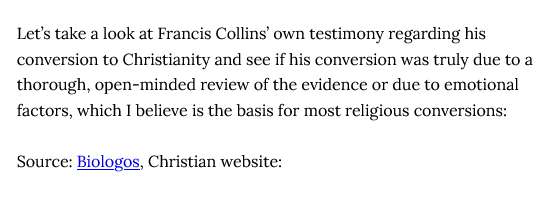
image

image594×174 7.96 KB

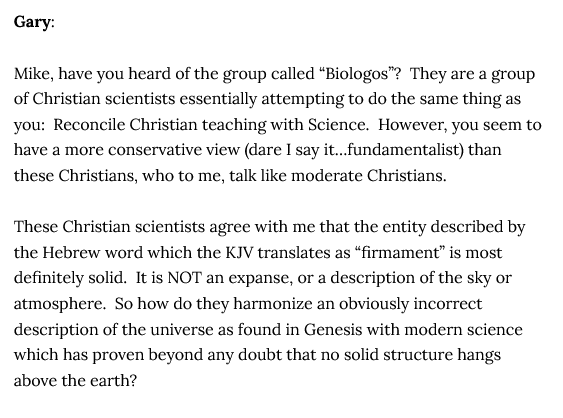
image

image584×265 10.5 KB

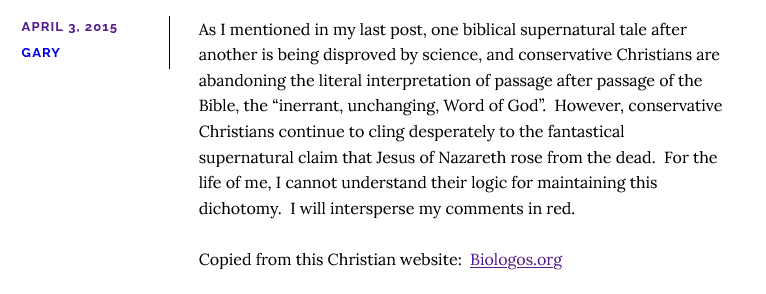
That underlined “here” is Biologos.

image

image569×106 4.04 KB

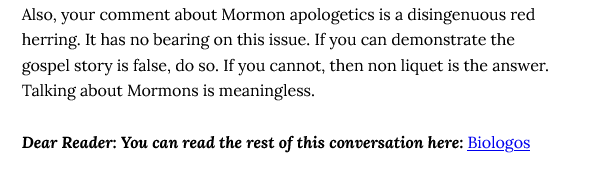
image

image555×200 7.46 KB

image

image563×418 17.2 KB

image

Abandon your comforting superstitions and come into the light of Reason and science.

When atheism turns on the light, there is nothing for it to illuminate.

Vinnie

3 Likes

Why do you expect Him to conform to your MSWV?

That’s an important one – the only being who could be lord of an institution such as the Sabbath was the one who instituted it, just as the only being who could be greater than a temple was the deity for whom the temple was built.

Which reduces everything up until about the time of Napoleon to hearsay.

1 Like

Gary,

It’s all about faith mate. We don’t have it, me and thee. In the narrow sense. Trying to attack it is trying to attack OUR humanity. In the broad sense. Because our faith, thine and mine, is anchored in coherent, warranted, justified, true, belief; knowledge. We go beyond it, in beauty, in love, even though that is completely natural too, and tumbles into the black hole of empiricism. So there is no beyond, no escaping. Faith.

Most here have two magisteria, two poles on the belief spectrum, two foci of the ellipse, separated more than ours, the best tending to no overlap, to extreme elliptical orbits.

I more than suspect that you and I never had, or got to, those practically independent foci. So as our knowledge waxed, our non-knowledge waned.

That cannot happen to those with two magisteria.

They have ‘By the Spirit’ as the ultimate get out of jail free card to put faith before forensics.

How I envy them.

As for the rest, ignorance is bliss.

Really? No common humanity? No beauty? No gratitude? No kindness? No love?