“the Son of God, who, instead of accepting the sacrifice of one of his creatures to satisfy his justice or support his dignity, gave himself utterly unto them, and therein to the Father by doing his lovely will; who suffered unto the death, not that men might not suffer, but that their suffering might be like his, and lead them up to his perfection."
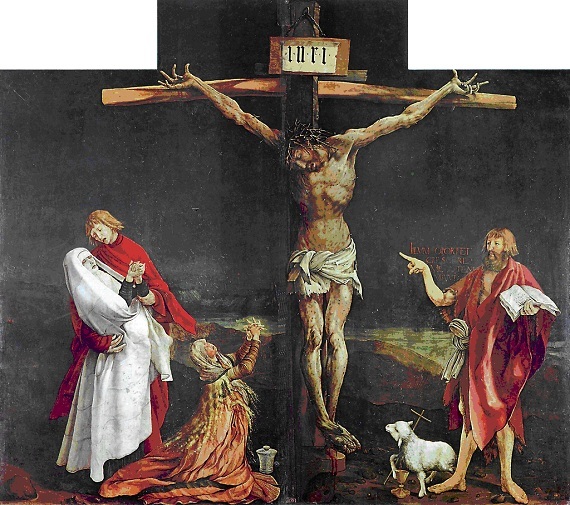
Since it’s now the Passion week, let me close with one of my favorite paintings, the central panel fro Grunewald’s Isenheim Altarpiece.
Actually, Norman, I would say that its theological application(s) include setting the conceptual background for exploring nature: everything you see is a created thing, a “creature.” None of it is divine, so all of it is fair game for us to probe as deeply as we wish. This is what is often called the “de-deification” of nature, and IMO it’s a crucial attitude for scientists to hold.
In addition, the notion of creatio ex nihilo that is so often associated with Genesis (rightly, IMO, though I recognize the minority of my view on this) is intimately related to the modern scientific emphasis on learning about nature through what has been called “rational empiricism,” that is a combination of reason and experience. Robert Boyle once put it like this:
“it appears by the history of the creation [Genesis], that the world itself was first made before the contemplator of it, man: whence we may learn, that the author of nature consulted not, in the production of things, with human capacities; but first made things in such manner, as he was pleased to think fit, and afterwards left human understandings to speculate as well as they could upon those corporeal, as well as other things. And if the world were not made by God, but was eternal, as the old Peripateticks thought it; or was made by chance, as the Epicureans held; there is yet less reason to believe, that there is any necessity, that the nature of primitive things must be commensurate to our understandings; or that in the origin of other things any regard was had, whether they would, or would not, prove comprehensible to men.”
In a sense it ties in with a kenotic view of Jesus Christ, which I have held for years. There are some similarities with both Polkinghorne and OOrd. I suggest too many evangelicals are really crypto-Appollinarians
I think we all come at Genesis with different colored glasses which lend itself to the robustness of its examination. I would challenge that creation to the Jewish mind that penned Genesis is more in tune with ordering the worldview of the faithful Jew and their plight and perception of being exiled out of their land and from God. The created appears to be more about what Walton proposes as functional establishment than anything we might recognize as a scientific proposition. Let me provide an example: In Genesis 1 we have the ordering and establishment of the Sun, moon and their assignment was to determine seasons and times. This would be in reference to their Temple worshiping in which they set their festivals via these markers. However the author of Revelation being the good Walton functional reader that he is says that the Sea form Genesis 1 is no more and that indeed because there is no more Temple worship that the Sun and the moon are no longer needed for their created purpose. In other words he functionally un-assigns or de-creates those entities that were assigned their function in Genesis 1. This occurs because Christ would supply the light and thus the Seas which are OT symbols of the turbulent gentile world would give way to only one humanity now. No more division of Jew and Gentile faithful. (Eph 2:12-14). No more is the land distinct from the waters as Christ has calmed the waters. Rev 17:15.
Ted, I don’t deny the use of ANE creation stories that comprise the base of Genesis but I believe they were reformed to provide theological instruction and background for a people that had lost everything and were struggling with the ramifications of being people in exile and needing a foundational story to immerse themselves in. Genesis comprises the same themes that are restated over and over again in the Law and the Prophets. I believe if they are read through Jewish 2nd Temple eyes then the heart of its message is more accurately discernable.
I also believe that a good astrophysicists who looks at the wonder and order of the universe today will come to the same conclusion that the Jews did; that the Heavens declare His glory. I just don’t think we moderns should read Genesis outside of the Jewish context. Not the literal context of YEC; but out of the context of understanding deeply the origin and intent of Genesis as foundational to a people who needed direction to remain a people of God. There is a surface reading and then there is a deeper contextual reading such that Paul brings to his Genesis interpretations although many don’t realize his 2nd T background influence.
I like to read Genesis as theological literature first and then through Christ I am free to follow where God’s physical world instructs His ordering.
Your comments are appropriate and appreciated. It’s a matter of emphasis, to be sure. I am less persuaded by John Walton’s approach than you are, and more persuaded by the approach taken in a famous article by another biblical scholar, the late Conrad Hyers: D:\ASAWEB~1\PSCF\1984\JASA9-84Heyers.htm
Both approaches situate Genesis in an ANE context, which I believe to be essential, but they do it somewhat different ways. Both Walton and Hyers would say what you say, namely, that we shouldn’t look to Genesis for any scientific insights. I fully agree with that also. My claim is more subtle, namely that there are some theological insights rooted in Genesis–whether or not the ancient Hebrews had identical insights–that have been deeply influential on modern science, even though this would be very surprising (perhaps even unwelcome) news to most scientists. I would go so far as to say that one of the insights I spelled out, namely the “de-deification” of nature, actually was in fact shared by the ancient Hebrew audience hearing the hexameron. Would you agree at least with that part?
I’m going to file an amicus brief here and say that Hyers’ book The Meaning of Creation: Genesis and Modern Science is absolutely, without a doubt, the best book on Genesis and science I’ve ever read. It’s the book I return to again and again to understand these issues better. The fact that almost nobody has heard of it is an absolute tragedy.
I have his essay titled “Dinosaur Religion: On Interpreting and Misinterpreting the Creation Texts” here in my classroom, and if is any indicator, I’m not surprised to hear high accolades for his book. It’s also a tragedy that there doesn’t seem to be a kindle edition of it available. The essay was also published in 1984. Was it part of his book I wonder?
Wow, Brad–that’s quite a compliment to Hyers. I might actually say the same thing myself, and I certainly don’t hesitate to agree that the relative obscurity of the book is “an absolute travesty.” The article by Hyers that I linked is taken from the book. So is a sequel, also in the ASA Journal: D:\ASAWEB~1\PSCF\1984\JASA12-84Heyers.htm
I gave readers of an earlier column an “assignment” to read Hyers in light of a few questions that I formulated, here: The Framework View: History and Beliefs - BioLogos
Yes, George, the Hebrews reduced the pantheon to one, but in the process they denied the divinity both of “Nature” as a whole and also any specific part(s) of Nature. I think it was S.G.F. Brandon, a leading scholar of the ancient Near East, who called that the “de-deification of nature,” but don’t quote me on that.
Yes, Job has God running the natural world. So do I. When someone like me says that God creates through evolution, I don’t mean that trivially; I mean that God works constantly, and that part of the divine work that we can comprehend is what we summarize in the scientific picture of the world. God does have mystical powers, such as the ability to make a world from nothing, the ability to give matter certain properties and powers rather than others, the ability to raise Jesus bodily from the grave, and the ability to make creatures capable of knowing God. To keep the list short.
1 Like
gbrooks9
(George Brooks, TE (E.volutionary T.heist OR P.rovidentialist))
32
“This does not mean that nature is secularized or desacrilized; for it is still sacred by virtue of having been created by God, declared to be good, and placed under ultimate divine sovereignty. What it does mean is that to treat Genesis 1 as of the same order as later science is to confuse result and cause. Genesis 1 clears the cosmic stage of its mythical scenes and polytheistic dramas, making way for different scenes and dramas, both monotheistic and naturalistic. Thus, if there is a scientific look to the text, it is not because it is an early form of natural history, but because the cosmic order, in its totality, is now defined as nature.”
I think I grasp what you mean by this “de-deification” … the Egyptians surmised there was a GOD for every day. And the Gnostics carried this idea into the post-Christian world.
But I think you and others make a good case about what the Hebrew scribes were intentionally doing … and I’ll be paying more attention to that in future readings and discussions…
In this same essay, Hyers also refers to astrology and alchemy as examples of ‘half-way’ houses on monotheism’s way toward the de-divinizing of nature. Atheists would also refer to Christianity as merely just another ‘half-way house’. But here is where Hyers shows his true Christian colors as he seems (in the confines of this essay, anyway) to simply not go there. He doesn’t let that set the agenda, but unapologetically (detractors might say: ‘uncritically’) adopts the theistic (indeed, monotheistic) mantle for how the discussion will be framed. I don’t know what the rest of the book is like, or if he does choose in other parts of the book to pick up the other end of that neo-atheist rope to engage in their favorite tug-o-war game. Perhaps choosing non-combatant status in that by virtue of his devastating critique of the entire game itself is the best option. But I’m on thin ice without having read the rest of his book (to my own recollection anyway). Is the rest of his work as brilliantly penned as this essay?
I intend to get a hard copy of that for my shelves at school --it occurs to me that (on the strength of this essay alone), I would probably pick this book in any sort of ‘reading exchange’ I may engage in with somebody. Thanks, Ted and Brad, for reminding me and reviving an appreciation of this great writer.
 says that the Sea form Genesis 1 is no more and that indeed because there is no more Temple worship that the Sun and the moon are no longer needed for their created purpose. In other words he functionally un-assigns or de-creates those entities that were assigned their function in Genesis 1. This occurs because Christ would supply the light and thus the Seas which are OT symbols of the turbulent gentile world would give way to only one humanity now. No more division of Jew and Gentile faithful. (Eph 2:12-14). No more is the land distinct from the waters as Christ has calmed the waters. Rev 17:15.