Climate Change, Hurricanes, and Witches?

I implore you @wbwane to take a pause and see what you are doing here. You are a smart guy, but it looks like something is preventing you from accurately understanding climate science. What is it? Your last three posts have all been off in the same way.

The Problem with These Graphs: They Show 2% of Earth

These graphs show Alabama and the Midwest US - about 2-3% of Earth’s surface. That’s the entire trick.

What the global data actually shows:

2024 was 2.65°F (1.47°C) warmer than the 1850-1900 baseline. The 10 warmest years on record have all occurred in the last decade (see NASA Science).

In the 1930s? The US was hot, but the planet as a whole was much cooler. When you compare 1930-1939 to 2010-2023 globally, most of the planet shows dramatic warming in the recent period:
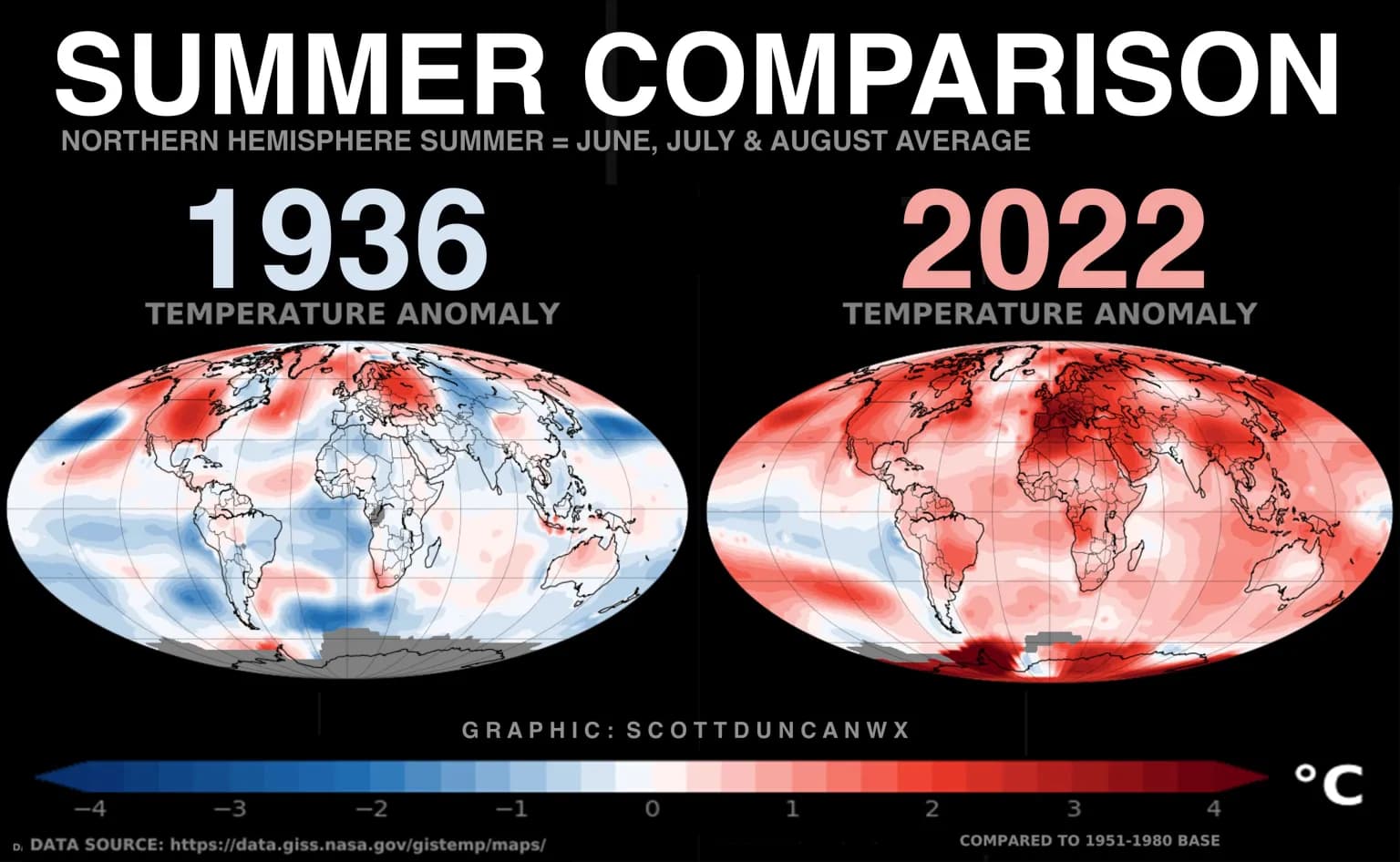
(see this for a discussion on the 1930s heat wave in the midwest: WFLA).

Why was the 1930s US so hot?

The Dust Bowl wasn’t natural - it was caused by “plowing up the middle third of the U.S.” and removing native grasslands. This human-caused land destruction generated extreme regional heat.

Climate models can only reproduce the 1930s US heat when scientists add in the massive devegetation that actually happened. Models match global temperatures extremely well - they just don’t predict every local quirk from land-use disasters.

About those state temperature records:

This is confusing climate (long-term trends) with weather (individual extreme days). Climate change doesn’t mean every single location breaks its all-time high every year.

Climate models are designed for global predictions, and they nail it. Judging them by Alabama’s summer temperatures or whether Iowa broke its 1934 record is like judging a US weather forecast based only on whether it got Tucson right.

Why cherry-pick a handful of states instead of looking at the whole planet? Because the global data - from NASA, NOAA, and every major scientific institution - shows exactly what physics predicts: rapid warming tracking with greenhouse gas increases.
9 Likes

Exactly. The only reason to focus on a few US states is because they do not match the global trend.

5 Likes

This is apples and oranges, isn’t it?

A sample of the global climate prediction models used in this graph:

ACCESS CM2 is a global climate model

IPSL CM6A LR is a global climate model.

GISS E2 IG is a global climate model

Etc. Etc. and so forth.

5 Likes

Denialism is always about wallets. The implication to them, the fatter the bigger, if we have to do something about global warming. For that not to be a burden on the poor, in fact the opposite, those with excess above sufficiency must be taxed to obtain equality of outcome, climate justice, social justice. Righteousness. It’s all child simple.

Knowing denialists are lying for the greater good. Their wallets. After a varied while they believe it.

2 Likes

The situation reminds me in part of Lang’s film “Metropolis” and Wells’ story “The Time Machine” – not in their depiction of the poor but of the wealthy. Most of us live separated from poverty, and continents away from daily starvation, violence of failed governments, raw competition for clean drinking water. We can’t even imagine it. We are oblivious.

So, people make misleading comarisons like:
“The Microsoft founder is a somewhat surprising convert to the idea that human welfare matters more than emissions targets.”

IMG_1157

image

3 Likes

No wonder the ‘liberal’ wing of the ruling class lose when they make the working class pay, whether it’s for sustainability or immigration.

Jeder nach seinen Fähigkeiten, jedem nach seinen Bedürfnissen. Which Marx got from the Bible of course.

2 Likes

Not just the poor who are denied loans to build coal, gas, or oil fired power plant to provide electricity, but Parisians who were instructed not to run their air conditioners in order to save the planet. On the subject of models, I remember a talk by Steve Koonin some years ago when he noted “I come from a modeling community….these climate models are poorly constructed and don’t work”. Formerly Provost at Cal Tech.

What, pray tell, is climate justice?

Hmmmmm. Did NASA have satellite data in 1936? One form of cherry picking is to say”….well, the models don’t reproduce the 1936 data…so let’s add a term to the equation.” Run the model back and see if it picks up the little ice age and then on back to the medieval warm period.

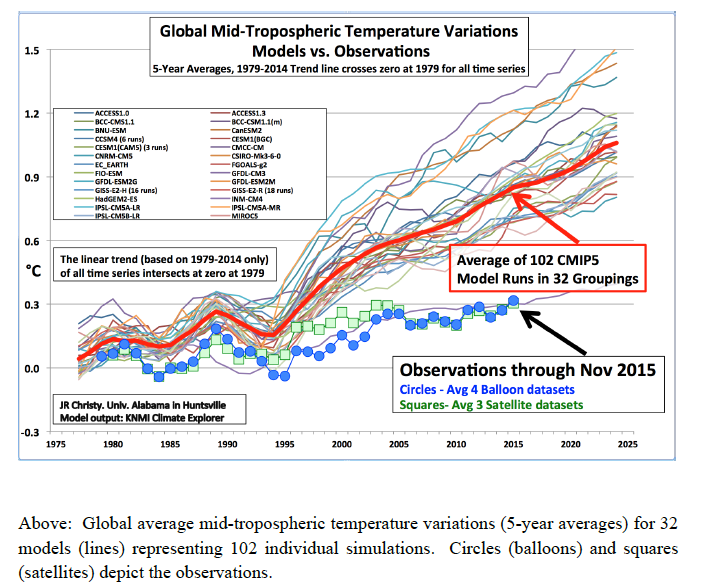
Attached is my favorite drawing fro

m Congressional testimony by John Christy showing that ONE model got it right….a Russian model. But, the Russians don’t fund work to provide scare data for their audience, they only fund, under deep cover, items to scare the rest of the world into the folly of NetZero.

What Marx said above. Eliding Acts 4:32–35, 11:27–30. Righteousness.

1 Like

A URL to the plot would’ve been helpful. Fortunately, John Christy’s presentation was well known enough (it’s from Feb 16, 2016, for those that care about the provenance of presented figures), to easily find discussions and dissection. Once again, apple to oranges comparison.

Who is this Gavin Schmidt, the author of the first post and founder of the blog? Well, a climatologist and Director of the NASA Goddard Institute for Space Studies. See here.

3 Likes

An ordinary approach to modelling potentially complicated phenomena is to start from simple models and then add variables to see what is needed to get comparable patterns that we can see in nature.
The logic behind this approach is a hope to identify the key variables among the multitude of potential variables contributing to the phenomenon. In other words, to understand why we observe such phenomena as we observe in reality.

Building a model that mimics the real patterns is usually much more complicated. Almost always, there is a need to include more variables and the equations become more complicated.

At the start of the modelling of global climate, some details in the models were ‘black boxes’, for example the formation and impacts of clouds (IIRC). It was known that these factors can affect the climate but there was not enough of detailed knowledge or enough of computing power to include these factors realistically.
Overall, the early models modelled the globe as unrealistically large modules (cells), simply because there was not enough of computing power to run more detailed models.

Step by step, the models have become more realistic and model the climate in smaller cells. Such models demand supercomputers but luckily, there are better computers available. It is no wonder that the results of the older models were crude approximations but they served well by showing what appeared to be the key variables and from what ‘black boxes’ there was a need to get better knowledge.

3 Likes

Gavin Schmidt’s job has depended on scaring people. My guess is that the current administration will eliminate that whole institute.

It’s not about being scared. It’s about being just. Righteous. Christian. Christ-like. Something all higher animals, and even plants, are aware of. Fair. Kind.

2 Likes

Carl Sandburg is quoted as saying: “If the facts are against you, argue the law. If the law is against you, argue the facts. If the law and the facts are against you, pound the table and yell like hell”.

In the lab we say: Data talks, BS walks.

In my comments I’ve tried to respond to the data presented as though the sources are making good faith efforts, engaged in active, serious debate and really want to advance understanding. So, if you’re interested in learning and still want to engage scientifically, talk to the data or discuss the science presented.

4 Likes

Additionally, there are over a hundred models. What criteria were used to pick the subset? Aside: There is still expected to be deviation in local conditions, but the question is particularly relevant when the subset of models was used to calculate the global temperature shifts in related presentations.

2 Likes

What proportion of US Evangelicals fully accept the science of global warming?

Only about 20% of U.S. Evangelical clergy fully accept the science of global warming, recognizing human activity as the primary cause. Among Evangelical laypeople, acceptance is slightly higher but still below national averages.

Here’s a closer look at the data:

:fire: Evangelical Clergy and Climate Science

  • Nearly 80% of Evangelical Protestant pastors reject the scientific consensus that climate change is primarily caused by human activity.
  • This makes Evangelical clergy the most skeptical among U.S. Christian leaders regarding climate science.

:man_raising_hand: Evangelical Laypeople

While clergy are highly skeptical, surveys of Evangelical churchgoers show:

  • About 30–40% accept that human activity contributes significantly to climate change.
  • However, many still view climate change as a less urgent or less morally pressing issue compared to other concerns like abortion or religious freedom.

This covers Baptists.

GPT5

1 Like

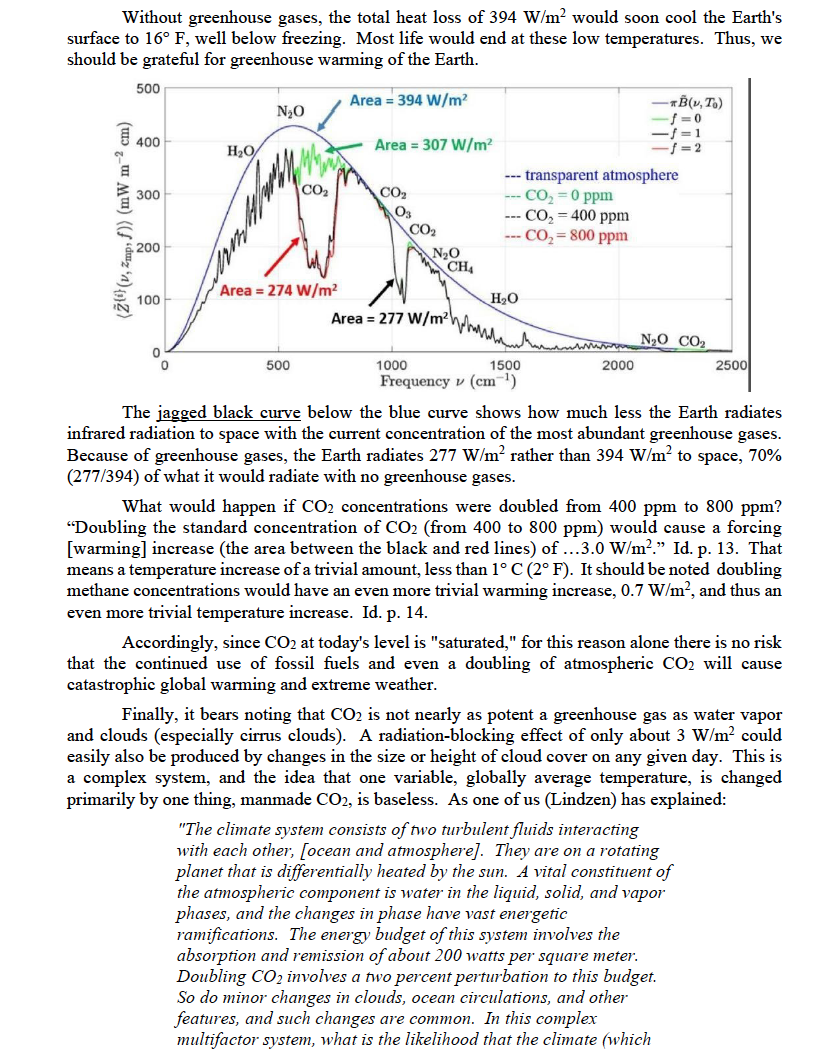
Bend and ear and listen to these data showing that, at about 400 ppm CO2, the energy absorption for CO2 is saturated. Adding more CO2 has little tangible effect as the first 400 ppm have removed nearly all of the energy at the wavelengths at which CO2 absorbs energy.

Rasool and Schneider made that determination back in 1971 during the era when there were fears of the approach of a new ice age. They studied the question of whether adding large amounts of CO2 to the atmosphere would reverse the cooling. Their conclusion, “not much”. Science, 173, 138 (1971).

There seems to be an implicit assumption that “climate change” is BAD. It would be very difficult to feed the 8 billion people on this planet with “little ice age” climate. How many people, even Canadians, retire to Saskatchewan??? Why do cruise ships prowl the Caribbean in winter and not the Gulf of Alaska?

It’s only bad for poor, brown people. Don’t worry, it’s white supremacist. The social collapse of Syria was caused by global warming.

1 Like