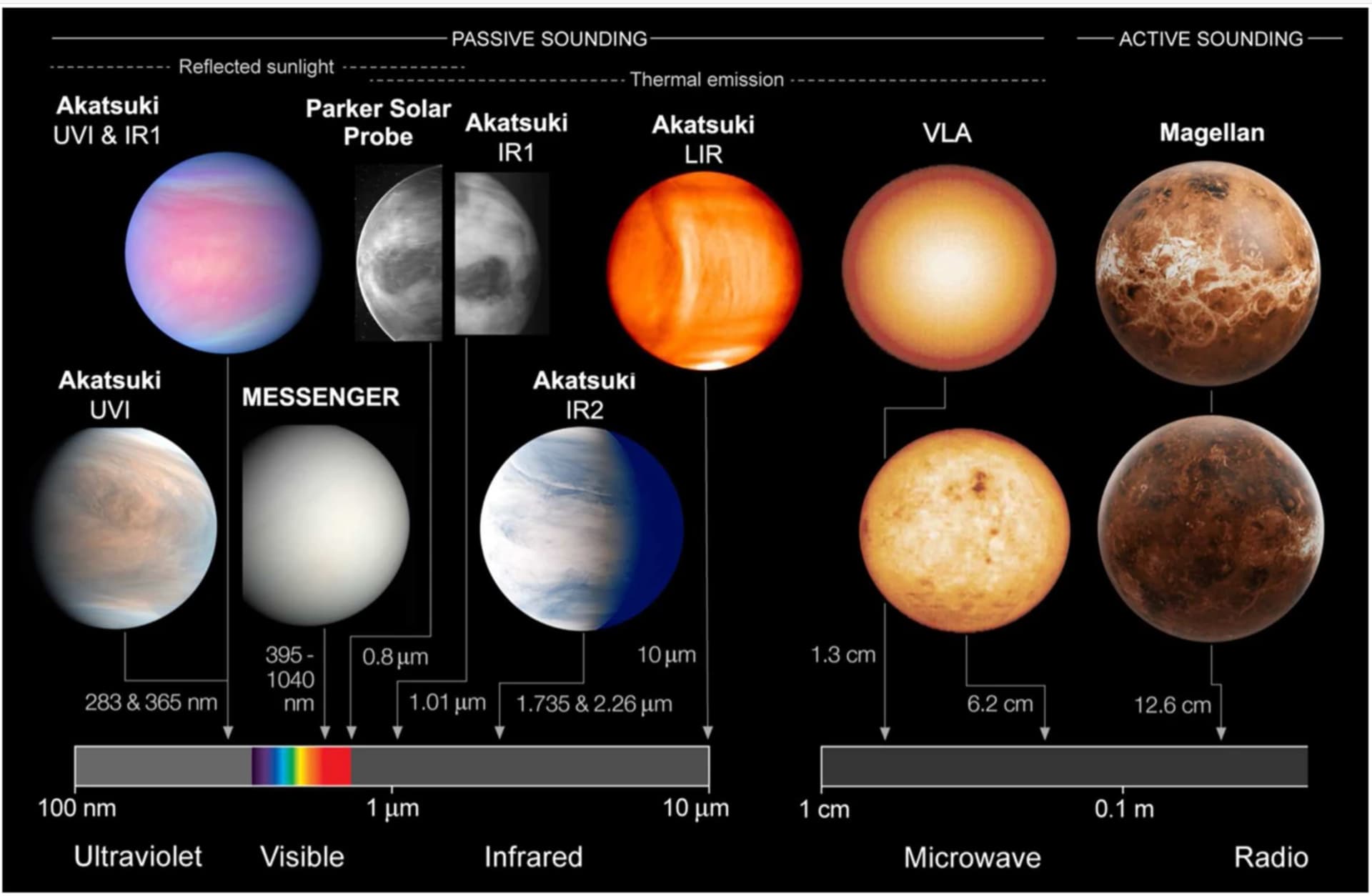
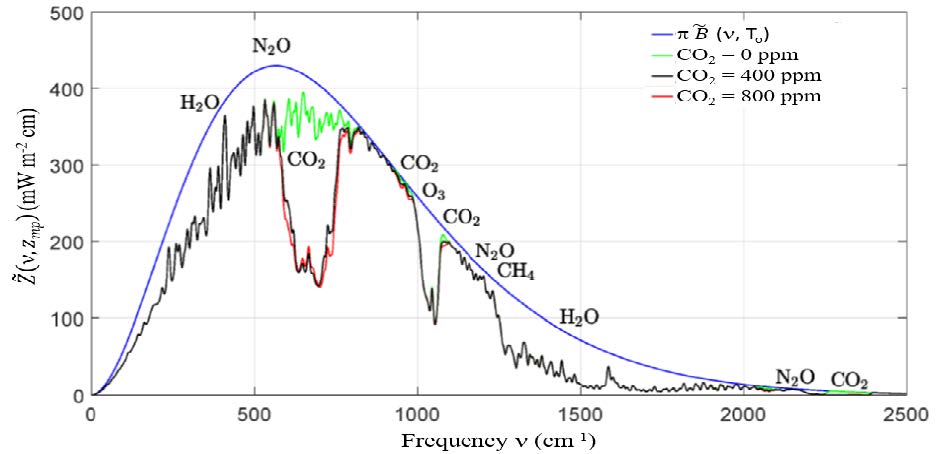
I seem to recall that “what happens on Venus stays on Venus”. It is a chance to learn some new things. With a much hotter temperature and at high pressure, 95 atm, equivalent to about 1 km depth in the Earth oceans, energy movement is quite different. The temperature is around 750 K, depending on which source is checked, meaning a spectrum nearer the visible spectrum. The IR absorption peak present for CO2 here in the Earth atmosphere will be quite different.
[unsourced cut and pasted copyrighted material removed by moderator]
T_aquaticus
(The Friendly Neighborhood Atheist)
409
If the greenhouse effect were saturated then none of the heat arriving on Earth would be able to escape. This would mean the Earth would be an ash cinder. It isn’t. Why? The greenhouse effect isn’t saturated. Adding more CO2 to the atmosphere will trap more heat. This scientific finding doesn’t change just because it would be expensive to stop burning fossil fuels.
Are you trying to argue that Solar Power will never be able to make
AND STORE power more cheaply than fossil fuels?
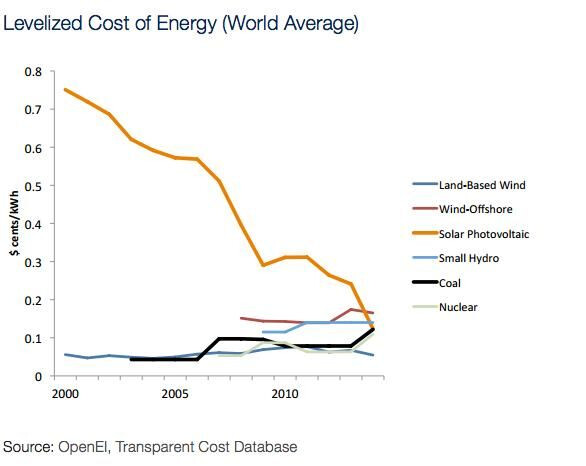
This graph shows the dramatic cost reductions in just 16 years.
PS:
”New Builds are Cheaper: New utility-scale solar and onshore wind projects are frequently cheaper than building new fossil fuel plants, and sometimes even cheaper than running existing ones, according to studies by Lazard and IRENA.”
”The costs for wind and solar have dropped dramatically (90% for solar, 70% for wind), making them economically attractive.”
AND:
“Hidden” Fossil Fuel Costs - - When pollution, health impacts, and climate change are factored in, renewables become even more cost-effective, say 350.org and UN.”
3 Likes
T_aquaticus
(The Friendly Neighborhood Atheist)
415
Storage is going to be the tricky part for both solar and wind. It will be hard to beat natural gas powered plants for electrical production at night or when the wind isn’t blowing, especially in the US where natural gas is often treated as a waste product from oil drilling. There’s always going to be a need for baseline power that can fill in when solar and wind aren’t available. The amount of battery infrastructure needed to fill this role is pretty staggering. Pump hydro storage is interesting, but only works where available and lacks efficiency.
That is true for places where there’s lots of sunshine or lots of wind. Putting solar in places like Germany makes no sense. Putting solar in the SW United States makes a lot of sense, as do wind farms in the Midwest.
IOW, we have to be smart with renewables and energy in general. Not every region will have the same solutions.
8 Likes
gbrooks9
(George Brooks, TE (E.volutionary T.heist OR P.rovidentialist))
416
What should be counted in the price of energy?
If we want to know the total costs, we need to consider all the consequences and costs of producing, transferring and using the energy.
Wind/solar has some disadvantages and the total cost will be higher than what is typically told. There is the need to store the energy in some form. Using the energy in transportation (electric cars) has a price, both through more expensive vehicles and through the environmental impacts caused by the mining of the needed rare earth elements.
Also with fossil fuels, the total costs need to include the costs of the environmental impacts of the production, logistics and use. The release of CO2 and CH4 is one of the key factors, many researchers would say THE key factor, driving the climate change towards the worse and the costs of using fossil fuels should be calculated so that the costs through the climate change are included in the price.
We have had a devastating culture where producers get the profits and others pay the costs. That needs to change, first in the way how the calculations of the total costs are done.
This reminded me of an opinion piece I rad a while back that argued that the Bonneville Power Administration should diversify into solar since solar can now be produced more cheaply than hydro! I don’t think that’s true for the scale for the BPA, but given that the cost of solar keeps dropping it might be a good idea anyway.
I saw an article recommending it for areas in California where it would serve a second function: the storage reservoirs would function to restore groundwater. Of course this entails deliberately losing part of the stored water, but I found the dual-function idea interesting.
I can’t find a reference but I recall an article a few years back that showed how the return-on-investment of solar for home roofing is marching northward. I forget how far north the ten-year break-even line was at the time, but I remember it was expected to be a decade or more before it reached my latitude.
There are frequent and loud suggestions that some places do so, from anti-nuclear types who are finally recognizing that the worst source of nuclear pollution almost everywhere is certain coal plants. It was one reason Oregon’s Boardman plant was shut down.
In Finland, north of the 60th latitude, the calculated return-on-investment time is between 8-15 years. North of the 65th latitude it is 12-15 years. As the calculated life-span of the solar panels is 25-30+ years, the panels should be economically profitable even at northern latitudes. The production of solar energy will be small between November and February - in addition to having short days and the sun is low in the horizon, snow tends to accumulate on the panels during winter. Solar panels are therefore a supplemental source of energy, not the primary one.