T_aquaticus
(The Friendly Neighborhood Atheist)
442
I did. The physical differences between humans and chimps is due to the mutations that have accumulated in each lineage since we shared common ancestry.
Whether bipedality is an advantage or not is a much larger question. No difference between species is automatically assumed to be advantageous. As to bipedality, it does appear to be quite advantageous for modern humans who live in a savanna-like environment. The pelvis and lower girdle that we have is very good for moving about land, and pretty efficient at jogging pace. For an ape species moving from an arboreal environment into a savanna environment, it is easy to see why a human-like pelvic girdle would be advantageous. Comparatively, chimps walk around on their two leggs like bow-legged cowboys. They aren’t good walkers or joggers, but their pelvic girdle is well suited for living amongst trees.
3 Likes
T_aquaticus
(The Friendly Neighborhood Atheist)
443
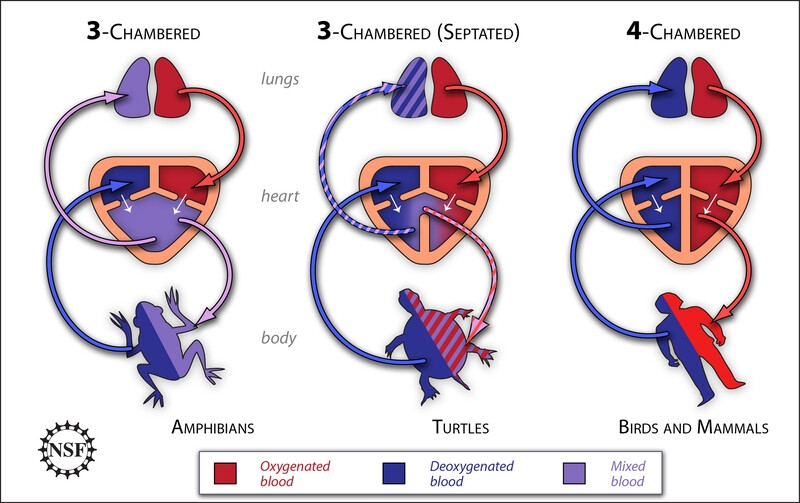
Mammals didn’t evolve from fish. We evolved from reptile-like amniotes. Modern reptiles already have adaptations for separating the the oxygen rich and oxygen poor blood in the form of a three chambered heart with a restriction between the ventricles that prevents complete mixing. Amphibians don’t need a separation between the ventricles because they get about 30% of their oxygen by absorption across their wet skin, much like fish extract oxygen across gills. Some amphibians have no lungs at all and depend entirely on their skin for respiration.
Evolution science readily offers stories about what allegedly occurred, but when it comes to explaining the nuts and bolts of how those things came to be, ToE generally has nothing to say … mainly bcoz no one knows, and no one will ever know.
And what would be the point of an “explanation” anyway, if no one knows if there’s any truth to it?
The “story” as you put it, is the nuts and bolts of how those things came to be.
If you have no interest in the response, why pose the question? You brush off a high level explanation as insufficient, and could not be bothered working through a detailed explanation. If you are not interested, the drive by comments to begin with?
Nothing can be proven about almost anything. At least there is physical evidence for evolution.
But you weren’t asking for proof, you were asking how snake fangs (or four-chambered hearts) could have evolved. If you didn’t want the answer, why ask?
Unless it was a rhetorical trick and you didn’t think there was an answer because you’d been told it was impossible.
Because once we have a possible explanation we can look at evidence and see whether or not there may be some truth to it.
4 Likes
T_aquaticus
(The Friendly Neighborhood Atheist)
449
I included a lot of nuts and bolts, such as the molecular basis for ventricular septation in mammals. Perhaps you could comment on them?
Also, you seemed to claim that there had to be an immediate jump from a two chambered heart to a four chambered heart. What about the 3 chambered heart in amphibians and the 3.5 chambered heart in reptiles?
2 Likes
T_aquaticus
(The Friendly Neighborhood Atheist)
450
Reminds me of a quote from Darwin.
“Ignorance more frequently begets confidence than does knowledge: it is those who know little, not those who know much, who so positively assert that this or that problem will never be solved by science.”–Charles Darwin, “Descent of Man”
“truth”? To arrive at truth requires proving that an explanation is factual, which, viz-a-viz the history of life on earth, is impossible.
Therefore “once we have a possible explanation we can look at evidence” will produce nothing more than yet more pointless story-telling.
That’s OK as cafeteria chat, I suppose, but such tales don’t advance scientific knowledge one little bit.
T_aquaticus
(The Friendly Neighborhood Atheist)
452
So you won’t accept anything short of time travel? If so, why ask for evidence to begin with?
I’m not interested in evidence - science can’t so much as demonstrate that the history of life on earth is the result of a natural process, which means, viz-a-viz that history, ToE and any evidence for it are rendered meaningless.
T_aquaticus
(The Friendly Neighborhood Atheist)
454
So no matter what we observe, you will not change your mind, correct?
No, we’re back to you thinking that because you can’t imagine it then it isn’t possible. That there are charts showing how the heart developed from something more primitive is enough to show that not only are transitional steps possible but that they actually happened.
Only by imposing arbitrary definitions.
This argument assumes that evolution is like building something according to a pre-defined plan. That shows a total failure to understand the science.
As does your “leg v fin” dichotomy – it ignores the fact that there are animals that have fins that they use like legs in some circumstances.
This brought to mind a friend who claims to have an IQ of 142 or higher, yet can’t grasp why a store would charge higher prices if its shippers had to pay employees more. It strikes me as similar to the failure to grasp evolution – the inability to make the connections between intermediate steps.
Hardly.
A few years ago I lost my phone. Our first hypothesis was that I’d misplaced it in the house. The experiment to verify this was to call it from another phone while we listened all over the house. The experiment failed, meaning that the story “You misplaced it in the house” was wrong. The second hypothesis was that it fell out of my pocket while driving; the experiment was the same, except listening in the truck.
Looking at the evidence narrows the possibilities by ruling some things out or by showing that some things are correct. But you’ll never find anything that’s correct unless you tell a story about how things happened and then test that story.
In the end we found my phone out on the dike road that leads to where I do conservation work. We didn’t plan to find it by hearing it, though; we knew that the wind out there would make that nearly impossible, so instead we waited until after dark. The story this time was that since the screen lit up when the phone rang, we would see that light in the darkness. That turned out to be true, but it also turned out that it was hearing it that got us looking in the right direction.
But that’s how science works: you make up a story to explain something, pick something in the story that could be shown to be either true or false, and use that to check the story. Obviously, every time something in the story turns out to be untrue then you change the story, and every time you find something that is true you mark it so any new story has to include it.
One beautiful thing about evolution is that God has provided us with stories that are so long and complex that there are lots of things to check as true or untrue, which means lots of imagining what He is actually up to.
Religion can’t so much as demonstrate that the history of life on earth is the result of a supernatural process, which means, viz-a-viz that history, creationism/intelligent design and any evidence for it are rendered meaningless.
Is that right?
3 Likes
T_aquaticus
(The Friendly Neighborhood Atheist)
461
It’s not just history, either. We can’t prove 100% that the events happening right in front of us have natural causes. If the demand is 100% absolute proof then one has to reject all of science.