They certainly could have received the spiritual grace of Christ because they were reciting the prayer in good faith, but this doesn’t mean that the Eucharist was validly consecrated.
Last time I checked, receiving the spiritual grace of Christ is sanctifying, valid consecration or not. Now, I have a better idea of Eucharistic realism. Since you asked elsewhere, that’s very much what I have believed for the last couple of decades or so.
I mean…yes of course? If a person is in good faith, he can certainly receive grace, even if he sincerely holds certain erroneous views, and even if the sacrament he is receiving is invalid. That is not really debatable. The Sacraments are sacred signs instituted by the Church to help us receive grace and strengthen our faith, but God is NOT bound by the Sacraments.
Even a good Muslim who is genuinely convinced that he is following God can receive God’s grace, even if his denial of Christ’s divinity is itself diabolical. See 1 John 2:22–23.
This does not mean that he is not in error. It simply means that if a person is mistaken, yet sincerely seeks God, God can sanctify that person by His grace, not because of the erroneous views he holds (and certainly not because truth doesn’t matter or it’s relative), but despite them.
When John says “who denies the Son does not possess the Father” he was talking about those who are guilty of heresy, people who accepted truth and then rejected it. People who have been conditioned to believe that Jesus is not God may well be, in some cases, saintly person who, through no fault of their own, are entrenched in erroneous views.
The rejection of Truth condemns a person when a person knows, intimately, what is true, and yet willingly decides to follow, or to continue to follow, erroneous beliefs which then become entrenched in his own consciousness. But only God can judge who is in good faith and who isn’t.
One thing is certain: whoever holds heretical views through no fault of his own can be saved, but can be saved in spite of them, certainly not because of them.
The problem is when we can’t differentiate whether the writing is purely human thought or AI thought.
1 Like
Can you elaborate on what of spiritual grace of Christ that can be received thru eucharistic realism that those of memorialist camp could not receive?
- When I participate in the Lord’s Supper, I experience Christ’s forgiveness for specific sins. Because I am not Memorialist, I can’t tell you what you can’t experience.
- From the Small Catechism, in the section on the Sacrament of the Altar, Martin Luther wrote:
- These words, “Given and shed for you for the forgiveness of sins”, show us that in the Sacrament forgiveness of sins, life, and salvation are given us through these words.
And he immediately explains the pastoral effect: “For where there is forgiveness of sins, there is also life and salvation.” Interestingly, more often than not, I experience the same thing regardless where I am when the words “Given for you” and “Shed for you” are spoken.
Sure, you can always ignore posts that feel too AI polished for your tastes. I am not worried that people here are trying to sneak AI in under false pretenses. This isn’t a class, no one is getting graded. We just didn’t want to be a captive audience for people forcing us to watch them play with it.
I guess personal experience is pretty subjective and it is of course perfectly fine to experience what you experienced. I do have 2 questions.
1. Forgiveness of sins for christians happen all the time outside the experience of eucharist. It is always a special time with Christ. What is so special about eucharist realism concerning forgiveness of sin? Is it more real?
2. Objectively, Christ didn’t give instructions for eucharist for forgiveness of sin. He wanted us to do this in remembrance of Him, definitely His sacrifice, His love, His body given to us and His blood poured out for us. Is your experience of Christ’s forgiveness is only what you have experienced yourself or that experience is shared by others who hold eucharistic realism as well?
For me, eucharist is a special moment to be reminded of how great the love of Christ and how great the sacrifice He made for me and others who believe in Him.
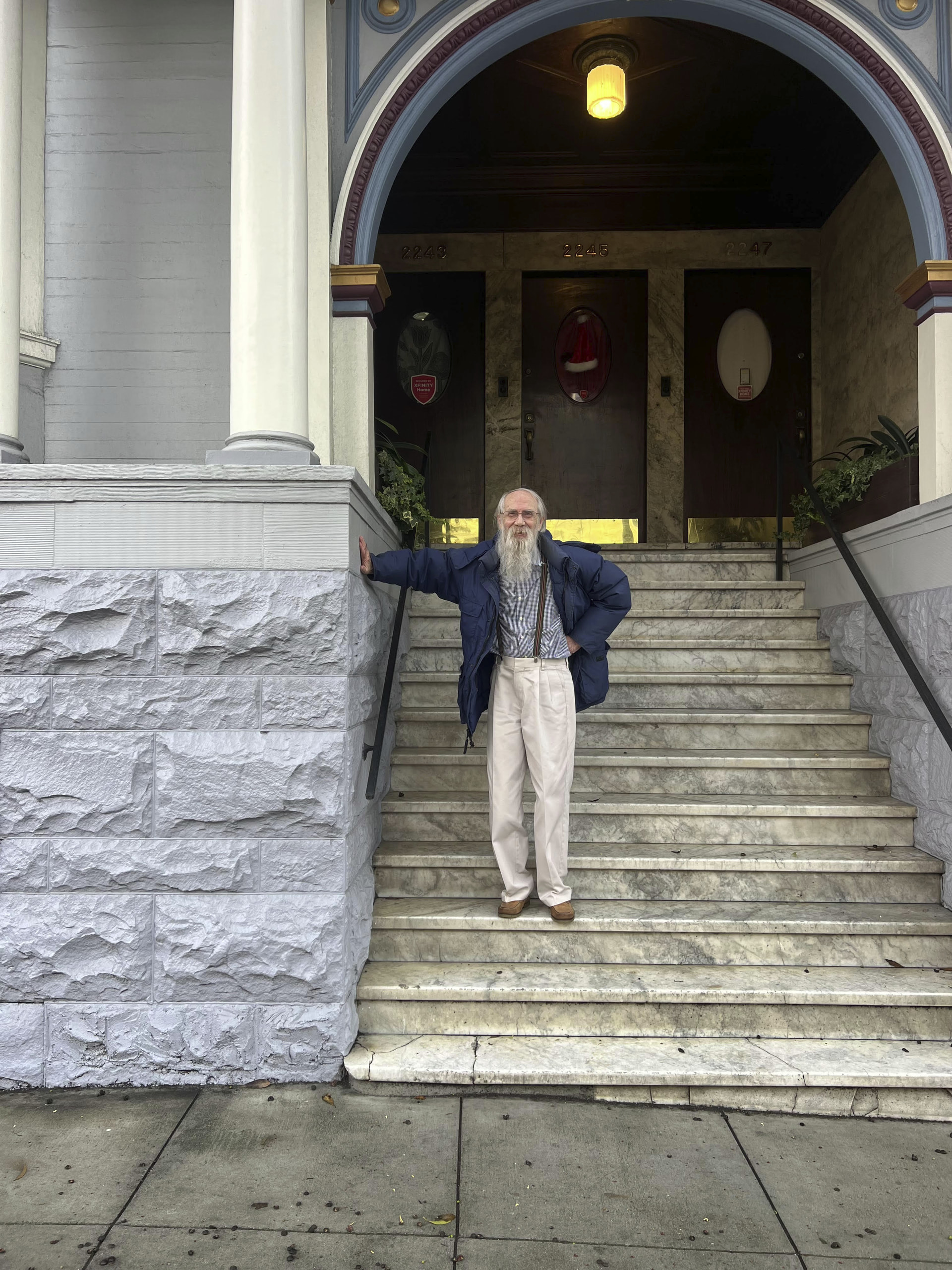
The photograph above shows the building where I lived in the mid-1970s at 2243–2247 Fulton Street in San Francisco, across the street from the University of San Francisco campus. At that time the building was being used as an intentional Christian household connected with the St. John the Baptist Catholic Charismatic Renewal community. Their chapel stood less than half a block away, and the rhythm of prayer meetings and fellowship shaped much of our life together.
The building itself had once been an apartment house. Each of the three floors had the same floor plan and its own front-door entrance from the street, which is why the doors in the photograph are numbered 2243, 2245, and 2247. In the middle of each floor there was also a back door that opened onto a stairwell connecting all three floors and a basement level, which was actually at street level behind the building.
When our household took over the building, the first floor became the communal area with the kitchen and dining space. The second floor held the men’s rooms and the third floor the women’s rooms. Thirteen of us lived there—seven adult women, four adult men, and two boys, the son and grandson of the oldest woman in the household. I was the only non-Catholic. I am quite sure I was invited at the request of that oldest woman, who had long been like an older sister to me.
Our house often became a place where people gathered after the charismatic prayer meetings. There would be open-house refreshments, conversations stretching late into the evening, and the easy fellowship that grows when people linger together in shared faith.
During our first Lent together we decided to observe Maundy Thursday with a Christian Passover meal. I had found a small, very thin booklet at Cokesbury Bookstore—something like A Christian Passover—that outlined a Christian adaptation of the Passover liturgy. Christian Passover seders were becoming fairly popular in church circles in the 1970s as people rediscovered the Jewish roots of the Last Supper. We followed the booklet’s pattern as best we could, preparing the foods it suggested and moving through the prayers and readings around the table.
Word spread through the community, and we invited a limited number of adults who did not live in the house to join us. We sold tickets to help cover the cost of the meal, and by the time the evening arrived more than forty people had gathered.
An adult man from the community who worked as a restaurant cook took charge of the lamb, preparing it in the kitchen on the first floor. Because so many people were attending, we set up the meal in the large front room on that same floor. Long folding tables and rows of folding chairs were brought in, turning what was normally a living room into a dining hall filled with people.
As we moved through the liturgy together, the meal followed the pattern of the traditional Passover. I remember especially the four cups of wine, and how the third cup was identified as the cup of redemption, linking the ancient Passover story to the words of Jesus at the Last Supper. At one point we also washed one another’s feet, recalling the moment in the Gospel when Jesus washed the feet of his disciples. The combination of the meal, the prayers, and that simple act of service gave the evening a sense of solemnity and warmth that has remained vivid in my memory.
When I participate in the Lord’s Supper now, I remember the Passover meal Jesus shared with his disciples, but I also remember that Maundy Thursday in the house on Fulton Street—the front room filled with tables and people, the lamb coming from the kitchen, the cup of redemption raised in the liturgy, the washing of feet, and the fellowship of a community that had intentionally chosen to live its faith together. The bread and cup remind me not only of Christ’s sacrifice but also of that moment when remembrance, service, and community came together around a shared table. For me the Eucharist has never been only a doctrine or a ritual. It carries with it the memory of that household and the grace that seemed to fill that season of life.
2 Likes
Miekhie, one additional observation about the Lord’s Supper that may help explain why that Maundy Thursday meal has continued to shape how I think about it.
First, about the word “remembrance.” In modern English we often hear that word as if it simply means thinking back to something that happened long ago. But the biblical word used in the New Testament carries a richer sense. It refers to a ritual remembrance, an act in which God’s saving work is recalled in a way that makes it present and meaningful for those participating.
Seeing the structure of the Passover meal helped me understand that better.
The Passover liturgy includes four cups of wine, each with its own meaning. The third cup is traditionally called the cup of redemption. In the Christian Passover liturgy we used that evening, that cup was explicitly connected with the moment in the Last Supper when Jesus said, “This cup is the new covenant in my blood.”
What struck me was that Jesus was not inventing a ritual out of nothing. He was taking the Passover liturgy his disciples already knew and filling it with new meaning centered on himself.
So when he said, “Do this in remembrance of me,” I have never understood that as merely recalling a past event in a mental sense. Sharing the bread and the cup becomes a way of participating again in the saving act that the Passover—and then the Last Supper—was proclaiming.
That understanding has stayed with me ever since that Maundy Thursday meal on Fulton Street.
4 Likes
If and when you read the narrative I just posted, what do you think I think?
- I suspect, but do not know, that those people who were at that Christian Passover that I described above carried and carry as vivid a memory of it as I do now.
1 Like
I, personally, am backing away from forum participation for this reason. Once it takes on that “A.I. polish” it loses the embodied human conversational tone (with inherent personal quirks of writing and ways of speaking) and then it simply stops being an engaging and ‘real’ discussion board for me. Not to mention the typical voluminous AI output that is visually hard to machete through.
But that’s probably just me…
1 Like
Yes. As I noted at one point, it can be validly – and better – translated as “as a memorial sacrifice”.
It is a symbol in the ancient sense, something which conveys that which it portrays.