Ross takes the text seriously and emphasizes the importance of studying all 66 books of the Bible in order to understand a topic. He finds, for example, that there is more information regarding the creation events in Job and Psalms then you can find in Genesis. I am sure he will take the same approach with the flood.
2 Likes
I appreciate your commentary/concerns David… almost missed this as I didn’t get a direct reply.
The same can be said for the flooding of the Persian Gulf, Caspian Sea or Black Sea. I don’t oppose the idea of a real regional flood in Mesopotamia that actual people like Noah, his family and livestock survived on a boat of some kind. I see this though as a kind of flashback or reverse foreshadowing of a much earlier event that the flood really represents.
To see where I’m coming from, we need to look at what I have previously said about Noah:
This date of 373 mya is based on my timeline counting back from the time of Christ (Issac being His type in Genesis). All the begats multiplied by 365k years based on 2 Pet 3:8 arrive at this number. Originally I had 362 mya for the birth of Noah (Tetrapods) but needed to add back in the omitted postdiluvial Cainan (extinct Multituberculates) that was correctly included in the genealogy from Luke.
- Luke 3:35-36 the son of Serug, the son of Reu, the son of Peleg, the son of Eber, the son of Shelah, the son of Cainan, the son of Arphaxad, the son of Shem, the son of Noah, the son of Lamech,
The Greek Septuagint correctly included Cainan in the Genesis genealogy but incorrectly added 100 years to many of the ages from the original Hebrew. Cainan was 130 when he begot Shelah (Therians) in the Septuagint, so the corrected age should be 30. We then take 11 million (30 x 365K) and add it on to the 362 million to arrive at 373 mya for birth of Noah.
Noah was 502 (or about 500) when he begat Shem (Mammals) approx 190 mya (502 x 365K = 183M) , and then there was another 100 years to the beginning of the Flood at 154 mya (100 x 365K = 36.5M). Subtract the 120 year warning (120 x 365K = 44M) from that and we arrive at the Triassic-Jurassic Extinction Event ~ 200 mya (44 + 154 = 198 may), or you can add the Flood timing (1 day equals 1 year) of 240 years (40 + 150 + 40 + 7 + 3), (240 x 365K = 88M) and arrive at the dinosaurs, Cretaceous-Paleogene Extinction Event 66 mya (154 - 88 = 66 mya). All these numbers line up amazingly well.
Correct. The dinosaurs are the Nephilim (giants) destroyed with the flood. Noah was a tetrapod, a small burrowing animal (the Ark is the burrow made of ‘gopher’ wood). From AI overview:
Engineering feats: Some animals, like pocket gophers, build complex tunnel systems with features like downward-sloping tunnels and low-lying “sumps” to collect and trap water away from living spaces.
I believe Noah having his nakedness uncovered in his tent, his intoxication and cursing Canaan is a parallel account with the latter portion of the flood. I already talked about the raven (shrouding the skies with the meteor impact) but didn’t describe the dove.
- Gen 8:9 But the dove found no resting place for the sole of her foot, and she returned into the ark to him, for the waters were on the face of the whole earth.
The word dove (3123. יוֹנָה yonah) comes from the root word yayin (3196. יַיִן) wine (by implication) intoxication. The dove initially couldn’t find its footing, and so its struggle I believe represents avian dinosaurs struggle to adapt. Non-avian dinosaurs go extinct while avian dinosaurs are subdued (intoxicated, a dove is a subdued creature), evolving into modern birds.
- Gen 9:20-21 And Noah began to be a farmer, and he planted a vineyard. Then he drank of the wine and was drunk, and became uncovered in his tent.
Noah is in his “tent” which I believe again represents a burrow and his intoxication from his wine represents his asphyxiation from low oxygen while trapped during a long flood event. When Ham (Theropods) tries to enter, Noah’s predicament, his curse or subduing (unconsciousness from asphyxiation) is transferred to Ham’s son Canaan (name meaning subdued, brought into synchronicity).
Part of the meaning of Ham is “hot” which could be a reference to the warm-bloodedness of theropods. From the verb חם (ham), to be hot, or the verb חמה (hmh), to protect or surround. With this second part, there is some sense of being inclined in this protective stance, or bowing in shame.
When looking at the meaning of the names of the three brothers together:
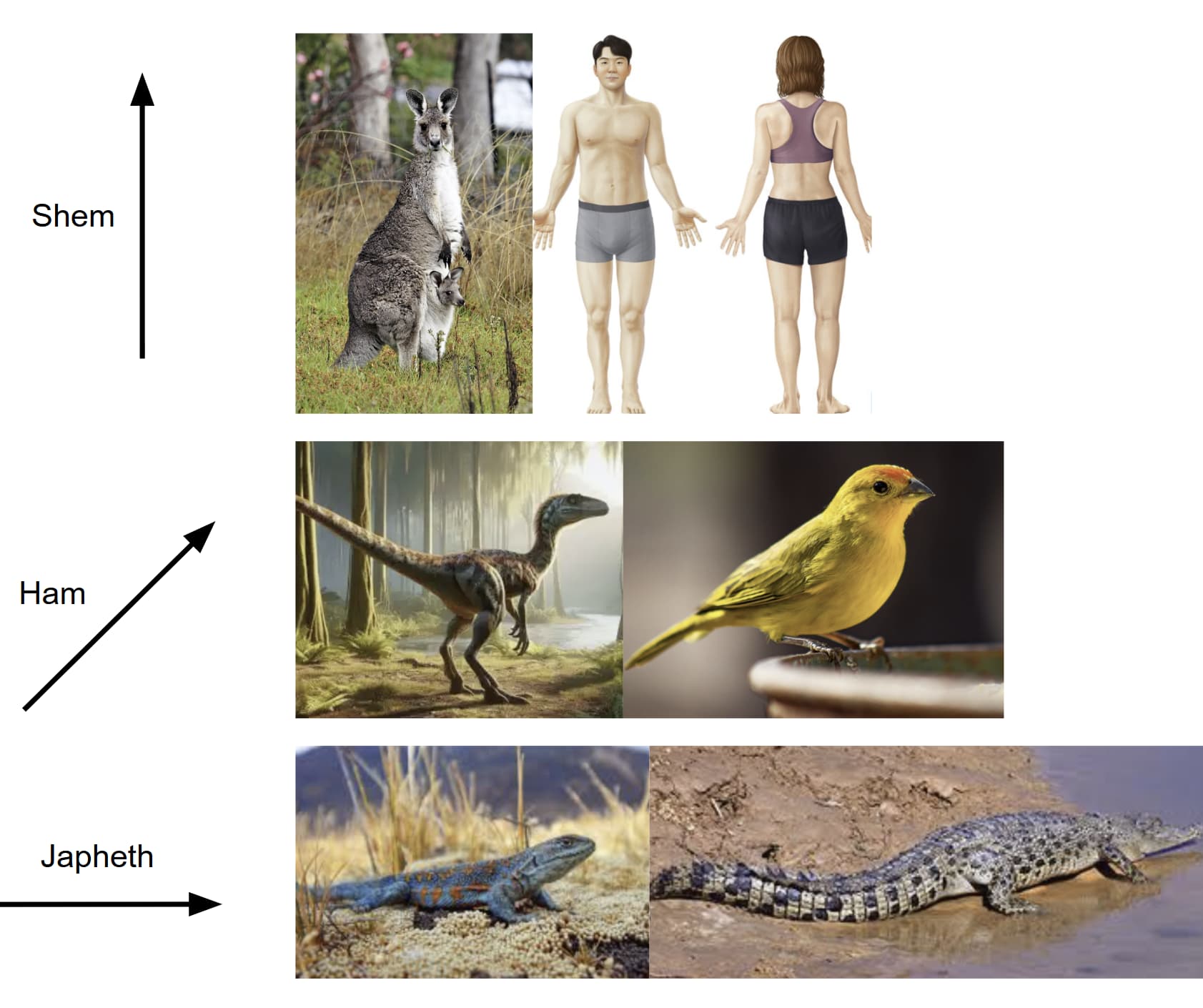
Shem (upright) represents Mammals, Ham (to incline) represents Birds, and Japheth (to expand, spread flat) represents Reptiles. This of course is a generalization, but along with Noah (inclusion of amphibians), all land animals are represented by the the names of those entering the Ark.
Another thing to note before we move on from this, the Genesis account does not technically say that it was the flood that destroyed all life not on the Ark. This gives room for the idea that it was the meteor impact alongside, at the end of the flood.
- Gen 9:11 Thus I establish My covenant with you: Never again shall all flesh be cut off by the waters of the flood; never again shall there be a flood to destroy the earth.”
Actual word order puts “again” after “cut off by the waters”.
Meaning of again (5750. עוֹד od) substantive a going round, continuance, but used mostly as adverb accusative still, yet, again, besides
It could read more like this:
- Gen 9:11 Thus I establish My covenant with you: Never shall all flesh be cut off beside the waters of the flood; never again shall there be a flood to destroy the earth.”
God is not just promising not to destroy all flesh again by a flood… He is promising not to have them witness the destruction of the earth ‘beside’ the waters in a ‘boat’.
Another passage:
- Gen 7:4 For after seven more days I will cause it to rain on the earth forty days and forty nights, and I will destroy from the face of the earth all living things that I have made.”
God destroyed everything on the face of the earth, not protected underground in a burrow or something similar. There was no place for dinosaurs to hide. God (not the flood) did it with a meteor at the same time or alongside the flood.
Another passage that may make it seem like the the flood itself that killed:
- Gen 7:20-23 The waters prevailed fifteen cubits upward, and the mountains were covered. And all flesh died that moved on the earth: birds and cattle and beasts and every creeping thing that creeps on the earth, and every man. All in whose nostrils was the breath of the spirit of life, all that was on the dry land, died. So He destroyed all living things which were on the face of the ground: both man and cattle, creeping thing and bird of the air. They were destroyed from the earth.
All flesh died “that moved on the earth”, that was on the “dry land, died”. God “He” destroyed them “from the earth”, not “destroyed by the flood” or that the “flood killed them”.
I do also like what @LikeHim suggests that the shrouded skies are part of the flood:
Emphasis mine. And this is what the raven represents.
- Gen 8:7 Then he sent out a raven, which kept going to and fro until the waters had dried up from the earth.
(6158. oreb) a raven (from its dusky hue) from arab. A primitive root (identical with arab through the idea of covering with a texture); to grow dusky at sundown – be darkened, (toward) evening.
This gets interesting. Ararat may mean “mountain of decent” or “the curse reversed”. Could this mean that what the Ark landed on was descended, possibly even underground? Another possible reference to being buried in a burrow, the ‘reverse’ of landing on a mountain top surrounded by the sea. But lets not dismiss that this is still a mountain, or maybe its an island.
Looking again at this map from the peak of the flood 85 mya:

This island has about the same dimensions as the Ark. It is surrounded by water and has a width that measures about 1/6th of its length… same as the Ark (50x300).
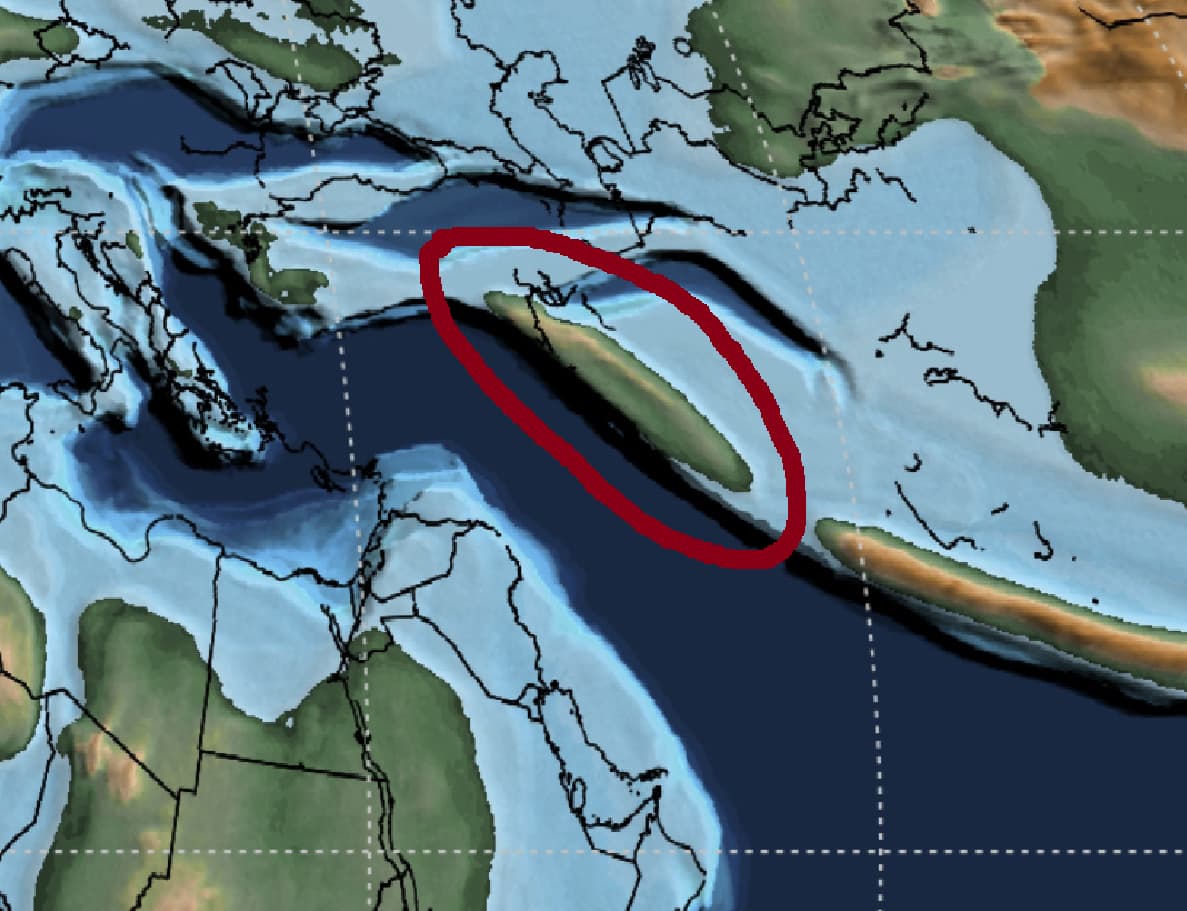
This same piece of land is where the mountains of Ararat are uplifted when Africa and Asia later collide. The Ark lands in place!
All birds are bipeds and most mammals are quadrupeds. Shem and Ham would be the other way around.
1 Like
With todays’ investigation with instruments We find some evidence of what truly happened. The Bible Genesis is written by God giving direct information to the Persons Brain who wrote it. God did not reveal what truly happened in History to the writer of Genesis.
This is why We have to Believe or then We began to doubt and investigate the truth. Mans history books indicate no involvement of God and some History is Fake News. The Bible is full of Gods’ perceived Involvement.
To read God took two copies of creatures in the Ark is impractical. Survival of creatures is more like it. One point that is fundamental, God is the Creator of all the DNA Recipe for creatures including Us Humans. Evolution/Mutation is Just God or His Angels adjusting The DNA each Creature to be able to survive and multiply in the environment it lives in. We Humans are God’s Highest Creation and We have perception of a God and the ability to Pray to God. God also made Our Brains for God to be able to communicate to Us through Thoughts and Commands as an interface. I have been giving Thoughts and Commands as a witness that this has happened to Me. This happened to Abraham, Moses, Jesus, and anyone can realize if God is talking to them in their Brain. Sometimes people say the Devil made Me do it.
By the way, CRISPR is tinkering with DNA, Bio- engineering/Plant Hybrids are DNA adjustment. We are now tinkering with God’s Creation.
I am writing this for I am a True Believer and a witness, some may think I’m nuts.
1 Like
These are all generalizations and there are of course a few outliers like the ostrich having straight legs or the platypus with splayed legs.
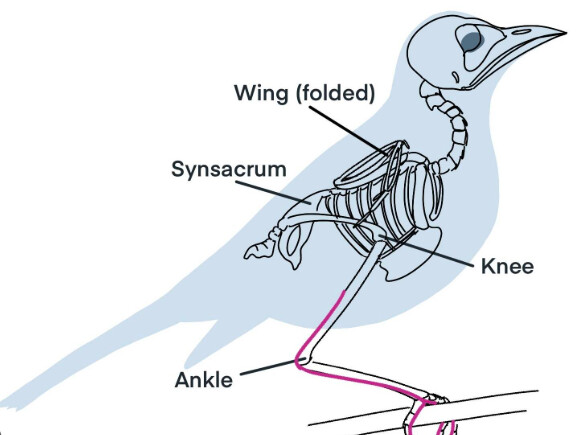
Its not about if they are biped or quadruped but their posture. With birds their head and whole body is inclined or leaning forward from their feet. When a lot of birds stand they are really bent forward at the knee. We only see the lower part of their legs because the upper part is hunched into their body for balance.
With reptiles their legs are splayed to the side and in some cases become completely useless like what happened with snakes and legless lizards. But mammals have their legs completely straight, biped or not. The giraffe and elephant are the two tallest animals on land while being quadrupeds. Oh and BTW, “Bigfoot” is just a bear walking on two legs.
Shem meaning of ‘upright’ may also be pointing the future direction of mankind toward humans and God giving us dominion over the earth. Canaan mentioned earlier represents the subduing of theropods like the T-rex who previously ruled the earth. Canaan as a place name means “land of purple”, purple being the color of royalty or rulership. Occupying Canaan then represents rulership over the whole earth.
The rulership of the land of Canaan was vacated after the flood and so God calling Abraham to the land of Canaan, his journey there represents the rise of primates (Abram) and specifically humans (Abraham) to govern the earth.
Humans have been tinkering for a while with domestication and selective breeding. We also do a little ‘engineering’ of our own when we choose a mate. Cut down a forest? Tinkering too. Release heavy metals while mining? Tinkering.
3 Likes
Where is that in the text?
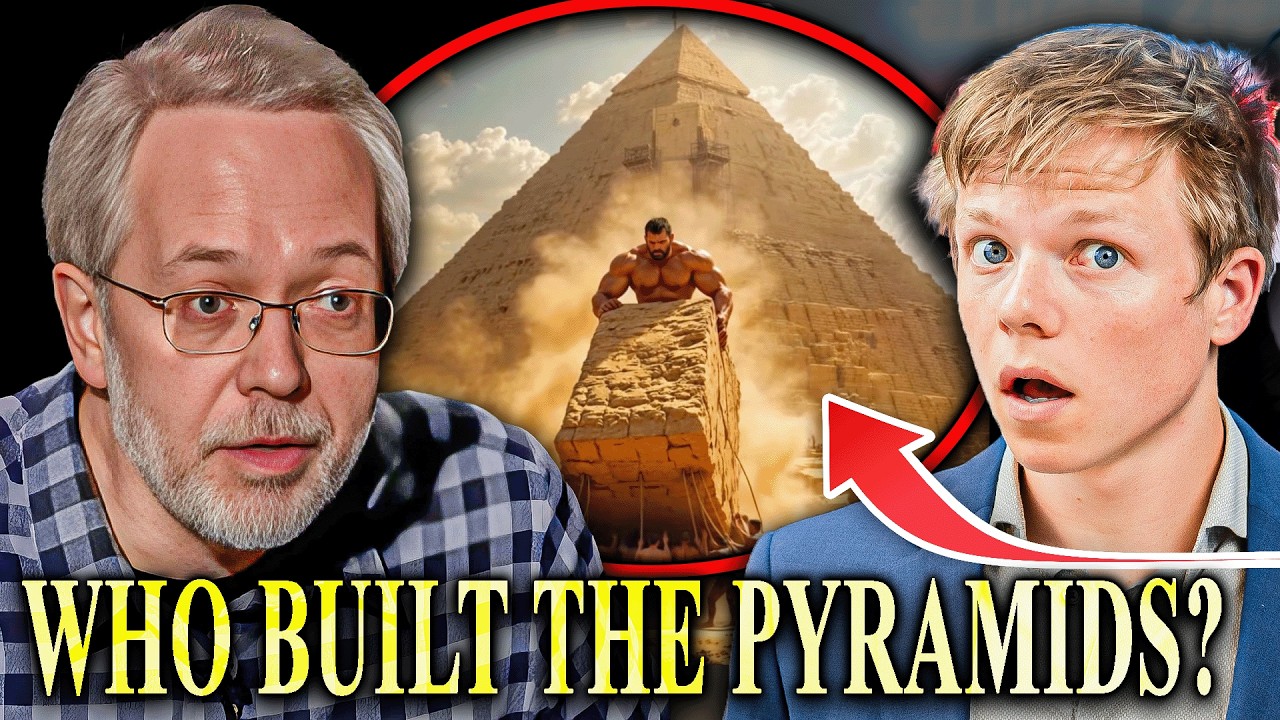
This should be mandatory watching:
1 Like
There are no sites of civilization; settlement and less, yes.
Why should this be mandatory watching? For whom?
The hand of the finger pointing liar and idiot has three times as many pointing back.
Anyone who wants to understand the Bible, including the Flood account.
As long as he separates his religious beliefs from knowledge. But from the get go, he’s religious.
You’ve shifted from showing a picture of a kangaroo and a human standing upright to saying that mammas have their legs completely straight.
But apart from shifting from body posture to leg posture after it being pointed out that most mammals hold their bodied horizontally, what you’ve shifted to simply isn’t true. You can see in your own picture that kangaroos don’t stand with straight legs. Nor do rabbits, deer[1], jerboas, echidnas, walruses, monkeys, bushbabies, wallabies, wombats, armadillos, pangolins, mice, hedgehogs, and many many more.
Hardly any mammals stand with their legs completely straight. Not even giraffes. What you are calling ‘generalisations’ are actually rare exceptions.
Stop trying to make reality correspond to your ideas and instead make your ideas correspond to reality.
The leg below the knee may be straight, but not above the knee. ↩︎
1 Like
Here’s a structured Summary and Critique of The Bible Unearthed: Archaeology’s New Vision of Ancient Israel and the Origin of Its Sacred Texts by Israel Finkelstein and Neil Asher Silberman.
Summary
1. Purpose and Approach
The authors bring together decades of archaeological discoveries in Israel, Egypt, Jordan, and Lebanon to reassess the historical reliability of the Hebrew Bible. They argue that many biblical stories—patriarchal wanderings, the Exodus, Joshua’s conquest, and the Davidic–Solomonic empire—are not literal history but later ideological constructions.
2. The Patriarchs and Exodus
-
Patriarchs: Abraham, Isaac, and Jacob’s stories reflect Iron Age realities, not the Middle Bronze Age. There is no archaeological evidence of their migrations or settlements.
-
Exodus: Egyptian fortifications and archaeological silence in Sinai undermine the idea of a large-scale Israelite escape. No evidence supports forty years of desert wandering.
3. Conquest of Canaan
The book critiques Joshua’s conquest narrative. Archaeology shows continuity at many Canaanite cities supposedly destroyed, while others were destroyed centuries earlier or later. The rise of Israelite villages in the highlands suggests an internal social transformation rather than an external invasion.
4. Rise of Israel and Judah
-
Early Israelites were likely former Canaanite pastoralists settling down, not invading outsiders.
-
The great “United Monarchy” under David and Solomon is depicted as a later literary exaggeration. Jerusalem at the time was a small hilltop town, incapable of supporting a vast empire.
-
Instead, the Omride dynasty (9th century BCE) was the true builder of monumental cities, palaces, and water systems.
5. Josiah’s Reforms and Biblical Composition
The authors emphasize King Josiah of Judah (7th century BCE) as central. Archaeological and textual evidence suggests much of the biblical history was compiled and shaped under his reign to support his religious reforms and territorial ambitions.
6. Exile, Return, and Memory
After the Babylonian exile, returning elites used scripture to unite the community, preserve identity, and project theological meaning onto the past. The biblical text became less a historical chronicle than a charter of identity and faith.
Critique
Strengths
-
Archaeological Rigor: The book systematically uses excavation results to challenge traditional historical readings, making it accessible to both scholars and general readers.
-
Historical Contextualization: By situating biblical composition in the political and cultural milieu of the late monarchic and post-exilic periods, it highlights how scripture functioned as ideological literature.
-
Clarity and Accessibility: Finkelstein and Silberman write in a vivid, engaging style that makes complex archaeological debates approachable.
Limitations
-
Minimalist Leanings: Critics argue the book leans toward “biblical minimalism,” dismissing too quickly the possibility that some traditions preserve authentic historical memory.
-
Overemphasis on Josiah: While Josiah’s reign was clearly pivotal, the book arguably overstates his centrality in shaping the biblical narrative, underplaying the role of exilic and post-exilic editors.
-
Reception Bias: The authors sometimes present scholarly debates as settled (e.g., on the historicity of David/Solomon), though other archaeologists (like Amihai Mazar) argue for more nuanced reconstructions.
-
Archaeology’s Silence Problem: Absence of evidence is often treated as evidence of absence; yet nomadic or small-scale groups may leave few traces.
Broader Impact
-
The book significantly influenced both academic and popular discussions of biblical history, challenging fundamentalist readings while affirming the Bible’s enduring cultural power.
-
Its synthesis of archaeology and historiography opened new debates about Israel’s origins, biblical composition, and the role of memory in shaping sacred texts.
 In short: The Bible Unearthed is a bold reinterpretation of Israelite history, arguing that the Bible is more a theological and ideological work of the Iron Age and exile than a literal chronicle. It succeeds in reframing the debate but is sometimes criticized for overstating its case and underplaying alternative interpretations.
2 Likes
Its a bit of both. Leg posture is going to effect body posture and vice versa. The kangaroo is in an upright tripod stance, standing plantigrade (on its heels) with support from its tail. I’m sure standing on our heals helped us gain our vertical stance and I think is a callback to God’s prophetic message in the Garden:
- Gen 3:15 And I will put enmity
Between you and the woman,
And between your seed and her Seed;
He shall bruise your head,
And you shall bruise His heel.”
Its with our heel (ankle joint) that we symbolically stomp on the head of the serpent (Satan), and can walk upright before God.
There are a number of mammals that are plantigrade including humans, great apes, bears, primates including lemurs, racoons, weasels, badgers, otters, skunks, kangaroos, opossums, meerkats, pangolins, rodents, hedgehogs, armadillos.
And you ignore the next thing I said:
God says to Abram (representing great apes, and a descendent of Shem) as He gives him his new name Abraham (humans):
- Gen 17:1b-8 “I am Almighty God; walk before Me and be blameless. And I will make My covenant between Me and you, and will multiply you exceedingly.” Then Abram fell on his face, and God talked with him, saying: “As for Me, behold, My covenant is with you, and you shall be a father of many nations. No longer shall your name be called Abram, but your name shall be Abraham; for I have made you a father of many nations. I will make you exceedingly fruitful; and I will make nations of you, and kings shall come from you. And I will establish My covenant between Me and you and your descendants after you in their generations, for an everlasting covenant, to be God to you and your descendants after you. Also I give to you and your descendants after you the land in which you are a stranger, all the land of Canaan, as an everlasting possession; and I will be their God.”
The land of Canaan (Israel) again represents our dominion over the entire earth. The Almighty God is not just the God of Jews in Israel but of the entire human species.
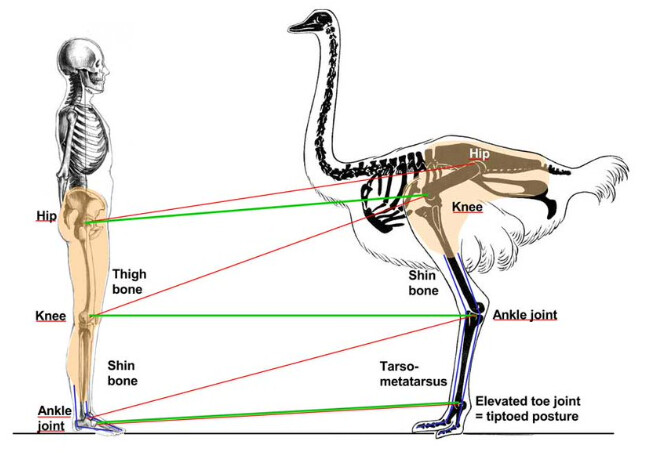
Not completely straight, but mammals have straighter knees. Again the comparison is with birds that have their knees tucked up into their body like they are crouched in a submissive posture. Even the ostrich that appears to have a more vertical stance is like this.
Other birds:
The summary is overgenerous in crediting Finkelstein’s approach with archeological rigor. 14C dating and dating variations in the earth’s magnetic field show that many of the major building projects were from the 10th century BC, not the 9th, thus dating from the United Monarchy.
The magnetic field has many small variations in exact strength and direction. Objects such as bricks and pottery have magnetic grains in them. When heated hot enough, that resets the magnetic field of the grains to align with the earth’s field at that time. In archaeological contexts, the heating might be with the firing of the brick or pot, or it might be reheating thanks to one of the many visitors to a region who applied lots of heat to a whole town at once. Of particular relevance to Finklestein’s minimalist errors, quite a few buildings got destroyed and/or reheated around 930-920 or so, when Shishak decided he had better uses for Solomon’s wealth than Rehoboam and Jeroboam I did.
3 Likes
Hugh Ross’ book has come out and I and the Bible teachers at my church were the first to interview him on this book. Watch it online!
Is there something specific you want to talk about? I think Ross either overstates his position or gets some things quite wrong, but he’s been making some arguments for years.
- Ignoring effective population size calculations that don’t show a global extreme bottleneck, showing population sizes of like 10,000+ going back some 800,000 years. There is some evidence for a bottleneck of just over a thousand around 900,000 years ago, though.
- Misstating Y Chromosome Adam and Mitochondrial Eve (they do NOT need to be related, nor the only two humans alive)
- There are lots of things we don’t have, like a synchronous flood layer between older archaeological sites and younger ones that should be obvious everywhere humans lived before the time of this flood. Scientists who actually study these things would have certainly noticed that! Here’s a paper describing some sites that would have been “before the flood” you can look at for some other references in the introduction.
However, this being said, we can say he deserves credit compared to the approach many other Christians take:
-
Taking the text seriously while engaging scientific evidence
-
Attempting to move beyond unproductive YEC vs. atheist dichotomy
-
Recognizing that genre and language matter in interpretation
At the end of the day, I and some other people here might say something like: A more promising approach might acknowledge the flood account as theological history—rooted in real catastrophic flooding events in Mesopotamian cultural memory but using literary conventions to communicate theological truths about God’s justice, mercy, and covenant faithfulness, without requiring every detail to be scientifically reconstructable.
4 Likes
It seems to me that Hugh Ross’ greatest strength is that he actually provides original material, yet his views (at least on Noah’s Flood) seem more in keeping with the church fathers, or in other words, more of what Christians believed before the creation vs. evolution debate. It seems to me that insisting on a global flood that reshaped the world’s landscapes not only is very difficult (if not impossible) to prove scientifically, but it also adds to the Biblical account. Scripture never says the flood created the world, it says it destroyed it (in the sense of the world of humanity).
On the other hand, I feel the Black Sea hypothesis (which would be the runner up to Dr. Ross’ position) seems in error of where early civilization was settled. I don’t see how a flood there would have made such an impression on early humanity.
Having said all that, I feel the greatest challenge Genesis 1-11 faces (as far as how both young earth and old earth creationists treat it) is the issue of population bottlenecks. But I do have faith that these issues can be resolved and the possibility of a genealogical Adam and Eve that came out in the last two decades seems to be the beginning of some interesting possibilities there.
1 Like
Is “TL;SFL” a legit acronym? (Too Long; Save For Later)
I agree, despite a not-rare argument that a pre-immersed Black Sea basin would have been the cradle of civilization.