As expected.

Richard
What do you think these sides are? The idea that the tempo and mode of evolution can change in time and between lineages is already a part of the modern theory.
Is this AI babble? There are words there, but I can’t figure out what they are meant to say.
1 Like
Yes, random deviations are a basic method of change (though there are others, such as the reshuffling that happens from creating one genome from two parents), but no, even focusing on that method alone doesn’t entail small steps. Chromosome duplications or reversals of the reading frame (reading parts of the code backwards) are not small steps, though they are random deviations. Most large steps have severe negative consequences (often death), but that gets to the other part of evolution – the part where those random deviations are filtered, both randomly and non-randomly by what works to create a reproducing organism.
Sure. I think everyone gets that. We just don’t find it interesting. Yes, if there’s such thing as an impossible change that evolution can’t produce, and if that thing is present in living organisms around us, then obviously evolution can’t explain it. But surely you can see that this assumes the conclusion? If you define IC as what evolution can’t do, then obviously nobody can show that evolution can do it. But according to definitions that aren’t circular – where IC is an arrangement of parts that do something that breaks without any one of them – evolution can easily be shown to create such systems: theoretically, analogically and observationally.
“If you would just share my premise that God doesn’t exist, you would see that obviously God doesn’t exist.” None of the atheists here would make such a vaccuous argument.
“If you would just share my premise that there are some changes that are impossible for evolution, you would see that they couldn’t come about through evolution.” How is this more meaningful?
2 Likes
A wonderful assertion, but, the answer to IC is to assemble each element and then join them together, and I still ask how you are going to do that within the limitations of natural procreation IOW the theoretical solution seems to ignore the context of the problem.
Logical fallacies aside. Isn’t that how science starts? With an unproven or suggestion? But, and here’s the rub, evolution has no motivation to find or even acknowledge ICs. In fact, they would cause a major headache that could even be terminal. Best ignore or dismiss it.
Richard
You are ignoring the possibility that those elements change through time. What that element looks like today may not be how it looked in the past. This is illustrated in the evolution of the irreducibly complex mammalian ear where two of the bones in the middle ear started out as lower jaw bones.
So we already have an IC system, the mammalian middle ear, where the intermediate steps are seen in the fossils. We can observe IC systems evolving in the fossil record.
IC systems were already acknowledged 100 years ago, and they were predicted to be an expected outcome of evolutionary mechanisms.
“… thus a complicated machine was gradually built up whose effective working was dependent upon the interlocking action of very numerous different elementary parts or factors, and many of the characters and factors which, when new, were originally merely an asset finally became necessary because other necessary characters and factors had subsequently become changed so as to be dependent on the former. It must result, in consequence, that a dropping out of, or even a slight change in any one of these parts is very likely to disturb fatally the whole machinery; for this reason we should expect very many, if not most, mutations to result in lethal factors …”
–Muller, H. J. (1918) “Genetic variability, twin hybrids and constant hybrids, in a case of balanced lethal factors.” Genetics 3:422-499.
All biologists recognize that there are IC systems in biology.
5 Likes
No I am ignoring nothing! You are just being stubborn and unthinking.
Time does not solve every problem!
The mammalian ear is not irreducible. You can hear with just an ear drum!
You seem to misunderstand what irreducible means
Richard
Physician, heal thyself.
Yes, it is.
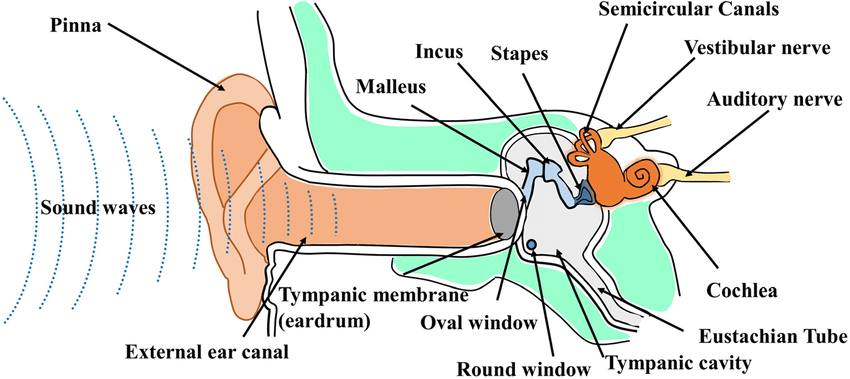
If you remove any one of those three middle ear ossicles you don’t get sound transmission to the inner ear. Damage to these bones or their absence can lead to profound deafness.
Nope. If you remove one of the middle ear ossicles the system stops working. It is irreducibly complex, and we can see the step by step evolution of this IC system in the fossil record.
4 Likes
Codswallop.
if you can make it, it is not irreducible.
An ear will function with just a drum. One bone, two bones, or three, It still functions. It is not irreducible.
if you want to change the rules go ahead But you are only fooling yourself.
Richard
WHAT???
Otosclerosis (oh-tuh-skli-ROH-sis) is a condition that causes hearing loss. The term “oto” means “of the ear” and “sclerosis” means “abnormal hardening of body tissue.”
Otosclerosis happens when irregular bone remodeling/growth occurs in your middle ear or, more rarely, your inner ear. Bone remodeling is a lifelong process in which existing bone tissue repeatedly restores itself. In otosclerosis, irregular bone remodeling interferes with sound’s ability to travel through your ear.
People with otosclerosis can develop mild to severe hearing impairment. The condition rarely results in total deafness. It typically affects both ears, but one ear is usually worse than the other.
I guess the bacterial flagellum isn’t IC either since bacteria do just fine without them?
3 Likes
T, Richard is using the “something that can’t evolve” definition of IC. It’s something that, by definition, cannot evolve. So if you accept that IC systems, by his definition, exist, then any attempt to show how evolution could have brought them about just means that you misidentified them as IC.
It certainly has in this thread, and the other IC thread. You claim that some change is impossible for evolution, then scientists post evidence that shows how that change was bridged by evolutionary forces. And then the thread starter comes in and yells “Stop it with all that science! Just accept the premise that there are some systems evolution can’t create, and believe without evidence that living things possess those systems!”
And round and round it goes.
4 Likes
It’s not. The answer to IC is to start with a non-IC system and then modify the elements within it until the system becomes IC.
You have been told this so many times you have no excuse for continuing to claim otherwise.
2 Likes
Ahh yes, the circular definition. So it doesn’t have anything to do with being irreducible or complex, just unevolvable. I have to wonder why they even bother with the words irreducible or complex since they are no longer part of the definition.
It is the infamous problem of someone not understanding why other people are not convinced by an argument they themselves are convinced by. Apparently, scientists are wrong for demanding evidence and logically sound arguments. Instead, scientists should just blindly accept what non-scientists tell them is true and not question it.
6 Likes
[citation needed]
2 Likes
i have never made any bones about it. That was the intention of ICs when coined.
If science wishes to change it then , so be it. They will forever deny what an IC is.
See above
It is not circular. It is.
Try a frog.
Richard
If we show the step by step evolution of an IC system does it cease being an IC system?
Both frogs and reptiles have a single middle ear ossicle. Mammals have three middle ear ossicles, and we can see how those two additional bones evolved from pre-existing jaw bones.
3 Likes
That’ll do. Technically the ear includes the outer flesh, also absent in non mammals. That is enough for it not to be irreducible.
If you don’t believe the biology, believe the physics. the clue is in the name
Ear Drum
It never was one.
Richard
Given your definition, there are no IC systems in biology to consider. Good. Ears, flight feathers, eyes, flagellum - all reducible. Now we can move on to productive activities and quit wasting time and energy on ID nonsense.
3 Likes

Of ccourse.
That is the whole point of this exercise.
There is none so blind as those who will not see.
But, of course, I cannot demonstrate the impossible and I have not the time or the energy to try and choose or describe one.
If you want to call that a win, be my guest.
Richard
I’m generally game for an exercise in programming simulations. I’d like to understand the point a bit better. At first, it seemed like an exploration of the evolvability of irreducible complexity (something I’ve explored previously via another simulation). But recent posts suggest that, in this context, the term is being defined such that if it evolves, it isn’t actually irreducibly complex.
So what exactly is the question being asked by this experiment? If the simulation is successful, what is the conclusion? If it is unsuccessful, what is the conclusion?
2 Likes