I don’t think it’s in the same category. That’s why we distinguish between natural evil and moral evil. I don’t know that I even believe things like disasters or genetic mutations or predation are truly evil. They cause harm and death. We are the ones who decided harm and death is evil. The world is the way it is in its goodness and beauty in part because tectonic plates moved and species went extinct and genes mutated. Harm and death is hardwired into the processes that bring about flourishing and life. So what I mean by nature being free is not that nature has choices or relates to God (maybe some animals do, I’m agnostic and uncommited to the idea that only humans and angels relate to their creator), I mean there is room in the way the natural world has been set up for harm and death as nature functions the way it is intended to function and promotes flourishing and life. So maybe the “best possible world” has harm and death as a part of its necessary cycles of life and goodness, there was no “perfect” world at one point that sin, death, and supernatural evil forces “ruined” or “broke.”
Okay. Thank you for the input!
This is part of the Theodicy issue: the creationists say that God decided to punish
humanity - - and the whole Universe - - because of the NATURAL “disobedience”
of 2 representatives of humanity.
Other denominations come up with a different solution: to forge humanity to God’s
liking, it was necessary to raise humanity up in such a world.
G.Brooks
Just curious, what makes that quote about Jesus so harmful?
Hmm, I don’t think so. Death is described in the Bible itself as the last enemy. One might infer that this refers to spiritual death only, but Jesus rose from the dead with His glorified body to show that all forms of death—both spiritual and physical—have been defeated.
We also know from Scripture that there will be no harm or death (at least for humans. I personally believe this will also apply to animals, but we can safely say that, at the very least, neither harm nor death will affect humans anymore) in the world to come. So I would say that these things are indeed evil even in God’s eyes; they are not simply something we have chosen to label as evil.
Yes. The question is whether it was supposed to be like this from the very beginning and we don’t have an easy answer to that.
This is interesting although this would imply that there are animals that could be damned. I don’t know, never heard about this.
That’s certainly one way to look at it. Alternatively, it may be a very imperfect—even evil—state of affairs that was permitted in order to bring about a greater good. It’s really difficult to arrive at a fully satisfactory answer.
Before I considered the idea (which I later discovered is supported by some theologians) that the angelic rebellion might be responsible for the brutality and suffering we observe in the natural world, I simply accepted natural evil—and the existence of laws such as the second law of thermodynamics—as the greatest mystery, the most profound and inexplicable one. However, that explanation provided me with a somewhat more satisfying (to me) answer.
What are your thoughts on some of the other explanations for suffering, like “God isn’t indifferent to it as he was Christ” or “God who loves us suffers along with us?”
I don’t have time for a full rundown on classical theology at the moment so I’ll offer this and a link.
It depends on how you understand it. If you take it to mean:
“Look, God is a moral agent who shares in our suffering. God feels our pain, God suffers alongside us” this troubling to me. Some newer forms of theism might agree with this, I do not. Fairness and rule-keeping are obligations binding moral agents who live under a shared standard of justice. God is not a moral agent in this sense. If it is meant to imply God justifies the brokenness of the world by taking his own medicine it is also false. These sound more like descriptions of Zeus or Quetzalcoatl than God to me.
Jesus was a divine person with two natures. We can talk about Jesus/God idiomatically but it goes in one direction:
Thomists use the rule of the communicatio idiomatum (the communication of properties). This rule states that because both natures belong to the one Person of Jesus Christ, you can predicate the properties of either nature to the Person, but you cannot predicate the properties of one nature to the other.
-
Correct: “God died on the cross.” (The human nature of Jesus died ).
-
Incorrect: “The Divine Nature died.” (God can’t die).
-
Correct: “God lived a morally perfect human life.”
-
Incorrect: "God, by His divine essence, is a moral agent
If you have been engaged primarily in internet arguments you may have missed an entire stream of Christian thought as theistic personalism seems to be the loudest today. But classical theism has been the most common throughout the history of there Church. For a primer on classical theism, go here.
Vinnie
But we all still die. So clearly physical death is part of the natural order still. Babies are still born into mortal bodies. So, yes, as Christians we place our hope in the Resurrection to immortal bodies and a New Creation that is somehow fundamentally different in ways than this one we inhabit, but I think the meaning of death being defeated is that the possibility of resurrection defeats death’s finality, not the idea that death is itself evil and must be ended. If we eat in the New Creation there will still be death. If our physical resurrected bodies have cells their will be death and renewal within our organism, even if we never age or get hurt or sick.
I believe that if God were indifferent to our suffering, He would not have assumed human form in Christ. In His human nature, He certainly suffered more than we can imagine.
Of this order of things yes, but Christ’s Resurrection is an anticipation of the world to come where death will have no place.
This is interesting, because I believe that everything good in this world will, in some way, be preserved in the world to come. That is why I see death as something profoundly evil. In the First Letter to the Corinthians, it is described as the last enemy, and in the Book of Revelation it is cast into the lake of fire. So yes, I believe there are strong reasons to consider death itself as evil.
In a sense, we even seem to know this instinctively. One of my earliest memories is of sitting in a highchair/babychair, crying because I had just learned that someone close to our family had died. I didn’t even understand that death was inevitable for everyone, yet the mere fact that someone had died struck me as a complete aberration. I was about two years old, with no real capacity for abstraction or speculation (and probably, at that age, with an IQ lower than that of an adult monkey) and yet I immediately perceived it as something wrong and was deeply disturbed by it.
It is, quite literally, my earliest memory—my next clear memories come from when I was around seven or eight years old.
First, to @BuffaloMax17 , things in space happen in very long time frames. Speculations about rogue black holes and massive coronal ejections aren’t laughable conspiracy theories, but how long before the event? The sun will eventually burn out. I’ll burn out long before that. Not a concern.
I don’t want to turn this into a Problem of Evil thread, but I agree with the distinction between “natural evil” and the evil done by humans. Christy, do you remember Jonathan Burke? (@gbrooks9 might remember him, since he frequented PS for a time.) He posted something a long time ago about “The Cost of Creation” and natural evil.
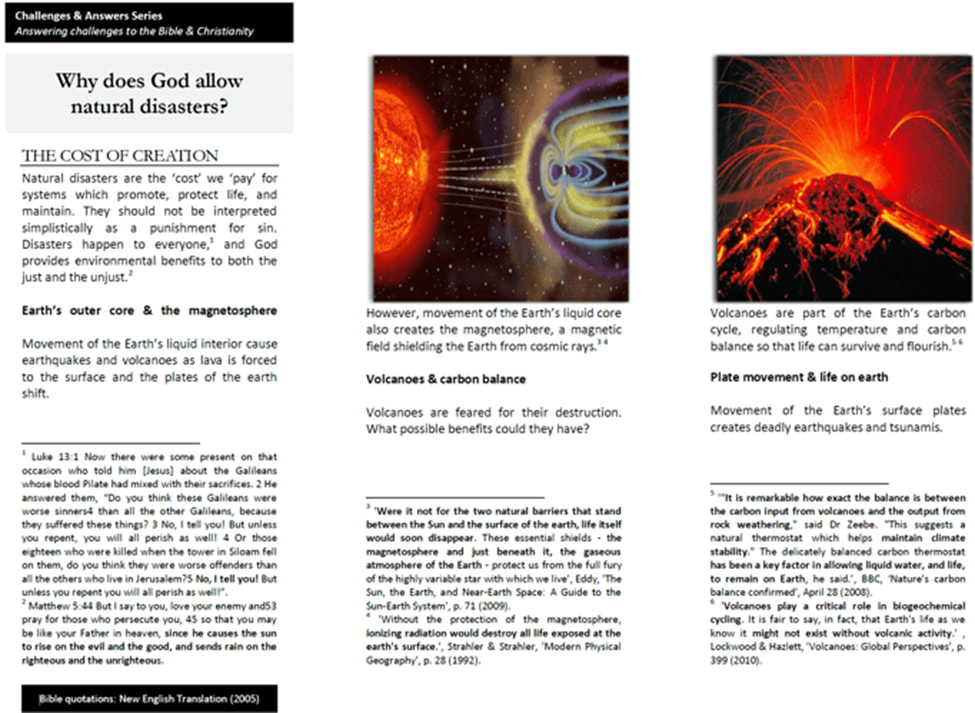
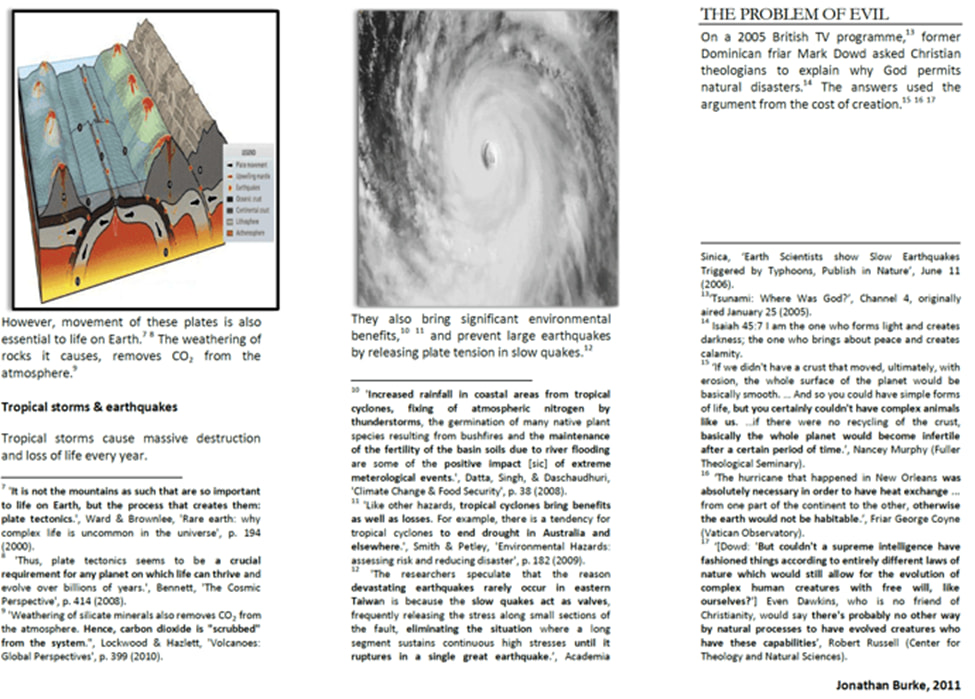
Leibniz coined the term “theodicy” and his argument was basically that among the infinity of possibilities available, God created “the best of all possible worlds.” (I won’t quote Wikipedia. It’s easily searchable.) I agree with Leibniz and think the Cost of Creation argument fits. Without what we call “natural disasters,” life on Earth would not and could not exist. It was a high-wire balancing act, but I’d say God pulled it off. The system works as designed, and if God intervened to stop natural disasters from occurring and save a few animal and human lives, all life on Earth would cease to exist.
Human evil is another matter. I chalk that up to free will, but let’s not get into that mess.
True. God is empathy.
True again. I got totally into apologetics as a young man and into my 30s. I never once argued someone into the Kingdom of God.
That’s the question.
This seems quite a stretch. It would imply that God cannot intervene in His own creation without causing it to cease to exist. How does this align with His omnipotence? Would God intervening to prevent a tsunami really destroy all life on earth? Why would that be the case?
It seems questionable, especially because it appears to suggest a system in which even God is constrained by the very physical laws He created—effectively making those laws superior to God Himself.
I mean I get the argument but God has the power to prevent some consequences of His laws from occurring without causing the end of the world. When He resurrected dead people, for example.
Maybe the dolphins aren’t fallen. And who says you have to have an eternal soul to relate to God. Humans have relationships with dogs and they are able to contribute in ways that certainly seem empathetic and caring, sometimes more so than a human infant. God is a person, so who says humans are the only creatures he enjoys talking to and experiencing things with?
This seems quite a stretch. It would imply that God cannot intervene in His own creation without causing it to cease to exist. How does this align with His omnipotence? Would God intervening to prevent a tsunami really destroy all life on earth? Why would that be the case?
It This seems quite a stretch. It would imply that God cannot intervene in His own creation without causing it to cease to exist. How does this align with His omnipotence? Would God intervening to prevent a tsunami really destroy all life on earth? Why would that be the case?
It seems questionable, especially because it appears to suggest a system in which even God is constrained by the very physical laws He created—effectively making those laws superior to God Himself.” those laws superior to God Himself.
I mean I get the argument, for example, that
No, I understand what you mean, but perhaps “relationship” would be a more accurate term, since a proper relationship implies genuine free will and the real possibility of rejection. I also believe that God delights in some of the animals He has created, but I am not sure that creatures other than angels and humans are capable of having a truly mutual relationship with Him.
God can intervene whenever he chooses. I’m simply saying God chooses not to intervene in natural disasters, because if he stopped every natural disaster in answer to prayer (or out of his own sympathetic reasons), life on Earth would literally cease to exist.
The same applies to free will. God could override any of our bad decisions for our own good, but he chooses not to do so. Why? No matter how many times I pray for the conversion of a friend or loved one, God doesn’t answer those prayers. Why?
Psalm 73
But as for me, my feet had almost slipped;
I had nearly lost my foothold.
**3 **For I envied the arrogant
when I saw the prosperity of the wicked.
**4 **They have no struggles;
their bodies are healthy and strong.[a]
**5 **They are free from common human burdens;
they are not plagued by human ills.
**6 **Therefore pride is their necklace;
they clothe themselves with violence.
One of the main reasons I still believe is that I hope to see justice done in the end.
Only if He, in His omnipotence, did not choose to prevent this from happening. Theoretically, being omnipotent, He could stop every natural disaster while still preserving life on Earth; I do not think this would be logically impossible for an omnipotent God.
The fact that He does not do so is another difficulty. I have my own thoughts on this: since I believe that such events are consequences of a demonic rebellion, it may be that He chooses not to always prevent them, lest He nullify angelic free will and its consequences—just as He does not always stop a human being who is about to commit an evil act.
I have the same concern. One of my friends had a sudden conversion after some years, but many others are still far from faith. I do believe, however, that before the end of their lives, every person receives a moment of clarity about God and a real, informed opportunity to accept or reject Him definitively. I believe that what C. S. Lewis said—that the gates of hell are locked from the inside—is true (meaning that literally no one ends down there without fully knowing it and without a real and informed rejection of God).
This is my firm belief and even some theologians (Fr.Most for example, but also others) and mystics have affirmed something like this (about the moment of clarity).
Hope this helps you to find some solace.
No problem if this does become a “problem of evil” thread. These are the big questions so any civilized discussion is okay.
I understand what you mean. When i said that death will be no more I was referring to the death of a conscious being—not to the absence of renewal within our bodies or anything of that sort. Just to clarify. 
Sure, I’m not sure either. But I also don’t speak dolphin and I’m pretty sure God does.
Yes—amazing animals. They’re second only to pandas for me (I’m literally obsessed with pandas  ).
).