An ortholog of this gene does serve a purpose in insects but this is irrelevant because it has no function in non-oviparous mammals. We know this because in mammals it is a highly fragmented pseudogene. The fact that only egg laying mammals have a working ortholog of this gene should serve as a clue for you (it’s for egg yolk in vertebrates which is why there isn’t a single non-egg laying mammal that has a working copy of it).
There are literally 3 - 4 tiny fragments of this gene that are found in apes (representing a mere 5% of the original gene). It is only these fragments which link us back to our egg laying ancestors. What is left of this pseudogene is so far removed from a working gene that it is laughable when creationists suggest that this was once a working gene in humans.
Here I’ve taken VTG1 in chickens and aligned it to the fragments that remain in various mammals.

Here is the neighbourhood for VTG1 in chickens (Note the neighbouring genes)

And here is where these fragments of VTG1 are found in apes. I’ve labelled the three remaining fragments that match the working gene: S1, S3, S4 (These codes correlate to the aligned portions in my original diagram)
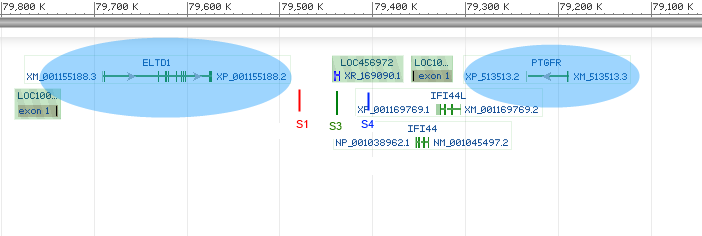

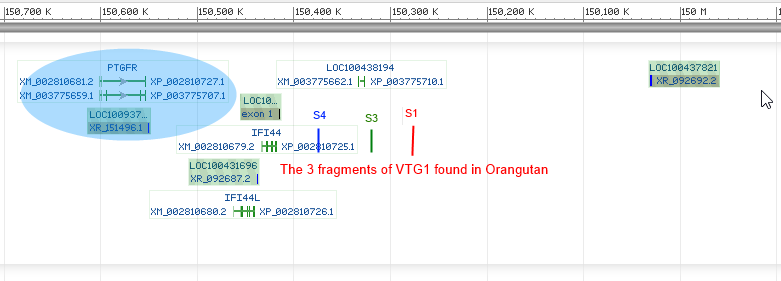
Even though a mere 5% of this gene remains, the same 5% is found in all the apes. The fragments are found in the same correct order in all the apes (ELTD1 → S1 → S3 → S4 → PTGFR). The fragments are found in identical locations (the same gene neighbourhood) in all the apes.
Regarding your critique about nested hierarchies, you say the same thing in every article and this has been explained to you on multiple occasions.