A question for Ken Ham last week and a question about debates

I read that the same sequence exists for the creation of Insulin and because insulin is central to different creatures it proves heredity. That is just one way to look. You could just as easy say that insulin is a necessary means to convert glucose into energy and therefore will occur wherever that is needed. It is building block not a sign of heredity or ancestry.

I read about introns and exons which are basically breaking down further the structure of DNA into component parts. The introns being the connection between exons. Great! What the hell has an algorithm got to do with how they sit? I am assuming that a DNA sequence is made to build up the correct coding for whatever it is making. That will not change whether the insulin is for a human, an ape, or rat. You will see identical strands for any creature that utilises insulin. That is not ancestry. That is biomechanics.
The idea of parallel evolution is already established. An artic Fox and a Ptarmigan changing from white to black according to season. If that happens in the macro view why cannot it happen in the genetic one? Why does similarity have to be ancestral and not just part of the necessary structure? Why couldn’t these sequences have “evolved” separately but be the same because, basically, it is the only option available so it will be “found” as many times as necessary. It is not the starting point but the finish that matters.
I also read that so-called “junk” DNA might just be “spent” DNA, that is, no longer needed, but essential early on.
I have read that the development of an embryo and the presence of gills proves the connection with fish, Why? How is an embryo completely submerged in liquid supposed to breathe? It is a necessary stage so the gills are a necessary part of that stage. Function trumps ancestry every time. It does not prove that we developed from Fish. An embryo cannot survive the transition from gill to lung without the support of the mother. Without that support the change is impossible. So why do you think nature managed to do it?
There is practical naivety in concentrating on DNA. It does not reflect the outside pressures of the macro world.

Richard
All these stories about how birds developed are just that, stories. They are no more historical than the Garden of Eden. They give a slightly more plausible narrative in terms of reality but they are still speculative. The writers of the Bible tried to make sense of what they saw around them. The stories were plausible within their knowledge. The same could be said about Evolutionary development. it fits what is known but it is still just speculation. whether a winged animal could climb is mute. Bats cling. They even seem to be able to scale walls but could they climb trees? Even if a creature could climb a tree and glide down, how does that fit with the general need for food and safety? What would the abilities of the doner creature be so that the wings could be termed an advantage? Could a creature just jump out of a tree and glide down in a thick forest? There would only be limited landing spaces or gaps to fit through.

Gliding might be a prerequisite for powered flight, but does it have the same advantages and qualify for survival pressures?

This all assumes that you could just sprout wings, of couurse.

Richard

All of this was addressed here:

4 Likes

Incorrect. The sequence is similar, and insulin from cows and pigs has function and can be used by humans, but the sequence varies between species. The sequence of chimp insulin is much closer to ours, as you might expect. This article by Dennis Venema in the ASA journal looks at that, with figure 1A being a neat comparison of several species’ sequence. https://www.asa3.org/ASA/PSCF/2010/PSCF9-10Venema.pdf

4 Likes

But we don’t see identical strands. That’s the point. The insulin gene in different species has a different sequence. The DNA is different.

This is a comparison of a portion of the the protein sequence for human and mouse insulin:

Query  25   FVNQHLCGSHLVEALYLVCGERGFFYTPKTRREAEDLQVGQVELGGGPGAGSLQPLALEG  84
            FV QHLCGSHLVEALYLVCGERGFFYTP +RRE ED QV Q+ELGGGPGAG LQ LALE 
Sbjct  25   FVKQHLCGSHLVEALYLVCGERGFFYTPMSRREVEDPQVAQLELGGGPGAGDLQTLALEV  84

Query  85   SLQKRGIVEQCCTSICSLYQLENYCN  110
            + QKRGIV+QCCTSICSLYQLENYCN
Sbjct  85   AQQKRGIVDQCCTSICSLYQLENYCN  110

They are different.

The insulin protein in cattle is much longer than the one in humans. There’s a lot of variation amongst species.

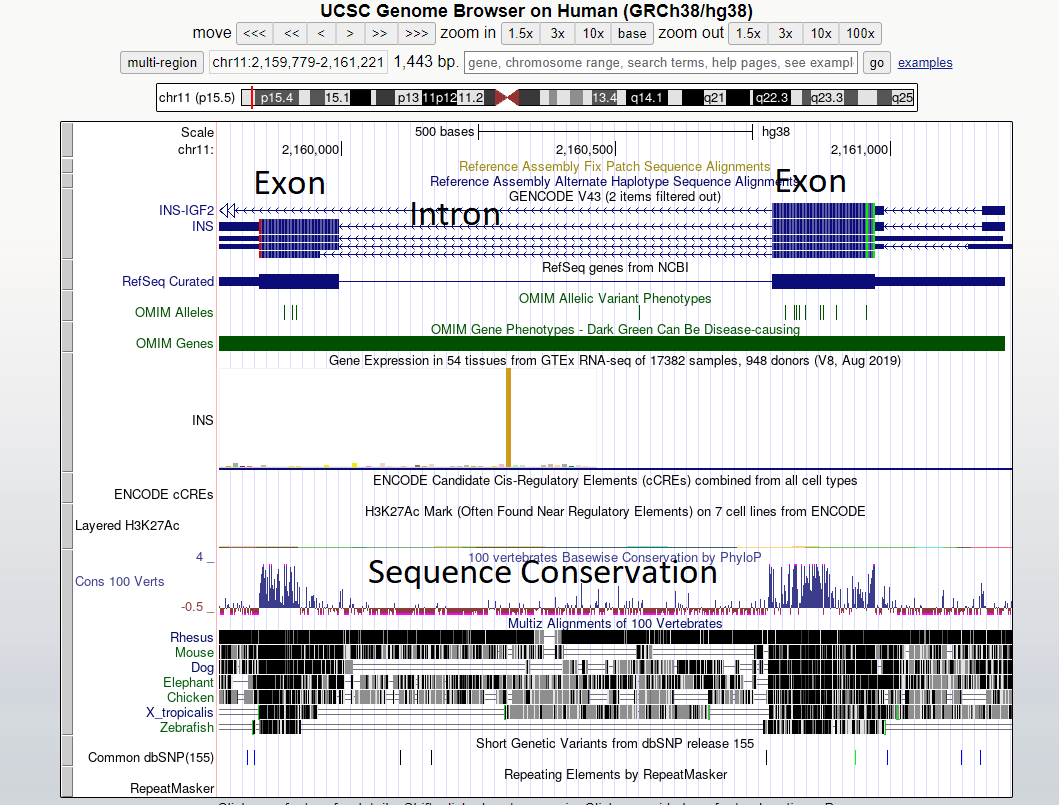
But not only that, there is a difference in the number of similarities between the exons and intron in the insulin gene. The gene has one intron in the middle of the rather short gene. What happens when we look at sequence conservation in the exons and introns?


click for larger version

Look at the sequence conservation. When comparing the gene from 100 different vertebrates we see that the sequence is much more similar in the exons than in the intron. Why?

Well, this is exactly the pattern we would expect if vertebrates evolved from a common ancestor. The introns are just clipped out of the RNA before it is translated into a protein, so the sequence of the intron has no impact on the protein. However, the sequence of the exon has a direct impact on how the protein functions (and it is still different between species). Therefore, some mutations in the exons will be deleterious so they will be removed by selection. This is not the case for introns, so introns will accumulate more mutations over time. Again, this is exactly what we see. The exons are more similar because deleterious mutations have been selected against in that sequence compared to the neutral accumulation of mutations in the introns.

ID/creationism can’t explain why we see this pattern all over the genome and throughout biology. Evolution and common ancestry explains it perfectly.

Human embryos never have gills. Human embryos do have pharyngeal arches which do directly develop into gills in fish. In humans they develop into other structures, but they still share the same embryonic stage with fish. There is no reason an all powerful, all knowing deity with unlimited resources and time would need to reuse a single thing, so there is no reason why humans should share stages of embryonic development with any other species. However, this is exactly what we would expect to find if humans share common ancestry with all other vertebrates.

Like i said, you just dismiss the DNA evidence with a handwave.

5 Likes

You are claiming that it is impossible for these species to have evolved. All we need to address this claim is a viable pathway for evolution to take, even if it is speculative. Your claim that evolution is impossible is also completely speculative.

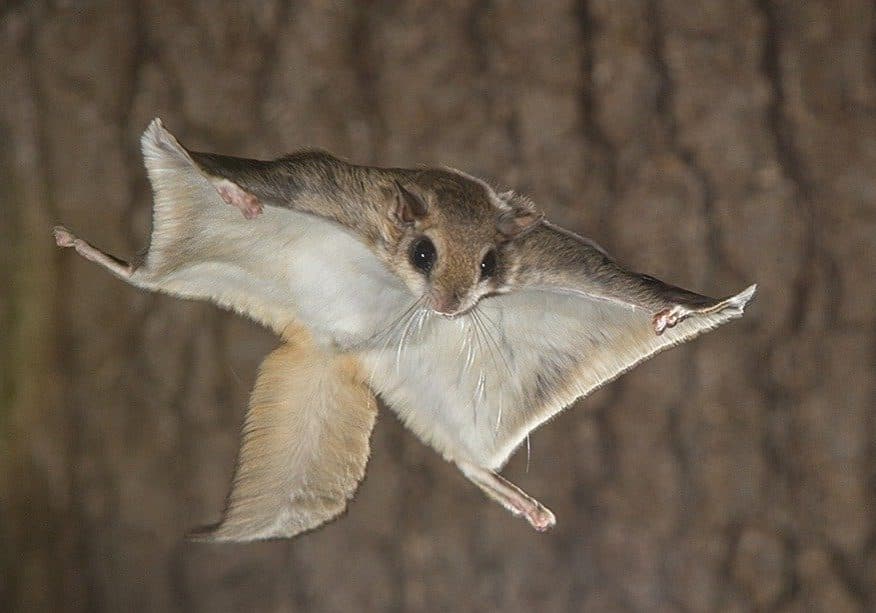
Ask these squirrels who do the very thing you describe.

Climbing trees and gliding is advantageous for these squirrels, so why couldn’t it be advantageous for a bird ancestor?

3 Likes

Which you would expect as they have completely different diets and are therefore working with completely different parameters. I bet that there are similarities, in fact I can see them in the ones you quoted. What is the difference between those similarities and your nested ones?

Do we really understand the coding well enough to answer that?

That is another wild assertion. In fact I would say the opposite applied. If it works why invent another version?

If I was developing something from a single cell, the initial development would be identical and slowly diverge as the needs must. There is no need to complicate things by making each one from scratch. You have a basic formula, you use it.

And you put too much emphasis on it. Perhaps there is a middle ground?

Richard

That’s the opposite of what you said before:

"I am assuming that a DNA sequence is made to build up the correct coding for whatever it is making. That will not change whether the insulin is for a human, an ape, or rat. You will see identical strands for any creature that utilises insulin. "

They are one in the same. Look at the select species below the sequence conservation graph. When we put these species on the tree of life we can see there relative positions reflected in the pattern of similarities and differences. Mice are more closely related to humans than zebrafish, and that’s what the comparisons show in DNA.

But let’s take this one step further. Let’s look at the insulin gene over at Homologene.

https://www.ncbi.nlm.nih.gov/homologene?cmd=Retrieve&dopt=AlignmentScores&list_uids=173

Hopefully that link works. If it doesn’t, enter “INS” into the search bar, click on the insulin gene search result, and then click on “Show Pairwise Alignment Scores”.

Let’s look at the comparisons between human (H. sapiens), mouse (M. musculus), and chicken (G. gallus).

First, human v. mouse and human v. chicken.

Human – mouse = 82.4% similar
Human – chicken = 65.4% similar

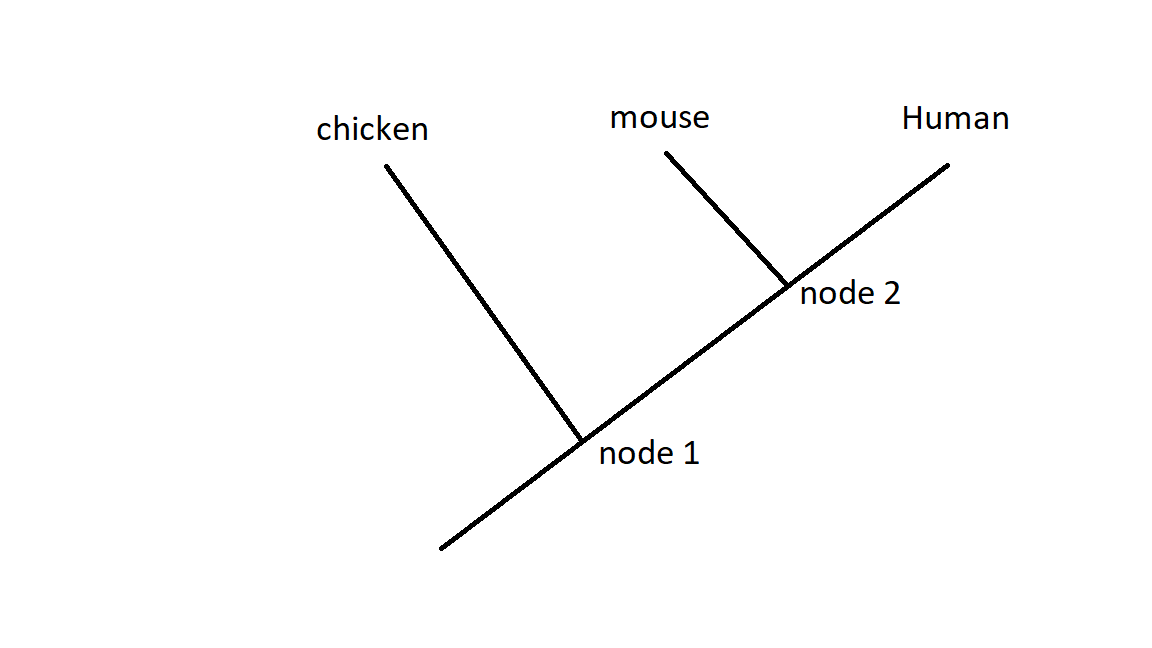
So what would we expect for the mouse v. chicken comparison? Let’s use our tree of life.

The node connecting humans to chickens is the same node that connects mice and chickens. Therefore, the distance between humans and chickens is the same as the distance between mice and chickens. So we would expect the mouse v. chicken comparison to be close to the human v. chicken comparison. And it is:

Human – mouse = 82.4% similar
Human – chicken = 65.4% similar
Mouse – chicken = 67.9%

We could do the same for other trios, such as humans, dogs, and chickens or humans, dogs, and mice. We see this same sort of pattern, the exact pattern we would expect from common ancestry and evolution.

Added in edit (forgot to address the rest of the post):

Yes. Sequencing technologies are accurate. These are the sequences in those species. Sequencing is not a matter of “understanding the coding”. As an analogy, I don’t have to know the chemical makeup of a rock in order to measure its mass. DNA sequence is as easy to get as the mass of a rock. We don’t need to know what a DNA sequence does in order to get its sequence.

Why not invent another version? It would be just as easy for God to invent something new as it would to reuse something.

For that matter, how do you explain different adaptations in different species? For example, the camera eyes of cephalopods (squid, octopi, and cuttlefish) are outwardly similar to the vertebrate eyes. However, the internals are all different. The retina in the cephalopod eye faces forward while the vertebrate retina is inverted. So why have different designs for two different camera style eyes? Why not reuse the design? Or, why only limited the inverted retina to species that have a backbone?

Why am I putting too much emphasis on DNA evidence? Its a direct record of a species ancestry, so it offers an excellent piece of data to test these ideas.

3 Likes

We have taken this discussion over two threads. I think it is time we gave it a rest

There is no mileage in imposing human values and/or constraints onto God. It won’t wash.

As I said on the other thread. The point is not to say that you are definitely wrong, only that you are not definitely right.

DNA is not the saviour (or clincher) of Evolution

Richard

This topic was automatically closed 6 days after the last reply. New replies are no longer allowed.