We ARE the image of God, in His cosmic temple – that’s what the point is in Genesis 1: YHWH-Elohim built His own temple, and placed us in it as His image.
Basing a point on a preposition in a translation is poor theology.
Not in the OT they aren’t – they are elohim, and “elohim” never refers to humans (well, at least living ones – there’s one exception in the case of a dead one).
Only after the final resurrection will we be Yahweh’s heavenly council – Paul says we “will” judge angels, not that we already do.
Not quite, or not in a strict sense. The problem is that there is no way to translate from the Hebrew to any western language without suffering an unwitting category shift; elohim gets rendered as god(s), but unless you go back to Homeric times in Greece the concepts just don’t line up (old Greek mythology aligns astoundingly with ANE views). To illustrate, all angels are elohim, but not all elohim are angels, and that’s true of first century BC/CE as well as today (it was in those centuries espeially that “angel” went from denoting a function [to which some elohim were assigned, but not all] to denoting a type of being).
But elohim other than Yahweh were considered to be entities that He created at least as far back as the united monarchy, and not all elohim were part of the divine council per se.
This is something I wish I’d tackled in grad school, but if I’d tried to delve into everything of interest I’d still be there . . . .
Well duh.
Ancient Hebrew had no “royal we” – it wasn’t part of their linguistic conceptualization. To put it another way, they had no “plural of majesty” – it just isn’t there. “Let us” as it is in the text is one entity addressing other entities.
They belong to the category “heavens” in “heavens and earth”. That would make them probably as old as the universe.
Excellent reference.
Hardly – the “host of heaven”, an ANE term for the stars, are in the OT worldview part of the ranks of elohim. If we go with the literal identification of every star with an elohim, then the location ID of elohim here extends at least 38 billion light years.
FCOL don’t you get anything other than your certitude?
Lighten up for God’s sake!
I think that is the whole point.
people here sem to take me more serious than I do myself. so that their derision backfires.
In truth you should have remembered your little psychoanalysis.
However,
Playing Devil’s advocate is a two edged sword, as can be humour.
Ad hominum is still not a valid argument, whether I am being deadly serious or flippant. The argument still stand on its merit, not on who, or how it is presented. I can laugh of the insults, but that does not mean they were not intended to hurt or discredit.
And by the time we get to Jesus, the divine council is gone.
Not older? So they’re created per universe? From forever?
So our archangels, Lucifer, Gabriel, Michael, and all the lesser angels cover all the billions of inhabited worlds, past and present? They are demiurgical? There’s only one Satan?
Ah, so each inhabited star system gets its own elohim angelic host? And at least one always goes to the bad and corrupts a large minority?
Although I don’t personally hold to the day-age interpretation or concordism in general, since the Hebrew word used for day in Genesis 1 can also just mean a longer, indefinite period of time, wouldn’t it be simpler to just say that the days of creation were really ages of varying duration without trying to make them the same length?
Yes, The Carasoyn is good–thank you! I do get a bit mixed up in that story, though. I have a collection of his–I like “The Golden Key” very much–also “Day Boy and Night Girl,” and the longer “Princess and the Goblin” and “Princess and Curdie.” There is a lot of wisdom in there. Have you read his “Unspoken Sermons” at all, or the Wingfold series by him? I appreciate his honesty in doubt.
That might be interpreted from an ANE perspective, but does not appear intrinsic to the text. There is no mention of a temple, “cosmic” or otherwise.
Not considering that there is a preposition is poor theology. To be sure lets look more at what is said of Jesus:
Heb 1:3 who being the brightness of His glory and the express image of His person, and upholding all things by the word of His power, when He had by Himself purged our sins, sat down at the right hand of the Majesty on high,
Col 1:15 He is the image of the invisible God, the firstborn over all creation. 16 For by Him all things were created that are in heaven and that are on earth, visible and invisible, whether thrones or dominions or principalities or powers. All things were created through Him and for Him. 17 And He is before all things, and in Him all things consist.
The image of God is His visible appearance.
John 14:9 Jesus said to him, “Have I been with you so long, and yet you have not known Me, Philip? He who has seen Me has seen the Father; so how can you say, ‘Show us the Father’?
Sons of Elohim are humans.
Job 1:6 Now there was a day when the sons of God came to present themselves before the Lord, and Satan also came among them.
Satan represents our human flesh nature, and can show up among any of us, even in Peter.
Matt 16:23 But He turned and said to Peter, “Get behind Me, Satan! You are an offense to Me, for you are not mindful of the things of God, but the things of men.”
These can’t be angels:
Gen 6:1 Now it came to pass, when men began to multiply on the face of the earth, and daughters were born to them, 2 that the sons of God saw the daughters of men, that they were beautiful; and they took wives for themselves of all whom they chose.
…for angels don’t marry:
Mark 12:25 For when they rise from the dead, they neither marry nor are given in marriage, but are like angels in heaven.
The resurrection has already happened.
John 11:25 Jesus said to her, “I am the resurrection and the life. He who believes in Me, though he may die, he shall live. 26 And whoever lives and believes in Me shall never die. Do you believe this?”
The hour is coming…
John 5:28 Do not marvel at this; for the hour is coming in which all who are in the graves will hear His voice 29 and come forth—those who have done good, to the resurrection of life, and those who have done evil, to the resurrection of condemnation.
…and then it comes:
Matt 27:51 Then, behold, the veil of the temple was torn in two from top to bottom; and the earth quaked, and the rocks were split, 52 and the graves were opened; and many bodies of the saints who had fallen asleep were raised; 53 and coming out of the graves after His resurrection, they went into the holy city and appeared to many.
Hey, so while a day can have a figurative meaning, as in a longer period, it does still have defined start and end points. Genesis 1 says there is an evening and a morning, and if defined, I believe this can still have a varying duration. The word for ‘day’ is yom (3117. יוֹם) – a day (as the warm hours), whether literal (from sunrise to sunset, or from one sunset to the next), or figurative (a space of time defined by an associated term), (often used adverb) –
With the warm hours or active period we should be able to notice if the defined boundaries I have set in the OP are a possibility. So lets break it apart into an evening and morning, roughly 12 hrs each so the morning begins about halfway between each day.
Day 1 (4.5-2.3 bya) – The morning is about 3.4 bya – God divides the light from the darkness and we see that light can be a metaphor for life.
Gen 1:3 Then God said, “Let there be light”; and there was light.
John 1:4 In Him was life, and the life was the light of men.
Matt 5:14a “You are the light of the world…
God gets up in the morning twilight before the sun is fully up. The first known life was about 3.48 bya:
The earliest direct known life on Earth are stromatolite fossils which have been found in 3.480-billion-year-old geyserite uncovered in the Dresser Formation of the Pilbara Craton of Western Australia. – Earliest known life forms - Wikipedia
Day 2 (2.3-1.8 bya) – The morning is about 2.0 bya and we see the next big step in the creation of life are protists which are single celled eukaryotic organisms. Most of which reproduce sexually and first appear about 2.0 bya:
Of geologic note, Day 2 also starts out with an ice age known as the Huronian Ice Age (~2.4-2.1 bya). It gets cold at night.
Day 3 (1.8-1.3 bya) – The morning is about 1.55 bya and here we see the first multicellular life which were of the plant variety (algae):
Macroscopic multicellular life had been dated to around 600 million years ago, but new fossils suggest that centimetres-long multicellular organisms existed as early as 1.56 billion years ago. Maoyan Zhu at the Chinese Academy of Sciences in Nanjing and his colleagues report the discovery of well-preserved fossils from northern China showing organisms up to 30 centimetres in length. The creatures’ cells measure 6–18 micrometres in diameter and are closely packed. From comparisons with modern organisms, the authors suggest that the fossils were probably photosynthetic eukaryotes similar to modern algae. – Ancient origins of multicellular life | Nature
Day 4 (1.3-0.87 bya) – The morning here is about 1.08 bya and the next big advancement of life is fungi (between plant and animal life):
Minute fossils pulled from remote Arctic Canada could push back the first known appearance of fungi to about one billion years ago — more than 500 million years earlier than scientists had expected. – Billion-year-old fossils set back evolution of earliest fungi
Day 5 (872-411 mya) – Its morning around 642 mya and while the first animals (sponges) are created in the evening (first part), they are basal similar to fungi or plants. The next big step is mobile animals (starting in the water of course):
Animals first appeared in the Ediacaran Period (about 635 million to 541 million years ago), soft-bodied forms that left traces of their bodies in shallow-water sediments. – Animal - Evolution, Paleontology, Adaptation | Britannica
Also of geologic note similar to the ice age on Day 2, we have ice ages in the Cryogenian Period, biggest of which was the Sturtian glaciation (about 717-660 mya), hypothosized to have been a Snowball Earth event …burrr, its cold!
Day 6 (411-Present (Time of Christ)) – The morning here is about 205 mya, and while mobile animals started moving onto land (tetrapods) in the earlier part of the night (about 355 mya), its still during the same night when the ecological balance is disrupted with dinosaurs (the ‘Nephilim’) running amuck. When the morning comes, God sees the wickedness and issues a “120 year” warning with the “Triassic–Jurassic extinction event” (201 mya) that doesn’t completely wipe them out.
Sea floor spreading (with volcanism, the windows of heaven) of the Atlantic caused by rifting (fountains of the deep broken up) is a major cause for the high stands (Noah’s Flood) in the Cretaceous period.
Gen 7:11 In the six hundredth year of Noah’s life, in the second month, the seventeenth day of the month, on that day all the fountains of the great deep were broken up, and the windows of heaven were opened. 12 And the rain was on the earth forty days and forty nights.
The 120 year warning expired 154 mya when the 40 days of rain begins in the Kimmeridgian:
At the time of Blake Spur (170 Ma, early Bajocian), a drastic change occurred both in the relative plate motion direction (from NNW–SSE to NW–SE) and in the spreading rate (an increase to ∼ 1.7 cm/y). After a small increase between Chron M25 (∼ 154 Ma, Kimmeridgian) and Chron M22 (∼ 150 Ma, Tithonian), the spreading rate slowed down to about 1.3 cm/y and remained fairly constant until Chron M0 (125 Ma, Barremian–Aptian boundary). – An alternative early opening scenario for the Central Atlantic Ocean - ScienceDirect
The Flood (Cretaceous period) is then concluded with the Cretaceous–Paleogene extinction event about 66 mya, allowing mammals and humans in particular to rise to the top of the food chain.
Gen 1:28 Then God blessed them, and God said to them, “Be fruitful and multiply; fill the earth and subdue it; have dominion over the fish of the sea, over the birds of the air, and over every living thing that [h]moves on the earth.”
If someone writes twelve paragraphs using terms like “bunt”, shortstop", “run”, “base”, “out”, “2nd base”, and “innings”, the word "baseball doesn’t have to be there to know that the paragraphs are about baseball. To the ancient Hebrews, the first Creation account has that kind of set of markers that says, “temple inauguration” – the word “temple” doesn’t have to appear.
Nope – it’s a term that means the subsidiaries of someone. It’s used across the ANE of the members of a royal court; the members are “sons of the king” whether they’re blood relations or not.
“Satan” is not a name here, it is a title – the Adversary. He doesn’t “represent” anything, he is a being who opposes those who are Yahweh’s.
Yes – “Get behind, me, Adversary”, or “adversary”.
Angels? That term is an anachronism in that context. The terms "sons of elohim means “beings who are themselves elohim”. The whole point there is that they were violating the proper order of things with bizarre results.
Not according to John’s Apocalypse.
I’m not going to bother commenting on your science-fiction allegory.
“The Temple: Its Symbolism and Meaning Then and Now” is a book by Joshua Berman that explores the significance of the ancient Temple in Jerusalem and its enduring impact on Jewish life. The book examines the Temple not just as a sacrificial center, but as a symbol of national and spiritual life, central to the concepts of holiness, justice, and divine presence, and discusses how its symbolism is still relevant today, notes Amazon.com and AskNoah.org. [1, 2, 3, 4]
Key themes and concepts
Holistic view: The book presents the Temple as part of an organic whole, integral to other aspects of Jewish faith like the Sabbath, land, and kingship, rather than an isolated entity.
Symbolism and rites: It delves into the symbolism behind the Temple’s structure, rituals, and commandments, including animal sacrifice, and re-examines them in a new light.
Spiritual and national center: The Temple is portrayed as the focal point for prayer, social unity, education, and justice, serving as the center for the nation in multiple spheres of life.
Enduring relevance: It explores how the commandments related to the Temple continue to influence modern Jewish life and how the ideas of “rebuilding” a dwelling place for God’s presence remain relevant today, even without the physical structure, says Amazon.com. [1, 2, 3, 4, 5]
What the book analyzes
Fundamental spiritual concepts: The book explains how Temple commandments illuminate fundamental spiritual concepts such as holiness, righteousness, and the meaning of sacrificial offerings.
Historical context: It examines how social, economic, political, and religious currents influenced the Temple’s construction, destruction, and reconstruction.
Biblical perspective: The work probes biblical passages to provide insight into the meaning of the times, including the era in which we live, notes Amazon.com. [1, 2]
@graft2vine I applaud the work you have done and time you have spent looking into and synthesizing this, though I don’t agree with your conclusion.
To me, there is a much simpler explanation which many here have talked about on some level. I can (to the best of my memory) mention scholars who support these ideas, but I could not tell you where the info is in their writings, there is too much covered here to go back and look for it all.
I firmly believe after research, that as has been said here before Genesis 1 is not about material origins, but it about God fashioning the universe as his dwelling place - a temple, and placing humans as the image in that temple. The “creating” has to do with giving something a name and function, not materially making it, and related to the ANE concept of “creating”. It is related primarily to ordering things. This is supported by OT scholar John Walton, though I am sure there are others too.
This has profound implications on what the Image of God means for humans. It means that it is not a quality but a calling - a vocation. It is being called to be the representative of God’s power and presence on earth, and having authority granted to that position. God brought humans into the picture to be this Image and continue the creation process with him - extending the “garden” into the rest of the Universe. We, of course derailed this by representing other actors and powers and their interests instead of God. Jesus set the project back on track through being the true image of God we failed to be and wresting authority back from the powers of darkness by his suffering, death, and resurrection. Jesus in some sense completes the creation project by becoming the Firstborn from among the dead - the first of the new creation. He brings into the world what we failed to. These ideas are more or less supported by N.T. Wright - or at least my best understanding of what he talks about.
Bible scholar Tim Mackie talks about in some of his Bible Project material how elohim, the “we” relates to the ANE understanding of spiritual or “divine” beings. With Yahweh being the creator, and the others being subservient to him in his divine council. In modern eyes, “gods” are something that is worshipped. While this was the case with many ANE cultures, the Israelites were prohibited from worshipping any elohim other than Yahweh. In other words, the Israelites called spiritual beings gods, but only one was to be worshipped as creator - that being Yahweh. This is distinct from the modern understanding of what “gods” are, and should be used primarily for understanding what the text is saying, not developing a pantheon of gods theology, which is strictly absent in Israelite worship of Yahweh (though in their courtship of Caananite culture they strayed into this).
If we try to place significant modern understandings into the text, we lose much of the rich theology that can be gleaned from it as we strive to understand what the writers were saying about God, and ultimately what Jesus death and resurrection meant.
It also has implications for what we are supposed to be doing even now- representing God’s presence on earth to creation and to each other, which we are constantly failing terribly at.
These ideas are not “mine”, but put out there by people much smarter than me in regards to the text, history, and culture. I simply benefit from the work they have done.
Again, @graft2vine it is incredible the synthesis you have made, and I applaud digging into the texts so deeply even though I disagree with your conclusions.
First post, I hope I replied to the thread in the right way!
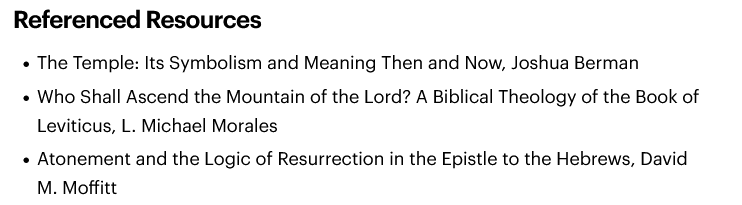
Funny, IMO, that you would mention Tim Mackie because it was his conversation with Jon Collins in What Is Atonement? who brought these references to my attention:
Walton overstates the case. A way to be clearer is to point out that the meaning of “good” in that context means “functions well, as intended”. The text is definitely about material origins, it’s just that the material aspect isn’t actually primary – very strange to a modern Westerner.
A major theme of the first Creation story is setting that straight by indicating that all the gods of Egypt were created by YHWH-Elohim and were supposed to serve Him. That message has been summed up as “all your gods are belong to Yahweh!”.